
North Macedonia
A plan for Skopje
Not a list of things to see in Skopje — a day-by-day plan somebody could actually follow, built from places we can point to a source for. Make your own in about a minute.
- 2 nights
- Couple
- Balanced pace
- Mid-range budget
Every place here was checked on 2026-10-30 or later, and each one says where it came from.
The plan, day by day
Day 1
09:30
You arrive
13:00
Meze Bar
Suggested because you chose food
- 1h
- Meal
14:30
Museum of the City of Skopje
Picked because you chose culture & museums + balanced energy
- 2h 30m
- Culture & museums
2h open
Nothing planned here. That was on purpose.
19:00
Skopski Merak
Suggested because you chose food
- 1h 30m
- Meal
20:30
Skopje Fortress
Picked because you chose culture & museums and local experiences + balanced energy
- 1h 30m
- Culture & museums
Day 2
08:00
Martini
Suggested because it fits a mid-range budget
- 45m
- Meal
45m open
Nothing planned here. That was on purpose.
09:30
Museum of the Republic of North Macedonia
Picked because you chose culture & museums + balanced energy
- 2h 30m
- Culture & museums
1h open
Nothing planned here. That was on purpose.
13:00
Destan
Suggested because you chose food
- 1h
- Meal
14:30
Museum of Contemporary Art Skopje
Picked because you chose culture & museums + balanced energy
- 2h 30m
- Culture & museums
2h open
Nothing planned here. That was on purpose.
19:00
Pelister
Suggested because you chose food
- 1h 30m
- Meal
20:30
Philharmonic of the Republic of North Macedonia
Picked because you chose culture & museums + balanced energy
- 2h 30m
- Culture & museums
Day 3
08:00
Cafe Li
Suggested because you chose food
- 45m
- Meal
45m open
Nothing planned here. That was on purpose.
09:30
Holocaust Memorial Center for the Jews of Macedonia
Picked because you chose culture & museums + balanced energy
- 2h 30m
- Culture & museums
1h open
Nothing planned here. That was on purpose.
13:00
La Terrazza
Suggested because you chose food
- 1h
- Meal
14:30
You leave
Weather through the year
Monthly averages from NASA's 25-year climate record, day and night together.
Best months: June, July, August, and September
| January | Cold: -1°C, 77 mm |
|---|---|
| February | Cold: 1°C, 68 mm |
| March | Cold: 5°C, 73 mm |
| April | Cold: 10°C, 66 mm |
| May | Mild, some rain: 15°C, 76 mm |
| June | Mild, some rain: 19°C, 57 mm |
| July | Mild and dry: 23°C, 37 mm |
| August | Mild and dry: 23°C, 39 mm |
| September | Mild, some rain: 18°C, 68 mm |
| October | Mild, some rain: 12°C, 88 mm |
| November | Cold: 6°C, 97 mm |
| December | Cold: 0°C, 85 mm |
From the Wikivoyage guide
Quoted from the travel guide anyone can edit, as it read on the day we took it.
Understand
In the Povardarie region, Skopje is the financial and political center of North Macedonia and by far its biggest city. The city population is around 800,000, however unofficially during working-days it can almost reach more than 1 million, which is more than half of the population of the country. The most diverse in the country, Skopje houses many ethnicities; besides the majority Macedonians, many Albanians, Turks, Roma, Serbs, Bosniaks and others call Skopje home.
26 July 1963 is one of the worst dates in the history of Skopje. An earthquake struck the city at 05:17. 75% of the buildings in the city disappeared in just a few seconds. After that, the big rebuilding project began, trying to make Skopje the model city of the socialist world. The plan was drawn by the Japanese architect Kenzo Tange, who also designed the new railway station. The plan was never fully carried out. Many reconstruction projects have started. Some towers of Kale Fortress and the old cathedral are being reconstructed, and the old theater is also under reconstruction. Skopje is an eclectic mix of Christian and Islamic culture, with both vying to make themselves visible. However, this cultural mix has also spawned a lively and varied society. You can see people playing chess in the morning in the numerous cafés and green spaces in the summer. In the evening, Skopje comes to life as the locals dine in the cafés before heading to the bars and live music clubs, most of which are open until 01:00 or later.
See
Individual listings can be found in Skopje's district articles
The largest concentrations of sights in Skopje are found in Centar and the Stara Čaršija (Old Town). The former is the modern hub of the city and contains newer attractions, while the latter is home to many of the city's historical sights. Outer Skopje is home to larger sights that are more spread out.
The Skopje Fortress stands above central Skopje, on the right bank of the Vardar. Much of the exterior walls, including several towers, remain, while excavations continue on the interior. The Stara Čaršija sits below the fortress to the south. Countless Ottoman-era structures make up the historic district. Minarets from mosques like the 15th-century Mustafa Pasha Mosque dominate the district's skyline. The oldest of these mosques dates from 1436. Of the remaining Turkish baths, two are in good condition and now serve as museums. The three caravansaries in the Old Bazaar feature lovely courtyards and are open to the public as cafes or museums. While Islamic buildings are prevalent in the Stara Čaršija, it is also home to central Skopje's most important church, St Saviour Church, known for its wood-carved iconostasis.
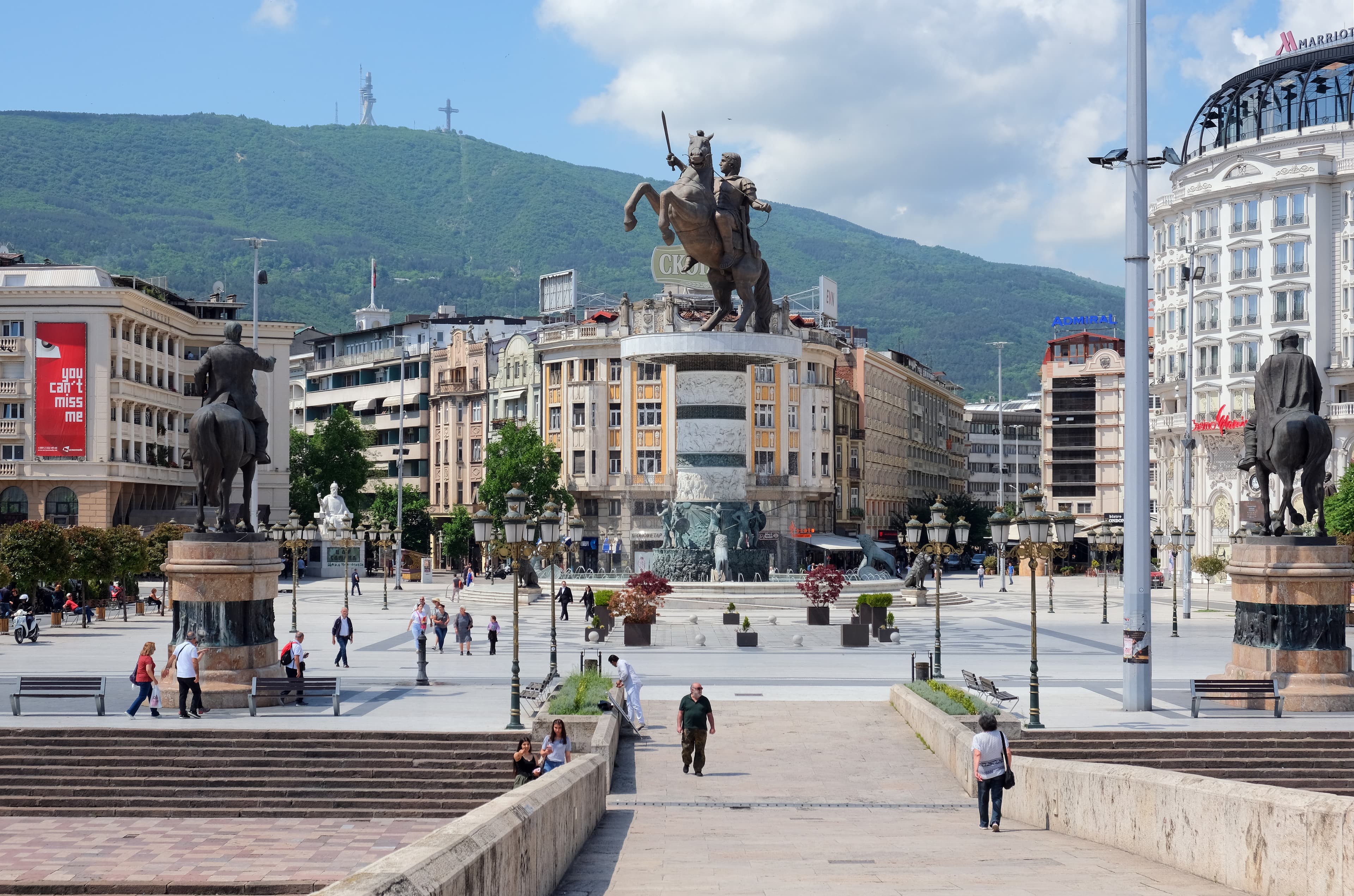
One of the main symbols of Skopje, the Stone Bridge connects the Old Town to Centar on the left bank of the Vardar. Centar is home to the main government offices of North Macedonia. It is also home to Macedonia Square, the city's central square. The face of the square has changed with new buildings constructed in older architectural styles, as well as the addition of massive monuments like that of Alexander the Great, the centerpiece. Another major piece of the changes to Centar is Porta Macedonia, a large triumphal arch. The city's best museums are found in Centar, such as the Museum of the Macedonian Struggle, the Holocaust Museum, and the Mother Teresa Memorial House, dedicated to the Skopje native.
Some of Skopje's best sights are found outside the city centre. Matka Canyon is one of North Macedonia's gems, both culturally and naturally. It is home to numerous medieval churches and monasteries, often hidden in the scenic mountains. Mount Vodno is capped by the Millennium Cross, overlooking the city and reachable via a cable car. In addition, archaeological sites dot the area, like the 55-arch Skopje Aqueduct. The Skopje Zoo contains a few hundred animals.
Do
The Macedonian National Theatre in Centar, is the home of the State Ballet. The theatre holds theatre, opera, and ballet performances all year round.
City Park is a large green area in Centar. A part of it is a museum, with several monuments within. It is a nice place to go for recreation, as there are pathways around the small lakes, the children’s amusement park, cafes, restaurants, etc. The city zoo and stadium are also within the park. In the summer, Skopje's nightlife concentrates on the nightclubs in this park.
Stroll through the town. You can get a good first impression of the city's sights in one or two hours, covering bazaar, fort and post-earthquake buildings. Equipped with a guidebook and a city map you can easily do it on your own.
Football – The national soccer team play at Toše Proeski National Arena, which is also the home of FK Vardar and FK Rabotnički. Several other club teams play in the city, the most recent Macedonian Football league winner being FC Shkupi.
Day tours
Explore Matka Canyon: 50 minutes outside of central Skopje; it has a lake and a hydroelectric dam set in a beautiful gorge. Kayaking/canoeing on the lake is a popular activity, as are fishing, hunting, and swimming. Climbers may enjoy a variety of tours of varying difficulty there. Vrelo Cave has many stalactites and two lakes at the end of the cave. There are several monasteries in the Matka Canyon Area that you can hike to.
Kadina Reka Hunting Site in Skopje/Outer Skopje 25 km from Skopje.
Climb Vodno Mountain, in Karpoš. The largest mountain to the south of Skopje, 1066 m above sea level, it towers over Skopje. It is a popular hiking destination with marked paths leading through the woods, with a couple of rest areas. Climbing this mountain will give the best views of the city and the valley which Skopje is in.
Hike Vodno Mountain to Matka Canyon: If you start early, hiking even further west along the ridge of Vodno Mountain can be a full-day hike. The hike from Skopje to Matka via Vodno is about 18 km. There might not be a bus back to Skopje, but you could stay in the hotel at Matka, which has prices starting at €35 for a room.
Eat
North Macedonia’s capital offers something to satisfy all modern tastes and appetites. Make sure to try the famous Macedonian foods such as burek, Shopska Salata, and others.
Skopje’s eateries are plentiful and offer a diverse range of local and international flavors. International cuisine is well represented in Skopje with Chinese, Italian, Indian, Greek, Mexican, Middle Eastern and French restaurants all found within the city center. In addition, pizza and fast food places abound, as do small bakery cafes selling pastries such as the ubiquitous burek (a flaky filo pie stuffed with meat, cheese or spinach).
In the city centre
1 Pelister, Macedonia Square 7 (directly on Macedonia Square overlooking the main pedestrian area), ☏ +389 78 411 302. Large central restaurant and café with a broad international menu, desserts, cocktails and one of the busiest terraces in the city centre. (updated May 2026)
2 Restaurant Old House, Boulevard Phillip the Second of Macedon 14 (east of the city centre near the Macedonia Opera and Ballet building), ☏ +389 2 3131 376. Built in 1836, this is considered the oldest traditional house in Macedonia still in active use. Protected as a cultural monument by the Bureau for Protection of Cultural Heritage, the wood-and-stone house features original carved ceilings and traditional Macedonian architecture. Once home to six generations of the Jovanovich family, today it operates as a national restaurant with refined Macedonian cuisine and historic atmosphere. (updated May 2026)
3 Dropstop Gastrobar, Maksim Gorki 31A (in the immediate city centre, just west of Macedonia Square near the City Wall complex), ☏ +389 71 375 247, reservations@dropstop.mk. Modern wine-focused gastrobar specializing in Macedonian wines, charcuterie and tasting menus with wine pairings. Located inside a modernist building from the Kingdom of Yugoslavia period that survived the 1963 Skopje earthquake. Indoor dining area is fully non-smoking. (updated May 2026)
Drink
There is no big clubbing going on in Skopje, but the city has it range of decent bars almost feeling sub-cultural, and of course a selection of the all so often shady night club or tourist aka fancy cocktail bar.
See the district articles for more details.
Get around
By bus
Skopje Bus has a vast, frequent and efficient bus network. A ride of any length (without interchange) with the red public buses is:
35 denar through the SkopjeBus app (top-up starts at 50 denar, iOS, Android),
35 denar by using Skopska card, or
50 denar in cash (from the driver) — you will get a ticket with a QR code, which you need to scan using one of the scanners inside the bus to validate it.
The SkopjeBus application has an English interface. It also provides bus timetables.
It is only possible to buy the Skopska card during business hours at the bus station (not later than 18:00).
Also, there is a daily ticket which cost 120 denar for the city lines and 150 denar for all the lines.
By taxi
Taking a taxi in Skopje should normally not cost more than 300 denar. An example journey is from City Centre to Biser (a shopping centre with many bars and cafes that is popular with young people) which should take about 5-10 mins and cost around 150 denar.
From the train station to the center of the city is 2 km and should cost 50–100 denar. Never let yourself be talked into going somewhere where you did not plan to go in the first place. Like many cities in Europe, if you seem unsure and foreign, the charge will probably be higher so appear confident about the price and if the taxi driver still insists on a ridiculous price, find another taxi—there are plenty. But many taxis have and will use their meter, so there should be no discussion about the price.
As of 2025, Wizi (iOS, Android), an online taxi hailing app with an option to pay using credit card in the app or directly in the taxi is available. This is the best option for tourists to avoid any hassle.
By train
A suburban rail line was launched in September 2026. It runs from Skopje's main railway station to the village of Zelenikovo south of the city, which is about a 20-25 minute ride one way. It does not have much use for tourists, aside from the archaeological site of Tauresium.
Stay safe
Skopje, just like the rest of North Macedonia, is a relatively safe place. But, the usual rules about common sense apply here as they would anywhere. The places where crime occurs most often are in the places where tourists have little reason to be at.
Like many other parts of Eastern and Central Europe, there are people who will beg around the major tourist sites, they especially target tourist-looking people, and sometimes may engage in pickpocketing.
If you don't like the typical touristy slop, avoid the old town and the bazaar — it's over-rated, over-priced, and you expose yourself to potential scams and con men. Everything south of the river has more charm and decency.
Practical facts for North Macedonia
Taken from open data. Rules and numbers change, so check locally before you rely on them.
- Currency
- Macedonian Denar (MKD)
- Languages
- Macedonian, Albanian, Turkish, and Serbian
- Plugs and power
- Types C and F, 230 V at 50 Hz
- Traffic drives
- On the right
- Country calling code
- +389
- Time zone
- Europe/Skopje
Official travel advice
Quoted from each government as published, with the date they last changed it. We do not add a verdict of our own.
UK Foreign, Commonwealth & Development Office
- No areas listed that it advises against travelling to
Read the full adviceTravel disruption
The European Union’s (EU) new Entry/Exit System (EES) is now being implemented across the Schengen area. The EES may take each passenger extra time, so it is important to be prepared to wait longer than usual at EU country borders and allow more time for immigration controls if travelling to and from the Schengen area.
US Department of State
Level 1 of 4: Exercise normal precautions
Read the full adviceExercise normal precaution in North Macedonia.
North Macedonia is generally a safe destination for travelers.
• Review our Travel Guidance for North Macedonia to learn how to prepare for a safe trip.
Entry and visas
Entry rules depend on your passport and change without notice. Check the official pages before you book.
Sources