
Austria
A plan for Salzburg
Not a list of things to see in Salzburg — a day-by-day plan somebody could actually follow, built from places we can point to a source for. Make your own in about a minute.
- 2 nights
- Couple
- Balanced pace
- Mid-range budget
Every place here was checked on 2026-10-20 or later, and each one says where it came from.
The plan, day by day
Day 1
09:30
You arrive
13:00
Sternbräu
Suggested because you chose food
- 1h
- Meal
14:30
Residenzgalerie Salzburg
Picked because you chose culture & museums + balanced energy
- 2h 30m
- Culture & museums
2h open
Nothing planned here. That was on purpose.
19:00
Burrito Factory
Suggested because you chose food
- 1h 30m
- Meal
20:30
Salzburger Landestheater
Picked because you chose culture & museums + balanced energy
- 2h 30m
- Culture & museums
Day 2
08:00
Café Tomaselli
Suggested because you chose food
- 45m
- Meal
45m open
Nothing planned here. That was on purpose.
09:30
Mozart's birthplace
Picked because you chose culture & museums + balanced energy
- 2h 30m
- Culture & museums
1h open
Nothing planned here. That was on purpose.
13:00
Raschhofer's Rossbräu
Suggested because you chose food
- 1h
- Meal
14:30
Hangar-7
Picked because you chose culture & museums and local experiences + balanced energy
- 2h 30m
- Culture & museums
17:00
Museum der Moderne Salzburg
Picked because you chose culture & museums + balanced energy
- 2h 30m
- Culture & museums
19:30
Zum Zirkelwirt
Suggested because you chose food
- 1h 30m
- Meal
21:00
Felsenreitschule
Picked because you chose culture & museums + balanced energy
- 2h 30m
- Culture & museums
Day 3
08:00
Cafe Bazar
Suggested because it fits a mid-range budget
- 45m
- Meal
45m open
Nothing planned here. That was on purpose.
09:30
Toy Museum Salzburg
Picked because you chose culture & museums + balanced energy
- 2h 30m
- Culture & museums
1h open
Nothing planned here. That was on purpose.
13:00
Sankt Peter Stiftskulinarium
Suggested because you chose food
- 1h
- Meal
14:30
You leave
Weather through the year
Monthly averages from NASA's 25-year climate record, day and night together.
Best months: June, July, August, and September
| January | Cold: -2°C, 92 mm |
|---|---|
| February | Cold: -1°C, 72 mm |
| March | Cold: 4°C, 84 mm |
| April | Cold: 9°C, 72 mm |
| May | Rainy: 13°C, 136 mm |
| June | Rainy: 17°C, 158 mm |
| July | Rainy: 19°C, 146 mm |
| August | Rainy: 18°C, 153 mm |
| September | Rainy: 14°C, 113 mm |
| October | Cold: 9°C, 90 mm |
| November | Cold: 4°C, 69 mm |
| December | Cold: -0°C, 79 mm |
From the Wikivoyage guide
Quoted from the travel guide anyone can edit, as it read on the day we took it.
Understand
Salzburg, which has been inhabited since the Neolithic period, is the fourth-largest city in Austria (after Vienna, Graz and Linz) and the capital of the federal state of Salzburg. In 45 AD, it was a Roman establishment. The Bavarians took over in the 6th century. At the end of the 16th century, under Archbishop Wolf Dietrich von Raitenau, the transformation of the medieval town into the "Rome of the North" began, with new buildings following the Italian baroque style. The buildings from this era are mostly in the "Old Town", as it is known today. The old town is one of the best-preserved city centres in the German-speaking world and was listed as a UNESCO World Heritage Site in 1997. Salzburg became part of the Austrian Empire in 1816. It frequently ranks favourably in quality of life rankings.
Origins of name
The name Salzburg, literally "Salt Castle", is derived from the barges carrying salt on the Salzach river, which were subject to a toll in the 8th century.
Early history and medieval period
Traces of human settlements dating to the Neolithic Age and later a Celt camp have been found in the area. Starting from 15 BC, the small communities were grouped into a single town which was named by the Romans as Juvavum. Little remains of the city from this period.
The Hohensalzburg Fortress was built in 1077 and expanded in the following centuries. Independence from Bavaria was secured in the late 14th century.
Independent state
Salzburg was the capital of an independent state from the early 14th century until 1805. It was ruled by prince-archbishops, who became rich by the salt mines in the south of the city. This led to the architectural gem you see today, as materials and architects were imported from Italy and other European countries. This is also why, compared to other Austrian cities, sacral monuments surpass the few secular buildings in every respect. The prince-archbishops were forced to give up their political powers during the French occupation in 1805, when Napoleon Bonaparte introduced the concept of separation of Church and State in all the occupied territories.
See
Architecture
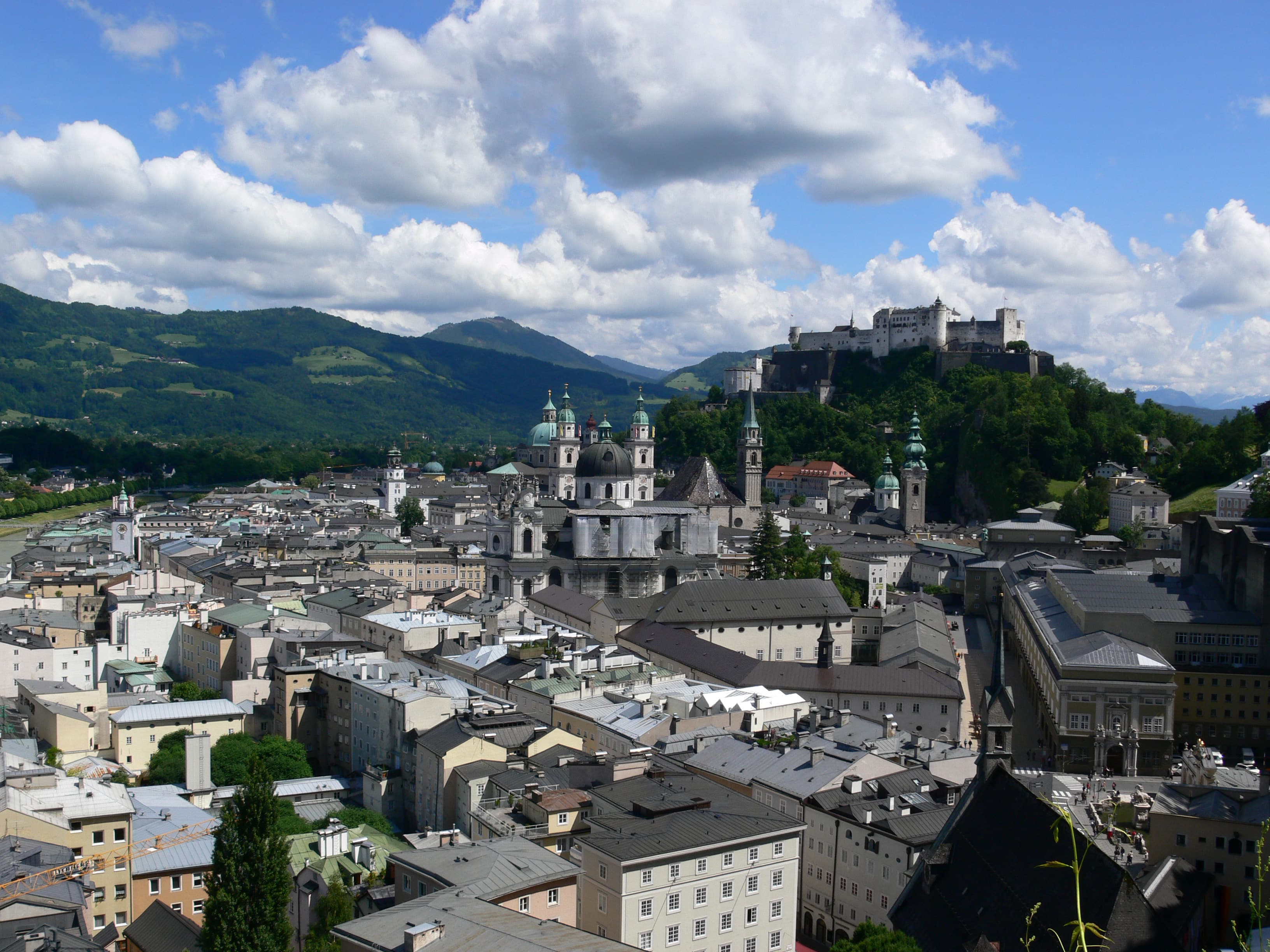
The Salzburg Altstadt is a UNESCO World Heritage Site celebrated for its well-preserved Baroque architecture and rich cultural heritage. Nestled along the banks of the Salzach River and surrounded by the Mönchsberg and Kapuzinerberg hills, the Altstadt is home to many architectural landmarks. Notable sites include the Hohensalzburg Fortress, one of Europe's largest medieval castles; Salzburg Cathedral; and Getreidegasse, a bustling shopping street known for its high townhouses and as the birthplace of Wolfgang Amadeus Mozart. The area also features charming squares such as Mozartplatz, which hosts a monument to Mozart, and Residenzplatz, known for its impressive fountain. The Altstadt's narrow, winding streets and historic buildings offer visitors a glimpse into Salzburg's past, making it a must-visit destination for those interested in history, architecture, and music.
1 Schloss Hellbrunn, Fürstenweg 37, ☏ +43 662 820372-0, fax: +43 662 820372-4931, info@hellbrunn.at. Apr Oct: 09:00-16:30; May Jun Sep: 09:00-17:30; Jul Aug: 09:00-21:00 (only trick fountains from 18:00). Once the summer palace of the Archbishops of Salzburg it has lots of clever fountains and pretty gardens. When you take the tour stand next to the guide otherwise you will get wet. Hellbrunn is surrounded by vast gardens, including a good children's playground with swings and flying fox (zip wire), and a cold wading pool, and is a perfect place for a picnic or a long walk through the green. In the Steintheater (Stone Theater), the first opera in Middle Europe was conducted. Children and adults alike are amused. There is an excellent and substantial zoo within the grounds. Adults €13.50, students (19-26 years old) €8.50, children (4-18 years) €6.00, family ticket (2 adults, 1 child) €29.50. (updated Sep 2018)
Do
Casino Salzburg, 5071 Wals-Siezenheim, ☏ +43 662 85 44 55. Open daily except for December 24. Slot machines: 12:00-03:00, Live games: 15:00-03:00. Free admission.
1 Salzburg Zoo, Anifer Landesstr 1, ☏ +43 662 820176-0, office@salzburg-zoo.at. Daily 09:00-23:00. The zoo is in south Salzburg and is open 365 days a year. It also has a petting zoo for children. There is a restaurant on site serving traditional Austrian dishes. Adults: €10.10, students (under 27): €7, children (4-14): €4, family: €26.50.
2 Untersberg. The mountain is perennially popular with tourists due to its proximity to the city of Salzburg, less than 16 km to the north of the mountain and within easy reach by bus. A variety of paths lead to the top, but most people use the cable car that lifts passengers over 1300m to the Geiereck peak. The cable car runs from the 2 St Leonhard station in the town of Gartenau to the station at the Geiereck peak. Can be reached from Salzburg by taking bus 25 to its terminus station. (updated Sep 2018)
Chess — Giant chess board painted onto the ground, past the cathedral (travelling away from the river). You'll have to wait your turn, but it's worth it.
Football: FC Red Bull Salzburg play soccer in the Austrian Bundesliga, the top tier. They play in Red Bull Arena (capacity 32,000) in Wals-Siezenheim 3 km northwest of city centre.
SV Austria Salzburg are a breakaway club formed in 2005 in protest at Red Bull's takeover of FC Salzburg. They play in the minor leagues at Max Aicher Stadium (capacity 1600) just east of the airport.
Festivals
For almost a century, Salzburg has hosted the world-famous Salzburg Festival. Festivals also take place during Easter time (with mostly Baroque music), and in autumn.
Salzburg Festival: 20 July – 30 August 2018. For almost a century, Salzburg has hosted this world famous festival, with operas, concerts, and theatre plays in different locations throughout the city. It was founded by Hugo von Hoffmansthal, Max Reinhardt and Richard Strauss in 1920. It takes place in July and August, the most famous piece is the "Jedermann" ("Everyman") by Hugo v. Hoffmansthal, being conducted in front of the Dom (Cathedral) every year. (date needs updating)
Eat
A typical dessert from Salzburg is the Salzburg Nockerl, a tasty baked soufflé best served with ice cream, berries and whipped cream. Good places make it to order, which takes at least 30 minutes, and the serving size is huge: one Nockerl is easily enough for four!
Street food
1 Salzburger Würstelkönigin, Ferdinand-Hanusch-Platz 5. Gorgeous hotdogs and great spot to chill by the Salzburg river. The grilled meat sandwich with the Century Sauce (Jahrhundertsoße) is amazing. You can meet the whole world here. (updated Sep 2022)
2 Heisse Kiste, Schwarzstraße 4. An institution. Recommended are the Leberkäs and the Käsekrainer. Real sausage culture - very tasty. One of the most popular addresses among the people enjoying Salzburg's nightlife to grab a sausage with bread for a midnight snack. (updated Sep 2022)
3 Lechners Würstelstand!, Universitätspl. 18. If you want to try Austria's original street food in Salzburg, this is the place to go. Very traditional, very tasty. Service is fast. Everything is delicious. (updated Sep 2022)
4 Würstelstand Alter Markt, Alter Markt 3. The Käsekrainer and the warm sauerkraut are delicious. Tasty fries, Bosna and whatever the sausage heart desires. There might be a queue and then it takes some time... (updated Sep 2022)
Winter season
5 Maroni-Salzburg, Hanuschplatz 1, ☏ +43 662 824372. Have roasted chestnuts and a glass of glühwein in the winter season right before you start off to the Christmas Market. Maronibraterei Salzburg (updated Dec 2021)
Budget
6 Wilder Mann, Getreidegasse 20. Wilder Mann offers traditional Austrian cuisine. The restaurant provides large portions and friendly-service. Smoking is allowed in the restaurant. (updated Sep 2022)
7 Schmankerl, Glockengasse 10. Affordable meals and you support a social project of the town of Salzburg. Very friendly staff, well attended. The meals are good. (updated Sep 2022)
8 Paninoteca Piccolo Mondo, Waagpl. 5. A lovely selection of paninis that look really lovely and taste just like Italy. Quality wines and tasty pasta. Recommendation for the antipasti platter. (updated Sep 2022)
Drink
Beer
1 Augustiner Bräustübl, Lindhofstrasse 7 (near Muller Hauptstr, or Augustinergasse 4, On the Mönchsberg, bus stop Landeskrankenhaus, or a 20-min walk along the river from the city center), ☏ +43 662 431-246. Augustine monks have been brewing here since 1621. Today it's Austria's largest beer hall, with a lovely garden outside when the weather is nice and enormous inside halls when it isn't. Grab a table, a few ceramic steins of Märzenbier beer straight from the barrel, and pick your favorite Austrian dishes from the market-style shops. Or you can bring your own food (not drinks!) if you want. 1/2L beer €3.60. (updated Sep 2022)
The Shamrock, Rudolfskai 12, Judengasse 1, ☏ +43 662 841-610. Guinness, cider, German and Austrian beer as well, occasional live music, and a nice atmosphere. Popular with local university students. Expect the place to be packed on a weekend night.
Stiegl Brauwelt, Bräuhausstrasse 9. Bus stop Bräuhausstrasse on line 1. Tour the brewery and museum and have a Stiegl in the brewery's own pub and beer garden. The tour costs €9 and it includes three 20cl drinks and a gift.
Stieglkeller, Festungsgasse 10, ☏ +43 662 8426810. 11:00-23:00. The Stieglkeller is open from May to September. It offers a small choice of traditional dishes, Stiegl beers, Radler and other drinks. It is most recommendable for its fantastic panoramic view over the city. The lower terrace is with service, though you are expected to consume food there. The upper two terraces are self-service areas.
O'Malley's. Everyone goes here. Great bartenders. Open late for real drinkers.
Die Weisse, Rupertgasse 10 (near Linzergasse), ☏ +43 662 872-2460. Located in one of Salzburg's most historic breweries, this is where all the locals hang out. It's best to make reservations Wednesday through Saturday as it can get crowded. They also serve treats from Bavaria and Salzburg!
Café
2 Tomaselli, ☏ +43 662 844-488. Alter Markt 9. A traditional Viennese coffee house, the oldest in Salzburg. Try the Einspänner and Sacher cake!
Get around
The best way to get around Salzburg is by foot.
There is a network of city buses, the StadtBus, with numbers from 1 to 10, 12 and 14 (O-Buses, electric, trolley-bus) and 20-27 (fuel-powered). From the bus driver, you only get a single A single ticket for €3. The other option is buying a 5-ticket-strip in advance (€11,50). A 24-hr ticket costs €4.70, when bought at the vending machine (all prices from 2024). There are also daily, weekly and monthly passes. The Salzburg Verkehr application allows you to buy these tickets from your mobile phone. Make sure that you do not catch one of the last buses. They will take you several kilometers out of town with your only way back being by walking or taxi. If you need to get somewhere late at night it may be best to take a taxi or walk.
The "Lokalbahn" train has a separate train station under the main train station and travels in the direction of Oberndorf and Lamprechtshausen. Tickets can be bought on the train.
From May 2025, overnight guests will pay a mobility contribution of initially 50 cents per day (from May 2027 1.10 €/day) and can use all public transport in the state of Salzburg free of charge.
Another option for exploring areas around the main city (Bad Ischl, Fuschlsee, etc.) are the POST-BUSes. These also leave from the main train station; tickets can be bought from the driver.
An excellent option is renting a bike. Salzburg has over 100 km of bike paths, and using this mode of transportation is often faster than bus, car or foot. There are also excellent bike paths on either side of the river which you can follow to either Freilassing (35 min), Oberndorf or Hallein (each about an hour away).
Salzburg Card
Depending on how long you want to stay in Salzburg and how much you want to pack into one day, the Salzburg Card could be a good investment, it includes:
Free single admission to all the city's attractions.
Free use of public transport throughout the city, including fortress funicular, panorama boat & cable car Untersberg.
Attractive discounts for cultural events.
Discounts for various tours and excursions.
The Salzburg Card costs: 24 hr/adult €34.00, 48 hours €41.00, 72 hours €47.00 (Oct 2025).
Practical facts for Austria
Taken from open data. Rules and numbers change, so check locally before you rely on them.
- Currency
- Euro (EUR)
- Languages
- Austrian German, Croatian, Hungarian, and Slovenian
- Plugs and power
- Types C and F, 230 V at 50 Hz
- Traffic drives
- On the right
- Country calling code
- +43
- Time zone
- Europe/Vienna
Official travel advice
Quoted from each government as published, with the date they last changed it. We do not add a verdict of our own.
UK Foreign, Commonwealth & Development Office
- No areas listed that it advises against travelling to
US Department of State
Level 1 of 4: Exercise normal precautions
Read the full adviceExercise normal precaution in Austria.
Austria is generally a safe destination for travelers.
Read our Travel Guidance for additional information on travel to Austria.
Entry and visas
Entry rules depend on your passport and change without notice. Check the official pages before you book.
Sources