
Italy
A plan for Rome
Not a list of things to see in Rome — a day-by-day plan somebody could actually follow, built from places we can point to a source for. Make your own in about a minute.
- 2 nights
- Couple
- Balanced pace
- Mid-range budget
Every place here was checked on 2026-10-27 or later, and each one says where it came from.
The plan, day by day
Day 1
09:30
You arrive
13:00
Campo de' Fiori
Suggested because you chose food
- 1h
- Meal
14:30
Palazzo Colonna
Picked because you chose culture & museums and local experiences + balanced energy
- 2h 30m
- Culture & museums
2h open
Nothing planned here. That was on purpose.
19:00
Baccanale Trastevere
Suggested because you chose food
- 1h 30m
- Meal
20:30
Parco della Musica
Picked because you chose culture & museums + balanced energy
- 2h 30m
- Culture & museums
Day 2
08:00
Antico Caffè Greco
Suggested because you chose food
- 45m
- Meal
45m open
Nothing planned here. That was on purpose.
09:30
Altare della Patria
Picked because you chose local experiences + balanced energy
- 2h 30m
- Adventure sports
1h open
Nothing planned here. That was on purpose.
13:00
Flavio al Velavevodetto
Suggested because you chose food
- 1h
- Meal
14:30
Palazzo della Civiltà Italiana
Picked because you chose culture & museums and local experiences + balanced energy
- 1h 30m
- Culture & museums
3h open
Nothing planned here. That was on purpose.
19:00
Glass Hostaria
Suggested because you chose food
- 1h 30m
- Meal
20:30
Teatro Argentina
Picked because you chose culture & museums + balanced energy
- 2h 30m
- Culture & museums
Day 3
08:00
Babington's
Suggested because it fits a mid-range budget
- 45m
- Meal
45m open
Nothing planned here. That was on purpose.
09:30
Galleria Borghese
Picked because you chose culture & museums + balanced energy
- 2h 30m
- Culture & museums
1h open
Nothing planned here. That was on purpose.
13:00
La Pergola
Suggested because it fits a mid-range budget
- 1h
- Meal
14:30
You leave
Weather through the year
Monthly averages from NASA's 25-year climate record, day and night together.
Best months: May, June, September, and October
| January | Cold: 7°C, 73 mm |
|---|---|
| February | Cold: 8°C, 77 mm |
| March | Cold: 10°C, 69 mm |
| April | Mild, some rain: 14°C, 56 mm |
| May | Mild, some rain: 18°C, 57 mm |
| June | Mild and dry: 23°C, 34 mm |
| July | Warm and dry: 26°C, 26 mm |
| August | Warm and dry: 26°C, 26 mm |
| September | Mild, some rain: 21°C, 70 mm |
| October | Mild, some rain: 17°C, 82 mm |
| November | Rainy: 13°C, 114 mm |
| December | Cold: 8°C, 92 mm |
From the Wikivoyage guide
Quoted from the travel guide anyone can edit, as it read on the day we took it.
Understand
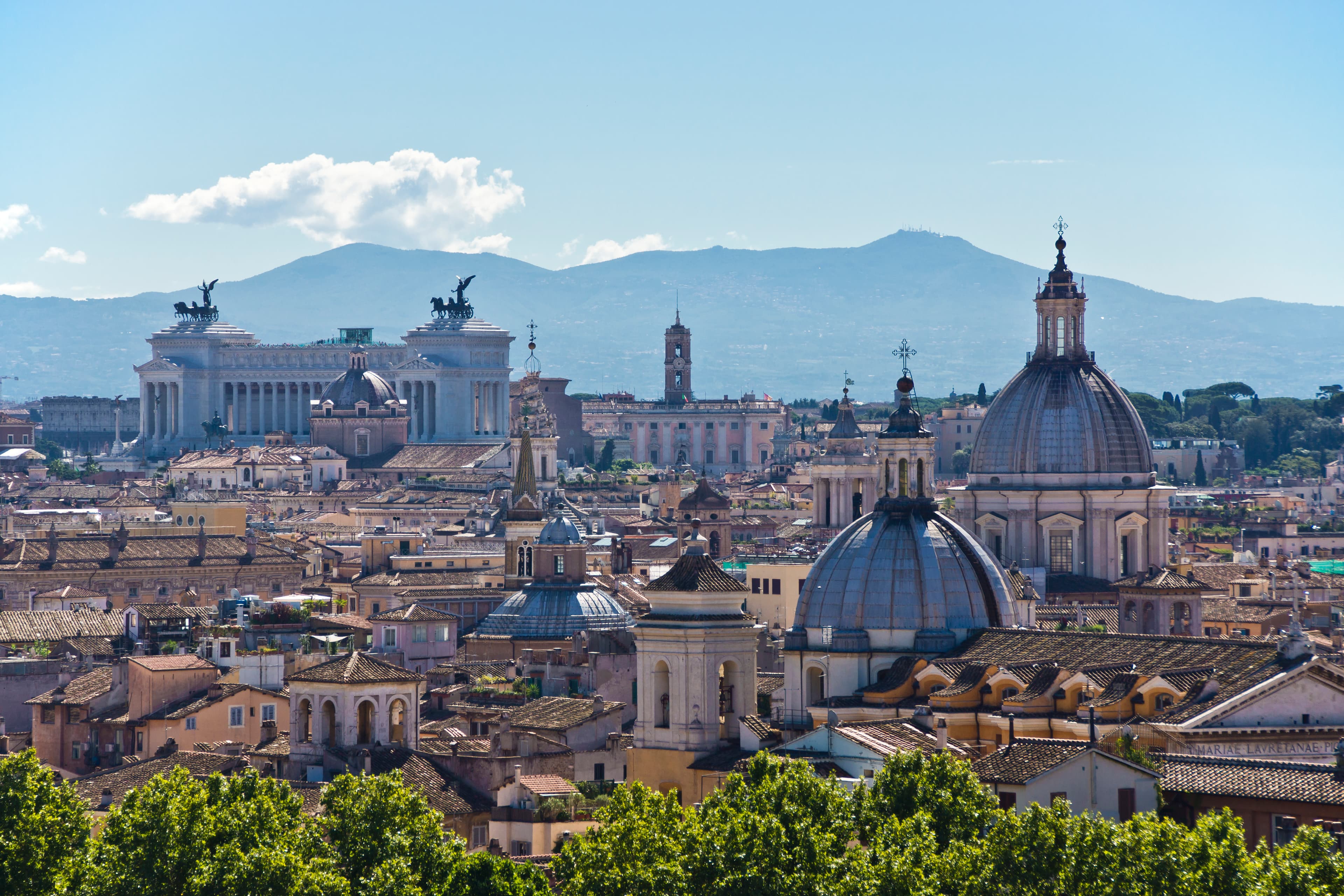
Situated on the River Tiber, between the Apennine Mountains and the Tyrrhenian Sea, the "Eternal City" was once the administrative centre of the mighty Roman Empire, governing a vast region that stretched all the way from Britain to Mesopotamia. Today it remains the seat of the Italian government and home to numerous ministerial offices. Rome has 2.7 million inhabitants while the metropolitan area is home to around 4.5 million.
Architecturally and culturally, Rome has some contrasts - you have areas with pompously huge majestic palaces, avenues and basilicas, which are then surrounded by tiny alleyways, little churches and old houses. The centre of Rome is mainly ancient, and modern buildings are usually concentrated in the suburbs, unlike Milan (where new and old architecture is combined both in the centre and the outskirts). You may also find yourself walking from a grand palace and tree-lined elegant boulevard, into a small and cramped Medieval-like street.
The abbreviation "S.P.Q.R" is ubiquitous in Rome, short for the old democratic motto "Senatus Populusque Romanus" (Latin), i.e. "The Roman Senate and People".
For two weeks in August, many of Rome's inhabitants shut up shop (literally) and go on their own vacations; many stores, restaurants and other amenities will be closed during this time. The temperature in the city centre at this time of year is not particularly pleasant. If you do travel to Rome at this time, be prepared to see Chiuso per ferie (Closed for holidays) signs on many establishments. Even in these weeks the city is very beautiful and if you are looking for a less overcrowded vacation in Rome, this is not a bad time. You will always be able to find somewhere to eat.
History
Rome's history spans over 2500 years, which have seen its transformation from a small Latin village to the centre of a vast empire, through the founding of Catholicism, and into the capital of today's Italy. Rome's history is long and complex. What follows is merely a quick summary.
See
Italians are very fond of their landmarks; in order to make them accessible to everyone one week a year there is no charge for admittance to all publicly owned landmarks and historical sites. This week, known as "La settimana dei beni culturali", typically occurs in mid-May and for those 7 to 10 days every landmark, archaeological site and museum belonging to government agencies (including the Quirinale presidential palace and gardens, the Colosseum and all of the ancient Forum) is accessible and free of charge.
Government-owned museums and historical sites have free admission on the first Sunday of every month. There are also significant discounts for EU citizens aged 18 to 25, although this will require identification. Note that in 2026, tourist fees were introduced to some particularly busy attractions: the Trevi fountain costs €2 and a €5 Roma Mic card is required for some civic museums including the Napoleonic Museum and the Giovanni Barracco Museum of Ancient Sculpture.
Roma Pass
If you'll be staying in Rome for at least 3 days, consider purchasing the Roma Pass. It is valid for 3 days and costs €58.50 (Aug 2024). It entitles holders to free admission to the first two museums and/or archaeological sites visited, full access to the public transport system, and discounts for the other museums, tourist sites, exhibitions, music events, theatrical and dance performances. This pass gets you in to the Colosseum (Colosseo), Palatine Hill (Palatino Hill), the Baths of Caracalla (Terme di Caracalla), and the catacombs as well as the Terme di Diocleziano, Palazza Massimo alle Terme, Crypta Balbi, Palazzo Altemps, Villa dei Quintili, and the Tomb of Cecilia Metella.
A Roma Pass 48-hours is also offered for €36.50 (Aug 2024) and is valid for 2 days. For this pass only the first museum and/or archaeological sites visited is free.
Check the expiration date at the back of the Roma Pass card. If the card's validity has expired it does not work in the metro's ticket gate. Be sure to buy the passes at official tourist offices. There are also small booths on the streets that sell tickets, but they could charge you a higher price.
Do
Take in a show. There are lots of theatres, but you will need to know Italian to enjoy them. The main concert venue is the Auditorium in Viale Pietro de Coubertin to the north of Rome. The Auditorium at Parco della Musica is a large complex composed of three separate halls whose shapes are inspired by musical instruments. These are positioned around an open-air amphitheatre, that is used nearly every night in the summer for concerts. The Parco della Musica hosts a constant stream of classical, popular, and jazz music, featuring national as well as international musicians and groups. Really big names perform outdoors in the summer; usually in either the Olympic Stadium or in Stadio Flaminio, which is next door to the Parco della Musica. In winter the Palalotto in EUR is an important pop concert venue.
To get full details of what is on, buy a copy of the La Repubblica newspaper on Thursdays, when it has an insert called TrovaRoma. There are a couple of pages in English but even with no Italian you should be able to decipher the main listings. This is not published in late July and August, when half of Rome heads to the beach. Both La Repubblica and Il Messaggero have daily listings.
Walk and feel the energy of Rome; sights are everywhere waiting to be discovered.
Walk or cycle along the banks of the Tiber. There are steps down to the river from close to most of the bridges. A few have special runners for cycle wheels. This gets you away from the traffic fumes and gives a different perspective of Rome. Not usually possible in winter when water levels can be very high.
Explore the Trastevere neighbourhood for some great cafes and trattorie, and a glimpse at a hip Roman neighbourhood.
Sports
Football: The men's national soccer team don't have a fixed stadium but often play in Rome.
Two city teams play in Serie A, the top tier, AS Roma and SS Lazio. They share Stadio Olimpico (capacity 70,000) in the north of the city. Matches between these two are known as the Derby della Capitale, and often suffer crowd violence.
Rugby: The men's national team play at Stadio Olimpico. The premier tournament is the Six Nations in Feb / March.
Eat
Individual listings can be found in Rome's district articles
Rome is full of good restaurants, many in attractive settings, particularly when you sit outside in the evening. No one location can be recommended to search for a good restaurant: some of the best places to eat are in the most unpromising locations while well-situated restaurants can often live on their reputation rather than the quality of their food. Restaurants in guidebooks can be good but prices can be inflated because it is more than likely a "tourist trap". To find an authentic restaurant that won't break the bank, try to find a place in a more residential area or somewhere that isn't in the middle of the tourist locations.
Many of the good restaurants in Rome are hard to find, but a good tip is to go where Italians live and eat. The downside is that waitstaff at these restaurants usually do not speak English, so be prepared to have to speak some Italian. On the top of the green, old mountain (Monte Verde Vecchio) there are some trattorias with authentic Italian cuisine at an affordable price. Rome also has many beautiful spots to eat, so buying some delicacies to make up a picnic can be a great experience. In Via Marmorata you find Volpetti's which is known for its amazing selection of cheese, prosciutto and delicious pastries (and also for its prices!). A more affordable choice is to go to a local supermarket which will also have good fresh foods for lunch.
Drink
Individual listings can be found in Rome's district articles
Coffee
Starbucks has long avoided Rome, but in April 2023 the first one appeared in the center of Rome. And no wonder: Italian coffee is great so our friends from Seattle would face a lot of competition. A latte in Italian is just a glass of milk. If you're expecting coffee in that glass, you should ask for a caffe latte. A latte macchiato (meaning "marked") is steamed milk stained with a smaller shot of espresso. "Espresso" or "normale" is just that, but more commonly just referred to as caffe. Espresso doppio means a double shot of espresso, while espresso macchiato is espresso 'marked' with a dab of steamed milk. Americano — the one to order if you like filter coffee — is espresso diluted with hot water and not drunk much by Italians. Cappuccino is well known outside of Italy, but be warned: it is considered very un-classy, and somewhat childish, to order one after 11AM (and certainly after a meal). Decaffeinato is self-explanatory, but often referred to by the common brand-name Caffe Hag.
Wine and water
House wines are almost always drinkable and inexpensive. You are better off ordering a bottle rather than house wine in most establishments in Rome due to some places watering down their wines. You may often find a bottle of wine on the table for you. Believe it or not: this bottle will be less expensive than a glass would be in the US or UK, possibly only €4 or €5. This does not always apply to those places that look really tourist-trap-like! Slightly better quality wines are usually sold at a relatively small mark-up on shop prices. Most Romans drink water with their meals. In restaurants it normally comes in 1 litre bottles and can be had normale (still water) or gassata (carbonated water).
Get around
By car
In a nutshell: Don't do it. Well, some people actually enjoy it as a master class in defensive driving. Roman traffic is chaotic (and has been since the first century BC), but it is possible to drive there. However, the roads are not logical, the signs are few and the condition of the roads gets worse daily. It will take a few weeks to understand where to drive, to get where you want to go. When driving in Rome it is important to accept that Italians drive in a very pragmatic way. Taking turns and letting people go in front of you is rare, but pedestrians are usually grudgingly yielded to. Motorbikes and scooters are driven fearlessly, darting in and out of traffic and splitting lanes. There is little patience so if the light is green when you go into the intersection and you are too slow they will let you know. A green light turning to amber is a reason to accelerate, not brake, in part because the lights usually stay amber for several seconds. If you brake immediately when the light changes you are likely to get rear-ended. Parking is so scarce, that in some areas you may have to leave your car kilometers away from your destination.
Rome is plagued with people who demand money to direct you to a space, even on the rare occasions when there are many places available, however the locals can make anywhere a parking space by flashing their hazard-lights, even if it looks like they are getting away with it, do not try this. While in Rome, it is far better to travel by bus or metro, or (in extremis) take a taxi.
In the centre, many areas are limited to drivers with special electronic passes. If you go into these areas (which are camera controlled and marked with the sign ZTL) you will end up with a large fine, particularly if your car has Italian plates.
Stay safe
Rome is generally a safe place, even for women traveling alone. However, there have been rape cases around the Roma Termini train station, so be careful especially at night time. There is very little violent crime, but plenty of scams and pickpocketing that target tourists. As in any other big city, it is better if you don't look like a tourist: don't exhibit your camera to all and sundry, and keep your money in a safe place. Consciousness and vigilance are your best insurances for avoiding becoming a victim of a crime in Rome. Remember, if you are pickpocketed or victim of another scam, don't be afraid to shout, "Aiuto, al ladro!" (Help, Thief!) Romans will not be nice to the thief.
Members of the Italian public are likely to be sympathetic if you are a crime victim. Police are also generally friendly if not always helpful. Carabinieri (black uniform, red striped trousers) are military police, and Polizia (blue and grey uniform) are civilians, but they both do essentially the same thing and are equally good, or bad. If you are robbed, try to find a police station and report it. This is essential to establishing a secure insurance claim and to replace documents: the chances of it resulting in the return of your possessions are, however, fairly remote.
Respect
Romans regularly interact with foreigners and tourists; it shouldn't be hard to find friendly help provided you know some Italian. As for most every place in Italy, just be polite and you won't have much trouble.
If you hit someone with your luggage or shoulder while walking on a street, say "sorry" (Mi scusi): despite being very busy, Rome is not London or New York and going ahead is considered bad behaviour, while a little apology will be satisfactory.
In buses or trains, let older people have your seat if there's no space available. The gesture will be appreciated.
Romans, and Italians as well, are very chaotic while in a queue, and often "clump" without any particular order: It's considered impolite, but they do it anyway. Be careful while driving,
as Romans often drive frantically and bend the rules to cope with the heavy traffic.
Practical facts for Italy
Taken from open data. Rules and numbers change, so check locally before you rely on them.
- Currency
- Euro (EUR)
- Languages
- Italian (Italy), German (Italy), French (Italy), Sardinian, and 3 more
- Plugs and power
- Types C, F, and L, 230 V at 50 Hz
- Traffic drives
- On the right
- Country calling code
- +39
- Time zone
- Europe/Rome
Official travel advice
Quoted from each government as published, with the date they last changed it. We do not add a verdict of our own.
UK Foreign, Commonwealth & Development Office
- No areas listed that it advises against travelling to
Read the full adviceThis travel advice also covers Vatican City.
Demonstrations and national strike
Recent demonstrations across northern Italian cities have led to violent riots and looting. There is an increased presence of police and military personnel in Milan. Further demonstrations may take place in major cities. See Political demonstrations.
A national strike is planned for 30 October and is expected to affect transport systems. Check with your travel provider for the latest information.
US Department of State
Level 2 of 4: Exercise increased caution
Read the full adviceExercise increased caution in Italy due to terrorism.
There is risk of terrorist violence, including terrorist attacks and other activity in Italy. Visit the U.S. Department of State's country reports on terrorism to learn more.
Petty crime is common, especially in popular tourist locations and on public transportation, including trains. Stay aware of your surroundings. Most crimes against foreigners are crimes of opportunity, like purse snatching, pickpocketing, and car break-ins.
Entry and visas
Entry rules depend on your passport and change without notice. Check the official pages before you book.
Sources