
United States
A plan for Pittsburgh
Not a list of things to see in Pittsburgh — a day-by-day plan somebody could actually follow, built from places we can point to a source for. Make your own in about a minute.
- 2 nights
- Couple
- Balanced pace
- Mid-range budget
Every place here was checked on 2026-10-21 or later, and each one says where it came from.
The plan, day by day
Day 1
09:30
You arrive
13:00
Pamela's Diner
Suggested because you chose food
- 1h
- Meal
14:30
Carnegie Museum of Natural History
Picked because you chose culture & museums + balanced energy
- 2h 30m
- Culture & museums
2h open
Nothing planned here. That was on purpose.
19:00
Mediterranean Grill
Suggested because you chose food
- 1h 30m
- Meal
20:30
Heinz Hall
Picked because you chose culture & museums + balanced energy
- 2h 30m
- Culture & museums
Day 2
08:00
Tazza D'oro
Suggested because you chose food
- 45m
- Meal
45m open
Nothing planned here. That was on purpose.
09:30
Frick Art & Historical Center
Picked because you chose culture & museums + balanced energy
- 2h 30m
- Culture & museums
1h open
Nothing planned here. That was on purpose.
13:00
St. Clair Social
Suggested because you chose food
- 1h
- Meal
14:30
Stephen Foster Memorial
Picked because you chose culture & museums and local experiences + balanced energy
- 2h 30m
- Culture & museums
17:00
USS Requin
Picked because you chose local experiences + balanced energy
- 2h 30m
- History
19:30
Tessaro's American Bar & Hardwood Grill
Suggested because you chose food
- 1h 30m
- Meal
21:00
August Wilson African American Cultural Center
Picked because you chose culture & museums + balanced energy
- 2h 30m
- Culture & museums
Day 3
08:00
61c Café
Suggested because it fits a mid-range budget
- 45m
- Meal
45m open
Nothing planned here. That was on purpose.
09:30
Fort Pitt Museum
Picked because you chose culture & museums + balanced energy
- 2h 30m
- Culture & museums
1h open
Nothing planned here. That was on purpose.
13:00
Piccolo Forno
Suggested because you chose food
- 1h
- Meal
14:30
You leave
Weather through the year
Monthly averages from NASA's 25-year climate record, day and night together.
Best months: May, July, August, and September
| January | Cold: -3°C, 73 mm |
|---|---|
| February | Cold: -2°C, 68 mm |
| March | Cold: 3°C, 78 mm |
| April | Cold: 10°C, 85 mm |
| May | Mild, some rain: 16°C, 94 mm |
| June | Rainy: 21°C, 105 mm |
| July | Mild, some rain: 23°C, 91 mm |
| August | Mild, some rain: 23°C, 81 mm |
| September | Mild, some rain: 19°C, 85 mm |
| October | Mild, some rain: 12°C, 84 mm |
| November | Cold: 5°C, 68 mm |
| December | Cold: -0°C, 79 mm |
From the Wikivoyage guide
Quoted from the travel guide anyone can edit, as it read on the day we took it.
Understand
History
The first European to "discover" the site of Pittsburgh was French discoverer/trader Sieur de La Salle in his 1669 expedition. The settlement of Pittsburgh began as a strategic point at the confluence of three rivers, with Britain, France, and the local Native American tribes all vying for control over this spot and thus, the region. On what is now referred to as The Point, where the rivers meet, several forts were constructed by competing French and British forces during the French and Indian War. In 1758, British general John Forbes ordered the construction of Fort Pitt, named after British Secretary of State William Pitt the Elder. He also named the settlement between the rivers "Pittsborough".
Manufacturing in Pittsburgh began in earnest in the early 19th century, and by the US Civil War the city was known as "the armory of the Union." This began a sharp escalation of industry, particularly steel and glass. By the late 19th century, Pittsburgh was known as the Steel City. Andrew Carnegie began the Carnegie Steel Company in 1892, which became United States Steel (USS) a decade later and grew to be the largest corporation of any kind in the world. Carnegie became the richest man on Earth and, along with other local magnates of industry, gave Pittsburgh cultural institutions such as the Carnegie Museums, Carnegie Library, and Carnegie-Mellon University. A number of other Fortune 100 companies have called Pittsburgh their headquarters, helping fund world-class museums, theaters, universities, and other attractions.
See
See the Districts articles for more listings.
Museums
Pittsburgh is home to many wonderful museums, including some truly world-class institutions. The Carnegie Museums in Oakland are absolutely spectacular; enclosed in one massive building is the Carnegie Museum of Natural History, with extensive exhibits on paleontology, geology, and biology, and the Carnegie Museum of Art, with classical and contemporary works by many fine artists. Nearby is the Frick Art and Historical Center, which is the home of steel magnate Henry Clay Frick's mansion, now open for tours. In the Strip District is the Senator John Heinz History Center, an affiliate of the Smithsonian Institution and the largest history museum in Pennsylvania, with six floors of permanent and changing exhibitions on the history Western Pennsylvania.
North Side is home to quite a few museums. The Andy Warhol Museum is one of the most comprehensive single-artist museums in the world, with exhibits of the artist's life and work, recreations of portions of "The Factory", screening of films, and educational programs about the Pittsburgh-born artist as well as other contemporary and pop artists. The Carnegie Science Center, a major science museum which is another of the Carnegie Museums, and the Children's Museum of Pittsburgh are both very popular with kids. The Mattress Factory is contemporary art on the installation-scale, with several notable James Turrell works in their permanent collection. The National Aviary allows you to get up close with plenty of exotic birds.
Architecture
Pittsburgh has more than its fair share of incredible architecture in many different styles, largely thanks to the wealth of its earlier industrialists and diverse influences of its many immigrants. Following the decline of the steel industry, the city has prioritized historic preservation and sustainable building as the city modernizes. Architecture buffs will find something interesting in every corner of the city, but there are some highlights:
Do
See the Districts articles for more listings.
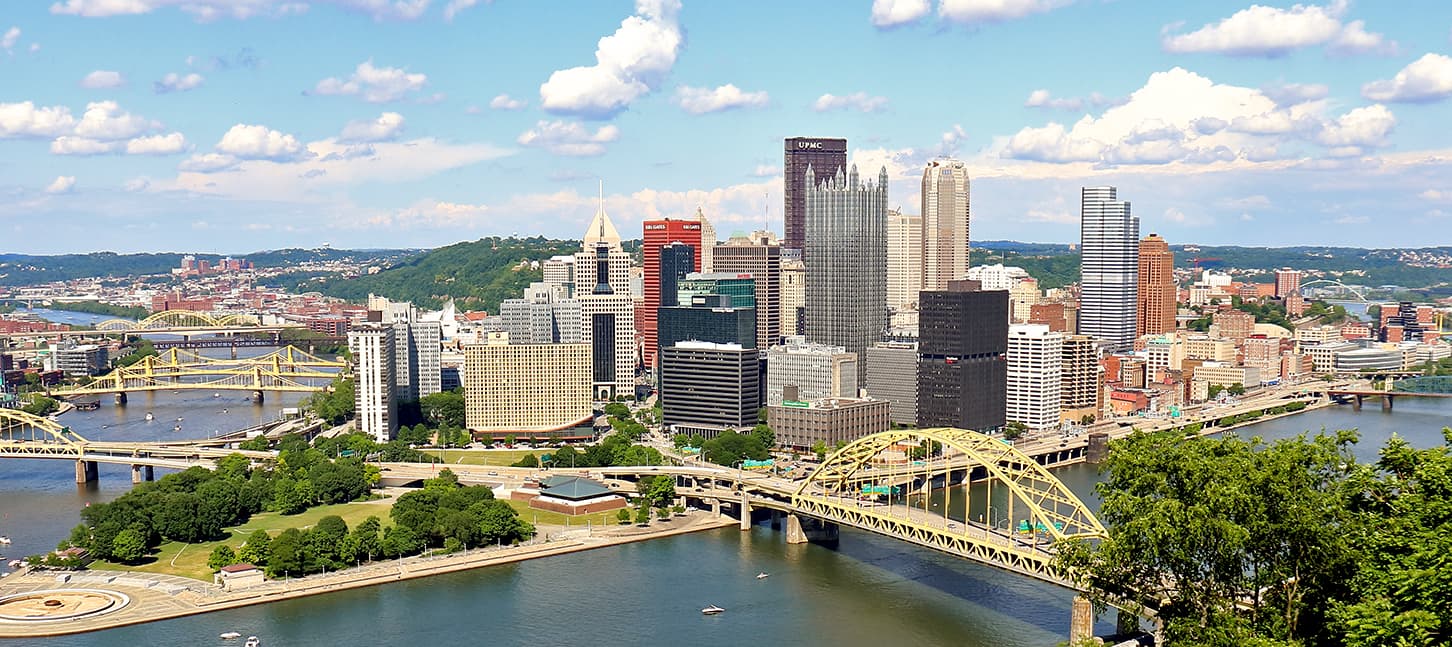
If you can only do one thing in Pittsburgh, take one of the incline railways to the top of Mount Washington near South Side to take in the view of the beautiful skyline. The Monongahela and Duquesne Inclines rise nearly 400 feet over the city from stations near Station Square. The views from Mount Washington are magnificent, but they are only the most popular - there are numerous other spots to take in views of the city, many that are more off the beaten path.
Several different tour companies are based out of Station Square in South Side, and many of them give river tours - indeed, one of the best ways to see Pittsburgh is from the three rivers themselves, taking in views of the downtown skyline, the hillsides, the bridges, and the stadiums.
Sports
With tons of die-hard fans, three major league sports teams, and a long history of sports dedication, Pittsburgh is truly a great sports town. Few things define Pittsburgh like the Pittsburgh Steelers NFL team, who go down in history as one of the greatest NFL franchises of all time and have one of the largest fan bases in all of American football. The Steelers play all their home games at Acrisure Stadium (renamed from Heinz Field in 2022, but most locals still use the old name) in the North Side. Also in the North Side is PNC Park, home of the Pittsburgh Pirates MLB team. While the Pirates had a hard go of it for two decades, they've found new energy and manage to keep a loyal fan base, with a ballpark that is considered one of the most beautiful in the major leagues.
Pittsburgh is home to the Pittsburgh Penguins NHL team, who play Downtown at PPG Paints Arena.
Eat
See the Districts articles for individual listings.
The Pittsburgh restaurant scene is a little different than most cities. In many neighborhoods, they can be difficult to find and are often patronized mainly by locals. The hills and rivers make the roads tricky. So, if you're from out of town your best bet is to pick up a local copy of the Pittsburgh magazine and do a quick search of the "Best Restaurants" section.
Each district has its unique restaurants, but the main districts for eating are the Strip District, South Side and, of course Downtown. Mt Washington, Lawrenceville, Shadyside, Oakland, Bloomfield, and Squirrel Hill also contain a wide variety of restaurants. If you're willing to go a little off the beaten path, you'll find gems tucked away just slightly further out which are still accessible by PAT bus.
Primanti Bros.. As synonymous with Pittsburgh as the hot dog is to New York. The Primanti sandwich is served on a sheet of wax paper with two slices of Italian bread, piled high with coleslaw and french fries. The other ingredients after these depends on the sandwich you order. There are many locations in and around the Pittsburgh area (including at each of the three major league sports stadiums) but the original is in the Strip District. A stop should be made here to try some food that embodies Pittsburghers.
The Strip District has tons of ethnic groceries, eateries, and vendors, with plenty of free samples.
Squirrel Hill has a variety of more ethnic restaurants: Mediterranean, kosher, Italian, etc.
Bloomfield, known as Pittsburgh's Little Italy, is home to many small Italian restaurants. Don't expect the Olive Garden!
Typical Pittsburgh dishes to try include halushky, pierogies, kolbasi, stuffed cabbage, city chicken, and chipped ham.
If you're in town for a wedding, then one distinctive regional tradition is offering hundreds, if not thousands, of homemade cookies for guests to eat at the reception.
Drink
See the Districts articles for more listings.
Pittsburgh is a city serious about its drinking. A popular anecdote tells of the priorities of earlier Pittsburghers: It's said that for every church, there's a bar across the street (and there are a lot of churches!). A Slavic drinking culture has made the city largely "a shot and a beer town." Even today, trendy and pretentious bars are scarcer than elsewhere, but almost any taste in bars and clubs can be found. The highlights are listed below, but almost every neighborhood has a fair concentration of bars.
The South Side Flats neighborhood has the most popular and diverse bar scene, and is said to have more bars per block/capita than almost anywhere else in the U.S. Most bars are along a mile-long strip of E Carson St. between 7th and 29th Sts.
The Strip District is home to some more posh nightclubs, and some other bars. This is also the center of Pittsburgh's gay culture, with several gay-owned businesses, bars, and clubs lining Liberty Avenue. A semi-fictionalized account of Liberty Avenue's gay culture is depicted in the television program Queer as Folk.
Beer is very dear to Pittsburgh, highlighted by Penn Brewery, in the North Side, a popular German beer hall and restaurant in a beautiful historic old brewery building, which also hosts an annual Oktoberfest. The Hofbräuhaus Pittsburgh on the South Side is modeled after the legendary 400- year-old Hofbräuhaus in Munich. In addition, East End Brewing and the Church Brew Works are two local breweries whose beers can be found on tap all over the city.
Coffee is just as important to many Pittsburghers as beer. Some examples can be found at: Tazza D'Oro in Highland Park; Coffee Tree in Squirrel Hill and Shadyside; Nicholas Coffee Downtown; and Crazy Mocha, which has many locations around town. The Strip District has three roasters, notably La Prima Espresso.
Get around
Pittsburgh is difficult for strangers to get around in because the roads go every which way, constrained by the rivers and hills. Many are one-way and nearly all are narrow, as they were laid out in the days of horse-and-buggy transportation. Those with a GPS navigation device should get around all right. For those without, a taxi is an option until you get used to the roads, but the public transit, operated by the Port Authority (see below), works quite well for travel within the city. If you do find yourself lost or unsure, however, do not be afraid to ask for help. Many locals are so friendly - and giving directions can be so confusing - that they might just show you to your destination themselves.
By public transit
The Pittsburgh Regional Transit, ☏ +1 412 442-2000 (previously known as Port Authority or PAT as some residents refer to it), operates bus, light rail and incline service in Pittsburgh. Bus service covers much of Pittsburgh and Allegheny County and, for the most part, is reliable and clean. Light rail (commonly referred to as "The T") connects the south side of the city to downtown and the stadiums, but doesn't connect to many other points of interest.
Routes can be confusing, but both the Port Authority's website and Google Maps (which is perhaps better) offer trip planners. Google Maps also shows bus and trolley stops. Bus stops are typically marked with a simple blue sign reading "Bus Stop" and listing route numbers and names.
Before boarding a bus or trolley, check Port Authority's schedules (all of which are available on their website) and confirm its destination with the driver. Evening and Sunday service can be challenging outside of the Light Rail, busway, and Downtown-Oakland-Squirrel Hill-Waterfront service, with less frequent service at hard-to-memorize intervals and earlier-on-Sunday ending times.
Stay safe
As in most of the United States, the phone number to dial for emergencies is 911.
Crime in Pittsburgh is generally comparable to other large cities in the US: while overall crime rates may look high on paper, the vast majority of violent crimes occur in run-down residential areas that are of little interest to most visitors. Common-sense rules (don't flash large amounts of money or jewelry, walk only along lighted streets at night, etc.) are enough to keep one safe in most cases. As a general rule, the following neighborhoods should be avoided (especially at night); while this list appears to be large, the average tourist will go to few, if any, of these neighborhoods (with noted exceptions):
Central: The Hill District, Crawford-Roberts, Bedford Dwellings, Uptown near the Lower Hill.
Additionally, Downtown, the Central Business District area, can also be unsafe after the business crowd leaves, and common precautions suitable to urban US city centers should be followed. The area near 2nd Avenue and Allegheny County Jail should be particularly avoided even during the day.
East: Homewood-Brushton, Wilkinsburg, Lincoln-Larimar, Lemington, Belmar, Garfield, East Allegheny, East Hills.
North: Central North Side, Spring Hill, Perry, Perry South, California-Kirkbride, Northview Heights, Morningside Heights, Stanton Heights
South: Mt. Oliver, Hazelwood, Beltzhoover, Arlington Heights, St. Clair Village, Upper Homestead, Allentown, Beechview, Knoxville, and parts of Brookline.
West: West End, Fairywood, Sheraden.
Outside the city: McKeesport, Penn Hills, McKees Rocks, though a tourist is highly unlikely to visit any of these.
Practical facts for United States
Taken from open data. Rules and numbers change, so check locally before you rely on them.
- Currency
- US Dollar (USD)
- Languages
- American English, Spanish (United States), Hawaiian, and French
- Plugs and power
- Types A and B, 120 V at 60 Hz
- Traffic drives
- On the right
- Emergency numbers
- Any emergency911
- Country calling code
- +1
- Time zones
- America/Adak, America/Anchorage, America/Boise, America/Chicago, and 25 more
Official travel advice
Quoted from each government as published, with the date they last changed it. We do not add a verdict of our own.
UK Foreign, Commonwealth & Development Office
- No areas listed that it advises against travelling to
Read the full adviceThis travel advice also covers American Samoa, Guam, Northern Mariana Islands, Puerto Rico, and United States Virgin Islands.
Entry and visas
Entry rules depend on your passport and change without notice. Check the official pages before you book.
Sources