
Norway
A plan for Oslo
Not a list of things to see in Oslo — a day-by-day plan somebody could actually follow, built from places we can point to a source for. Make your own in about a minute.
- 2 nights
- Couple
- Balanced pace
- Mid-range budget
Every place here was checked on 2026-10-23 or later, and each one says where it came from.
The plan, day by day
Day 1
09:30
You arrive
13:00
Smalhans
Suggested because you chose food
- 1h
- Meal
14:30
Oslo Opera House
Picked because you chose culture & museums and local experiences + balanced energy
- 2h 30m
- Culture & museums
2h open
Nothing planned here. That was on purpose.
19:00
Kaffistova
Suggested because you chose food
- 1h 30m
- Meal
20:30
Parkteatret
Picked because you chose culture & museums and food + balanced energy
- 2h 30m
- Culture & museums
Day 2
08:00
Theatercaféen
Suggested because it fits a mid-range budget
- 45m
- Meal
45m open
Nothing planned here. That was on purpose.
09:30
The Mini Bottle Gallery
Picked because you chose culture & museums + balanced energy
- 2h 30m
- Culture & museums
1h open
Nothing planned here. That was on purpose.
13:00
Statholdergaarden
Suggested because you chose food
- 1h
- Meal
14:30
Peer Gynt Sculpture Park
Picked because you chose culture & museums and local experiences + balanced energy
- 2h 30m
- Culture & museums
2h open
Nothing planned here. That was on purpose.
19:00
Hot Shop
Suggested because you chose food
- 1h 30m
- Meal
20:30
National Theatre Oslo
Picked because you chose culture & museums + balanced energy
- 2h 30m
- Culture & museums
Day 3
08:00
Karlsborg Spiseforretning
Suggested because you chose food
- 45m
- Meal
45m open
Nothing planned here. That was on purpose.
09:30
Emanuel Vigeland Museum
Picked because you chose culture & museums + balanced energy
- 2h 30m
- Culture & museums
1h open
Nothing planned here. That was on purpose.
13:00
Maaemo
Suggested because you chose food
- 1h
- Meal
14:30
You leave
Weather through the year
Monthly averages from NASA's 25-year climate record, day and night together.
Best months: June, July, and August
| January | Cold: -6°C, 78 mm |
|---|---|
| February | Cold: -5°C, 60 mm |
| March | Cold: -2°C, 56 mm |
| April | Cold: 4°C, 61 mm |
| May | Cold: 10°C, 92 mm |
| June | Mild, some rain: 14°C, 96 mm |
| July | Rainy: 16°C, 112 mm |
| August | Rainy: 15°C, 122 mm |
| September | Cold: 11°C, 96 mm |
| October | Cold: 5°C, 104 mm |
| November | Cold: -1°C, 94 mm |
| December | Cold: -5°C, 78 mm |
From the Wikivoyage guide
Quoted from the travel guide anyone can edit, as it read on the day we took it.
Understand
Oslo is the demographic, economic and political centre of Norway. As the capital of Norway, Oslo hosts several national institutions within government, education, culture, sports and transport. The city has a good selection of cultural institutions and a good selection of restaurants, some world class but most ordinary, as well as night life in general. While it is an expensive city for some overseas visitors, many of the best things are free of charge, notably Oslo's proximity to wild nature, inner city parks and variety of outdoor activities.
Metropolitan Oslo also includes most of Akershus county and the line between these is so blurred that the two is seen as one city. Local public transport such as the Oslo metro covers Oslo proper and the surrounding districts. Oslo proper has over 700,000 inhabitants while metropolitan Oslo has well over 1 million inhabitants. Oslo's influence is felt well beyond the metropolitan area and the wider "Oslo region" includes the densely populated lowlands around the inner Oslo fjord and the flatlands around the airport. This region covers only 5% of Norway's area but has 25 to 30% of the population.
Name and history
The history of the city can be traced back to at around year 1000. Oslo was according to the ancient saga founded by king Harald Hardråde in 1048, and became a diocese in 1070. The city became the capital of Norway around 1300, but lost its privileges during the Danish-Norwegian union from 1348 to 1814. In 1624, a fire devastated old Oslo, and the city was moved some kilometres west to gain protection from the fortress at Akershus. The new city was built in a strict grid plan that still appears modern, this area is now within downtown Oslo (between Akershus fortress and Oslo cathedral) and known as Kvadraturen. The expanding city Christiania was built on the land of the Aker estate so the river and the oldest church are "Aker" river and church respectively. Christiania developed west of the Aker river, while Old Oslo became a backwater between Alna river and Ekeberg hill.
See
Individual listings can be found in Oslo's district articles
Buildings and structures
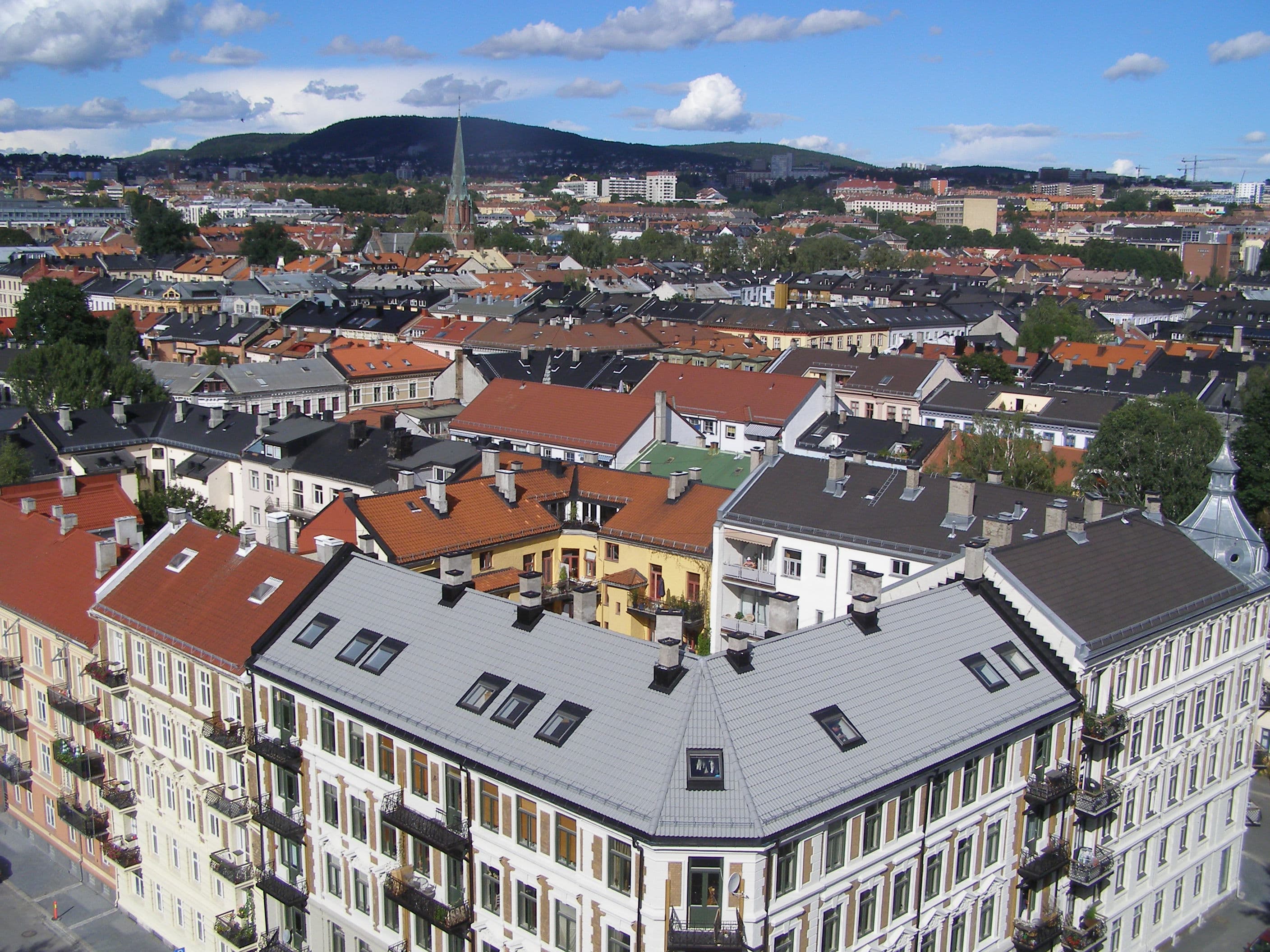
Architecture in Oslo may at first seem dull. Compared to Stockholm and Copenhagen, downtown Oslo has much less historic architecture. Most of the historic buildings are located along the Parliament-Palace axis (upper part of Karl Johan Street). This central area and the public buildings there were designed after Oslo became the capital of Norway in 1814. The charm of Oslo can also be found in the affluent inner-city suburbs of for instance Frogner and Fagerborg as well as above St.Hanshaugen park. The districts surrounding the very centre is characterised by the city's rapid expansion after 1850. These areas were developed when horses were still the most important transport, and blocks of flats from this period usually have a gate (known as port) from the street into the back yard where horses were kept. Oslo also has many exciting building projects, and the city's whole waterfront is undergoing a thorough change.
The streets of Oslo are famous from films and TV series such as Skam and Beforeigners (see Nordic Noir).
Northern Europe has a distinct wooden house tradition. Wooden houses are not allowed downtown, but these charming houses can be found in large numbers in villa suburbs such as Bygdøy and Holmenkollen, or former workers' areas such as Rodeløkka, Kampen, Vålerenga, Damstredet, Hellerud or Telthusbakken. The 1624 fire destroyed much of old Oslo (some churches and Akershus castle remain) and central Oslo is dominated by the city that was designed after the fire.
Museums
Oslo has an amazing number of museums, among them the Viking Ship Museum, with the Oseberg and Gokstad ships. Many of the museums are located next to each other and don't take long to visit.
Do
Individual listings can be found in Oslo's district articles
Visit the local city district Grünerløkka, (tram 11, 12 and 18 to Nybrua, Schous plass, Olaf Ryes plass or Birkelunden, tram 17 or bus 30-31 to Heimdalsgata or Birkelunden, or bus 21 to Sannergata). A part of the city filled with cafés, bars, small fashion and designer shops, nice parks. The river Akerselva runs on the west side, with a selection of (well hidden) bars, clubs and cafés nearby.
Explore the archipelago of the Inner Oslofjord. Islands with many beaches, hiking trails and sites of cultural heritage are just waiting to be discovered. In the summer there are ferries from the dock by the city hall to islands such as Hovedøya, Langøyene, Bleikøya, Nakkholmen and Gressholmen. If you have a fishing rod, bring it along, as well as the picnic basket, sunglasses and possibly swimwear!
Football: the men's national soccer team plays home games at Ullevaal Stadion, capacity 28,000, five km north of city centre. Oslo has one club playing soccer in Eliteserien, Norway's top tier: Vålerenga. Clubs in the second tier, 1. divisjon, are KFUM and Skeid. The domestic playing season is March-Nov.
Hiking
The easily accessible nature and many trails are just a short boat, metro, or bus ride away from anywhere in the city. Both in the inner city and especially in the forests of southern and northern Oslo there are countless hiking and cycling opportunities.
Eat
Individual listings can be found in Oslo's district articles
There are a lot of both expensive and cheap places to eat in Oslo. The cheapest restaurants are Asian restaurants which, in many cases, serve good food at low prices.
Check the menus on the door. Even though you should always use your eyes (and nose) in any food establishment, Norwegian Food and Health regulations are very strict and enforced effectively, so eating out in Oslo is safe.
Street snacks are also available throughout the city, but they're usually more expensive than in comparable cities elsewhere.
The locals use Vink from Aftenposten and the business daily DN for curated restaurant reviews – they're well worth a trial subscription that commonly is 1 NOK for the first month, provided you remember to cancel the subscription.
Aker Brygge (tram 12, bus 21, 32, 33 or 54; stops Aker Brygge, Vika Atrium or Bryggetorget) is a waterfront located south of the city hall. During summer the area is very noisy and vibrant. There are outdoor restaurants and bars almost everywhere. Be sure to get some tasty seafood (or whatever else you like to eat) while you are there, or just enjoy your cold beer in the summer sea-breeze. This is the most expensive area in Oslo to dine or drink, so unless the weather is good, you can just as well stay indoors somewhere else.
Drink
Individual listings can be found in Oslo's district articles
For more information on drinking in Norway, see the section Drink (Norway)
Buying alcohol in stores
Beer at 4.75% or below can be purchased in supermarkets at a price of 30–50 kr for a 0.5L can. Supermarkets stop selling beer after 20:00 each day, 18:00 on Saturdays, and 16:00 on holiday weekends. It is not possible to buy beer in a shop on a Sunday. It is illegal to drink in public areas. You will usually only get a warning if spotted by a police officer, if they even bother to bother you, but if you behave impolitely or they are having a bad day you can get a fine of 1,500 kr. However, in public parks during summer, laws are not enforced much at all. Good places to go for a park beer are Sofienbergparken and Kuba at Grünerløkka, Frognerparken in Majorstua, or the park at St. Hanshaugen, on a hill with great view located between Grünerløkka and Majorstuen.
Hard liquor, wine and beers above 4.75% ABV can only be bought at the state-owned shops called Vinmonopolet or at the international airport terminals. Vinmonopolet outlets are open M–F until 18:00, Sa 16:00, Su closed. Some of the central Vinmonopolet outlets in Oslo are:
Oslo Central Station, beneath the staircase leading down to Trafikanten
In the basement of Oslo City shopping centre
In the Steen og Strøm shopping centre, close to Karl Johans gate
Rosenkrantzgate 11, close to Grand Hotel, Karl Johans gate
At Aker Brygge, Bryggegata 9. This shop has been relocated from Vika and has the same large selection of beers. (Tram 12 or you can take one of several buses that stop in Dokkveien or Vika Atrium).
Thereses gate, Bislett (near Bislett stadium, trams 17 and 18)
Tøyengata 2, Grønland Basar. (All eastern subways, exit at Grønland Torg or bus 37 to Tøyengata)
Pubs and bars
All bars, pubs and restaurants in Oslo are smoke-free, which means you have to go outside to smoke. But since you can't drink on the street, you have to leave your drink inside, unless the bar/pub has a designated drink-area which is still open (they always close earlier than the venues themselves).
Get around
Oslo has a comprehensive public transport network, consisting of trains, metro, trams, buses and ferries. The network covers the Oslo municipality and the Akershus county surrounding the city. The network is planned and coordinated by Ruter.
There are two main hubs for public transport within the city centre: Oslo Central Station (Oslo S) / Jernbanetorget and Nationaltheatret. All metro lines pass these stations, all train lines pass Oslo S and most trains (including the Airport Express Train (Flytoget)) pass Nationaltheatret. Nationaltheatret is most convenient for key buildings such as the Royal Palace, the National Museum, the Parliament, Oslo Concert Hall and Oslo City Hall.
The five metro lines have numbers 1 through 5, the six tram lines have numbers 11 through 19 and the bus lines have numbers from 20, while trains are L1, L2 etc. and ferries are B1, B2 etc.
The Ruter Service Center is the information centre for public transport in Oslo. It is found at Jernbanetorget, by the foot of the clock tower just outside Oslo Central Station. There are also centres at Aker Brygge and Oslo Airport (Gardermoen). The centres hand out free maps, give information and sell all kinds of tickets. The Ruter website/app has timetables, maps, route planner and search engines for all city transport in Oslo, as well as all transport in the nearby counties of Akershus, Østfold, Oppland, Hedmark, Buskerud, Vestfold and Telemark. The Oslo Tourist Information Centre is in the same office at Jernbanetorget, at the rear counters.
Fares
There are three ways to pay for a public transport journey in Oslo:
Ruter app . The app enables you to purchase single, 24-hour, 7-day, 30-day and 365-day tickets. You must digitally "activate" the ticket prior to travel. Internet required.
Stay safe
Emergencies
Police (Emergency only), ☏ 112. If you are unsure which emergency number to call, 112 is the central for all such rescue services and will put you in contact with the correct department.
Police (non-emergencies), ☏ 02800 (in country only)Country code missing, +47 22 66 90 50 (Oslo Police District).
Fire (Emergency only), ☏ 110.
Emergency Medical Services (Ambulance), ☏ 113.
Crime
Oslo is generally a safe city, but as in any metropolitan area, some caution is warranted. Violent crime is rare, but not unheard of. Avoid getting in to quarrels in taxi queues after closing hours of bars. Avoid groups of drunk young men. The police advise that the area along the Akerselva river from Grønland to Cuba is best avoided after dark. It is known for instances of rape, muggings and drug dealing. Though Oslo isn't as dangerous as many places around the world, there are a few working-class areas that many locals would advise people not to visit at night, some of which are: Stovner, Holmlia, and Grønland/Tøyen. The chances of your getting mugged or robbed in these areas aren't extremely high, but it's not worth taking the risk.
Women should remain vigilant at night and when clubs and pubs are closing. Avoid walking alone through parks and poorly lit areas of the city. Do not, under any circumstances, use “pirate taxis” or other unofficial transportation.
Theft and pick pocketing is a nuisance. Normal precautionary rules apply:
Watch out for pick pockets in crowds and public transport.
Do not leave your belongings unattended.
Avoid leaving your mobile phone and wallet on café tables.
If you are yourself subject to criminal acts, or witness a crime, it is generally accepted to report or tip it to the police. It is a welcome contribution to better public safety.
Scams
Common scams are rare but occur in Oslo as in any big city. In 2008 there were reports on the "guessing game" being perpetrated on the street - don't get involved in street-betting as it is certain to be a scam.
Winter conditions
For more information on driving in winter conditions, see the Winter driving article.
Practical facts for Norway
Taken from open data. Rules and numbers change, so check locally before you rely on them.
- Currency
- Norwegian Krone (NOK)
- Languages
- Norwegian, Norwegian Bokmål, Norwegian Nynorsk, Northern Sami, and 1 more
- Plugs and power
- Types C and F, 230 V at 50 Hz
- Traffic drives
- On the right
- Country calling code
- +47
- Time zone
- Europe/Oslo
Apps to install before you land
Install them on Wi-Fi before you go. Each one was checked by a person against the guide that names it.
Trains and local transport
Official travel advice
Quoted from each government as published, with the date they last changed it. We do not add a verdict of our own.
UK Foreign, Commonwealth & Development Office
- No areas listed that it advises against travelling to
US Department of State
Level 1 of 4: Exercise normal precautions
Read the full adviceExercise normal precaution in Norway.
Norway is generally a safe destination for travelers.
• Be aware of landslides and avalanches. Norway’s steep mountains make these common. Heavy summer rain or winter snow accumulation can cause them.
• A special kind of clay called “quick clay” (kvikkleire) can cause ground to collapse in some areas where people live.
• Keep your belongings safe. Watch your wallet, phone, and bags in busy tourist spots like hotels and transit stations.
• Review our Travel Guidance for Norway to learn how to prepare for a safe trip.
Entry and visas
Entry rules depend on your passport and change without notice. Check the official pages before you book.
Sources