
Uruguay
A plan for Montevideo
Not a list of things to see in Montevideo — a day-by-day plan somebody could actually follow, built from places we can point to a source for. Make your own in about a minute.
- 2 nights
- Couple
- Balanced pace
- Mid-range budget
Every place here was checked on 2026-10-30 or later, and each one says where it came from.
The plan, day by day
Day 1
09:30
You arrive
13:00
Bouza Bodega Boutique
Suggested because you chose food
- 1h
- Meal
14:30
Museo Torres García
Picked because you chose culture & museums + balanced energy
- 2h 30m
- Culture & museums
2h open
Nothing planned here. That was on purpose.
19:00
Bar Facal
Suggested because you chose food
- 1h 30m
- Meal
20:30
Sala Zitarrosa
Picked because you chose culture & museums + balanced energy
- 2h 30m
- Culture & museums
Day 2
08:00
K Fe
Suggested because it fits a mid-range budget
- 45m
- Meal
45m open
Nothing planned here. That was on purpose.
09:30
Estévez Palace
Picked because you chose culture & museums + balanced energy
- 2h 30m
- Culture & museums
1h open
Nothing planned here. That was on purpose.
13:00
Los Leños
Suggested because you chose food
- 1h
- Meal
14:30
Fernando García Museum
Picked because you chose local experiences + balanced energy
- 2h 30m
- Local experiences
17:00
Museo Andes 1972
Picked because you chose culture & museums + balanced energy
- 2h 30m
- Culture & museums
19:30
La Corte
Suggested because you chose food
- 1h 30m
- Meal
21:00
Los Yuyos
Picked because you chose food and local experiences + balanced energy
- 1h 30m
- Food
Day 3
08:00
Café Brasilero
Suggested because it fits a mid-range budget
- 45m
- Meal
45m open
Nothing planned here. That was on purpose.
09:30
National Museum of Visual Arts
Picked because you chose culture & museums + balanced energy
- 2h 30m
- Culture & museums
1h open
Nothing planned here. That was on purpose.
13:00
La Cibeles
Suggested because you chose food
- 1h
- Meal
14:30
You leave
Weather through the year
Monthly averages from NASA's 25-year climate record, day and night together.
Best months: January, February, November, and December
| January | Rainy: 23°C, 102 mm |
|---|---|
| February | Rainy: 23°C, 106 mm |
| March | Rainy: 21°C, 118 mm |
| April | Rainy: 18°C, 114 mm |
| May | Mild, some rain: 15°C, 84 mm |
| June | Mild, some rain: 12°C, 98 mm |
| July | Cold: 10°C, 92 mm |
| August | Mild, some rain: 12°C, 89 mm |
| September | Mild, some rain: 13°C, 96 mm |
| October | Rainy: 16°C, 103 mm |
| November | Mild, some rain: 19°C, 96 mm |
| December | Mild, some rain: 21°C, 86 mm |
From the Wikivoyage guide
Quoted from the travel guide anyone can edit, as it read on the day we took it.
Understand
History
There are several theories about the origins of the city's name. The "monte" part is generally considered to be the hill where the Cerro fort is now. According to one theory the hill was named "Monte-VI-D-E-O(este)", which translates to Mountain six (VI in Roman numerals) From East to West. Another popular theory is that a member of Ferdinand Magellan's world circumnavigation would have shouted "Monte vide eu!", which translates to "I see a mountain!" when seeing the hill – however, the circumnavigation happened two centuries before the foundation of the city so it might well have been another mountain he saw.
Construction of the Cerro fort, at the time called Montevieu fort, was started by the Portuguese in 1723. The following year the Spanish started building the city of Montevideo on the opposite side of the bay where Ciudad Vieja is now, and occupied and colonized the rest of the region. During its almost 300 years of existence, Montevideo has been part of the Spanish and Portuguese empires, occupied by the British for a few months in 1807 and afterwards a part of Brazil and today's Argentina before finally becoming the capital of the newly-founded Republic of Uruguay in 1828.
See
Plaza Independencia
The Independence square is a symbol of Montevideo and lined by several prominent landmarks.
1 Plaza Independencia. The square at the end of 18 de Julio Ave., with the latter being the main commercial artery of the city. On the last Saturday of September, all the museums and historical places of interest around the Plaza Independencia open for free to the public. There is also a large "Murga," or a traditional South American parade in which all the Uruguayan political parties take part. The event is known as El Día del Patrimonio, the Day of Heritage. On the middle of the square there is a statue of general José Artigas, and under it, his mausoleum. (updated Jul 2015)
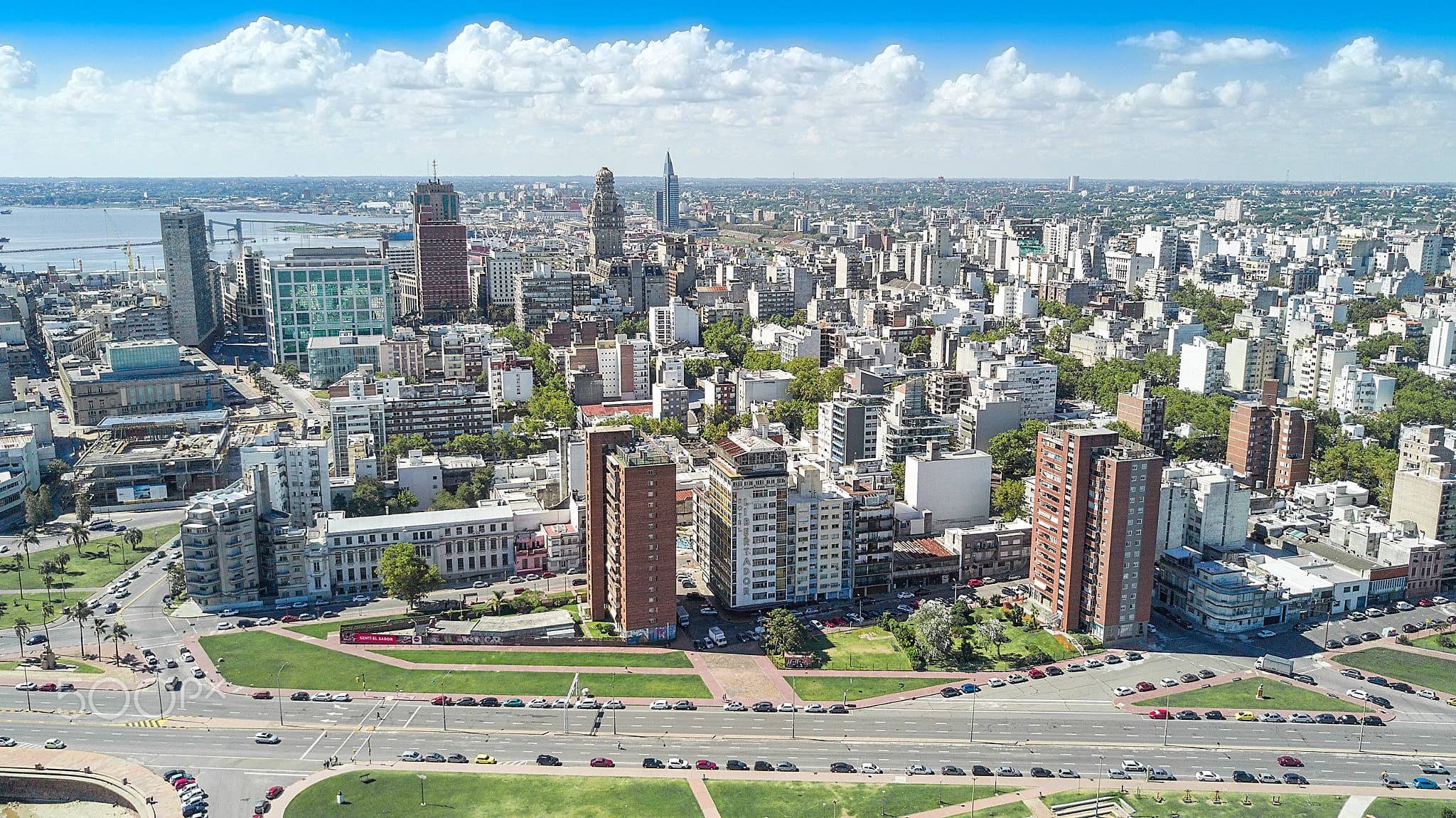
2 Palacio Salvo. Eastern side of Plaza Independencia. Once South America's highest building, the 95-m-high Art Deco building Palacio Salvo still dominates Montevideo's skyline. In the past there used to be an observation deck that could be accessed for free. U$200-300 for 30-min tour including observation deck. (updated Jan 2018)
3 Mausoleo de Artigas. This large monument in the Plaza Independencia pays tribute to José Gervasio Artigas, one of the heroes of the Uruguayan Independence. Under the monument is the mausoleum, which is open on the weekends. It contains an urn with his ashes and two honor guards keeping watch.
4 Palacio Estévez (Estévez Palace). The Palacio Estévez was the office building of Uruguayan presidents until 1985. Today it is a museum of the Uruguayan presidency.
5 Torre Ejecutiva. The current presidential office, next to the former. The Executive Tower was first planned as a courthouse in the 1960s, the project was halted several times until the house was finalized as the presidential office in 2009.
6 Edificio Ciudadela. Glass-framed office building at the western end of the square with a terrifying number of air conditioning units.
7 Puerta de la Ciudadela. A gate to the old town; if you pass through it you're at Sarandí, Montevideo's main pedestrian street. This is one of the few remaining parts of the old city wall.
Do
There are practically no old movie theaters left in Montevideo: they have been rebuilt into churches. However there are good movie theaters with the newest movies in the shopping malls. All foreign movies are in the original language with Spanish subtitles.
Take a boat trip in a small boat from the pier near Mercado del Puerto.
Watch a football match at 1 Estadio Centenario. The national stadium is where the first football (soccer) World Cup was held, won by the host nation. Today it is used by the national team and by the clubs of the city.
In some parks there is public training equipment.
2 The Rambla. This waterside roadway has people biking, fishing, drinking mate, and enjoying the great views. 22 km long (13.6 miles), the Rambla goes along Montevideo's waterfront. Lovely at sunset.
Tango. Argentina claims to be "home of tango", but Uruguay was equally important on the development of this music and dance style: one of the most famous tango songs, La Cumparsita (which refers to Montevideo Carnival's cumparsas) was written by an Uruguayan composer and premiered in Montevideo, and the passport Carlos Gardel held at the time of his death stated he was born in Tacuarembó, Uruguay (although France and Argentina also claim to be his motherland). Contrary to the extremely coded and exhibitionist milongas of Buenos Aires, its Montevidean counterparts are laid back, boast a great level of dance and are almost solely frequented by locals. Hoy Milonga Montevideo lists the action, which takes place in dedicated places, bars or public squares.
3 Estadio Gran Parque Central, Carlos Anaya 2900 (in La Blanqueada neighbourhood). The Gran Parque Central is the stadium of Club Nacional de Fútbol, and it is the oldest football stadium in the Americas. It was also one of the venues of the 1930 FIFA World Cup. Uruguayan championship matches and international matches are played here. The price of tickets may vary depending on the type of match.
Eat
Potatoes, rice, salad and such is usually ordered separately. If you just order e.g. a steak as it is stated in the menu and you will literally only be served a steak. Portions are usually large. In areas frequented by tourist restaurants often offer menus with several courses.
Cover charges (cubierto) are frequent in Montevideo's restaurants. They are usually around U$50.
Typical food is:
Meat — Uruguay is renowned for its meats, and Montevideo has many parrillas where they are grilled up to perfection. If you would like a large beef meal, you should head to Mercado del Puerto in the old town. In and around the Mercado there are several such restaurants. Good paella is also available there.
Chivito — This is the local sandwich, made with meat and vegetables. It can be served al plato (on a plate), which means it is going to take a fork and knife to eat it. It is tastier, cheaper and much bigger than a hamburger. 1 Marcos Chivito is one of the best places in Montevideo to get these tasty treats, as well as 2 La Mole, and some "Carritos". An excellent choice is to try chivitos in 3 Bar San Rafael.
Milanesa — is a common meat dish mostly in South America, including Uruguay. It consists of a thin slice of veal, chicken or sometimes beef. Each slice is dipped into beaten eggs, seasoned with salt, and other condiments according to the cook's taste (like parsley and garlic). Each slice is then dipped in breadcrumbs (or occasionally flour) and shallow-fried in oil, one at a time. Some people prefer to use very little oil and then bake them in the oven as a healthier alternative. Sometimes it may include a fried egg on top.
Fresh Pasta and Fresh Gnocchis — they are everywhere on the menus, with all types of vegetarian or meat sauces... usually a cheap, filling and delicious option!
Desserts — In Uruguay, desserts are huge and plentiful. There is dulce de leche on almost everything and stores that sell nothing but caramels. Many places sell nothing but dessert, so pick the one with the best looking pastries and cakes and enjoy!
Churros — Find them for sale at the "Parque Rodó". Try the sweet versions - they come with sugar on top, or filled with chocolate, dulce de leche or cream filling - or the cheese-filled ones.
Drink
There's a wide choice of places in Montevideo for going out for a drink. However, before midnight there is very little going on, and while bars are open before that you might be the only patron. In the old town it is not hard to find cafés and dance and music locals where you can experience the local culture. The street Bartolomé Mitre in the pedestrian area of the old town has plenty of cafés and bars to choose among, but prices tend to be higher than elsewhere in Montevideo. Many establishments have a happy hour and by good weather you can enjoy your drink outside. The streets of 25 de mayo (Bacacay) and Sarandi are pedestrianized and have a range of bars and restaurants with good atmosphere. A little bit to the east, the streets San José and Soriano run parallel to Avenida de 18 Julio. On both of those streets you can find good places to spend the night. Finally, district of Pocitos is also a popular place for drinking and partying with several popular bars.
Cafés
1 la Ronda Café, Ciudadela 1182, ☏ +598 2904 3402. Mon-Fri 12:00-late, Sat Sun 19:30-late. A small café with nice interior where you can enjoy music and drink or eat. The food is a combination of Uruguayan and Mexican cuisine.
2 Cafe Brasilero, Ituzaingo 1447. Chic café with regular live performances. The oldest working café in Montevideo, it was opened in 1877 and retains a historical atmosphere with historical photos and paraphernalia. You can have different sandwiches and croissants here.
3 Porto Vanila. Chain of several cafés in shopping malls and on the street. A big variety of sandwiches and pastries.
Bars and pubs
4 Shannon Irish pub, Bartolomé Mitre 1318. Many different beer brands and regularly live bands.
5 El Pony Pisador, Bartolomé Mitre 1000 (corner of Buenos Aires), ☏ +598 2915 7470. A bar/club that also has regular live music performances.
6 Bar Valentin Pub Rock, Bartolomé Mitre 1322. In daytime it is a bar, but later in the evening it becomes a disco.
Get around
By bus
Buses are the only form of mass public transit available in town, so it's likely you'll use them at some point.
STM transit cards are free, give discounts on the many types of fares and allow for buses integration: U$29 for 2 buses in 1 hr or U$44 for any number of buses in 2 hr, against U$36 for the normal fare paid in cash. You can get yours at the Abitab shop on the ground floor of Tres Cruces Terminal, or in any other agreed post. Abitab minimal top-up is of U$100.
Be aware that there are no route maps at the bus stops, that the lines deserving a certain stop might not be indicated, and that the bus stop might not have any mark at all.
There are a few routing tools to help with the task of figuring out the bus system: Moovit app is a traveller's favorite because it's available in many other cities around the globe and has an intuitive interface in many languages (most notably English, Portuguese and Spanish) and Cómo ir is the official app launched by the Montevideo Administration. Other options are MontevideoBus and Bondi.
Montevideo buses are entered through the front door. The fee is paid either to the driver or to the collector (if present) sat to the right. There are many types of tickets available and you are supposed to say which one you want: if you don't know, say una-hora. Remember to take the receipt and keep it with you for the duration of your trip because control officers might board the bus and ask for them. In many buses, the "please stop" button is over the doors - observe others if in doubt.
Notice that the line CA1, which connects Tres Cruces Terminal to Ciudad Vieja, is exceptionally included on the "boleto céntrico" type of fare, so it's cheaper: U$20 if paid by card, U$26 if in cash (against U$29/36 for other lines on the same route).
Stay safe
Security
Montevideo used to be safer before, however it is still a safe city compared to e.g. Brazilian cities. Pickpocketing occurs downtown so backpacks and handbags should preferably be worn so that you can see them. Robberies are known to happen, including "smash and grab" attacks where the robber smashes a car window, grabs a bag or other item from the seat, and runs.
The most secure neighbourhoods, according to a report from a realtor magazine, are Buceo, Pocitos, Punta Carretas and Parque Rodó, followed by Colón, the downtown, Sayago and Conciliación.
The old town outside the pedestrian area is considered dangerous after dark. This also applies to the beach promenade outside the old town. In the daytime there are frequent police patrols on old town's streets and many establishments have security guards standing outside the door. In the summer the beaches of Ramírez and Pocitos should be avoided at nighttime.
If you are an obvious foreigner you are more frequently targeted by beggars. However they aren't violent. Near attractions there are often people presenting themselves as "keepers" that allegedly will look after your parked car for a fee. Unlike in other places they reportedly don't ask for payment in advance and don't behave in an intimidating way.
Tourists are advised not to visit certain peripheral suburb neighbourhoods known for being sources of insecurity, such as 40 semanas, Barrio Borro, or the outskirts of Casabó. Although some of them are not slums at all, the level of crimes is higher than the downtown or the suburbs. The Cerro district west of the bay, famous for its fort, is also reportedly one of the districts you should not be wandering around in as a tourist and absolutely not alone, specially at night.
The police can be called by dialing 911.
Drugs
Like elsewhere in Uruguay, driving with any blood alcohol level greater than 0 is prohibited. Do not drive under the effects of alcohol. Also in Montevideo as well as the rest of the country, smoking is prohibited in public enclosed spaces. Violation of this policy may carry fines.
Practical facts for Uruguay
Taken from open data. Rules and numbers change, so check locally before you rely on them.
- Currency
- Uruguayan Peso (UYU)
- Language
- Spanish (Uruguay)
- Plugs and power
- Types C, F, I, and L, 230 V at 50 Hz
- Traffic drives
- On the right
- Emergency numbers
- Any emergency911
- Country calling code
- +598
- Time zone
- America/Montevideo
Official travel advice
Quoted from each government as published, with the date they last changed it. We do not add a verdict of our own.
UK Foreign, Commonwealth & Development Office
- No areas listed that it advises against travelling to
US Department of State
Level 2 of 4: Exercise increased caution
Read the full adviceExercise increased caution in Uruguay due to crime.
Exercise increased caution in Uruguay due to crime.
Crime is most common in these departments:
• Montevideo
• Canelones
• Maldonado
• Rivera
Violent crime occurs across the country. Crimes include homicide, armed robbery, carjacking and theft. These crimes can happen at any time and have affected U.S. citizens.
Entry and visas
Entry rules depend on your passport and change without notice. Check the official pages before you book.
Sources