
Italy
A plan for Genoa
Not a list of things to see in Genoa — a day-by-day plan somebody could actually follow, built from places we can point to a source for. Make your own in about a minute.
- 2 nights
- Couple
- Balanced pace
- Mid-range budget
Every place here was checked on 2026-10-27 or later, and each one says where it came from.
The plan, day by day
Day 1
09:30
You arrive
13:00
Ristorante E Prie Rosse
Suggested because you chose food
- 1h
- Meal
14:30
Teatro Gustavo Modena
Picked because you chose culture & museums and local experiences + balanced energy
- 2h 30m
- Culture & museums
2h open
Nothing planned here. That was on purpose.
19:00
Tierra Nuestra
Suggested because you chose food
- 1h 30m
- Meal
20:30
Politeama Genovese
Picked because you chose culture & museums + balanced energy
- 2h 30m
- Culture & museums
Day 2
08:00
La Cremeria delle Erbe
Suggested because it fits a mid-range budget
- 45m
- Meal
45m open
Nothing planned here. That was on purpose.
09:30
Galata - Museo del mare
Picked because you chose culture & museums + balanced energy
- 2h 30m
- Culture & museums
1h open
Nothing planned here. That was on purpose.
13:00
Brera
Suggested because you chose food
- 1h
- Meal
14:30
The Biosphere
Picked because you chose local experiences + balanced energy
- 2h 30m
- Local experiences
17:00
House of Cristoforo Colombo
Picked because you chose culture & museums and local experiences + balanced energy
- 2h 30m
- Culture & museums
19:30
Sà Pesta
Suggested because you chose food
- 1h 30m
- Meal
21:00
La Coccagna
Picked because you chose food and local experiences + balanced energy
- 1h 30m
- Food
Day 3
08:00
Antica Latteria
Suggested because you chose food
- 45m
- Meal
45m open
Nothing planned here. That was on purpose.
09:30
Edoardo Chiossone Museum of Oriental Art
Picked because you chose culture & museums + balanced energy
- 2h 30m
- Culture & museums
1h open
Nothing planned here. That was on purpose.
13:00
27 sapori
Suggested because you chose food
- 1h
- Meal
14:30
You leave
Weather through the year
Monthly averages from NASA's 25-year climate record, day and night together.
Best months: June, July, August, and September
| January | Cold: 4°C, 56 mm |
|---|---|
| February | Cold: 5°C, 60 mm |
| March | Cold: 8°C, 71 mm |
| April | Mild, some rain: 12°C, 71 mm |
| May | Mild, some rain: 16°C, 67 mm |
| June | Mild, some rain: 20°C, 47 mm |
| July | Mild and dry: 23°C, 34 mm |
| August | Mild, some rain: 23°C, 49 mm |
| September | Mild, some rain: 19°C, 61 mm |
| October | Mild, some rain: 14°C, 97 mm |
| November | Cold: 9°C, 145 mm |
| December | Cold: 5°C, 79 mm |
From the Wikivoyage guide
Quoted from the travel guide anyone can edit, as it read on the day we took it.
Understand
When visiting northwestern Italy (Milan, Turin) it is absolutely worth staying for a couple of days or a weekend in Genoa. The city is a good base to explore the Italian Riviera and world-famous places like Portofino and the Cinque Terre.
Genoa is a place where you discover daily new surprises, even if you stay for years.
The city may be less known by major tourist operators, but its splendor is often hidden inside the narrow streets of the historical center, called "vicoli".
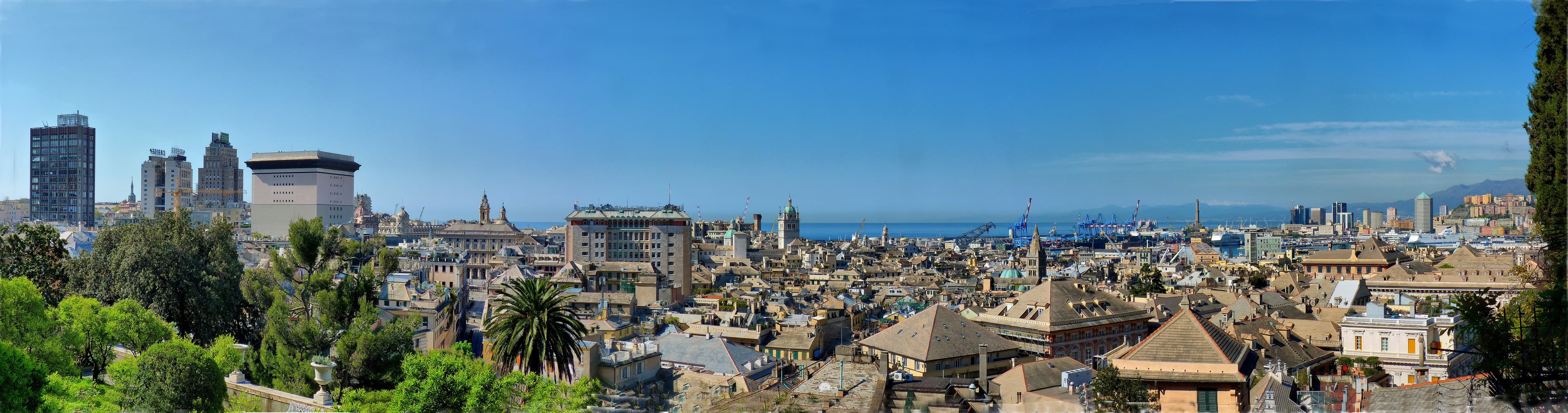
Genoa is a sort of decayed glorious port town, whose decay, however, is what makes it so interesting and pretty. The façades of grand palaces are hidden in scruffy, yet enticing alleyways, and there are really curious treats for anyone in virtually every alley. The city is your "typical" Italian one - quite sunny (during summer), with Mediterranean-looking houses topped by slate roofs, filled to the brim with outdoor cafes and bars, with lots of tiny and quirky alleyways, elegant designer shops, and restaurants. Today, also, the old port has been renovated, and has some funky avant-garde modern architecture, a delightful marina, and several seaside bars and shops.
See
Old City
Genoa has one of Europe’s largest preserved historical centers, made up of an incredible number of tiny streets and alleys called Caruggi. Walking through it will plunk you right back to olden times when Genoa was the most important harbor of the Mediterranean sea.
1 Christopher Columbus House (Casa di Cristoforo Colombo) (Piazza Dante). The house where Columbus lived as a child. (updated Mar 2017)
The impressive fortification belt built on the hills surrounding the city, originating in the 16th century.
2 Spianata Castelletto. A nice belvedere where one can have a pleasant view of the city and of the seaport. It can be reached by public lift from Piazza della Nunziata or on foot from that very same square. (updated Mar 2017)
3 Via Garibaldi. also known as Via Aurea and Strada Nuova, Golden Street and New Street has very impressive baroque buildings. (updated Jun 2018)
Some similar buildings are also found in Via Balbi.
4 The Old Harbour (Porto Antico) (north of the Aquarium). An entertainment area with museums, cinemas, cafés and also a beautiful promenade along the sea. (updated Mar 2017)
5 Lanterna di Genova, Access through Lanterna pedestrian promenade (800m) starting near the ferry terminal in Via Milano (100 m from bus stops; 400 m from "Dinegro" subway station; 1.5 km from Principe train station; 1.5 km from "Genova Ovest" highway exit), ☏ +39 349 2809485, lanterna.giovani.urbanisti@gmail.com. Sat Sun 14:30-18:30 (last access: 18:00). The prominent Genovese symbol since 1128: the second tallest traditional lighthouse in the world €6 full price; €4 reduced price.
A lot of beautiful churches, some of which date back to the Romanesque time (San Giovanni di Pre', San Donato, Santa Maria del Castello)
6 Castello d'Albertis (D’Albertis Castle Museum of World Cultures), castellodalbertis@comune.genova.it.
7 Palazzo Ducale. Where the Dukes of Genoa used to live. (updated Mar 2017)
8 Cathedral of San Lorenzo. (updated Mar 2017)
9 Galeone Neptune, ☏ +39 010 247 6608. Replica of a 17th-century Spanish galleon. (updated Mar 2017)
10 Via Balbi. Also has some similar buildings. (updated Jun 2018)
Museums
Art museums
11 Museum of Modern Art - Villa Croce.
Do
There are plenty of things to do in Genoa, although it is very advisable to visit in spring and summer. A lot of young kids spend their time playing with their friends in Parks found within certain antique Villas, some of them are also museums (i.e. Villa di Negro- oriental arts museum Edoardo Chiossone). Go for ice cream along the beaches and beach promenades. There are a lot of paintings in the town and on the brick floors which a lot of people admire. Fishing for catfish is also a hobby you might enjoy.
Via XX (venti) Settembre - Via San Vincenzo
Genoa's main street Via XX settembre, is filled with cafes and high street fashion shops. Start from Brignole station and head towards Piazza De Ferrari. Via San Vincenzo, another popular shopping destination, runs parallel to Via Venti (as the Genoese call it) from Brignole.
De Ferrari - San Lorenzo/Centro Storico
De Ferrari square lies in the heart of the city, surrounded by the Carlo Felice theatre, and Palazzo Ducale. Head towards Via San Lorenzo and get lost inside the Centro Storico. A bustling net of alleyways that gains its character from being close to the port and as such is a melting pot of cultures. You can breathe the Sea air and the port of a once-strong maritime republic.
It is full of bars, shops, antique barbers (va canneto il lungo), butchers and restaurants. Get lost! (though you might want to take a map because you could get lost.)
On Friday and Saturday nights, these alleyways fill up with people, excellent for bar crawling and living the night. Find its many chupiterias, to get speciality shots or find smaller more rustic birrerias. Occasionally you can find live bands on the streets or in many of the bars, especially by Piazza delle Erbe and Piazza Luzzati.
Eat
The vast majority of places charge service for a fixed amount per person (called coperto), as is customary in Italy. A trattoria, cafe or bar will not charge this fee for lunch, and this is often a good place to get pasta or a sandwich in the afternoon. Restaurants are open from approximately 12:30 - 15:00 for lunch and 19:30 - 22:00 for dinner.
Pesto sauce originates from the city of Genova. It is used in many dishes, including pastas and pizzas.
Another must try from the Genovese or Ligurian cuisine is focaccia, which is a flat oven-baked Italian bread that may be topped with onions, herbs, or other foodstuffs. Focaccie are quite tasty and often cheaper than pizzas. There are many 'focaccerie' scattered throughout Genova and its surroundings. These are basically take away places, and easy on the wallet, too. In many of the focaccerie, you will find improvised varieties of focaccie, but usually, the best tasting ones come with only tomatoes or onions and a bit of olive oil. The original "focaccia" is simply topped with olive oil, salt and a little bit of white wine
Don't miss a chance to try farinata, a thin crusty pie made with chickpea flour, water, salt, and olive oil.
Budget
Around the Piazza De Ferrari
1 Trattoria Da Maria, Vico Testadoro 14 (close to Piazza de Ferrari), ☏ +39 010 581080. Traditional regional cuisine and a practical and crowded atmosphere. Possible opening for lunch only, no reservation. (updated May 2022)
2 Il Tempio Dell'Hamburger, Salita del Prione, 41R. (updated May 2022)
3 Il Masetto, Via di Canneto Il Lungo, 111. A Hamburger restaurant (updated May 2022)
4 Ristorante La Pietra Genova, Via di Ravecca, 20r. (updated May 2022)
Around Porto Antico
5 Osteria La Lanterna, Via San Siro 12R (close to Via San Luca and Museo del Risorgimento), ☏ +39 010 2461608. This restaurant offers mainly fish dishes. (updated May 2022)
6 Antica Friggitoria Carega, Via di Sottoripa, 113 r. A takeout restaurant (updated May 2022)
7 Il Ristoro dei Grimaldi, Vico San Luca 1_2r. A pizza takeaway restaurant (updated May 2022)
8 Pastificio Artigianale di Canneto, Via di Canneto Il Curto, 49. (updated May 2022)
Drink
Piazza delle Erbe: small square in the old town, with nice bars (5 min. walking from Piazza De Ferrari and Palazzo Ducale) open until 01:00. On Fridays and Saturdays it is crowded with young people.
. Riviera hotel Pl
Area of Porto Antico. Down of piazza Caricamento and close to the Bigo there is a float restaurant with the nose of it being a night bar, with sometimes offering live music. Wide wood chairs to relax and see the sea in summer.
Get around
By car
Locals will say driving around the city is somewhat faster than public transportation (traffic jams at rush hours notwithstanding), but once you have reached your destination you are faced with the nightmare and frustration of looking for a nonexistent parking spot. It is not just chance that most locals switched from cars to scooters - to the extent that even finding a spot for a scooter has become difficult too. All attractions within the center are in walking distance or well served by public transportation, therefore a car is of no use at all. If you still decide to drive into the city, don't bet on available street parking (there are street parking fees anyway) go directly to a parking garage and hope not all of them are full. If you think of driving to the beach on a sunny weekend day within Genoa or in another town along the coast, forget it. Finding a parking spot in walking distance to your beach is a once-in-a-lifetime event. Use public transit instead.
Public transportation
Public transportation will probably be your best bet within the city. The bus network is operated by AMT and services the whole city until 01:00. Be sure to check the routes and timetables you need because the system can be somewhat confusing, e.g. some routes only travel at certain times and are replaced by other similar ones with different numbers at those times. There is also an underground line connecting the main square, piazza De Ferrari, with the northwestern neighborhood of Rivarolo, serving the historical center, the Porto Antico tourist area, the Stazione Principe main train station and the ferry terminal at Dinegro along the route.
There are also a number of public elevators and cable railways connecting the center with the neighborhoods on the surrounding hills. The upper stations of the Ascensore di Castelletto elevator and of the Funicolare del righi railway offer an astonishing view of the city.
Stay safe
Crime
Streets in Genoa are usually quite safe, especially in the main tourist areas and residential areas. Downtown, Quarto dei Mille, Quinto del Mare and Nervi are all safe districts during the day as well as the evening.
However, some limited areas in the historical centre off the main alleys might be subject to petty crime or just be uncomfortable for the general tourist (e.g. prostitutes waiting for clients in the middle of the day in dark side alleys just a couple of blocks away from a tourist attraction). Especially north of Piazza Caricamento/via Banchi/via Luccoli, around the Via Pré and in the Stazione Principe area, it is advisable to exercise extra caution and follow your common sense, e.g. avoid walking into narrower, darker, deserted alleys off the main paths unless you know where you are going. Pay special attention to your surroundings, avoid displaying flashy items and do not carry large amounts of cash or valuables.
Muggings or violence towards tourists are practically unheard of, however deft pickpockets are not. Be particularly careful in the via San Lorenzo/via San Bernardo/via San Donato area (which is a popular and very crowded nightlife zone for students and young people) and also on city buses.
Traffic
When walking, you should not expect motorists (especially scooters and bikers) to be particularly disciplined. At unsignaled crosswalks, you might need to insist on your right of way by just starting to cross the road (with caution!), as Italian pedestrians normally do, rather than waiting for motorists to stop. If a car, van or truck has stopped to let you cross, be very careful and always assume there might be a scooter passing that vehicle at high speed without seeing you.
Practical facts for Italy
Taken from open data. Rules and numbers change, so check locally before you rely on them.
- Currency
- Euro (EUR)
- Languages
- Italian (Italy), German (Italy), French (Italy), Sardinian, and 3 more
- Plugs and power
- Types C, F, and L, 230 V at 50 Hz
- Traffic drives
- On the right
- Country calling code
- +39
- Time zone
- Europe/Rome
Official travel advice
Quoted from each government as published, with the date they last changed it. We do not add a verdict of our own.
UK Foreign, Commonwealth & Development Office
- No areas listed that it advises against travelling to
Read the full adviceThis travel advice also covers Vatican City.
Demonstrations and national strike
Recent demonstrations across northern Italian cities have led to violent riots and looting. There is an increased presence of police and military personnel in Milan. Further demonstrations may take place in major cities. See Political demonstrations.
A national strike is planned from 9pm on 29 October to 9pm on 30 October. The strike may disrupt rail and air travel, taxis, highways, local public transportation, schools, and government offices. Check with your travel provider for the latest information.
US Department of State
Level 2 of 4: Exercise increased caution
Read the full adviceExercise increased caution in Italy due to terrorism.
There is risk of terrorist violence, including terrorist attacks and other activity in Italy. Visit the U.S. Department of State's country reports on terrorism to learn more.
Petty crime is common, especially in popular tourist locations and on public transportation, including trains. Stay aware of your surroundings. Most crimes against foreigners are crimes of opportunity, like purse snatching, pickpocketing, and car break-ins.
Entry and visas
Entry rules depend on your passport and change without notice. Check the official pages before you book.
Sources