
Japan
A plan for Fukuoka
Not a list of things to see in Fukuoka — a day-by-day plan somebody could actually follow, built from places we can point to a source for. Make your own in about a minute.
- 2 nights
- Couple
- Balanced pace
- Mid-range budget
Every place here was checked on 2026-10-30 or later, and each one says where it came from.
The plan, day by day
Day 1
09:30
You arrive
13:00
Shin Shin
Suggested because you chose food
- 1h
- Meal
14:30
Fukuoka City Museum
Picked because you chose culture & museums + balanced energy
- 2h 30m
- Culture & museums
2h open
Nothing planned here. That was on purpose.
19:00
Chikae
Suggested because you chose food
- 1h 30m
- Meal
20:30
TORIBUDOU
Picked because you chose food and local experiences + balanced energy
- 1h 30m
- Food
Day 2
08:00
Nooice
Suggested because it fits a mid-range budget
- 45m
- Meal
45m open
Nothing planned here. That was on purpose.
09:30
Fukuoka Art Museum
Picked because you chose culture & museums + balanced energy
- 2h 30m
- Culture & museums
1h open
Nothing planned here. That was on purpose.
13:00
博多ラーメンはかたや堅粕店
Suggested because you chose food
- 1h
- Meal
14:30
Fukuoka Prefectural Museum of Art
Picked because you chose culture & museums + balanced energy
- 2h 30m
- Culture & museums
2h open
Nothing planned here. That was on purpose.
19:00
Sumitora Tenjinten
Suggested because you chose food
- 1h 30m
- Meal
20:30
HKT48 Theater
Picked because you chose culture & museums + balanced energy
- 2h 30m
- Culture & museums
Day 3
08:00
VITO
Suggested because it fits a mid-range budget
- 45m
- Meal
45m open
Nothing planned here. That was on purpose.
09:30
Kōrokan Historical Museum
Picked because you chose culture & museums + balanced energy
- 2h 30m
- Culture & museums
1h open
Nothing planned here. That was on purpose.
13:00
PIZZAREVO
Suggested because you chose food
- 1h
- Meal
14:30
You leave
Weather through the year
Monthly averages from NASA's 25-year climate record, day and night together.
Best months: October
| January | Cold: 4°C, 70 mm |
|---|---|
| February | Cold: 5°C, 88 mm |
| March | Cold: 8°C, 118 mm |
| April | Rainy: 13°C, 140 mm |
| May | Rainy: 18°C, 158 mm |
| June | Wet season: 22°C, 299 mm |
| July | Wet season: 26°C, 357 mm |
| August | Wet season: 26°C, 204 mm |
| September | Rainy: 23°C, 189 mm |
| October | Rainy: 17°C, 109 mm |
| November | Mild, some rain: 12°C, 89 mm |
| December | Cold: 6°C, 79 mm |
From the Wikivoyage guide
Quoted from the travel guide anyone can edit, as it read on the day we took it.
Understand
Historically, Fukuoka was two cities divided by the central river: the merchant town of Hakata (博多) and the samurai feudal domain of Fukuoka (福岡). According to legend, when the cities merged in 1889, a group of samurai heard that "Hakata" was probably going to win the vote for the name of the merged city, so they crashed the meeting and forced them to name it Fukuoka instead. While probably apocryphal, the important point to remember is that the city is named Fukuoka, but the main railway station and port are known as Hakata Station and Hakata Port. There are city centers in both Chūō-ku (in old Fukuoka's downtown of Tenjin) and Hakata-ku.
The surrounding cities and towns make up the prefecture of Fukuoka. The city has 2.5 million residents including its suburbs.
Being a sizable, modern city it's still not hard to get around. A subway connects most of the city's main attractions, providing transportation between Hakata, Tenjin, Fukuoka International Airport, Meinohama, and Nishijin (where you can find Fukuoka Tower and the baseball ground of the Softbank Hawks: Fukuoka Dome). The main station in Hakata marks the terminus of the Sanyo Shinkansen bullet train. The Kyushu Shinkansen line also terminates here, and links the Sanyo Shinkansen directly with Kagoshima, at the southern tip of Kyushu.
1 Fukuoka City Tourist Information (Sightseeing Plaza Tenjin), Lion Plaza, 2-1-1, Tenjin, Chuo-ku. Daily 09:30-19:00. Information centre with English, Chinese and Korean speakers. (updated May 2019)
2 Fukuoka City Tourist Information (Hakata Station). Daily 08:00-21:00. In the middle of Hakata JR train station there is a Tourist Information Center (sometimes with English speakers) with brochures in English, Japanese and other languages. They can help with transport information and bookings. (updated May 2019)
See
1 Nakasu. This area is next to Tenjin and is Fukuoka's red-light district, with over 3500 restaurants, as well as ramen stalls (yatai), shopping, pubs, hostess bars, rooftop beer gardens in summer, one surviving movie theater, and sex trade. The neon lights on the Naka River are famous with over 60,000 visitors a day, and it has the busiest street in Kyushu. (updated Mar 2016)
2 Gion. This area has several historical shrines and Buddhist temples, including: (updated Mar 2016)
3 Kushida Shrine. The 8th-century Kushida Shrine is starting point for the annual Gion-Yamakasa Festival.
4 Tōchō-ji. It has a 10.8-m wooden Great Buddha. Free entry; ¥100 to see the Buddha. (updated May 2026)
5 Shōfuku-ji. Japan's first Zen temple.
Views
6 ACROS rooftop garden (Tenjin Chuo Park). 09:00-18:00 (March-October), 09:00-17:00 (November-February). The ACROS building has a terraced roof that merges with the park and contains some 35,000 plants representing 76 species. It is 809 steps to the top. Just east of ACROS is the former Prefectural Guest House, featuring turn-of-the-century architecture. Free. (updated May 2026)
ACROS observation deck (at the top of the rooftop garden). Weekends and public holidays only, 10:00-16:00. A 60-meter-high (200 ft) observation deck with good views over Fukuoka. Free. (updated May 2026)
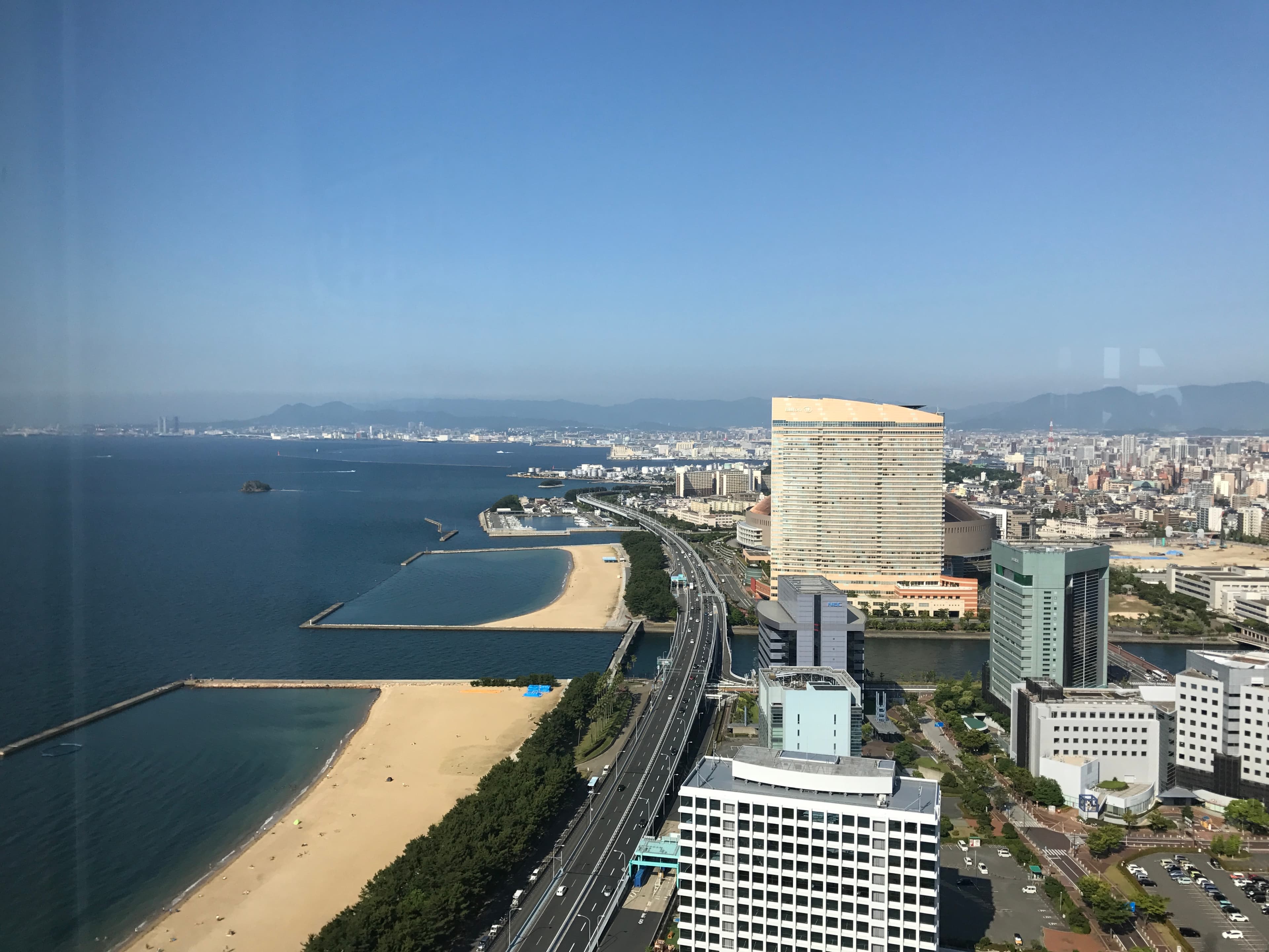
7 Fukuoka Tower (福岡タワー), Sawara-ku Momochihama 2-3-26. The triangular reflective tower has magnificent views of the city and Hakata Bay from its 123-meter-high observation deck. (The whole tower is 234 m; the remaining 111 m is a television mast.) In Christmas and the Star Festival (Tanabata) on July 7, this tower is decorated. During the rest of the year the view is best at night time. This is an iconic symbol of Fukuoka. There is a restaurant which commands a ¥300 sitting fee in addition to the meal. The menu is limited and the food is mediocre at best. ¥1000. (updated May 2026)
Do
For a good listing of what's happening and places to eat and drink, the local monthly English-language magazine Fukuoka Now is a great start.
1 Kabuki theatre (Hakata-za). An experience worth checking out. Check times and prices at the Hakata-za near Nakasu. If you don't want to stay for the whole show, or don't have so much money to spend, you can watch part of a show for about ¥800; see here for details. Half price student/young (~25) adult tickets may be available day of performance to be released 20 minutes prior to the show; see here for details. (updated May 2019)
2 Noh theatre, 1-5 Ohorikoen, Chuo-ku, ☏ +81 92 715 2155. A cultural experience that some may not want to miss. There is a Noh theatre in Ohori Koen. Many of the performances are free, get more information at the Rainbow Plaza (IMS building 8th floor). Don't worry, if you fall asleep during the play, it's almost expected. It's all part of the Noh experience. (updated May 2019)
3 Fukuoka SoftBank Hawks baseball. Winning the Japan Series seven times between 2011 and 2020, the Hawks was undoubtedly Japan's strongest team in the 2010s. Check out a baseball game at the Fukuoka PayPay Dome, which is about 15 min walking distance from Tōjinmachi subway station. Ticket prices vary by day, but you can get an outfield unreserved seat from ¥1,000.
If you haven't tried karaoke yet, why not try it now? There are many karaoke places to choose from, some with costumes you can borrow (just don't try to take them home). If you just want to go for a couple of hours, most places will charge by the hour; morning and afternoon hours being the cheapest. If you want to make a night of it, from 23:00, most have free time systems which mean nomihodai (all you can drink) and all you can sing for about ¥2,500, until 05:00.
Events
Fukuoka is famous for two annual festivals which are some of Japan's oldest and draw huge crowds.
Eat
Hakata is famous for its style of ramen, known as tonkotsu (豚骨, lit. "pork bone") ramen, which has a very pungent smell thanks to the thick broth that is made from simmering pork ribs for at least 12 hours (up to 3 days at some of the best restaurants), and is one of Japan's top three ramen. Enjoy it with pickled ginger and lots of sesame seeds. Save the broth, because you can order a refill of noodles (kaedama) for around ¥300 at many places.
Although there are restaurants all over town serving ramen at various price levels, some of the best joints are yatai, mobile food stalls (see also the Drink section). The stalls are set up early evening and can be found on major streets; particularly in Tenjin (near the post office), Nakasu and Nagahama-Dori. Also, along the river from Canal City, an entire strip of yatai can be found. Although ramen is the norm, you can find anything from yakitori to Italian cuisine. Brush up on your Japanese or pointing skills as these guys don't speak English at all. A few tips: respect other customers' space, don't go in large groups (split up and use multiple stalls), and don't stay too long.
Another regional product Hakata is famous for is the spicy mentaiko (明太子), or pollock roe condiment, though in actuality these days it is all imported. Enjoy it plain with breakfast, inside an onigiri, or tossed with spaghetti. It's widely available for tourists in JR Hakata Station as well as major department stores, although it needs to be refrigerated.
Fukuoka is also known for having good gyoza (pork dumplings) and there are many places to try some. (They are a perfect appetizer/side dish for ramen, incidentally.)
Lunch time is probably the best value for the money. Most restaurants will do lunch sets at 1/2 or 1/3 the price of their dinner sets, but serve the same course. If you have a bit more cash to spend and want to have a nice Japanese style lunch, the Grand Hyatt at Canal City and the Excel Hotel near Nakasu are both good. Most of the larger, nicer hotels in the area will serve beautiful lunch sets. Many restaurants and cafes in the area will have lunch sets under ¥1,000.
Drink
Yatai, or street stalls, are plentiful throughout Fukuoka and present a great place to grab a bite to eat and drink while mixing with the locals. Yatai are usually a last stop on a pub crawl since they provide cheap eats that taste better after a long night, and it's easier to start a conversation with a stranger after many beers. Don't rely on one for dinner! And bring your meishi (business cards) if you have any, because they often get swapped here. Along the river in Hakata, from about 16:00, you'll see the yatai vendors setting up their booths and preparing ingredients for the evening crowds. A few of the yatai vendors speak a bit of English. Just be careful about the prices, sometimes the yatai don't have menus, so be sure to ask what they have and how much things are.
Tenjin, ¥100 by bus from Hakata Station or to the west of Fukuoka Nishitetsu Station, is one of the best places in the whole country to explore Japanese nightlife. This also includes Daimyo, a farther out area which is becoming the "new Tenjin". The most well-known place to start is 1 Oyafukō-dōri (親不孝通り); the aptly-named "Disobedient Child Street" comes alive with youth activity, especially on weekend nights. It also has several ex-pat bars. It's only 400 m long but swells with young people at night. Unlike comparable areas in Tokyo, there are no scam bars in Tenjin, and the "snack bars" are not ridiculously overpriced. The area is aimed towards the locals but it is still large, new, fashionable, and full of unique experiences. This is one of the safest places imaginable to drop into a new bar, so why not give it a try?
Some of the smaller bars down the backstreets will often have a table charge of ¥200-500 per person. This usually means you get a tiny bowl of nuts, chips or pickled octopus.
Get around
By public transport
The Fukuoka City Subway consists of 3 lines. The Hakata subway station, located under the JR Hakata Station, can take passengers straight to Fukuoka International Airport (6 min, ¥260), to Tenjin, the city's de facto downtown district, and to other major stops. An all-day subway pass (ichinichi joshaken) costs ¥640. If you tap a contactless credit card as you enter and leave subway stations, you will be charged no more than the cost of an all-day pass per day. Regular tickets cost between ¥210 and ¥380 depending on distance. The local rechargeable contactless smart card is called Hayakaken and is compatible with other smart cards like PASMO (Tokyo) and ICOCA (Kyoto and Osaka). IC cards are also generally accepted on buses by multiple companies; some also accept contactless credit cards and QR code payments. When using a bus with an IC card reader or contactless credit card, be sure to tap when you enter and as you leave, so that you are charged the correct fare.
Contactless credit card payment (Visa, Mastercard, JCB, Amex, Diners, Discover) is available at all ticket gates on all subway lines. You can enter and exit by simply tapping your credit card or smartphone.
There is a special pass for overseas tourists which costs ¥2500 (¥1250 child) for one-day unlimited rides on buses, trains and subways, with some discounts at sights.
Fukuoka is well served by Nishitetsu buses. Fares vary based on distance traveled, starting at ¥150 (Oct 2025).
On foot
Downtown is small and compact enough to potentially wander around on foot. In the Tenjin area, Tenjin Chikagai (天神地下街, Tenjin Underground Shopping Center) runs under Watanabe Street and has many shops. It also connects the Tenjin and Tenjin-Minami subways stations with most major department stores and the Nishitetsu Fukuoka station; when transferring between these stations, you can take up to 120 minutes, leaving plenty of time for shopping. There is a passenger tunnel which connects Hakata and Gion subway stations and is useful during the frequent rains in summer and the bitter cold winds in winter, the latter of which is close to some of Fukuoka's temples and shrines.
Practical facts for Japan
Taken from open data. Rules and numbers change, so check locally before you rely on them.
- Currency
- Japanese Yen (JPY)
- Language
- Japanese
- Plugs and power
- Types A and B, 100 V at 50 or 60 Hz
- Traffic drives
- On the left
- Country calling code
- +81
- Time zone
- Asia/Tokyo
Official travel advice
Quoted from each government as published, with the date they last changed it. We do not add a verdict of our own.
UK Foreign, Commonwealth & Development Office
- No areas listed that it advises against travelling to
Read the full adviceGlobal travel impacts due to escalation in the Middle East
Escalation in the Middle East has caused widespread travel disruption, including airspace closures, delayed and cancelled flights.
US Department of State
Level 1 of 4: Exercise normal precautions
Read the full adviceExercise normal precaution in Japan.
U.S. citizens should always exercise caution when traveling abroad. Use these general tips to stay safe.
Entry and visas
Entry rules depend on your passport and change without notice. Check the official pages before you book.
Sources