
Bangladesh
A plan for Dhaka
Not a list of things to see in Dhaka — a day-by-day plan somebody could actually follow, built from places we can point to a source for. Make your own in about a minute.
- 2 nights
- Couple
- Balanced pace
- Mid-range budget
Every place here was checked on 2026-10-30 or later, and each one says where it came from.
The plan, day by day
Day 1
09:30
You arrive
13:00
Sea Shell Restaurant & Party Palace, Restaurant
Suggested because you chose food
- 1h
- Meal
14:30
Lalbagh Fort
Picked because you chose culture & museums + balanced energy
- 2h 30m
- Culture & museums
2h open
Nothing planned here. That was on purpose.
19:00
Bismillah Kabab Ghar
Suggested because you chose food
- 1h 30m
- Meal
20:30
Impress Telefilm Ltd.
Picked because you chose culture & museums + balanced energy
- 2h 30m
- Culture & museums
Day 2
08:00
Gusto coffee & bistro
Suggested because it fits a mid-range budget
- 45m
- Meal
45m open
Nothing planned here. That was on purpose.
09:30
Liberation War Museum
Picked because you chose culture & museums + balanced energy
- 2h 30m
- Culture & museums
1h open
Nothing planned here. That was on purpose.
13:00
Xindian Restaurant
Suggested because you chose food
- 1h
- Meal
14:30
Bangladesh National Museum
Picked because you chose culture & museums + balanced energy
- 2h 30m
- Culture & museums
17:00
National Museum of Science and Technology
Picked because you chose culture & museums + balanced energy
- 2h 30m
- Culture & museums
19:30
Sura
Suggested because you chose food
- 1h 30m
- Meal
21:00
Ahsan Manzil
Picked because you chose culture & museums and local experiences + balanced energy
- 1h 30m
- Culture & museums
Day 3
08:00
Bittersweet Cafe
Suggested because you chose food
- 45m
- Meal
45m open
Nothing planned here. That was on purpose.
09:30
July Uprising Memorial Museum
Picked because you chose culture & museums + balanced energy
- 2h 30m
- Culture & museums
1h open
Nothing planned here. That was on purpose.
13:00
Star Kabab Hotel & Restaurant
Suggested because you chose food
- 1h
- Meal
14:30
You leave
Weather through the year
Monthly averages from NASA's 25-year climate record, day and night together.
Best months: January, February, November, and December
| January | Mild and dry: 18°C, 9 mm |
|---|---|
| February | Mild and dry: 22°C, 20 mm |
| March | Mild, some rain: 27°C, 50 mm |
| April | Hot: 30°C, 149 mm |
| May | Wet season: 30°C, 292 mm |
| June | Wet season: 29°C, 382 mm |
| July | Wet season: 28°C, 437 mm |
| August | Wet season: 28°C, 359 mm |
| September | Wet season: 28°C, 283 mm |
| October | Rainy: 26°C, 185 mm |
| November | Mild and dry: 23°C, 38 mm |
| December | Mild and dry: 19°C, 18 mm |
From the Wikivoyage guide
Quoted from the travel guide anyone can edit, as it read on the day we took it.
Understand
Dhaka (DHAH-kah) emerged as a cosmopolitan city during the Mughal Empire. Today, Dhaka is South Asia's second most populous capital after Delhi and an important financial center alongside Mumbai and Karachi.
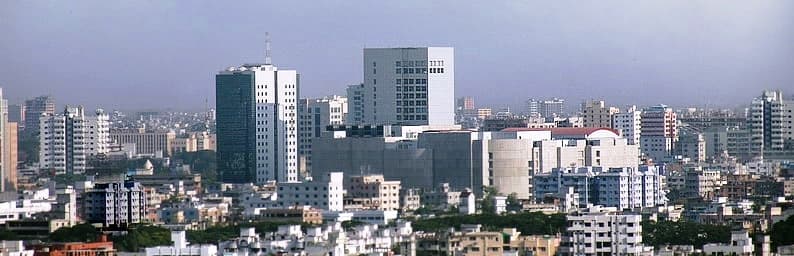
Modern Dhaka is a thriving, colourful and congested metropolis. Being one of the most densely populated places on the planet, Dhaka can be one of the most frenetic cities in the world. Its streets and rivers are filled with colourful chaos. The city plays host to the highest number of rickshaws in the world. Dhaka is also the center of Bangladesh's textile industry, the country's principal foreign exchange earner. Experiencing the city for the first time may seem overwhelming.
Geography
Dhaka covers 360 km2 (140 sq mi) in the lower reaches of the Ganges delta. It is bounded by the Rivers Buriganga, Dhaleshwari and Turag; and their numerous tributaries and river channels. The land is close to sea level. Dhaka is vulnerable to flash floods during the monsoon.
Etyomology
The literal meaning of the name Dhaka is "concealed". The enigmatic name might have originated from dhak trees found in the area; or from the 12th-century Hindu Dhakeshwari Temple.
History
The earliest settlements in the region date back 2,500 years. Dhaka was the capital of Bengal during the Mughal Empire in the 17th century. As the seat of administration and commerce in the Bengal Delta, the wealthiest and most fertile region in the Empire, it became one of the largest and most prosperous cities in Asia. Proclaimed as the provincial capital in 1608, Mughal Dhaka had a population of one-million people, with well-laid out gardens, monuments, tombs, forts, mosques, temples, and churches. The city was home to Armenian, Persian, Greek, Arab, Portuguese, French, Dutch, and English merchants. Its riverbanks were once dotted with numerous stately mansions and the city was described as the Venice of the East. The Dhaka District was famous worldwide for its fine cotton muslin fabrics. The British East India Company took control of the city in 1793.
See
Individual listings can be found in Dhaka's district articles
The University of Dhaka in Dhaka/Central was an epicenter of Bangladesh's struggle for self-determination. It has several notable colonial buildings, including the Curzon Hall, a masterpiece of European-Mughal architecture. The Burdwan House is home to the Bangla Academy. The campus also hosts the Central Shaheed Minar, the national monument dedicated to the Bengali Language Movement; as well as the tomb of the National Poet Kazi Nazrul Islam.
Gurdwara Nanak Shahi in Dhaka was built in 1830. It is the largest Sikh temple in Bangladesh and commemorates the visit of Guru Nanak, the founder of Sikhism, to Bengal in the 14th century.
Ramna Green is a vast stretch of green surrounded by a serpentine lake in Dhaka/Central.
Hatirjheel is a regional modernist transport system in central Dhaka with numerous bridges, flyovers and viaducts over a huge natural lake in Dhaka/Central.
Bangabandhu Sheikh Mujibur Rahman Novo Theatre (Dhaka Planetarium) is a state-of-the-art planetarium named after Sheikh Mujibur Rahman is near the Parliament in Dhaka/Central.
Eat
Individual listings can be found in Dhaka's district articles
Dhaka has an enormous variety of food catering to all budgets. Old Dhaka is overflowing with cheap Bangladeshi food where a meal can cost from Tk 50. In the upscale areas such as Gulshan and Banani there are Chinese, Indian, Thai, Vietnamese, Greek and Mexican restaurants, and franchises such as Pizza Hut and KFC - all at prices that the majority can't afford. Reservations are usually not required in most restaurants. A lot of the Buffet-style restaurants in this area have Tk 250–400, fixed price menu.
Local sweets (misti/mishti) like rasogollah and golap jam/pantuya/ledikeni are excellent, these are bite-sized soft milk curd balls dipped (drenched) in syrup, and come in white and red varieties. Shops throughout the town (and especially near Gulshan) sell imported condiments from Dubai, Europe, Malaysia and the US at a premium. Imported chocolate is especially expensive - and usually not in the best condition as it gets melted and re-solidified daily in the tropical heat. Fresh is better.
Be careful when buying food from street vendors as health and hygiene standards are not always top notch. Unlike Bangkok—street food in Dhaka is only for locals. Foreigners should stick to larger, organized (and unfortunately a little expensive) food outlets. In organized food outlets or in street stalls stick with more popular outlets where there are people inside or in line as that can indicate quality as the locals (and some travellers) and most likely to be clean and good eating. An empty restaurant or a lone food cart (with no customers) should be avoided as it's empty for a reason.
Traditional food
Dhakaiya Biryani
Traditional Dhakaiya spicy dish available in every corner of old Dhaka.
Bakorkhani
Bakorkhani or Bakharkhani is a traditional bakery item available in every corner of old town.
Drink
Individual listings can be found in Dhaka's district articles
There is a party network between the different expat clubs (Dutch Club, Canadian Club, Nordic Club, International Club, American Club, etc.) and some Bangladeshi clubs (Heritage, Privilege, etc.) These clubs usually require membership to enter, or befriend a member and have them sign you in. From there, you can purchase a book of tickets or a cash card and then use it to order your drinks.
Although alcohol is most easily available at the international clubs and top hotels, there are quite a few local places to find a drink for the enterprising traveller. Local bars are to be found in most neighbourhoods but can be difficult to locate due to lack of advertising. Popular brands of beer (Heineken, Carlsberg, Tuborg, Foster's etc.) and major types of spirits are available at these places, and at much lower prices than at hotel bars.
You can try:
The Dip, like most other Bengali bars, is a smoke-filled darkened room where many of its patrons would rather not be recognized too easily. Definitely an experience, nonetheless. Beers cost upwards of Tk 150 and "tots," which are single ounce servings of gin, vodka or whisky, are available from Tk 70 (local brands) to Tk 200. Female patrons may feel slightly uncomfortable.
Get around
It's not a lie; Dhaka is one of the most congested cities in the world due in large part to being one of the most populous cities in the world. Dhaka has often been referred to as the "Traffic Capital of the World", and you can literally spend hours in traffic.
A poorly developed road network, an inefficient traffic system, an unskilled traffic police force, poor efficacy of traffic laws, constant construction, lack of adequate parking spaces, and bad driving habits are some of the many reasons why Dhaka has immense congestion problems.
If you're struggling to find a fair fare with a driver among the multitude of transportation options, try walking a short distance to the next one. It's important to note that not all drivers are dishonest and it's better to seek out the reliable ones and give them your business. In the event that a driver demands more money upon arrival, it's best to stick to the agreed or metered fare and leave. It's also crucial to ensure that the driver knows where you're headed from the beginning, unless you're able to direct them yourself. Some drivers may claim to have local knowledge but end up taking a longer route, so be cautious. Additionally, it's recommended to carry a card with your hotel or hostel information written on it so that you can easily find your way back. A card with the actual address of your accommodation can make things even simpler.
Stay safe
If you happen to arrive at the Hazrat Shahjalal International Airport at night, it is best to remain there until morning. While the chances of anything bad happening upon exit are somewhat low, incidents such as kidnappings by taxi drivers are known to have happened to tourists who have tried to leave the airport in the small hours of the morning.
Otherwise Dhaka isn't terribly unsafe, but as in any huge city you should keep aware of your surroundings and try not to walk around at night. People are generally friendly and ready to help. The chance of problems is low. If you must be out late at night, it best not to bring valuables with you.
The safest mode for travel for a tourist is to hire a yellow cab. These can be rented for one trip or by the day. Be sure to write down the licence plate number. In case you feel unsafe or threatened by anyone, dial 999 to contact the emergency helpline.
If riding on a rickshaw, keep your bags close to you, so that no one can grab them.
The greatest danger probably comes from speeding buses and rickshaws. Keep well alert when walking along main roads.
Occasionally, there are strikes, called hartals. During these times, you should do your best to keep a low profile. Avoid any sort of large gatherings, even positive ones, during these times.
Practical facts for Bangladesh
Taken from open data. Rules and numbers change, so check locally before you rely on them.
- Currency
- Bangladeshi Taka (BDT)
- Languages
- Bangla (Bangladesh) and English
- Plugs and power
- Types A, C, G, and K, 220 V at 50 Hz
- Traffic drives
- On the left
- Emergency numbers
- Any emergency999
- Country calling code
- +880
- Time zone
- Asia/Dhaka
Official travel advice
Quoted from each government as published, with the date they last changed it. We do not add a verdict of our own.
UK Foreign, Commonwealth & Development Office
- Advises against all but essential travel to parts of the country
Read the full adviceAreas where FCDO advises against all but essential travel
FCDO advises against all but essential travel to the Chittagong Hill Tracts, an area made up of the districts of:
• Rangamati
• Khagrachari
• Bandarban
Find out more about why FCDO advises against travel.
See how to get help from the UK government abroad including in an emergency.
Flooding
Flash floods and landslides have affected parts of Bangladesh, including the Chittagong Hill Tracts, Cox’s Bazar and Sylhet regions.
There is an increased risk of seasonal flooding in parts of northeast Bangladesh, including the Sylhet region, due to heavy rainfall during the pre‑monsoon period.
Flooding may occur with little warning and could disrupt transport, utilities and access to services, particularly in low‑lying and river‑adjacent areas.
Monitor local weather forecasts and updates from the Bangladesh Flood Forecasting and Warning Centre and the Bangladesh Meteorological Department and follow the advice of local authorities.
Global travel impacts due to escalation in the Middle East
Escalation in the Middle East has caused widespread travel disruption, including airspace closures, delayed and cancelled flights.
US Department of State
Level 2 of 4: Exercise increased caution
Read the full adviceExercise increased caution in Bangladesh due to unrest, crime, terrorism, and kidnapping. Some areas have increased risk. Read the entire Travel Advisory.
Unrest
Protests can occur and turn violent without notice. Avoid all gatherings, even peaceful ones.
Crime
In Bangladesh’s major cities, common crimes include muggings, burglaries, assaults, and illegal drug trafficking.
Stay aware of petty crime in crowded areas, such as pickpocketing. These crimes tend to be based on time and location. There is no evidence that foreigners are targeted because of their country of origin.
Entry and visas
Entry rules depend on your passport and change without notice. Check the official pages before you book.
Sources