
South Korea
A plan for Busan
Not a list of things to see in Busan — a day-by-day plan somebody could actually follow, built from places we can point to a source for. Make your own in about a minute.
- 2 nights
- Couple
- Balanced pace
- Mid-range budget
Every place here was checked on 2026-10-27 or later, and each one says where it came from.
The plan, day by day
Day 1
09:30
You arrive
13:00
Balohaejang
Suggested because you chose food
- 1h
- Meal
14:30
Busan Museum
Picked because you chose culture & museums + balanced energy
- 2h 30m
- Culture & museums
2h open
Nothing planned here. That was on purpose.
19:00
홍성방 본점
Suggested because you chose food
- 1h 30m
- Meal
20:30
을숙도 문화회관
Picked because you chose culture & museums + balanced energy
- 2h 30m
- Culture & museums
Day 2
08:00
Good ol' days
Suggested because it fits a mid-range budget
- 45m
- Meal
45m open
Nothing planned here. That was on purpose.
09:30
동래문화회관 (Dongnae Cultural Center)
Picked because you chose culture & museums and local experiences + balanced energy
- 1h 30m
- Culture & museums
2h open
Nothing planned here. That was on purpose.
13:00
마가만두
Suggested because you chose food
- 1h
- Meal
14:30
Gwangbok Memorial Hall
Picked because you chose culture & museums + balanced energy
- 2h 30m
- Culture & museums
2h open
Nothing planned here. That was on purpose.
19:00
Ilbeonji Fish Restaurant
Suggested because you chose food
- 1h 30m
- Meal
20:30
술곳간
Picked because you chose local experiences + balanced energy
- 1h 30m
- Local experiences
Day 3
08:00
Terarosa
Suggested because you chose food
- 45m
- Meal
45m open
Nothing planned here. That was on purpose.
09:30
Busan Modern History Museum
Picked because you chose culture & museums + balanced energy
- 2h 30m
- Culture & museums
1h open
Nothing planned here. That was on purpose.
13:00
겐로쿠우동 부산점
Suggested because you chose food
- 1h
- Meal
14:30
You leave
Weather through the year
Monthly averages from NASA's 25-year climate record, day and night together.
Best months: October
| January | Cold: 2°C, 30 mm |
|---|---|
| February | Cold: 4°C, 52 mm |
| March | Cold: 8°C, 79 mm |
| April | Rainy: 13°C, 137 mm |
| May | Rainy: 17°C, 144 mm |
| June | Rainy: 21°C, 175 mm |
| July | Wet season: 24°C, 299 mm |
| August | Wet season: 26°C, 244 mm |
| September | Rainy: 22°C, 176 mm |
| October | Mild, some rain: 17°C, 75 mm |
| November | Cold: 11°C, 46 mm |
| December | Cold: 4°C, 33 mm |
From the Wikivoyage guide
Quoted from the travel guide anyone can edit, as it read on the day we took it.
Understand
Located at the southern tip of the Korean peninsula and with over 3.6 million people, Busan is South Korea's second largest city. It is known for its beaches, seafood, and events such as the city's international film festival and the yearly polar bear festival. It appeals to those seeking a more laid-back atmosphere than Seoul. It has an international flair, with sailors from around the world trooping through, and a growing number of tourists.
The Haeundae area of Busan that contains a large amount of the city's attractions is described in a separate article.
Climate
Busan has a subtropical climate with hot, humid summers and mild winters. Snow is rare. Summer temperatures often exceed 30°C, and typhoons may occur from July to September. Winter is mild, with daylight lasting about 9 hours, while summer has up to 14 hours of daylight
Orientation
Busan sits roughly 450 km (280 miles) southeast of Seoul and about 150 km (93 miles) northwest of Japan's main islands.
Nampodong to the south is Busan's shopping and entertainment downtown, while central Seomyeon at the intersection of metro lines 1 and 2 is the main office building area and the most crowded area with people. Between them are Busan's train station and its international ferry terminals. The beaches of Gwangalli, Haeundae and Songjeong lie to the east, the ruins of the mountain fortress Geumjeong guard the north. To the west is Gimhae town where the Busan Airport is located.
The eastern district of Haeundae is the most accessible area for foreigners, and many of Busan's attractions can be found here making it a good base to start exploring the city.
See
See the Districts articles for more listings.
East Busan
The Haeundae area in East Busan is the main tourist destination of the city and is described in its own article.
The Suyeong (Gwangalli) area in East Busan is another noteworthy destination of the city and is described in its own article.
Central Busan
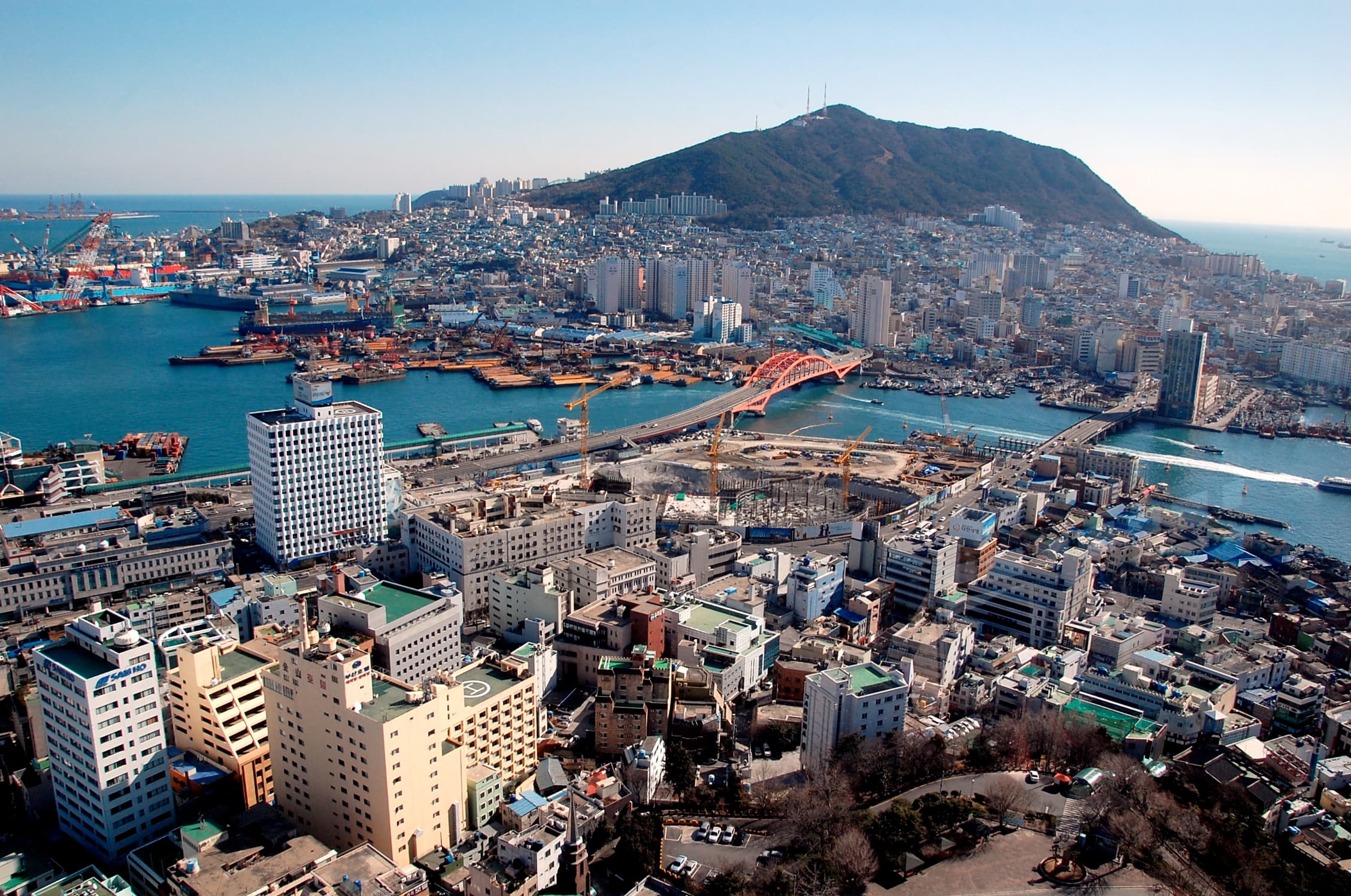
This is the old town of Busan with a lot of post-war buildings, large docks and atmosphere. This is the place to go see the heritage of the city.
The Central Busan is described in its own article.
The Hwangryeong mountain Observatory is one of the most famous spot for local people. If we go there we can see Gwangan Bridege for front and Seomyeon for the back. They provide wonderful view for visitors.
North Busan
Easy to overlook, the north part of the city has few tourist attractions. Nevertheless, it offers excellent hiking opportunities, the famous Beomeosa Temple as well as vibrant student life around the PNU university.
West Busan
The western part of the city is full of industrial parks leading to docks and the airport. There are however some nature areas preserved, such as the Nakdong River Estuary Migratory Bird Sanctuary and Taejongdae Park.
Address system
Busan has 16 city districts and 207 towns/villages. See Busan Addresses for details. The postal system is very fast. The road name address system is used in the same way as Seoul. (This is the same as the United States)
Do
See the Districts articles for more listings.
Events
As Korea's second largest city, there are a large number of events.
The Busan International Film Festival is based in Haeundae in the first 10 days of October. It takes place all across Busan showcasing many international films and often some significant premieres of new Korean films. Most of the events are held on Haeundae beach where there are many tents promoting the industry and public interviews with stars.
Polar Bear Swim (북금곰 수영대회), Haeundae Beach. A famous beach swim in the first week of January when the temperature is around 0°C. Hundreds of brave participants compete the cold in the sea. This event has run annually at the Choseon Beach Hotel since 1988. (updated Oct 2024)
Busan International Rock Festival, Samrak Park. Busan has been holding an annual Rock festival for 12 years now in August. Mostly Korean and Asian rock bands although some Western bands do appear.
Sea Art Festival 2013, Songdo Beach. An art festival held on the beach every year from mid-September to mid-October.
Hiking
The mountains around Busan have some good hiking trails. Hiking trails are not really well marked in Korea, even if you can read Korean script. Definitely do your research before you hike.
Hiking clothes are a must have fashion item in Korea these days, even if they only get used in the local mall. Prices are extremely high, so you should purchase what you need before coming to Korea.
Geumjeong Fortress in North Busan: at the top of the mountain head towards the South Gate (Nammun) of Geumjeong Fortress and then through the North Gate (Bukmun) and down to Beomeosa Temple. This has a distance of 9 km (3–4 hr).
Seokbulsa temple in North Busan is another impressive temple about 90 minutes' hike from the cable car station. It has magnificent statues carved into the mountain. Great views over Busan and very peaceful.
Jangsan Mountain in Haeundae can provide a good day's hiking. The military bases at the summit and minefields are clearly marked and fenced off, and great views over Busan and on a clear day to Japan.
Eat
See the Districts articles for more listings.
Korea is justly renowned for its great seafood tradition, and Busan as Korea's main coastal city provides possibly the best opportunity to try fresh seafood caught locally.
Jagalchi fish market where most of the seafood is landed. You can turn up at 07:00 for delicious grilled fish and a variation of Korean 'hangover soup', although many experiences at both the high and low end are available to you throughout the day.
International market where everything is available at very cheap prices. You can eat Spicy Glass Noodles, Chungmu-style Gimbap and Ssiat hotteok(sweet Korean pancake stuffed with seeds).
Restaurants in Korea open and close frequently, although if an establishment listed below has closed then another good option is likely to be found close by. Korean restaurants also usually serve only a few specialty dishes, so check with your party beforehand. Vegetarians, as elsewhere in Korea, should be mindful that there are limited options in Busan.
Sister rice soup It is a restaurant that sells pork and rice soup, one of the must-eat foods in Busan. You can taste rice soup filled with pork at a low price of ₩9,000 here. Because it is located near Gwangalli, there is a characteristic that allows you to see the sea after eating.
Local specialties
There are dishes you should try in Busan that are not typically available in other parts of Korea.
Dong-nae pajeon (동래파전) is a seafood and green onion pancake, an affordable and popular Busan dish.
Daegu Tang (대구탕) is a delicious flaky cod soup with vegetables. You will find dedicated restaurants for this at the east side of Haeundae beach.
Bokguk (복국) is a soup made with pufferfish, the type of which is extremely poisonous. It is the same as Japanese fugu. There are many places in Busan licensed to prepare pufferfish, but you may want to know what you are getting into. Typically there are cartoon pictures of a fish looking like a balloon outside, so should be easy to spot.
Drink
See the Districts articles for more listings.
Busan has thousands if not tens of thousands of drinking places scattered throughout the city and popular spots include Nampodong and the area around Pusan National University.
Just look around, and look up, on most streets if you are looking for a bar. Any tall commercial building is likely to have a few inside, usually with English words displayed and often the German word 'Hof' that indicated a place for eating and drinking.
The Kyeongseong University area has many selections in terms of density and sheer number of drinking establishments in Busan. Also, Kyeongseong University is located nearby Gwangalli Beach.
Gwangalli beach in Suyeong is a great place for a drink, especially at night time with the Gwangan bridge lit up over the bay.
In Haeundae, most of the bars that appeal to westerners are on the main street (Gunam-ro) between Haeundae metro station (exit 5) and the beach. Refer to the main Haeundae article for a full list.
Get around
Transportation Card
You can buy Cashbee card at subway stations and convenience stores. Other cards like T-money, and Railplus are also accepted in the city. Some convenience stores also allow you to recharge a card, although not all card types are accepted,
Using the transportation card will save you money compared to paying cash. See the sections below for the exact fares.
When leaving a bus you can 'scan out' in order to have a discounted fare when you board another bus if within 30 min. Furthermore, when you "scan out" from a metro and "scan in" to a bus within 30 min then the bus fare is reduced to ₩250. Otherwise, a new fare will be deducted each time you board a service. There is no daily cap on fares.
By metro or light rail
The four lines of the Busan Metro ( 1 2 3 4 ) can connect you to most places of interest in Busan. Other rides include Donghae and BGL (Busan-Gimhae Light Rail).
Both signage and announcements are in Korean and English, so finding your way is easy. But check carefully the direction you want to go, since once you go through the gate, it may not be possible to change platforms in many stations. For example, the Green line (2) goes between Jangsan and Yangsan which is confusing to begin with.
Single ride tickets are ₩1,400 or ₩1,600 depending on distance (hang onto your ticket until you exit). Using a transportation card discounts ₩100 and allows transfer between buses, Donghae and BGL . A one-day ticket (only for Line 1-4) costs ₩5,000. There are also 7-day ticket and 30-day tickets if you are planning to stay long.
The BGL meets up with lines 2 and 3 . The light rail provides a convenient way for transiting to Gimhae International Airport or going to Gimhae. Donghae line is for going to Haeundae or Songjeong, and continues north-east along the coast until terminating in the neighbouring city of Ulsan. Both lines use a slightly different fare system, although using transportation cards allows you to transfer between those with a discount.
Stay safe
Generally speaking Busan is as safe as most places in South Korea, which is to say very safe.
Busan is very safe to roam around freely at night. Be a little bit cautious when most bars close at around 03:00. Some bars stay open until the business dies down and in many cases this may not be until sunrise. Also take care in the area around Busan Station. If any place could be deemed seedy in Busan (which would be a stretch) this area could be considered so.
On the metro late at night, you may encounter elderly men who are rather vocal, and under the influence of alcohol, who may be unpleasant towards you. This is however unlikely to be dangerous, and you should just move to another metro car.
There are occasionally sand storms from China covering Busan. You should avoid going outside if one passes through.
Driving standards are rather erratic in Busan, even by general Korean standards. Be careful of zebra crossing without traffic lights since they are effectively ignored. Local women driving large SUVs with mobile phones glued to their ears are a common sight, as are the in-car TV entertainment systems running in many vehicles. Also be wary of motorcycles and scooters, since they tend to follow even fewer road rules and are often trying to deliver something very quickly. Switching between sidewalk and road as it suits.
At the beach
Beaches in Busan do experience riptides, and lifeguard cover outside summer is limited. Songjeong beach is very calm, shallow and safe.
There is a tsunami warning system and signs on the beaches, although the risk of a tsunami is far less than in nearby Japan. In the unlikely event a tsunami warning is issued for Busan or the South Korean coastline, head for the top of a tall building or higher ground. Higher ground is not easily accessible on Haeundae Beach.
Practical facts for South Korea
Taken from open data. Rules and numbers change, so check locally before you rely on them.
- Currency
- South Korean Won (KRW)
- Languages
- Korean (South Korea) and English
- Plugs and power
- Types C and F, 220 V at 60 Hz
- Traffic drives
- On the right
- Country calling code
- +82
- Time zone
- Asia/Seoul
Official travel advice
Quoted from each government as published, with the date they last changed it. We do not add a verdict of our own.
UK Foreign, Commonwealth & Development Office
- No areas listed that it advises against travelling to
Read the full adviceGlobal travel impacts due to escalation in the Middle East
Escalation in the Middle East has caused widespread travel disruption, including airspace closures, delayed and cancelled flights.
US Department of State
Level 1 of 4: Exercise normal precautions
Read the full adviceExercise normal precaution in the Republic of Korea (ROK or South Korea).
• Large-scale demonstrations may occur with little notice, potentially disrupting transportation and other essential services.
• Tensions on the Korean Peninsula remain high. North Korea continues to conduct missile launches and other military activities that may increase tensions. Travelers should monitor local developments and remain vigilant. The South Korean government conducts civil emergency drills throughout the year.
• Please note that consular services, including passport services, are not available at the U.S. Consulate in Busan; they are only available at the U.S. Embassy in Seoul.
Entry and visas
Entry rules depend on your passport and change without notice. Check the official pages before you book.
Sources