
Germany
A plan for Bremen
Not a list of things to see in Bremen — a day-by-day plan somebody could actually follow, built from places we can point to a source for. Make your own in about a minute.
- 2 nights
- Couple
- Balanced pace
- Mid-range budget
Every place here was checked on 2026-10-27 or later, and each one says where it came from.
The plan, day by day
Day 1
09:30
You arrive
13:00
Bremer Ratskeller
Suggested because you chose food
- 1h
- Meal
14:30
Focke Museum
Picked because you chose culture & museums + balanced energy
- 2h 30m
- Culture & museums
2h open
Nothing planned here. That was on purpose.
19:00
Das kleine Lokal
Suggested because you chose food
- 1h 30m
- Meal
20:30
Lokales
Picked because you chose food and local experiences + balanced energy
- 1h 30m
- Food
Day 2
08:00
Café Roselius
Suggested because you chose food
- 45m
- Meal
45m open
Nothing planned here. That was on purpose.
09:30
Weserburg
Picked because you chose culture & museums + balanced energy
- 2h 30m
- Culture & museums
1h open
Nothing planned here. That was on purpose.
13:00
Muchos Más
Suggested because you chose food
- 1h
- Meal
14:30
Oberneulander Mühle
Picked because you chose culture & museums and local experiences + balanced energy
- 2h 30m
- Culture & museums
2h open
Nothing planned here. That was on purpose.
19:00
Grauer Esel
Suggested because you chose food
- 1h 30m
- Meal
20:30
FRITZ Theater
Picked because you chose culture & museums + balanced energy
- 2h 30m
- Culture & museums
Day 3
08:00
De Luca
Suggested because you chose food
- 45m
- Meal
45m open
Nothing planned here. That was on purpose.
09:30
Übersee-Museum Bremen
Picked because you chose culture & museums + balanced energy
- 2h 30m
- Culture & museums
1h open
Nothing planned here. That was on purpose.
13:00
Knurrhahn
Suggested because it fits a mid-range budget
- 1h
- Meal
14:30
You leave
Weather through the year
Monthly averages from NASA's 25-year climate record, day and night together.
Best months: June, July, August, and September
| January | Cold: 1°C, 73 mm |
|---|---|
| February | Cold: 2°C, 55 mm |
| March | Cold: 4°C, 51 mm |
| April | Cold: 9°C, 39 mm |
| May | Mild, some rain: 13°C, 55 mm |
| June | Mild, some rain: 16°C, 64 mm |
| July | Mild, some rain: 18°C, 80 mm |
| August | Mild, some rain: 18°C, 74 mm |
| September | Mild, some rain: 14°C, 58 mm |
| October | Cold: 10°C, 63 mm |
| November | Cold: 6°C, 66 mm |
| December | Cold: 2°C, 73 mm |
From the Wikivoyage guide
Quoted from the travel guide anyone can edit, as it read on the day we took it.
Understand
History
Bremen was once a member of the medieval Hanseatic League and is still one of the most important cities in northern Germany. Together with the city of Bremerhaven on the North Sea it forms Germany's smallest state. Bremen has more than 1,200 years of history, and was, for most of its existence, an independent city-state.
Bremer Stadtmusikanten
The Bremer Stadtmusikanten (Town Musicians of Bremen) perhaps the most well known figures associated with Bremen are characters from the Brothers Grimm fairy tale of the same name. Their image adorns many of the souvenirs in the city. Next to the Town Hall is a much photographed statue of them.
Bremen today
Bremen is an extremely diverse middle-sized city, with highly visible Turkish, Arab, West African, Central Asian, South Asian and various other communities from several continents in addition to people with longstanding local or regional roots. Its restaurants and stores reflect that fact, and some eateries are striking in serving seriously spicy food by default to all comers.
Geography
Bremen is a rather long and narrow city, lining both sides of the river Weser. Along the north-west/south-east axis it stretches about 10 km, but across only 2 km. The entire city is located on flat plains.
Tourist information
1 Tourist-Information Bremen, Böttcherstraße 4 (im Haus des Glockenspiels), ☏ +49 421 3080010. Mon–Fri 09:30–18:00, Sat 09:30–16:00, Sun 10:00–16:00. In the historic "Haus des Glockenspiels" right at the market square. It offers city maps, guided tours, hotel bookings, and the "ErlebnisCard" for public transport and discounts. (updated Apr 2026)
See
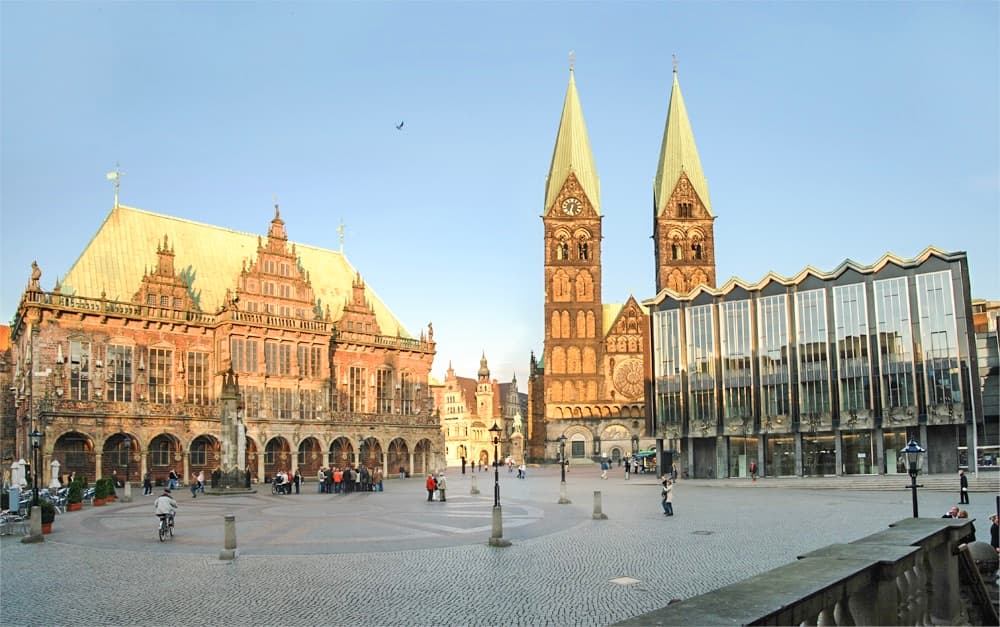
1 Rathaus (Town Hall), Am Markt 21, ☏ +49 421 3612733. Mon–Sat 11:00, 12:00, 15:00, 16:00; Sun 11:00, 12:00. This is one of the finest in Europe and has been included on the UNESCO World Heritage List. Building work started in 1410 and it is seen as an important display of the wealth and freedom of the city. €6.50. (updated Apr 2026)
2 Roland, Am Markt. 24/7. This statue on the main square, in front of the town hall, is of the Knight Roland, subject of the Medieval epic, the Song of Roland, who was a protector of trade. He appears in many European cities, especially those involved in the Hanseatic league. Bremen's is considered one of the finest and is included with Town Hall on the World Heritage List. The standing figure is 5.47 m tall. Free. (updated Apr 2026)
3 Dom St. Petri (Cathedral of St Peter), Sandstraße 10-12, ☏ +49 421 365040. Mon–Fri 10:00–17:00, Sat 10:00–14:00, Sun 14:00–17:00 (Check website for tower hours). Over 1,200 years old, its huge towered façade dominates the main square. The interior is also impressive, with some fine painted details on the ceilings. The cathedral was damaged by fire and lightning in the 17th century and also seriously impacted by bombings during World War II, and some of the damage is still visible, but it has been restored twice and is imposing, beautiful and well worth admiring for its form and the artwork and monuments that remain part of its exterior and interior. There is also a treasury displaying the collection of the cathedral. Entrance is free; for €3-€5 you can climb the Southern Tower, which offers nice views over the whole city. There are sometimes organ concerts in the Cathedral, particularly in the summer; see the Orgelsommer schedule for details. Admission for the organ concerts is €15, and the sound of the organs is great. Free entry to cathedral; Tower and Museum: €3–5. (updated Apr 2026)
Do
Stroll around the city center and visit the Schnoor-Viertel with its old buildings - most were built between the 15th and 18th century. If you are interested in art, visit the Bremer Kunsthalle (museum of art) with one of North Germany's finest collections.
Football: SV Werder Bremen play soccer in Bundesliga, the top tier. Their home ground is the multi-purpose Weser Stadion (capacity 42,000) on the north riverbank, 1 km east of city centre. The women's team play in their top tier at a smaller ground at Weser Stadion.
If you want to see green fields, cows, and birds, visit "Blockland" (site in German with some pictures) where thousands of local bikers and inline skaters go every weekend to enjoy the agricultural side of Bremen. It is located just north of the university, between the Autobahn and the meandering river Wümme. You can bike or skate along the dyke that contains the river, have traditional coffee and cake at Landhaus Kuhsiel or Gartelmann's Gasthof, or eat gourmet organic ice cream at Biohof Kaemena (they also sell organic milk and cheese). In winter there is no ice cream but there is ice skating on the river and many small canals. In warmer months it is also possible to rent a canoe or kayak to explore the nature preserve from the water.
There is indoor ice skating at Paradice, the skating hall in Walle (site in German). Paradice is opened from October to February.
A good way to get in touch with the locals is to stroll along the river Weser on the scenic Osterdeich, where - in good weather - lots of little groups hanging out on the grassy hills may invite you to barbecue with them or have a beer.
Eat
Several cafes and restaurants line the "Schlachte" along the Weser River, while other popular areas are the marketplace and the "Viertel" ("quarter") east of the Kunsthalle.
Many traditional dishes from Bremen and Northern Germany are very satisfying. The region is famous for cabbage (Grünkohl- green cabbage), fish (smoked eel, herring, smelt in March), an old sailor's meal called Labskaus (lobscouse) consisting of mashed potatoes, corned beef, onions, fried egg and beetroot or chick ragout (very fine) as well as red fruit jelly or Butterkuchen (cake with yeast and topped with lots of butter, sugar and almonds).
You can find some fish restaurants in Böttcherstraße. "Knigge" is the name of a traditional coffee house in Bremen.
Bremen culinary specialties are Knipp (smoked sausage), Labskaus, (fried corned beef with onions and mashed potatoes) and Braunkohl (leaf cabbage)
Budget
In the Old Town
1 Bratwurstglöck, Unser Lieben Frauen Kirchhof. Grilled sausages (updated May 2022)
2 Muchos más, Am Wall 135. Spanish cuisine (updated May 2022)
3 Kiefert Imbiss, Unser Lieben Frauen Kirchhof 27. Grilled sausages (updated May 2022)
4 Kismet, Sögestraße 72. A Turkish restaurant (updated May 2022)
5 Asia Bistro 68 Bremen, Papenstraße 2/4. (updated May 2022)
Around the main train station
6 Crêpes Suzette, Contrescarpe 74. (updated May 2022)
7 BeatzBurger, Auf d. Brake 13. (updated May 2022)
8 Mersin Tantuni & Grillhaus, Hillmannpl. 1. A Turkish eatery (updated May 2022)
9 Pyramide, Rembertiring 14-16. Spanish and Syrian dishes (updated May 2022)
Mid-range
10 Bremer Ratskeller, Am Markt (The entrance is in the western corner of the city hall, near the Roland and the City Musicians), ☏ +49 421 321676. 11:00-00:00. Stunning classic wine cellar located in the basement of the historic city hall. Has stored and sold German wines since 1405. Large menu includes regional specialties and has English translations. €10-20 (Aug 2017).. (updated May 2022)
11 Gasthof zum Kaiser Friedrich, Lange Wieren 13, ☏ +49 421 326429. Mon-Sat. Slightly smoked cut of pork with cabbage and mashed potatoes (Braunkohlteller) (updated May 2022)
Drink
The world-wide known Beck's Beer is brewed in Bremen. Guided brewery tours in English and German are offered Thursdays - Saturdays. The tour costs €10.50/person and lasts approximately 2 hours.
The Ratskeller is a wine cellar and restaurant with a famous collection of wines and the oldest wines in Germany.
There are many bars, pubs and cafes in Bremen: the Schlachte along the Weser and the Viertel, a young and lively quarter.
If you like beer and pretzels, try the Schüttinger brewery house (next to Böttcherstraße) where several types of beer are brewed and served directly.
Get around
By foot
Much of Bremen (or at least the part frequented by tourists) can be negotiated by foot - the best way to explore the old city and its surrounding districts.
By shared car
Members of the Cambio car-sharing network, whether in Germany or Belgium, can hire cars - Bremen is the company's headquarters.
By train
Most trains are operated by Deutsche Bahn and even the local trains that aren't can be booked through their website.
In the west lie the cities Delmenhorst and Oldenburg and the Frisian islands. In the east you can travel to Verden, in the south to Osnabrück.
There are trains from the main station to the peripheral areas of Bremen (twice per hour to North Bremen, to Mahndorf via Sebaldsbrück and to Hemelingen.)
By bus/tram
Bremen offers an extensive public transportation network with trams and buses.
Public transport maps of Bremen are available in German. There are night buses and trams (indicated by an "N") running through almost the whole night on F/Sa and Sa/Su, departing at :30 each hour from central station. You can buy tickets on the bus or tram, but is slightly cheaper to buy a set of 4 rides or a day pass for individuals or groups, or a weekly pass for individuals. Note that on trains, tickets must be purchased before you board. Public transportation timetables and ticket fares are available in English.
By taxi
Taxis are found nearly everywhere and every time, with a cost of about €1.25/km. There is no need to book a taxi in advance. Taxi drivers and call center employees may have difficulties to understand a phone call in English.
The two main taxi companies are
Taxi-Roland, ☏ +49 421 14433.
Taxi-Ruf, ☏ +49 421 14014.
By bike
You can rent bicycles at the railway station and several bike shops in Bremen. See details in German only.
Stay safe
The area close to the railway station is rough late at night, and it may also be a bit spooky to cross the Wallanlagen park then. Therefore, if you have to go from the old city to areas to its west or northwest late at night, consider taking a tram or bus instead of walking.
Practical facts for Germany
Taken from open data. Rules and numbers change, so check locally before you rely on them.
- Currency
- Euro (EUR)
- Language
- German
- Plugs and power
- Types C and F, 230 V at 50 Hz
- Traffic drives
- On the right
- Country calling code
- +49
- Time zones
- Europe/Berlin and Europe/Busingen
Official travel advice
Quoted from each government as published, with the date they last changed it. We do not add a verdict of our own.
UK Foreign, Commonwealth & Development Office
- No areas listed that it advises against travelling to
US Department of State
Level 2 of 4: Exercise increased caution
Read the full adviceExercise increased caution in Germany due to terrorism.
Terrorist groups and lone actors remain a constant threat in Germany and Europe, attacking people in public locations with knives, small arms, rudimentary explosive devices, and vehicles. Such attacks may occur with little or no warning and target:
• Tourist locations
• Transportation centers (airports, train, or bus stations)
Entry and visas
Entry rules depend on your passport and change without notice. Check the official pages before you book.
Sources