
United Kingdom
A plan for York
Not a list of things to see in York — a day-by-day plan somebody could actually follow, built from places we can point to a source for. Make your own in about a minute.
- 2 nights
- Couple
- Balanced pace
- Mid-range budget
Every place here was checked on 2026-10-20 or later, and each one says where it came from.
The plan, day by day
Day 1
09:30
You arrive
13:00
Skosh
Suggested because you chose food
- 1h
- Meal
14:30
Jorvik DIG
Picked because you chose culture & museums and local experiences + balanced energy
- 2h 30m
- Culture & museums
2h open
Nothing planned here. That was on purpose.
19:00
Ambiente Tapas
Suggested because you chose food
- 1h 30m
- Meal
20:30
Grand Opera House
Picked because you chose culture & museums + balanced energy
- 2h 30m
- Culture & museums
Day 2
08:00
Double Dutch Pancake House
Suggested because it fits a mid-range budget
- 45m
- Meal
45m open
Nothing planned here. That was on purpose.
09:30
York Cold War Bunker
Picked because you chose culture & museums and local experiences + balanced energy
- 2h 30m
- Culture & museums
1h open
Nothing planned here. That was on purpose.
13:00
Viceroy of India
Suggested because you chose food
- 1h
- Meal
14:30
Mansion House, York
Picked because you chose culture & museums and local experiences + balanced energy
- 2h 30m
- Culture & museums
17:00
Jorvik Viking Centre
Picked because you chose culture & museums + balanced energy
- 2h 30m
- Culture & museums
19:30
No 8 Bistro
Suggested because you chose food
- 1h 30m
- Meal
21:00
Joseph Rowntree Theatre
Picked because you chose culture & museums + balanced energy
- 2h 30m
- Culture & museums
Day 3
08:00
Spring Espresso
Suggested because it fits a mid-range budget
- 45m
- Meal
45m open
Nothing planned here. That was on purpose.
09:30
National Railway Museum
Picked because you chose culture & museums + balanced energy
- 2h 30m
- Culture & museums
1h open
Nothing planned here. That was on purpose.
13:00
Arras
Suggested because it fits a mid-range budget
- 1h
- Meal
14:30
You leave
Weather through the year
Monthly averages from NASA's 25-year climate record, day and night together.
Best months: July and August
| January | Cold: 3°C, 61 mm |
|---|---|
| February | Cold: 4°C, 51 mm |
| March | Cold: 5°C, 50 mm |
| April | Cold: 8°C, 49 mm |
| May | Mild, some rain: 11°C, 56 mm |
| June | Mild, some rain: 14°C, 75 mm |
| July | Mild, some rain: 16°C, 74 mm |
| August | Mild, some rain: 16°C, 83 mm |
| September | Mild, some rain: 13°C, 57 mm |
| October | Cold: 10°C, 74 mm |
| November | Cold: 6°C, 69 mm |
| December | Cold: 4°C, 65 mm |
From the Wikivoyage guide
Quoted from the travel guide anyone can edit, as it read on the day we took it.
Understand
Orientation
Although only the sixth-largest city in Yorkshire and having no official status, York is regarded as the county's capital, and is also positioned just east of its geographic centre. For 1800 years, it was the largest and most important city in northern England, though today has a rather modest population just shy of 200,000 people. Despite its size, York packs in more history and culture than many much larger places, and is a fascinating and beautiful destination any time of year.
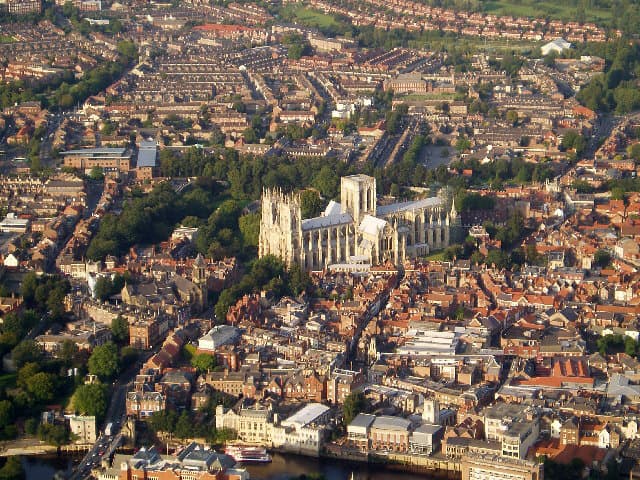
York city centre is a compact and dense warren of mostly pedestrianised streets lined with centuries-old buildings in a mix of architectural styles, from Roman and Viking remnants, through timber frame medieval structures, to much grander stone and brick edifices from later periods. The centre straddles both banks of two rivers - the Ouse (pronounced ooze) and the Foss - which merge just south of the castle. At the city's heart stands the imposing York Minster, one of the largest Gothic cathedrals in the world, and the mother church for northern England's Anglican community. It serves as the cathedral for the Archbishop of York (Stephen Cottrell, since 2020), who holds the third-highest office in the Church of England, after the King and the Archbishop of Canterbury. York's old town is completely encircled by a series of defensive medieval walls. At just over 2 miles (3.2 km) long, 13 feet (4 m) high, and 6 feet (1.8 m) thick, they are the UK's most extensive and best-preserved city walls.
See
There's plenty to see in York, but if you leave without visiting the Minster and either the Jorvik Viking Centre or the National Railway Museum, you're doing it wrong. If you only have a day, prioritise two of these.
Aside from these three standout attractions, the joy of York is in wandering the ancient streets and coming across surprising buildings and beautiful views all by yourself. You might find old churches, timber-framed shops, the ruins of an abbey, or the leftovers of medieval defences.
Landmarks
4 York Minster (Cathedral of St Peter in York), Deangate, YO1 7HH, ☏ +44 1904 557-200, info@yorkminster.org. Minster visits: Mon-Sat 9AM-4:30PM, Sun 12:30PM-3PM; Museum: Mon-Sat 10AM-4:30PM, Sun 1PM-3:15PM; Worship: 4 or more services daily 7:30AM-6PM. Seat of the Archbishop of York and the largest Gothic cathedral in northern Europe, York Minster dominates the skyline and dates back to the 8th century at least. The inside of the cathedral has beautiful stained glass and several interesting and peculiar features – look for the modern statues signalling "Christ is here" in semaphore and the dragon hanging from near the ceiling. The Undercroft Museum, beneath the Minster, displays centuries worth of archaeological findings in an interactive display. Then, climb the 275 steps to the top of the Minster's Central Tower to experience panoramic views from York's highest spot (ages 8+ only). The nightly Evensong worship has haunting acoustics, and is the only way of accessing the cathedral on Sunday late afternoons. On the south side of the Minster outside, don't miss the 1 statue of Constantine the Great, who was in 306 AD proclaimed emperor of Rome in York.
Do
Attractions
1 GR8escape (escape rooms), 4a Colliergate, YO1 8BP, ☏ +44 7897 122 834 (mobile). Daily, pre-booked time slot. No guaranteed entry if you turn up without a reservation. Email via online contact form. Your team is put in one of three themed rooms (Atlantis, NYPD, Ministry of Wizards), and you have 60 minutes to solve a series of puzzles and codes in order to escape. Teams from 2 to 6 players, ages 8 years and up with accompanying adult. M-F £48-78, Sa Su £54-88. Prices are per team and vary according to the number of players. (updated Jul 2020)
2 Horse racing (The Knavesmire), Knavesmire Road, YO23 1EX (1 mile (1.6 km) south of the city centre. Bus: 197 shuttle operates between railway station and course on race days), ☏ +44 1904 620-911, enquiries@yorkracecourse.co.uk. Regular flat-racing events Apr-Oct, though the big fixture is Ebor Races in late August. York has been going to the races since Roman times, and the current site, in use since the early 18th century, is one of England's largest horse racing venues. Racegoers to the County Stand must adhere to a formal dresscode. Outside that, dressing up smart is not required, but does add to the sense of occasion. £5-300, depending on race and desired seats. (updated Mar 2021)
Eat
Local specialities
As capital of Yorkshire, the county's cuisine is front and centre on many of York's menus. This is honest and rustic fare, in which generous portions are the norm, and large tasting platters are common. Yorkshire puddings, pies, local game, lamb and beef are all prized by restaurateurs, as are the local cheeses: wensleydale from the Dales, shepherd's purse blues from north of Thirsk and St Helen's Farm hard goat's cheese, produced in the Vale of York. The fish and crab in restaurants is often landed at East Coast ports such as Grimsby and Whitby, while the county's Norse connections are maintained by the serving of Yorkshire-made gravadlax.
The city itself has two famous products: ham and chocolate.
York ham has been produced within the city walls for hundreds of years, and far-fetched local legend states that the first hams were smoked with sawdust generated by the building of the Minster. Made with the meat of the large white pig, in taste the ham is mild, salty, smoky and often breaded, and in appearance a delicate pink. When served hot, it is traditionally accompanied by Madeira sauce. Disaster struck in the mid-2000s, when the last curer in town went out of business, and for 10 years there was no ham produced in York. Appleton's Butchers had a shop on Lendal from 2016, marking the return of York-cured hams, but closed down in 2020 during the COVID-19 pandemic. As a result, traditional York ham is no longer regularly produced in the city, though specialist butchers around Yorkshire do cure large white hams to a similar or identical recipe.
Drink
Brewing and distilling
The city of York is the site of three breweries, one combined with a vineyard, and one distillery.
Beer, that is ale, has been brewed within the city walls for centuries, and the latest iteration of this tradition is York Brewery, which brews a range of three pale ales, the award-winning dark ruby ale Centurion's Ghost, and their signature golden ale Yorkshire Terrier. There is also a constantly changing selection of limited-edition creations, which adds a touch of FOMO-fuelled uniqueness to any beer-lover's visit to York. You can also visit the brewery; see the 'Do' section for details.
The new kid on the block is Brew York, which eschews tradition by selling its brews by can. They specialise in U.S.-style craft beers, with hipsterish names such as Cereal Killa (a gluten-free citrusy pale ale), Goose Willis (gooseberry fool in beer form), and Tonkoko (the "9th best stout in the world!"). Periodically, they mix things up by discontinuing their entire range and releasing a new selection; there's even an IPA which changes its hops with each batch. You can drink at their achingly trendy "tap room" (see below), or else look out for the odd brew of theirs in pubs.
Wine: Yorkshire has no fewer than six vineyards. The closest is Yorkshire Heart at Pool Lane, Nun Monkton YO26 8EL. They also have a brewery and a campsite, and offer tours.
Get around
The City of York Council have a website named i-Travel York, which provides unbiased information for travelling around the city on foot, by bike, by bus and by car.
On foot
The best way to discover York: the city centre is small enough to walk from one side to the other in 20 minutes, and there is only a short distance on flat terrain between most of the sights. That said, the winding, narrow streets can be confusing and aren't always well-signposted, so a map is handy.
Some streets within the old city (i.e. inside the city walls) are pedestrianised during the day, closed to all cars except disabled drivers and emergency vehicles between 10:30AM and 5PM daily. You can see a map of these roads, locally known as footstreets, on i-Travel York. Some streets are subject to additional controls, for instance the Shambles is pedestrian-only at all times. Take care walking around the city centre when the roads open to car traffic at 5PM, as they fill up quickly with delivery vehicles servicing local shops and businesses.
If you enjoy walking, you must do the 2-mile (3.2-km) city wall circuit (see below for details), which offers views all around and should give you a feel for York's layout. Additionally, footpaths line the River Ouse for most of its journey through the city north to south, and there is a lot of parkland to discover alongside with the promise of wildlife sightings – see i-Travel's wildlife walks booklet for ideas.
By bike
York is one of the most cycle-friendly cities in the UK - there's an extensive network of cycle routes in and around the city, and most of the traffic controls have been set up to give cyclists priority. There are no significant hills in or around the city centre, which is a big help. The river path along the Ouse contains some wonderful bike routes out of the city. Also beware that police and CCTV operators take a very dim view of cycling without lights after dusk, or cycling in the city centre pedestrianised area before 5PM, and will hand out an on-the-spot £60 fine for doing so. Download your York Cycle Route Map for free from iTravel York.
Stay safe
York is a safe city with no significant crime problem. It is consistently ranked one of the best places to live in the whole UK, and high safety levels help to influence this. Unlike certain other European cities popular with tourists, visitors to York are not a particular target for scams and crimes. Terrorism is locally unheard of, though the nationwide threat level remains high. There are, however, some precautions worth taking.
Nightlife
Take care on weekend evenings in York. Plenty of local youngsters overestimate their capacity for alcohol and the city centre can seem to be awash with lager louts, mainly in the Micklegate area. If you are approached just keep on walking and they will find another victim to pester. Aim for Wikivoyage's recommended pubs, though, and you'll find that safe socialising in the company of affable locals is still possible!
York is very popular for "hen" and "stag" parties from all over the UK. Weekend race days also increases the number of "fun seekers" in the city centre!
Try to avoid secluded cycle paths and ginnels (alleyways) at night as it is not unknown for robberies to take place in these parts, however this tends to be away from the main city centre.
River safety
Be careful near and on the River Ouse, as it is deep and cold, and the current is surprisingly strong. If you have been drinking, avoid going near the river altogether, especially at night. The bankside paths can be slippery and poorly lit, and if you do fall in, there may well be no-one around to help you out. Several people drown in the Ouse every year, and alcohol and darkness play a role in the majority of deaths.
Flooding
In spite of elaborate defences, York floods pretty much every winter. All it takes is a few days of sustained rainfall somewhere upstream, and the houses and businesses nearest to the Ouse are submerged. There's about 30 mi (48 km) of Pennine moors, from Harrogate to Richmond, where the pouring rain has only one way out. If it keeps raining, then 48 hours later the river at York is brimming; another day of rain and riverside properties start to become inundated.
Practical facts for United Kingdom
Taken from open data. Rules and numbers change, so check locally before you rely on them.
- Currency
- British Pound (GBP)
- Languages
- British English, Welsh (United Kingdom), and Scottish Gaelic
- Plugs and power
- Type G, 230 V at 50 Hz
- Traffic drives
- On the left
- Country calling code
- +44
- Time zone
- Europe/London
Official travel advice
Quoted from each government as published, with the date they last changed it. We do not add a verdict of our own.
US Department of State
Level 2 of 4: Exercise increased caution
Read the full adviceExercise increased caution in the United Kingdom due to terrorism.
There is risk of terrorist violence, including terrorist attacks and other activity in the United Kingdom. Visit the U.S. Department of State's country reports on terrorism to learn more.
There is also risk of isolated violence by dissident groups in Northern Ireland. These groups mainly target police and military.
Petty crime is common, especially in popular tourist locations. Stay aware of your surroundings. Most crimes against foreigners are crimes of opportunity, like purse or cellphone snatching and pickpocketing.
Entry and visas
Entry rules depend on your passport and change without notice. Check the official pages before you book.
Sources