
United States
A plan for Washington
Not a list of things to see in Washington — a day-by-day plan somebody could actually follow, built from places we can point to a source for. Make your own in about a minute.
- 2 nights
- Couple
- Balanced pace
- Mid-range budget
Every place here was checked on 2026-10-27 or later, and each one says where it came from.
The plan, day by day
Day 1
09:30
You arrive
13:00
Eastern Market
Suggested because you chose food
- 1h
- Meal
14:30
The Octagon
Picked because you chose culture & museums + balanced energy
- 2h 30m
- Culture & museums
2h open
Nothing planned here. That was on purpose.
19:00
The Hamilton
Suggested because you chose food
- 1h 30m
- Meal
20:30
Ford's Theatre
Picked because you chose culture & museums + balanced energy
- 2h 30m
- Culture & museums
Day 2
08:00
Aboveground Union Market
Suggested because it fits a mid-range budget
- 45m
- Meal
45m open
Nothing planned here. That was on purpose.
09:30
National Postal Museum
Picked because you chose culture & museums + balanced energy
- 2h 30m
- Culture & museums
1h open
Nothing planned here. That was on purpose.
13:00
City Kabob & Curry House
Suggested because you chose food
- 1h
- Meal
14:30
National Air and Space Museum
Picked because you chose culture & museums + balanced energy
- 2h 30m
- Culture & museums
17:00
National Museum of Natural History
Picked because you chose culture & museums + balanced energy
- 2h 30m
- Culture & museums
19:30
Tom's Watch Bar
Suggested because you chose food
- 1h 30m
- Meal
21:00
Warner Theatre
Picked because you chose culture & museums + balanced energy
- 2h 30m
- Culture & museums
Day 3
08:00
Jacob’s Coffee House
Suggested because you chose food
- 45m
- Meal
45m open
Nothing planned here. That was on purpose.
09:30
National Museum of Women in the Arts
Picked because you chose culture & museums + balanced energy
- 2h 30m
- Culture & museums
1h open
Nothing planned here. That was on purpose.
13:00
PhoXotic
Suggested because you chose food
- 1h
- Meal
14:30
You leave
Weather through the year
Monthly averages from NASA's 25-year climate record, day and night together.
Best months: May, June, August, and September
| January | Cold: 0°C, 67 mm |
|---|---|
| February | Cold: 1°C, 70 mm |
| March | Cold: 6°C, 84 mm |
| April | Mild, some rain: 12°C, 92 mm |
| May | Rainy: 18°C, 109 mm |
| June | Rainy: 23°C, 118 mm |
| July | Rainy: 26°C, 116 mm |
| August | Rainy: 25°C, 109 mm |
| September | Rainy: 21°C, 107 mm |
| October | Rainy: 14°C, 105 mm |
| November | Cold: 8°C, 80 mm |
| December | Cold: 3°C, 95 mm |
From the Wikivoyage guide
Quoted from the travel guide anyone can edit, as it read on the day we took it.
Understand
History
Washington, D.C., is a city born of politics, by politics, and for politics. It wasn't the first national capital: Baltimore, Lancaster, York, Annapolis, Trenton, and even New York City all tried their hand at hosting the national government. For a time, it seemed like Philadelphia would stake a claim as home to the federal government. However, Congress soured on the "Cradle of Liberty" after disaffected American soldiers, with the tacit sanction of the Pennsylvania government, chased the legislators out of the city to Princeton. That incident made clear that the nation's capital would need to be independent from the then-powerful state governments and that the southern states would refuse to accept a northern capital.
Three of the nation's founding fathers, James Madison, Thomas Jefferson, and Alexander Hamilton, agreed in 1790 to a compromise location for a new national capital on largely uninhabited land along the Potomac River in the Mid-Atlantic. This was made famous in the musical Hamilton with the song The Room Where It Happened. The exact location was left up to George Washington, who carved a diamond-shaped federal district out of land donated by the states of Maryland and Virginia, which happened to be near his plantation at Mount Vernon. The new territory also included two existing settlements: Georgetown, on the Maryland side of the Potomac, and Alexandria, Virginia, at the district's southern tip.
See
Most of the attractions in D.C. are on the National Mall, the West End, and Capitol Hill. While there are many maps on display throughout the city, the official National Mall map and the Library of Congress map are great to have handy.
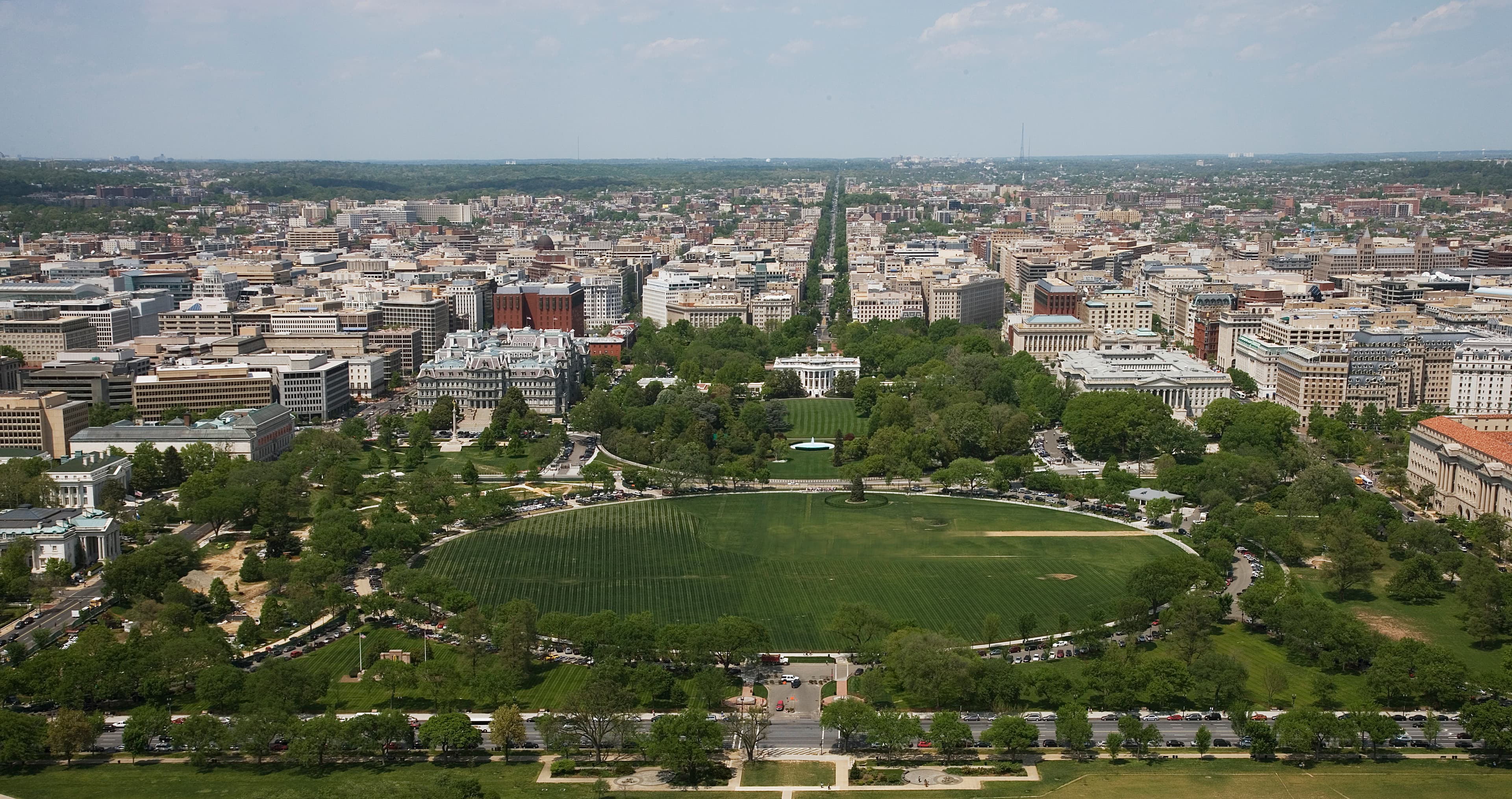
The National Mall is a unique park, filled with an intense concentration of monuments, memorials, museums, and monumental government buildings instantly recognizable to people all over the world. The Washington Monument, the Lincoln Memorial and Reflecting Pool, the Franklin Delano Roosevelt Memorial, the Vietnam War Memorial, the Korean War Veterans Memorial, the Jefferson Memorial, the National Gallery of Art, the National Air and Space Museum, the National Museum of Natural History, National Museum of American History, and the Holocaust Museum, are just a few of the top attractions on the National Mall. To walk down the National Mall is to thread the halls of world power in the modern era. Here the world's most powerful politicians and their staffs fill the grand neo-classical buildings of the three branches of US Government, making decisions that reverberate in the remotest corners of the world. The National Mall is larger than it looks, and a walk from one end of the National Mall to the other will take a while and may wear you down a bit. Plan ahead what you want to see and concentrate your activities in one section of the National Mall each day.
Do
Outdoor activities and parks
D.C. has the highest ratio of parkland to population in the country for a city its size. Many of these parks are crowded with soccer, football, rugby, kickball, baseball, and ultimate frisbee players. The National Mall may be the most famous park, but there are several other large beautiful parks in the city.
The 2,000 acre Rock Creek Park, a national park, bisects the city north of the Anacostia River. The park is full of deer (who overpopulate, due to lack of predators), squirrels, rabbits, raccoons, birds, and even a few coyotes. The park includes paved biking/running trails that extend from Maryland to the Lincoln Memorial and connecting with the Mount Vernon trail in Northern Virginia. There are also plenty of hiking trails, picnic spots, a golf course, a variety of Ranger-led/educational programs, and kayaks, canoes, and SUPs can be rented for $22-$32/hour at the Thompson Boat Center on the Potomac River. There are plenty of nice outdoor spaces just beyond the park. South of Massachusetts Ave, you can take a path west out to the beautiful Dumbarton Oaks in Georgetown, and then on to enormous Archibald-Glover Park, where the trails can lead you as far south and west as the Chesapeake and Ohio Canal National Historical Park and Palisades Park. Following the main trail along the creek all the way south will take you under the Whitehurst Freeway and down to the National Mall, where joggers avail themselves of the incredible path right along the Potomac beneath the monuments.
Eat
Washington has a little bit of everything, from really good ethnic takeout to lobbyist-fueled places that can run over $1,000 for a meal for two.
Fine dining cuisine
Most of the high end cuisine is available in the West End, the East End, Georgetown, and Dupont Circle—offering dining experiences ranging from steakhouses packed with powerful suits to Minibar by Jose Andres, a 12-seat restaurant offering a 30-course meal for $350 (excluding beverages, tax and 22% service charge). As a general rule, expect higher prices in popular tourist haunts such as Georgetown, Penn Quarter and Dupont Circle, while more exciting and innovative cuisine can be found to the east in Logan Circle, Adams Morgan and H Street.
Ethnic food
D.C.'s international might draws representatives from all over the world, and they all need ex-pat cafes and restaurants to haunt.
Salvadoran cuisine such as the pupusa is common in Columbia Heights. Pupusas are thick corn tortillas stuffed with cheese, optionally fried pork, refried beans, or all sorts of other things, then topped with a tart cabbage salad and an Italianesque red sauce.
Ethiopian food is a D.C. staple due to the city's large Ethiopian community. Ethiopian food is a wild ride of spicy stewed and sautéed meats and vegetables served atop a plate covered with a spongy bread called injera. You eat the dishes with your hands, using an extra plate of injera (similar to bread) as your sole "utensil"—rip off a piece of the injera and use it to pick up your food. It's proper in Ethiopia to use only the tips of your fingers in this exercise, and with good reason: you'll have a messy meal otherwise. It's also perfectly proper to feed your date, making this a fun cuisine if you know your date well. The best places to try Ethiopian food are in Shaw, which includes Little Ethiopia.
Drink
The legal drinking/purchasing age is 21 and it is strictly enforced in D.C. Be prepared to have your identification checked, even if you appear to be well over 21. Last call can be as late as 3AM, although many establishments will let you stay beyond that, especially downtown. It is rare but not unknown for nightclubs to stay open beyond 3AM though they may lock you in or stop serving alcohol.
As in most American cities, drinking alcoholic beverages on the street is illegal. The law is flouted openly in many areas but bars will not generally let you take your drink even a step off-premise.
Bars and dance clubs
Near downtown, Dupont and Logan Circle are probably the best neighborhoods to go if you are in town for just a brief period, full of locals of all ages, especially D.C. young professionals. U Street has lots of clubs and a thriving nightlife scene, and if you are European and looking for a good club, this is where you want to be. The larger Shaw neighborhood is well gentrified, though attracts a well to do, good-looking African American crowd, particularly at many of the city's brunch places which often double as nightlife venues as the evening progresses.
Georgetown has classier bars and clubs and some very expensive restaurants, but is shunned by the hip, cool crowd. The nearby West End has some interesting locales close to its border with Dupont Circle. Adams Morgan, formerly the dingy alternative to Dupont, has become hipper, cooler and trendier today, especially with young residents and visiting cool kids. You'll find many of the city's best bars and new restaurants here. Columbia Heights also has lots of bars, as well as a sizeable cluster of Asian, African and Hispanic bars and restaurants. Nearby, Mount Pleasant is home to most of the city's Salvadoran population and its signature comfort food, the pupusa, as well as a growing hip, if you know you know bar and restaurant scene akin to Adams Morgan. Woodley Park, Cleveland Park and Van Ness (aka Forest Hills) attract a wealthier older crowd, with many decent restaurants and plenty of watering holes, including a couple of bars and pubs. Nearby is upscale Tenleytown, which is surprisingly sedate for a student area but remains popular with middle aged residents.
Get around
Be prepared to walk until your feet hurt! It's no surprise that D.C. has been cited as the fittest city in the country; residents and visitors get a lot of exercise simply getting around the city! Even if you plan on taking public transportation or driving, you will often find yourself walking or biking for a large portion of the day. Most of the city's attractions, such as the museums and monuments along the National Mall, are located near each other, which makes driving or taking Metrorail between the sights either impractical or impossible.
Therefore, make sure to wear good walking shoes and, especially during the spring and summer, wear comfortable and light clothing, a wide-brimmed hat, apply sunscreen, and carry a bottle of water. Also, when it comes to shoes, lots of government buildings have metal detectors at the entrances, and if your shoes have any kind of metal reinforcement they will set off the metal detectors, forcing you to take them off, have them inspected, and just generally take more time getting in and out of the building than you had to spend. During the summer, visit air-conditioned museums during the day, and save the monuments, neighborhood tours, and other outdoor attractions for the cooler early morning and evening hours. Note that while the city is largely flat compared to those out west, there is significant variation in the topography. Below Florida Avenue is the geographical coastal plain, meaning consistently flat surfaces, but if you travel above it or travel east of the Anacostia, prepare for potentially steep hills!
Stay safe
Metropolitan DC Police Department presence in the city is predictably very heavy, especially in tourist areas and near government buildings. But they are only one of the dozens of law enforcement agencies operating in the city; in addition to MPD, the Capitol, Parks, and even the Metro have their own, independent forces (not to mention plenty of the Federal ones). In general, the often-traveled areas, such as the area around Smithsonian, the monuments, and the Kennedy Center, are safe to walk around, even in the evening. The areas east of the Capitol are generally less safe, but visitors can safely see attractions there if they stay aware of their surroundings. Although the number of homicides has ticked up, violent crime in D.C. is close to a generational low.
Homicides
The number of annual homicides has declined from 479 in 1991, when Washington was known as the "murder capital", to a low of 88 in 2012, and 186 in 2024. As a visitor, you are extremely unlikely to be the victim of a homicide; the vast majority of homicide victims in the U.S. are acquainted with their murderer long before the crime. The majority of homicides occur in the less-traveled parts of the city, such as Anacostia and the Northeast and Southeast, especially near public housing projects.
Muggings and robberies
Muggings are a problem in the nightlife-centered neighborhoods of Shaw, Adams Morgan, Columbia Heights, and Near Northeast and the area around the Gallery Place-Chinatown Metro station. However, visitors should not avoid these areas—on the contrary, it would be a shame to miss out on them—but visitors should be vigilant. In particular, avoid walking at night on side streets—stick to the well-lit main commercial strips, travel in groups, and maintain a basic level of sobriety.
Be extra vigilant with your mobile phones; they are a very popular snatch-and-grab item around the Metrorail stations and on the trains.
Respect
Most people in Washington have left-wing, cosmopolitan, secular and environmentalist values by American standards. This spares both domestic and foreign tourists from cultural clashes which might be imminent elsewhere. However, some strict rules of etiquette are almost distinctive in Washington DC.
On Metrorail
When boarding at the station, let those exiting the train step off onto the platform before boarding, and once aboard move to the center of the car. If you have luggage, move it as far out of the path of others as possible. Certain stations have escalators to cover the distances between platforms — walk on the left and stand on the right!
Business
People in Washington DC are punctual, so show up on time. The standard greeting is a firm handshake. Small talk and bringing up the subject indirectly are neither necessary nor expected. Most meetings get straight down to business.
Similarly, salespeople, waiters and other service employees are usually less attentive than their colleagues in other states, to respect customers' privacy, except a short "hello" to entering customers. Customers are supposed to make eye contact with servers for attention.
Dress
With its highly educated, professional, and political populace, D.C. is a relatively formal and fashion-conscious city. Even in the summer, t-shirts and shorts are in the minority downtown or at bars and restaurants. However, if you just want to enjoy being a tourist, wear what is comfortable and don't worry—you'll be in good company! But if you prefer to blend in, a safe bet anytime of day for men are nice dark jeans and an untucked button-up or polo shirt, and perhaps dark sneakers or something a little nicer and more stylish. Women will often blend in better in a nice pair of sandals, boots, or other nice shoes, and maybe skipping the T-shirt and sneakers in the evening.
For fine dining or the theater, expect to dress nicely. A good button-up shirt and slacks are a must for any nice restaurant.
Practical facts for United States
Taken from open data. Rules and numbers change, so check locally before you rely on them.
- Currency
- US Dollar (USD)
- Languages
- American English, Spanish (United States), Hawaiian, and French
- Plugs and power
- Types A and B, 120 V at 60 Hz
- Traffic drives
- On the right
- Emergency numbers
- Any emergency911
- Country calling code
- +1
- Time zones
- America/Adak, America/Anchorage, America/Boise, America/Chicago, and 25 more
Official travel advice
Quoted from each government as published, with the date they last changed it. We do not add a verdict of our own.
UK Foreign, Commonwealth & Development Office
- No areas listed that it advises against travelling to
Read the full adviceThis travel advice also covers American Samoa, Guam, Northern Mariana Islands, Puerto Rico, and United States Virgin Islands.
Entry and visas
Entry rules depend on your passport and change without notice. Check the official pages before you book.
Sources