
Poland
A plan for Warsaw
Not a list of things to see in Warsaw — a day-by-day plan somebody could actually follow, built from places we can point to a source for. Make your own in about a minute.
- 2 nights
- Couple
- Balanced pace
- Mid-range budget
Every place here was checked on 2026-10-27 or later, and each one says where it came from.
The plan, day by day
Day 1
09:30
You arrive
13:00
Nowy Bazar Różyckiego
Suggested because you chose food
- 1h
- Meal
14:30
Warsaw Uprising Museum
Picked because you chose culture & museums + balanced energy
- 2h 30m
- Culture & museums
2h open
Nothing planned here. That was on purpose.
19:00
Belvedere
Suggested because you chose food
- 1h 30m
- Meal
20:30
Teatr Muzyczny Roma
Picked because you chose culture & museums + balanced energy
- 2h 30m
- Culture & museums
Day 2
08:00
Cava
Suggested because it fits a mid-range budget
- 45m
- Meal
45m open
Nothing planned here. That was on purpose.
09:30
Museum of the History of Polish Jews
Picked because you chose culture & museums + balanced energy
- 2h 30m
- Culture & museums
1h open
Nothing planned here. That was on purpose.
13:00
Bazar na Kole
Suggested because you chose food
- 1h
- Meal
14:30
Museum of Warsaw
Picked because you chose culture & museums + balanced energy
- 2h 30m
- Culture & museums
2h open
Nothing planned here. That was on purpose.
19:00
Zapiexy Luxusowe
Suggested because you chose food
- 1h 30m
- Meal
20:30
Teatr Syrena
Picked because you chose culture & museums + balanced energy
- 2h 30m
- Culture & museums
Day 3
08:00
Piekarnia Cukiernia Grzybki
Suggested because you chose food
- 45m
- Meal
45m open
Nothing planned here. That was on purpose.
09:30
Asia and Pacific Museum
Picked because you chose culture & museums + balanced energy
- 2h 30m
- Culture & museums
1h open
Nothing planned here. That was on purpose.
13:00
U Fukiera
Suggested because you chose food
- 1h
- Meal
14:30
You leave
Weather through the year
Monthly averages from NASA's 25-year climate record, day and night together.
Best months: June, July, August, and September
| January | Cold: -4°C, 45 mm |
|---|---|
| February | Cold: -2°C, 38 mm |
| March | Cold: 2°C, 39 mm |
| April | Cold: 9°C, 41 mm |
| May | Mild, some rain: 14°C, 74 mm |
| June | Mild, some rain: 18°C, 67 mm |
| July | Mild, some rain: 21°C, 76 mm |
| August | Mild, some rain: 20°C, 62 mm |
| September | Mild, some rain: 15°C, 52 mm |
| October | Cold: 8°C, 49 mm |
| November | Cold: 4°C, 43 mm |
| December | Cold: -2°C, 44 mm |
From the Wikivoyage guide
Quoted from the travel guide anyone can edit, as it read on the day we took it.
Understand
A city of 1.8 million inhabitants (2021), it sits on the Vistula River (Polish: Wisła) in the middle of the country.
Warsaw's history of rapid development after many wars that ravaged and destroyed the city has earned it a reputation as a "phoenix city", able to recreate itself from the ruins and regain its erstwhile glory every time. During the Second World War, it suffered a fate similar to Rotterdam and Dresden in that it was almost completely razed, although in the case of Warsaw it was a much more tragic story of successive destruction and defeat. Due to the great efforts of its surviving inhabitants and, indeed the entire nation, it was rebuilt from a field of rubble, with its historic core recreated, but much of its heritage was lost. Warsaw also had one of the largest Jewish populations in Europe, which for the most part perished during the war, making Warsaw an important place of Holocaust remembrance.
History
Before becoming the capital
There are records of human settlements and economic activity in the area of what is now Warsaw from the 9th century onwards, but it wasn't until the 13th century that Warsaw was founded by the Dukes of Mazovia. While developing as an administrative and economic centre, it played second fiddle to Płock within Mazovia until the 15th century, and was by no means a match for Poland's former capital, Kraków. It gained growing importance due to its economic might and strategically important central location in Poland, cemented when the Polish Sejm (parliament of nobles) relocated there permanently in the 16th century, and it became the site of royal elections.
See
This is the city of Frederic Chopin, Maria Skłodowska-Curie, Władysław Szpilman and Pola Negri. Warsaw Old Town is inscribed on the UNESCO World Heritage List. Take a walk and explore the streets and squares which have been painstakingly rebuilt after the last war. Check out the tumultuous history of the metropolis on both sides of the Vistula river. Explore special places and associated with the uprisings, especially one, which took place in the Ghetto and second, which happened in 1944. Book a guided city walk across the city and discover how it has changed since the fall of communism. Most of the major sightseeing attractions are concentrated in Śródmieście, with some more in surrounding districts, the exception park and palace in Wilanów. Check the attractions of the Vistula river banks. That said, every district has something to offer if you have the time and want to research more, so do refer to district articles for details.
That said, most tourists will probably:
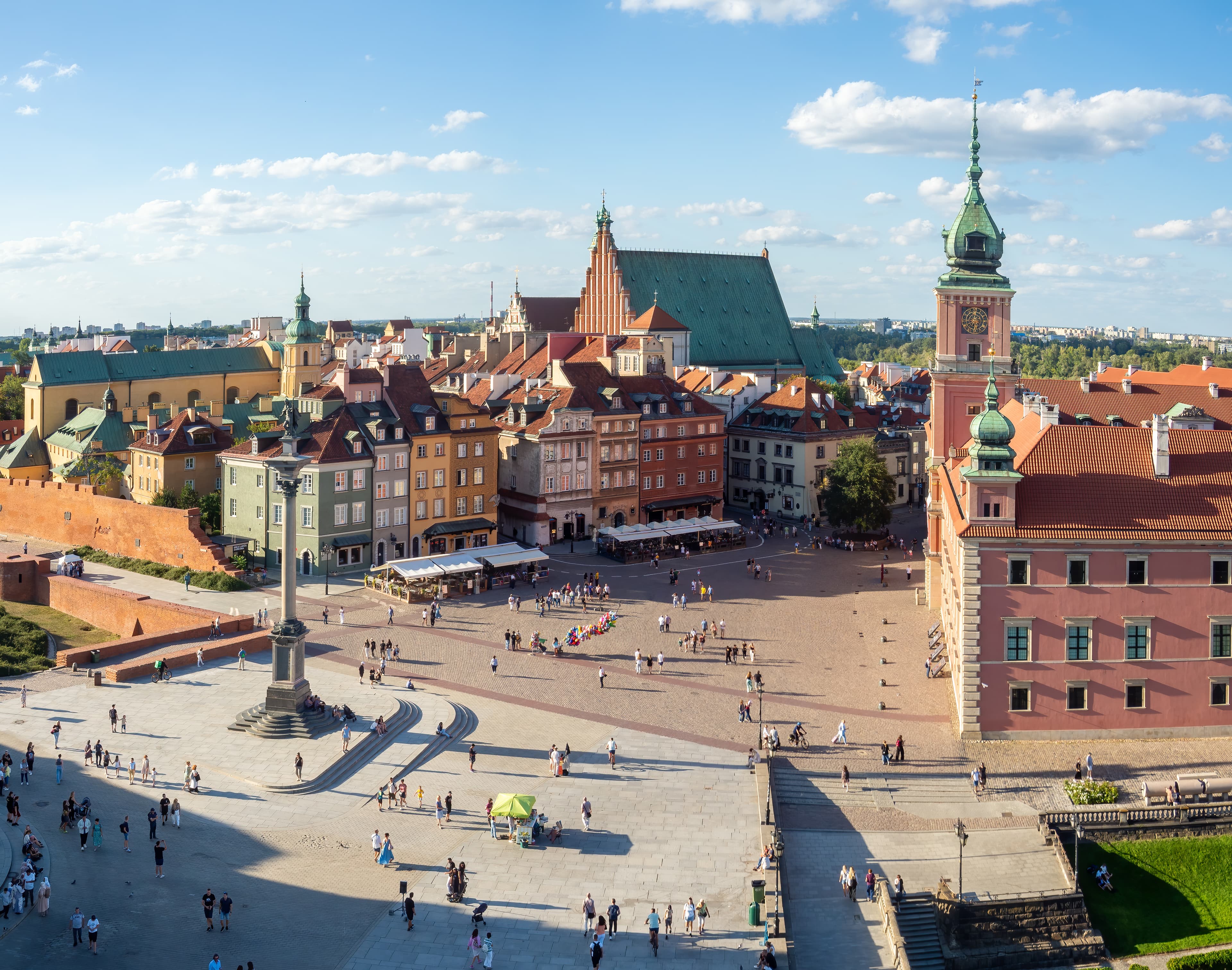
Visit the Old and New Town, the (recreated) oldest part of the city of Warsaw with the Royal Castle
From there, stroll down Krakowskie Przedmieście and Nowy Świat streets (parts of the "Royal Route")
Travel along the Royal Route (Trakt Królewski) linking the Royal Castle to the Royal Palace in Wilanów (Pałac Królewski w Wilanowie), some 10 kilometers farther
See Łazienki Park with the Chopin Monument (and attend one of the free open-air concerts in the summertime)
Take the elevator to the top of Palace of Culture and Science for a panoramic view of the city, or at least take a photo of this modern-day symbol of Warsaw
Visit the most important museums – Warsaw Uprising Museum, National Museum and the POLIN Museum of the History of Polish Jews
Relax on the Vistula Boulevards (Bulwary Wiślane), spreading out over 6 km (3.7 mi) of the Vistula banks
Do
Explore
Go on a tour of Warsaw – the Old Town and surrounding districts are sufficiently compact to allow a number of excellent walking tours through its history-filled streets. You'll see amazing things you would otherwise miss. Details are usually available from the reception desks of hostels and hotels.
Concerts and performances
Warsaw is home to several professional musical and play companies. Being the capital city means the Polish National Opera and the Warsaw Philharmonic (also, National Philharmonic) call Warsaw home. There are a number of other companies, including play companies and theaters that will likely be of interest to travellers.
The Presto Music Agency organises Chopin concerts at several venues across the city.
Headline music acts perform at the Bemowo airport in the Bemowo district and at the Stadion Narodowy (National Stadium) in the Praga Południe district of Warsaw. Smaller acts are hosted at clubs and concert halls around the city, but primarily in the center of Warsaw.
Festivals
The Cross-Culture Warsaw Festival (Festiwal Skrzyżowanie Kultur). World music festival. Concerts and music workshops, documentary screenings, exhibitions.
Jewish Culture Festival – The Singer's Warsaw (Festiwal Kultury Żydowskiej – Warszawa Singera), shalom@shalom.org.pl. August. (updated Oct 2024)
Warsaw Film Festival (Warszawski Festiwal Filmowy). October.
Planete+ Doc Film Festival. Documentary films. May.
Burn Selector Festival. Electronic & alternative music festival. September. 250 zł for two-day pass.
Orange Warsaw Festival. Big pop music festival on the Horse Racetrack Służewiec. May. 300 – 1000 zł for two-day pass.
Warsaw Summer Jazz Days. July.
Warsaw Autumn (Warszawska Jesień). International festival of contemporary music. September.
Grand Final of The Great Orchestra of Christmas Charity (Finał Wielkiej Orkiestry Świątecznej Pomocy). Annual charity event with thousands of fundraisers on the streets, free concerts in the city centre (usually Defilad Square or Bankowy Square), colourful TV studio with access from the street, mass street runs and number of local events and activities in the districts. Some attractions might be paid by donation to the collection box. Raised money are spent on high-quality medical equipment for the children hospitals in Poland. Usually on 2nd Sunday of January.
Eat
Warsaw is not globally renowned for its culinary scene, but it lacks nothing compared to other European capitals with regard to it. There is a wide choice of eateries from the most basic and cheapest to very sophisticated, and many different types of food are available throughout the city. Finding a unique dining experience is feasible daily.
For those on a budget, there are many kebab shops sprinkled around Warsaw, especially in Śródmieście, which offer decent food and portions for the fair price of 7-13 zł a kebab. Other cheap alternatives are milk bars, which are discussed later in the section, and Vietnamese restaurants.
Haute cuisine
If you are looking for a premium dining experience, your best chances are in Śródmieście, but away from the Royal Route. In Praga, head for Saska Kępa, and you will also find a fair share of upscale restaurants in Wilanów. New and innovative places crop up in the most unexpected locations, so do acquaint yourself with the district guides for the latest tips.
Warsaw is home to both Polish restaurants that hold Michelin stars:
Atelier Amaro, ul. Agrykola 1 (entrance from plac Na Rozdrożu square), ☏ +48 (22) 628 57 47, +48 607 970 000, reservations@atelieramaro.pl. Author's cuisine restaurant of chef Wojciech Modest Amaro. The restaurant does not offer à la carte dishes, in fact it doesn't have a fixed menu at all. Smart casual dress code is expected. Menus from 260 zł. (updated Apr 2016)
Senses, ul. Bielańska 12, ☏ +48 (22) 331 96 97, restaurant@sensesrestaurant.pl. A "private dining" restaurant, author's cuisine of chef Andrea Camastra. Reservation required. From 170 zł. (updated Apr 2016)
Food fairs
The new trend in Warsaw are food fairs, where fresh foodstuffs can be bought directly from producers, both for further processing and preparation at home and as ready dishes for consumption on site. Usually, some space for communal meals is provided. This can be a very nice option for breakfast or lunch. Some of the options are:
Targ Śniadaniowy (Breakfast fair), al. Wojska Polskiego 1; Skwer Grupy AK Granat and other places. Sat 09:00—16:00. Organised every weekend in various parts of town, usually (updated May 2016)
Drink
Old Town and areas like pl. Trzech Krzyży, ul. Nowy Świat, ul. Chmielna, ul. Krakowskie Przedmieście in Śródmieście are saturated with cafés. Coffee typically costs about 10-15 zł. Beer can cost 5-15 zł for half a liter (the supermarket price being 2.50-3 zł). Drink prices in clubs can go up to 50 zł. Drinking alcoholic beverages in public places is prohibited, but there are several places chosen by the local government where it can be possible.
Clubs
Clubs are plentiful in Warsaw and are a very popular way to spend nearly every night out.
The most popular nice and chic clubs are on ul. Mazowiecka in Śródmieście.
You will be denied entrance if you wear sport shoes, no matter how expensive they are. Inconspicuous black shoes will normally do the trick.
Student clubs are popular and usually moderately priced, but can be hit or miss. Normally, the centrally located Hybrydy is a good option for night out. Other student clubs, like Stodoła in Śródmieście, are less predictable and quality isn't necessarily a concern for these clubs' patrons. If the point is to get drunk, then these are the place to go for a cheap drink.
Beware of certain bouncers (for example in Park), they are not the talkative kind if they suspect you of something.
In addition, there are clubs in Wola and Mokotów as well as several popular and down-to-earth clubs in the Praga districts.
Tea and coffee
Throw stereotypes out the door. For Poles, one of the most important staples to quench their thirst is not wódka or beer, but rather tea and coffee. As such, you're likely come across dozens and dozens of cafés. Chain-wise, Coffee Heaven and W Biegu Cafe are the big players. Starbucks is also in Warsaw. The real treat of Warsaw, however, are small cafés that are littered about Warsaw. For the most part, a good cup of tea or coffee can be had for 5-10 zł a cup. A small tea kettle is between 20-30 zł.
Get around
Public transport
The public transport system in Warsaw is generally well-developed, with some 200 bus routes and 30 tram lines. The route descriptions on the tram stops are easy to follow (although bus stop notices are more complex), but it can last longer, however, to travel between destinations far from the city center. Warsaw has two underground metro lines, one going from south to north on the left bank, and the other from the east to the west. There are also some regional urban rail services (Polish: Szybka Kolej Miejska or SKM), although they depart at most every 30 minutes only. You can consult schemas on operator site for detailed information.
All of the abovementioned means of public transit share a single fare and ticketing system, operated by ZTM, a unit within the City of Warsaw responsible for the organization of all public transit. You can buy paper tickets from machines at some stops, or on board some trams. These must be validated on board. Tickets are available for single journeys and also for 24 and 72 hours. You can also buy tickets using the jakdojade.pl app (iOS, Android, Huawei apps). Mobile tickets can be validated by scanning a QR code on board. Jakdojade can help you plan the most convenient trip with the public transit between two points in the city. Google Maps can also do that, however they update bus schedules less often. There is also Easyway journey planner.
Stay safe
Warsaw is a safe city overall. The city center has a strong police presence and is generally a very safe area. The Praga districts used to be dangerous, but this is generally more hype than reality. Of course, it would be wise to exercise a little extra caution if you're in an area you do not know well. The bus and rail stations can be a magnet for homeless and drunkards, who, for the most part, will leave you alone.
Some areas south of the Palace of Culture and Science and the train station have a rather seedy feel to them, especially at night. Same goes for much of the neighborhoods immediately surrounding Warsaw-Chopin airport.
Though nowhere nearly as prevalent as in other major cities, pickpockets can sometimes be a problem and you should be careful to hold onto your belongings when in a large crowd or on buses (Number 175, which runs from the airport to city center, is reportedly infamous for pickpockets). At bars and clubs, a good rule of thumb is the cheaper the door entry and the laxer the bouncers are about letting people in, the more likely you're going to want to keep extra care of your wallet, passport, cell phone, and camera.
Violent behaviour is extremely rare and if it occurs it is most likely alcohol-related. While pubs and clubs are generally very safe, nearby streets may be scenes of brawls, especially late at night. Try to avoid confrontations.
Pub crawl tours are scams. Warsaw has no shortage of pubs to visit on your own time. Both male and female tourists have been sexually abused on organized pub crawl tours by guides. Please keep a wide breath of these.
It is not uncommon taxi drivers will try to scam tourists by overcharging when driving people from the train station. A taxi trip from the train station should cost no more than 15 zł at the maximum. Consider using an alternative service such as Uber or Bolt.
Practical facts for Poland
Taken from open data. Rules and numbers change, so check locally before you rely on them.
- Currency
- Polish Zloty (PLN)
- Language
- Polish
- Plugs and power
- Types C and E, 230 V at 50 Hz
- Traffic drives
- On the right
- Country calling code
- +48
- Time zone
- Europe/Warsaw
Official travel advice
Quoted from each government as published, with the date they last changed it. We do not add a verdict of our own.
UK Foreign, Commonwealth & Development Office
- No areas listed that it advises against travelling to
Read the full adviceUkraine-Poland border
Russian military strikes have taken place in Ukraine within 20km of the Polish border. Access to the border is restricted. See Safety and security.
US Department of State
Level 1 of 4: Exercise normal precautions
Read the full adviceExercise normal precaution in Poland.
Poland is generally a safe destination for travelers.
Review our Travel Guidance for Poland to learn how to prepare for a safe trip.
Entry and visas
Entry rules depend on your passport and change without notice. Check the official pages before you book.
Sources