
Canada
A plan for Vancouver
Not a list of things to see in Vancouver — a day-by-day plan somebody could actually follow, built from places we can point to a source for. Make your own in about a minute.
- 2 nights
- Couple
- Balanced pace
- Mid-range budget
Every place here was checked on 2026-10-27 or later, and each one says where it came from.
The plan, day by day
Day 1
09:30
You arrive
13:00
Yaletown Brewing Company
Suggested because you chose food
- 1h
- Meal
14:30
Vancouver Maritime Museum
Picked because you chose culture & museums + balanced energy
- 2h 30m
- Culture & museums
2h open
Nothing planned here. That was on purpose.
19:00
Japadog
Suggested because you chose food
- 1h 30m
- Meal
20:30
H. R. MacMillan Space Centre
Picked because you chose culture & museums + balanced energy
- 2h 30m
- Culture & museums
Day 2
08:00
Breka Bakery & Café
Suggested because it fits a mid-range budget
- 45m
- Meal
45m open
Nothing planned here. That was on purpose.
09:30
Chinese Cultural Centre Museum
Picked because you chose culture & museums and local experiences + balanced energy
- 2h 30m
- Culture & museums
1h open
Nothing planned here. That was on purpose.
13:00
Vij's
Suggested because you chose food
- 1h
- Meal
14:30
Vancouver Art Gallery
Picked because you chose culture & museums + balanced energy
- 2h 30m
- Culture & museums
17:00
Science World
Picked because you chose culture & museums + balanced energy
- 2h 30m
- Culture & museums
19:30
Phnom Penh Restaurant
Suggested because you chose food
- 1h 30m
- Meal
21:00
The Lamplighter Public House
Picked because you chose food and local experiences + balanced energy
- 1h 30m
- Food
Day 3
08:00
Cafe Medina
Suggested because you chose food
- 45m
- Meal
45m open
Nothing planned here. That was on purpose.
09:30
Vancouver Police Museum
Picked because you chose culture & museums + balanced energy
- 2h 30m
- Culture & museums
1h open
Nothing planned here. That was on purpose.
13:00
Blue Water Cafe + raw bar
Suggested because you chose food
- 1h
- Meal
14:30
You leave
Weather through the year
Monthly averages from NASA's 25-year climate record, day and night together.
Best months: July and August
| January | Wet season: -1°C, 323 mm |
|---|---|
| February | Cold: -1°C, 165 mm |
| March | Wet season: 2°C, 253 mm |
| April | Cold: 5°C, 145 mm |
| May | Cold: 10°C, 96 mm |
| June | Mild, some rain: 13°C, 84 mm |
| July | Mild, some rain: 17°C, 50 mm |
| August | Mild, some rain: 16°C, 61 mm |
| September | Rainy: 13°C, 122 mm |
| October | Wet season: 8°C, 233 mm |
| November | Wet season: 2°C, 348 mm |
| December | Wet season: -1°C, 295 mm |
From the Wikivoyage guide
Quoted from the travel guide anyone can edit, as it read on the day we took it.
Understand
While Vancouver is a comparatively young city, founded in 1867, its history begins long before. The Coast Salish indigenous peoples (First Nations) have lived in the area for at least 6,000 years. The present city's namesake Captain George Vancouver sailed through the First Narrows on 13 June 1792, naming Burrard Inlet after his friend Sir Harry Burrard. In 1867, the year of Canada's confederation, a saloon was built on this site and gave birth to a small shantytown of bars and stores, adjacent to the original mill, on the south shore of what is now the city's harbour. The settlement was named Gastown after John Deighton, better known by his nickname "Gassy Jack", who had founded the saloon; the name survives today for referring to the oldest part of the city. In 1870, the settlement would be named Granville after Granville George Leveson-Gower, 2nd Earl Granville, the British secretary of state for the colonies at the name, by the colonial government in Victoria). A seemingly endless supply of high-quality lumber was logged and sold through the ports of Gastown and Moodyville, across the inlet.
Some of the trees were gigantic beams which were shipped to China to construct Beijing's Imperial Palace. One account maintains that the world's windjammer fleets could not have been built without the trees of Burrard Inlet.
Vancouver's first City Hall was little more than a hand-painted sign nailed to a wooden tent post. The completion of the transcontinental railway in 1885 spurred growth even more, and by 1892 the area had over 20,000 residents. 18 years later, this figure was over 100,000. In 1886, the city was incorporated and re-named to its current name after a petition by William Van Horne, the president of Canadian Pacific Railway.
See
While Vancouver is still a young city, it has a variety of attractions and points of interest for the visitor.
Landmarks and historic buildings
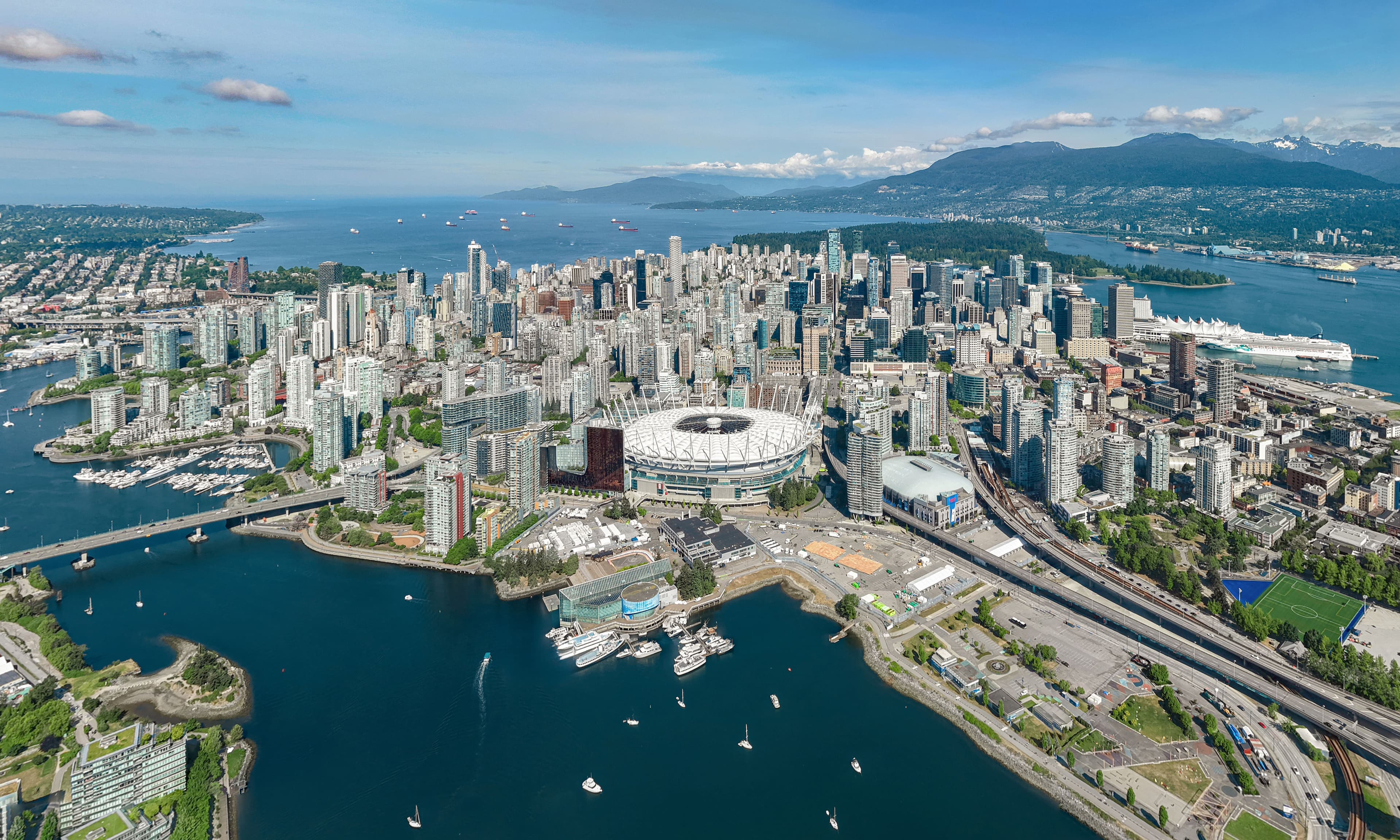
Many of the city's landmarks and historical buildings can be found in the central business district. Canada Place, with its distinctive sails, the nearby Olympic Cauldron, the intricate Art Deco styling of the Marine Building and the old luxury railway hotel of the Hotel Vancouver are in the central business district. Stanley Park (the city's most popular attraction), along with its neighbouring Coal Harbour walkway and the Vancouver Aquarium are in the West End. Gastown, the original town site of Vancouver, has a number of restored buildings and its steam clock is a popular spot to visit. Modern architecture worth visiting also includes Shangri-La, the tallest building in the city, and the Sheraton Wall Centre, both located in central business district. Another popular city landmark, the bustling markets and shops of Granville Island, is just to the south of downtown in an area called South Granville.
Museums and galleries
If you're looking to learn about the people of the Northwest Coast and some of its history, one good spot is the impressive Museum of Anthropology at the University of British Columbia, which houses several thousand objects from BC's First Nations. The museum is also home to significant collections of archaeological objects and ethnographic materials from other parts of the world.
The Vancouver Art Gallery in the central business district combines local with international through a variety of exhibitions and a permanent collection that focuses on renowned British Columbia artist, Emily Carr.
The Central Library location of the Vancouver Public Library, in the central business district at Homer and Robson Streets, is modelled after the Roman Colosseum, and houses the city's largest library.
Another sight in the central business district is the small Contemporary Art Gallery on Nelson Street, which features modern art. Also nearby, on the east side of False Creek is the shiny geodesic dome of the Telus World of Science (commonly known as Science World), which has a number of exhibits, shows and galleries aimed at making science fun for kids.
Do
Culture and festivals
Vancouver isn't all about the outdoors. It offers a variety of theatre, concerts and other cultural events. There are symphony and opera venues in the central business district and much of the city's live theatre can be found in South Granville, particularly on Granville Island with its thriving arts scene.
The city's Chinese heritage comes alive during Chinese New Year. Chinatown, in the east side of downtown, is awash in colour and has many festivities, including a parade. June sees the annual Dragon Boat Festival on False Creek.
There is no shortage of festivals around the city, with many local ones particular to a neighbourhood. The festival that draws the largest crowds is the Honda Celebration of Light, a three-night extravaganza of fireworks over English Bay in late July. Countries compete with 20-30 min displays choreographed to music. The fireworks start at 10PM and are best viewed from Sunset Beach in the West End or Kits Beach/Vanier Park in Kitsilano. It is strongly recommended to take public transit and to get there a few hours early as the crowds are huge. Roads in the vicinity of English Bay are typically closed from 6PM onwards.
EAT! Vancouver - The Everything Food + Cooking Festival takes place every year. The festival takes place in early November. Celebrity chefs, popular local restaurants, wineries, food & beverage manufacturers, cookbook authors, retailers, artisans, & many others from the culinary world come together for a 6-day event.
Other notable festivals include the Vancouver International Film Festival that runs in Sept-Oct; the Fringe Festival that presents live theatre in a variety of styles and venues; Bard on the Beach Shakespeare Festival that runs May - September at Vanier Park in Kitsilano; and the three day Folk Fest on the beach in Kitsilano that features a large selection of current and upcoming folk, roots and world music acts. Another notable event is Vancouver's annual Vancouver Pride Parade, in early August, which attractsover 600,000 spectators.
Eat
Where to begin? There is something for everyone in this cosmopolitan city, and the variety of cuisines and price points have been described as a foodie's delight. In particular, you will find many different kinds of Asian food available. If you fancy sushi many places offer "all you can eat" lunches for $12, which offers food of a wildly varying quality. In general, the city is up there with some of the best cities in North America when it comes to food. If you can do without alcohol, you can usually have a pretty reasonable meal for under $12, and at one of the more expensive restaurants in the city, $70 will get you a four course feast with exquisite service.
While you are in Vancouver, look out for stands selling the Japadog, a contraction of "Japanese style hot dog", which uses Japanese ingredients such as nori seaweed or Japanese mayonnaise to garnish the sausage. Contrary to the name, it is not from Japan and was invented locally in Vancouver. Another local speciality is the B.C. roll, an uramaki sushi roll containing barbecued salmon and cucumber, which is widely available at sushi restaurants in the city.
The highest density of restaurants is in Kitsilano or the West End. The central business area has many of the high end restaurants either along Robson Street or associated with the many hotels in the downtown area. East Van tends to have many authentic ethnic restaurants.
Vancouver is also famous for its Cantonese restaurants, in particular because it received a huge number of top chefs from Hong Kong fleeing the impending handover back to China in the 1980s and 1990s. Because of this large diaspora from Hong Kong, the price and quality of dim sum, siu mei and other Cantonese dishes here is among the best in the world, with many even claiming that Vancouver's Cantonese food is better than that of Hong Kong and Guangdong. However, Vancouver's Chinatown is now a shadow of its former self, with most of the remaining restaurants being tourist traps serving mediocre food. These days, the best Chinese food can be found in the suburb of Richmond, with a majority of its inhabitants being ethnically Chinese. Restaurants are all over the place on No. 3 Rd, Westminster Hwy, Alexandra Rd, and on the many side streets just east of Richmond Centre.
Drink
Most of the nightclubs are in the central business district, especially along the Granville Street strip, south of Robson and along Water Street in Gastown. There are a number of good local pubs in the various quieter neighbourhoods of the city, such as along Main Street or Broadway. Closing times for most of these pub-like establishments begin at 1AM; nightclubs close between 2AM-3AM with a very small number operating after-hours. Nightclubs with music, a DJ and a dance floor usually charge an entrance fee. Be aware that many nightclubs often have long lineup queues on weekends, which are usually self-imposed regardless of whether or not the establishment is near capacity to attract business. Flexibility and willingness to go early is key should nightlife become part of your travel plans.
Liquor stores by 11PM at the latest close, while many are closed by 9PM, and there will exist no other legal options apart from drinking at an establishment beyond this time.
Coffee
On Robson and Thurlow, there used to be two Starbucks kitty-corner to one another, hardly surprising as Starbucks is the most dominant of the three coffee shop chains found in Vancouver and it is claimed there are more Starbucks per capita in Vancouver than anywhere else. The other chains, Caffe Artigiano and Blenz, are found throughout downtown. JJ Bean is favoured among the locals and it's a great place to spend a few minutes to a few hours nursing a coffee and one of their ginormous muffins; there are ten locations scattered throughout the city. Bean Around the World is a popular coffee house chain with ten locations. Waves Coffee is popular with students for its 24-hour operations, and free Wi-Fi internet. For independent chains try Mario's on Dunsmuir and Howe; they have a unique feel and a slower pace than other coffee shops. Make sure not to miss Trees' cheesecakes and its roasted on-site organic coffees.
Get around
Vancouver is one of the few major cities in North America without a freeway leading directly into the downtown core (freeway proposals in the 1960s and 1970s were defeated by community opposition). As a result, development has taken a different course than in most other major North American cities resulting in a relatively high use of transit and cycling, a dense, walkable core and a development model that is studied and emulated elsewhere.
By public transit
TransLink, ☏ +1-604-953-3333. The main public transit network in the Vancouver area, including: Bowen Island, Burnaby, Coquitlam, Delta, Langley, Lions Bay, Maple Ridge, New Westminster, North Vancouver, Port Coquitlam, Pitt Meadows, Port Moody, Richmond, Surrey, Vancouver, West Vancouver, and White Rock. Its network includes buses, SkyTrain (rail rapid transit), SeaBus (ferries), West Coast Express (commuter rail), and HandyDART (door-to-door shared-ride service for those who cannot ride public transit without assistance). (updated Mar 2022)
TransLink's website and customer information line both offer trip planning and information about fares, where to buy tickets and the refund policy. A regional transportation map is widely available at convenience stores and on TransLink’s website. TransLink does not have a mobile app, but Google Maps, Transit and Citymapper all have access to TransLink's GPS data to show current route information and estimated arrival times.
Fares and zones
TransLink breaks Metro Vancouver into three fare zones; your fare depends on the number of zones you travel in. The standard adult fare is $3.50 for all bus trips across all zones. It also covers all travel system-wide at off-peak times: weekends, holidays, and weekday evenings after 6:30PM. Travel out of Vancouver on the SkyTrain or SeaBus crosses fare zone boundaries and costs $5.10 to $6.70 on weekdays before 6:30PM.
After paying fare, you can transfer or re-board an unlimited number of times at no extra charge for 90 minutes. Compass Card and Compass Ticket users have no restrictions on transferring between modes of transit, but bus riders paying cash fare can only transfer to other buses.
Stay safe
Vancouver is a great place to visit if you use common sense like keeping an eye on your possessions, knowing where you are going and avoiding alleys and unfamiliar areas at night should keep you out of trouble. Unless involved in illegal activities (such as the drug trade), it is highly unlikely you will fall victim to any sort of violent crime. If you need emergency help, dial 911.
Like any major metropolitan city, Vancouver has areas that should be travelled with caution. The most notable is the Downtown Eastside (specifically Hastings Street between Abbott and Gore). This neighbourhood is infamous for homelessness, drug-use, and prostitution. As a result of these conditions, violence is quite a common problem. If you do accidentally stroll into the Downtown Eastside it is not difficult to find your way out, but if you get lost or feel uncomfortable the best thing to do is approach a police officer. Tourists exploring Gastown and Chinatown can easily wander into the Downtown Eastside unwittingly. Chinatown turns into a ghost town in the evening, and is mainly filled with homeless people, so you should avoid the area at night.
It's also wise to exercise caution in the Granville Mall area (Granville St between Smithe St and Hastings St) in the central business district on Friday and Saturday nights. As Vancouver’s bar and nightclub district, the sheer volume of people combined with alcohol consumption make disorderly conduct and rowdy behaviour fairly common. But this shouldn't act as a deterrent - if you're not looking for trouble, you probably won't find it, and there is a strong police presence. The streets at night in the Granville Mall area are usually (and quite literally) clogged with people at night time. Such an enormous mix of people and alcohol can be a dangerous mix if you are not cautious.
Some parts of the city have high rates of property crime. Theft from vehicles is especially problematic and parked cars with foreign or out-of-province plates are frequently targeted. The best thing is to not leave any money and valuables in plain view. Many of the locals use steering wheel locks to prevent vehicle theft.
While using public transit, if you feel unsafe, approach a Transit police officer (usually at SkyTrain stations). For non-emergency requests, you can call ☏ +1-604-515-8300.
Practical facts for Canada
Taken from open data. Rules and numbers change, so check locally before you rely on them.
- Currency
- Canadian Dollar (CAD)
- Languages
- Canadian English, Canadian French, and Inuktitut
- Plugs and power
- Types A and B, 120 V at 60 Hz
- Traffic drives
- On the right
- Emergency numbers
- Any emergency911
- Country calling code
- +1
- Time zones
- America/Atikokan, America/Blanc-Sablon, America/Cambridge Bay, America/Creston, and 19 more
Official travel advice
Quoted from each government as published, with the date they last changed it. We do not add a verdict of our own.
UK Foreign, Commonwealth & Development Office
- No areas listed that it advises against travelling to
US Department of State
Level 1 of 4: Exercise normal precautions
Read the full adviceExercise normal precaution in Canada.
Canada is generally a safe destination for travelers.
Crime
• Petty crime is common, especially in popular tourist locations. Stay aware of your surroundings.
• Most crimes against foreigners are crimes of opportunity, like purse snatching, pickpocketing, and car break-ins or theft.
• Review our Travel Guidance for Canada to learn how to prepare for a safe trip.
Entry and visas
Entry rules depend on your passport and change without notice. Check the official pages before you book.
Sources