
Finland
A plan for Turku
Not a list of things to see in Turku — a day-by-day plan somebody could actually follow, built from places we can point to a source for. Make your own in about a minute.
- 2 nights
- Couple
- Balanced pace
- Mid-range budget
Every place here was checked on 2026-10-27 or later, and each one says where it came from.
The plan, day by day
Day 1
09:30
You arrive
13:00
Pub Niska
Suggested because you chose food
- 1h
- Meal
14:30
Keihässalmi
Picked because you chose culture & museums and local experiences + balanced energy
- 2h 30m
- Culture & museums
2h open
Nothing planned here. That was on purpose.
19:00
Yasukon keittiö
Suggested because you chose food
- 1h 30m
- Meal
20:30
Turku Concert Hall
Picked because you chose culture & museums and local experiences + balanced energy
- 2h 30m
- Culture & museums
Day 2
08:00
Fontana
Suggested because you chose food
- 45m
- Meal
45m open
Nothing planned here. That was on purpose.
09:30
Turku Art Museum
Picked because you chose culture & museums + balanced energy
- 2h 30m
- Culture & museums
1h open
Nothing planned here. That was on purpose.
13:00
Mami
Suggested because you chose food
- 1h
- Meal
14:30
Luostarinmäki museum quarter
Picked because you chose culture & museums + balanced energy
- 2h 30m
- Culture & museums
17:00
Karjala
Picked because you chose local experiences + balanced energy
- 2h 30m
- History
19:30
Kortteliravintola Kerttu
Suggested because you chose food
- 1h 30m
- Meal
21:00
Samppalinnan Kesäteatteri
Picked because you chose culture & museums + balanced energy
- 2h 30m
- Culture & museums
Day 3
08:00
Fabbes Café
Suggested because it fits a mid-range budget
- 45m
- Meal
45m open
Nothing planned here. That was on purpose.
09:30
Qwensel House
Picked because you chose culture & museums + balanced energy
- 2h 30m
- Culture & museums
1h open
Nothing planned here. That was on purpose.
13:00
Svarte Rudolf
Suggested because you chose food
- 1h
- Meal
14:30
You leave
Weather through the year
Monthly averages from NASA's 25-year climate record, day and night together.
Best months: July and August
| January | Cold: -5°C, 60 mm |
|---|---|
| February | Cold: -5°C, 47 mm |
| March | Cold: -2°C, 42 mm |
| April | Cold: 4°C, 41 mm |
| May | Cold: 10°C, 47 mm |
| June | Mild, some rain: 14°C, 65 mm |
| July | Mild, some rain: 18°C, 65 mm |
| August | Mild, some rain: 17°C, 72 mm |
| September | Mild, some rain: 12°C, 63 mm |
| October | Cold: 6°C, 78 mm |
| November | Cold: 2°C, 74 mm |
| December | Cold: -2°C, 70 mm |
From the Wikivoyage guide
Quoted from the travel guide anyone can edit, as it read on the day we took it.
Understand
Greater Turku (as defined here) includes a few surrounding towns and some countryside. Of these Raisio in the north-west is included here, while Kaarina and Naantali have their own articles, as has the Turku countryside in the north, including (west to east) Masku, Rusko, Paattinen (part of Turku) and Lieto.
Name
The origin of the word "Turku" the old Old East Slavic word търгъ (tŭrgŭ), which means "marketplace". The Swedish name of the city is Åbo, the origin of which is unclear.
History
Turku is Finland’s oldest city and one of the oldest in the entire Nordic region. The city came into existence at Koroinen on the banks of river Aura, a few kilometres north from the current market square. It was a centre for trade in the 1150s, and in 1229, the bishopric was transferred there as well. The Aura River Valley had already been a prosperous and relatively densely populated area since the Iron Age.
The year 1229 is, somewhat arbitrarily, regarded as the year in which the City of Turku was founded. The construction of Turku Castle began in the 1280s, the Dominican monastery of St. Olof was being built on Samppalinna Hill and Turku Cathedral was consecrated in the year 1300. From this point on, the city held an important position in the Swedish realm and it had staple town charter (the right to conduct foreign trade), assuring that trading was brisk. The German bourgeoisie of Turku held a major role in the early development of the city, and Turku had a community that was part of the Hanseatic League, which dominated trade along the coasts of Northern Europe. The tradition of declaring Christmas Peace has continued from the 14th century to these days (and is broadcast in several countries).
See
The vast majority of the city's sights are within a kilometre or two from Kauppatori. Two sights in the city are considered above others (by Finnish visitors): the medieval castle, which is the symbol of Turku, and Turku cathedral, the national shrine of Finland, but there are several more modest pearls to find. Aboa Vetus & Ars Nova invites visitors to explore the medieval history and culture of Turku and to reflect upon thought-provoking contemporary art. Luostarinmäki is the only larger part of the city that survived the great fire of Turku in 1827. Nowadays it houses an open air living handicrafts museum, with local artisans working in traditional ways. The biological museum has dioramas showing Finnish fauna of different biotops. The museum of art has a collection from the time of national awakening in the 19th century, besides more modern works. The Museokortti card gives free entrance to most museums.
History and museums
1 Aboa Vetus et Ars Nova, Itäinen Rantakatu 4–6, ☏ +358 20-718-640, info@aboavetusarsnova.fi. 11:00–19:00. Aboa Vetus & Ars Nova combines history and contemporary art; Aboa Vetus tells about the history of Turku and about archaeology, with a nice touch for children. Ars Nova is a museum of modern art. The permanent exhibition of Aboa Vetus illuminates the medieval life of Turku. The museum consists of the ruins of stone buildings exposed in archaeological excavations. Now you can actually step in and walk on the medieval streets of Turku, which used to be buried underground. The largest museum shop in Turku, Laurentius museum shop, is by the entrance. It sells jewellery, toys, cards, books and other souvenirs. The museum also houses M Kitchen and Café, the brunch of which is especially popular among Turku residents. In the summertime the Linnateatteri theatre company also performs comedy in the museums courtyard. €10/7/5.50, family ticket €24, children under 7 free.
Do
Turku is especially lively during the summer season, from the latter part of May to early September, as well as around the Advent and Christmas period in December. The banks of the river Aura are regarded Turku's summertime living room. The shores are the setting for many urban events and are also popular for picnic and relaxing.
Theatre and performing arts
For chamber music, check also the weekly concerts at the Wäinö Aaltonen and Sibelius museums. One-off performances can be harder to find, as information channels vary.
1 Turku City Theatre (Turun kaupunginteatteri), Itäinen Rantakatu 14 (by the Theatre Bridge), ☏ +358 2 262-0030, fax: +358 2 262-0065, kaupunginteatteri@turku.fi. The main theatre building on the banks of river Aura has gone through a thorough renovation. Turku City Theatre offers performances on four different stages. It offers serious drama, musicals and children's theatre, including visiting productions. €30–50/15–40. (updated Feb 2017)
Turun konservatorio, Linnankatu 60. The music institute of Turku gives several concerts a week during the terms, ranging from children's first performances to concerts by graduating musicians and teachers, across most genres and at several venues.
2 Logomo, Köydenpunojankatu 14 (behind the train station), ☏ +358 29-1234-800, info@logomo.fi. Logomo is in an old locomotive workshop, and was the main venue for the Capital of Culture year in 2011. It provides spaces for several exhibitions and major performances throughout the year. It also has a café and a shop, and serves as waiting room for Turku's central railway station.
3 Turku Philharmonic Orchestra (Turun filharmoninen orkesteri), Aninkaistenkatu 9 (by the Puutori square), ☏ +358 2 262-0804. Ticket office: Mon–Fri 11:00–17:00 and before events. Turku Concert Hall, built in 1952, was the first concert hall in Finland. It is mainly used by Turku Philharmonic Orchestra, which has a legacy from 1790! The last concert in this hall has been held; the new Concert hall, Fuuga, near the City Theatre, will be inaugurated on 26 October 2026. Usually €21/9. (updated Oct 2018)
Eat
Turku and other parts of Finland Proper are home to the more western influenced Finnish cuisine, which has features especially from Sweden, Denmark and Germany. The long traditions of farming and fishing in the area have contributed to the local food culture. Fish, especially herring – the regional fish of Finland Proper – has been at the heart of the region's culinary traditions for centuries. It is eaten all year round salted, fried, grilled and smoked. In addition, perch, whitefish and pike are often used. You must also remember to try the famous raisin sausage, a regional speciality which you can buy for example from the Market Hall. Another regional speciality is the sweet malt bread from the archipelago: skärgårdslimpa. As a dessert enjoy a good cup of coffee together with pulla (cinnamon roll) or Piispanmunkki ("Bishops Doughnut"), as people here call the traditional North German pastry Berliner.
Lunch offers, meals at kebab-pizzerias and fast food meals (including drinks and chips) usually cost €9–15. Simpler proper restaurant meals of some simple pasta, a soup or a salad, with water or a soft drink, are usually around €10–20. For meals with a high-grade steak and good wine, expect to pay at least €30–60. Proper restaurants are often open until 22:00, with the kitchen closing at 21:00. Some restaurants keep the bar open until later in the night. Fast food chains and some kebab-pizzerias, grills and other such places are open later at night, some as late as 03:00–05:00.
Drink
The minimum age required to enter bars, pubs and nightclubs differs; for legal reasons, one must be at least 18 to enter places that mainly serve alcohol, but many clubs and bars have higher age limits (mostly 20–24 years).
Restaurants and bars have varying closing hours, but generally, the popular nightclubs and discos are open until 04:00, as in most Finnish cities.
For dancing other than disco, there are a few dance restaurants and cruises, but the main venues for social dancing are the dance pavilions and, off season, a few other locations, where you will find sober and skilful dancers. see Social dancing above. Each of these venues usually have a dance once or twice a week.
Cafés
There are many cafés in Turku. The ones listed here are not representative, but mostly more odd ones. See also Lunch and brunch above.
1 Café Art, Läntinen Rantakatu 5 (in the centre by the river), ☏ +358 40-158-3383. Mon-Fri 10:00–19:00, Sat 10:00–17:00, Sun 11:00–17:00. Special coffees along with delicious cakes.
2 Aschan, Eerikinkatu 15 (in Hansa Shopping Center). Mon-Fri 08:00–20:00, Sat 09:00–18:00, Sun 12:00–18:00. Aschan is a café and lunch restaurant, until 2018 a popular confectory and café in Turku, now with franchises in Turku and Helsinki. It sells all kinds of coffee, drinks and sweet and salty bakeries, beard, pies and cakes.
3 Fabbes Café, Tehtaankatu 6, ☏ +358 50-535-3647, fabbescafe@gmail.com. Mon–Fri 08:00–16:00; lunch 11:00–15:00, late lunch if anything left. Fabbes café is a cosy small café in the beautiful Biskopsgatan area (ÅA campus). 2–3 lunch options, one of which is vegan. Coffee included. They have a nice selection of pies (sweet and savoury), cakes, cinnamon rolls and home-made sweet treats, smoothies, etc. Nearly everything at Fabbe's is baked or produced in house, and you can tell the difference – nothing factory made and few additives. (You can check their web page for today's menu, but the latest news may be from a few years ago.) Breakfast €9, lunch €10–12 (late lunch €6), coffee with bun €4. (updated May 2026)
Get around
The market square, Kauppatori (Swedish: Salutorget) is often considered the midpoint of the city, and most sights and restaurants, and most businesses in the centre, are within a kilometre from there. Nearly all buses pass by or have their terminus near Kauppatori, and reach every corner of the city, mostly with reasonable frequency. A bike is still the quickest way to get around and cycleways are generally good, but in the central business district you may have to cycle among cars or lead your bike.
By foot
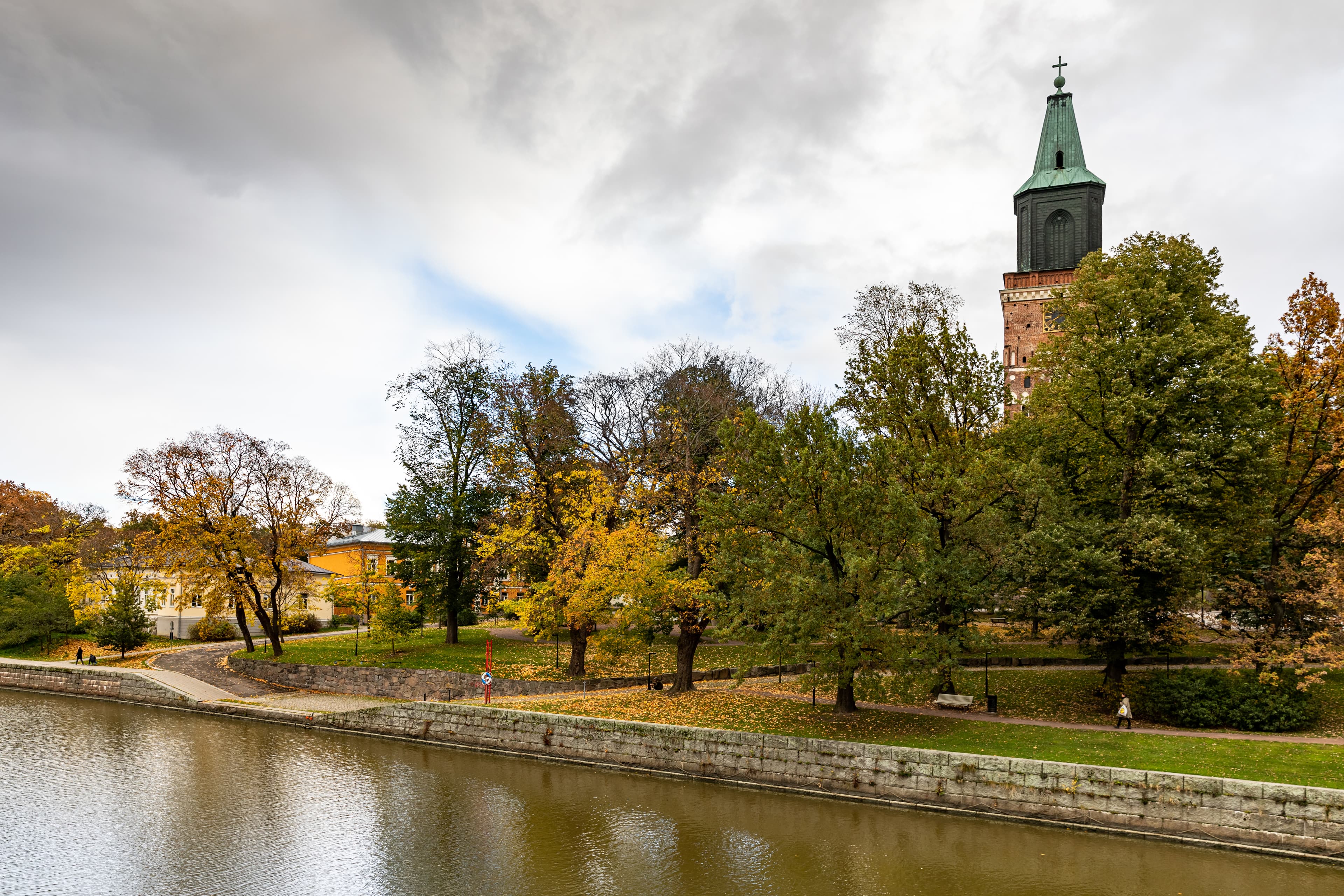
The vast majority of the city's sights are within a kilometre or two from Kauppatori. The river Aura passes through the centre, and its banks are very popular, allowing for a pleasant stroll from, say, the national shrine of Finland, the Turku Cathedral, to the Turku Castle, which used to house Swedish Kings – or upstream to experience some countryside.
Turku Touring, the official tourist agency of the city, offers different walking tours for visitors. There are also leaflets with self guided walking tours, such as Sculpture walk, ArchitecTour, Romantic Turku and Stepping it up. You can get a map from the main library (Linnankatu 2) or the tourist information. If you have a smartphone you can download a Citynomadi app and get a map there.
By bicycle
The fastest and most flexible way of seeing Turku is on a bike. There are good bike paths mostly as needed, although at the very heart of the city you have to know the routes or sometimes join car traffic, or get off the bike unless sufficiently experienced; not all the best routes are obvious. Some routes in the centre are brushed and salted in winter: along the river, around the campuses and through the central business district. Elsewhere cycleways and roads are not always maintained sufficiently in the winter for easy (in the centre: safe) biking, but local hardcore cyclists are biking throughout the year.
Stay safe
Turku is generally a safe city.
Turku faces some problems with street violence and organised crime, but common street sense should be enough in most cases. There are no no-go areas.
On weekend nights drunken people may cause annoyance, especially after last call. Swimming in the river is forbidden for good reason: the river banks provide very little access to the shore; what was intended as a quick refreshing dip will result in an expensive rescue operation or worse.
In emergencies, always call 112, which is the general emergency number for police affairs, fire, medical care and social services. If in doubt, it is always better to call and ask.
For non-emergency medical care, the City of Turku provides medical advice over the phone at ☏ +358 2 100-23. Lines are open weekdays 08:00–15:00. The hearing-impaired have their own service for the evaluation of medical care, counselling and making an appointment at a health centre. This can be contacted during office hours by sending an SMS message to ☏ +358 44-907-3824.
Turku University Hospital's T-Hospital is the region’s accident and emergency hospital, as well as healthcare centre off hours and for non-locals. It provides specialized medical care and treatment around the clock to those who have fallen suddenly ill or sustained injury.
9 Turku University Hospital Emergency Department, Savitehtaankatu 1 ("T-sairaala", across the railway and highway 1, by highway 10, near Kupittaa railway station), ☏ +358 2 313-8800 (helpdesk), +358 2 313-1420 (regarding children), +358 50-592-4740 (SMS for those who cannot speak), +358 2 313-8930 (enquiries by next of kin). 24 hr daily. Call for advice before coming, queues are often long. (updated Jul 2022)
Emergency social services can be contacted through 112; in business hours (weekdays 08:30–15:30) call ☏ +358 2 262-6003. Also life management.
10 Police, ☏ +358 295-440-501 (non-urgent – urgent: 112). Mon–Fri 8–17 (shorter hours for many matters). (updated Jun 2018)
In daytime there are several pharmacies to choose from, some with quite long hours. If you get a prescription, you could ask about the handiest one.
Respect
Avoid walking in the cycle lanes. Dedicated cycleways are clearly marked, but sometimes run directly next to the pavement (sidewalk). On the other hand, when biking close to people, especially on cycleways shared with pedestrians, be careful when passing children, dogs or people who might lose their balance if scared.
When waiting in lines, be patient and polite. Finns never jump queues – but make sure you actually stand in the line. If unsure, ask. In many places you are expected to get a queue number from a machine.
Do not feed seagulls or pigeons especially in the city centre. Seagulls taking people's ice creams or sandwiches is a real problem in some areas, and feeding them is encouraging that behaviour. Feeding birds is officially prohibited in many areas. In other places it might be allowed and encouraged, but check official advice.
Practical facts for Finland
Taken from open data. Rules and numbers change, so check locally before you rely on them.
- Currency
- Euro (EUR)
- Languages
- Finnish (Finland), Swedish (Finland), and Inari Sami
- Plugs and power
- Types C and F, 230 V at 50 Hz
- Traffic drives
- On the right
- Emergency numbers
- Any emergency112
- Country calling code
- +358
- Time zone
- Europe/Helsinki
Official travel advice
Quoted from each government as published, with the date they last changed it. We do not add a verdict of our own.
UK Foreign, Commonwealth & Development Office
- No areas listed that it advises against travelling to
US Department of State
Level 1 of 4: Exercise normal precautions
Read the full adviceExercise normal precaution in Finland.
Entry and visas
Entry rules depend on your passport and change without notice. Check the official pages before you book.
Sources