
Canada
A plan for Toronto
Not a list of things to see in Toronto — a day-by-day plan somebody could actually follow, built from places we can point to a source for. Make your own in about a minute.
- 2 nights
- Couple
- Balanced pace
- Mid-range budget
Every place here was checked on 2026-10-27 or later, and each one says where it came from.
The plan, day by day
Day 1
09:30
You arrive
13:00
Ginger
Suggested because you chose food
- 1h
- Meal
14:30
University of Toronto Art Centre
Picked because you chose culture & museums + balanced energy
- 2h 30m
- Culture & museums
2h open
Nothing planned here. That was on purpose.
19:00
Hollywood Gelato
Suggested because you chose food
- 1h 30m
- Meal
20:30
RBC Amphitheatre
Picked because you chose culture & museums + balanced energy
- 2h 30m
- Culture & museums
Day 2
08:00
Jules Cafe Patisserie
Suggested because it fits a mid-range budget
- 45m
- Meal
45m open
Nothing planned here. That was on purpose.
09:30
St. Lawrence Market South
Picked because you chose culture & museums, food, and local experiences + balanced energy
- 2h 30m
- Culture & museums
1h open
Nothing planned here. That was on purpose.
13:00
Juicy Dumpling
Suggested because you chose food
- 1h
- Meal
14:30
Campbell House
Picked because you chose culture & museums and local experiences + balanced energy
- 2h 30m
- Culture & museums
17:00
Roundhouse Park
Picked because you chose local experiences + balanced energy
- 2h 30m
- Local experiences
19:30
Pai Northern Thai Kitchen
Suggested because you chose food
- 1h 30m
- Meal
21:00
Ed Mirvish Theatre
Picked because you chose culture & museums + balanced energy
- 2h 30m
- Culture & museums
Day 3
08:00
Dutch Dreams
Suggested because it fits a mid-range budget
- 45m
- Meal
45m open
Nothing planned here. That was on purpose.
09:30
Casa Loma
Picked because you chose culture & museums and local experiences + balanced energy
- 2h 30m
- Adventure sports
1h open
Nothing planned here. That was on purpose.
13:00
Juicy Dumpling
Suggested because you chose food
- 1h
- Meal
14:30
You leave
Weather through the year
Monthly averages from NASA's 25-year climate record, day and night together.
Best months: June, July, August, and September
| January | Cold: -3°C, 54 mm |
|---|---|
| February | Cold: -3°C, 49 mm |
| March | Cold: 1°C, 53 mm |
| April | Cold: 6°C, 71 mm |
| May | Mild, some rain: 11°C, 73 mm |
| June | Mild, some rain: 18°C, 71 mm |
| July | Mild, some rain: 22°C, 75 mm |
| August | Mild, some rain: 22°C, 59 mm |
| September | Mild, some rain: 18°C, 66 mm |
| October | Mild, some rain: 12°C, 74 mm |
| November | Cold: 5°C, 66 mm |
| December | Cold: 1°C, 63 mm |
From the Wikivoyage guide
Quoted from the travel guide anyone can edit, as it read on the day we took it.
Understand
Toronto has an estimated population of over 3.2 million people as of 2024, and is the heart of the Greater Toronto Area (GTA) which has 7.1 million people. It also anchors the Golden Horseshoe region, which wraps around Lake Ontario from Toronto to Niagara Falls, home to over 11.1 million residents, approximately a quarter of Canada's entire population. Toronto is the fourth largest city and fifth largest urban agglomeration in North America.
Distances between cities in the area can be great as it sprawls along, outward and even wraps around the western end of Lake Ontario; public transit is not always effective enough to make it a quick or seamless trip. Many suburban residents rely on private cars to get around.
Toronto is also known as "the 416" after its first area code (although now 647 and 437 area codes are also used); or since 2014, "the 6", a term coined by the rapper Drake, which represents the area code).
Outlying suburbs are also known as "the 905" after their area code, although this code is also used in the Hamilton and the Niagara Peninsula, stretching from Cobourg and Colborne in the east to the border in Niagara Falls to the southwest.
More than half of its residents were born outside of Canada, and as a result the city is fortunate to host many vibrant bustling neighbourhoods with street signs in several languages.
See
Individual listings can be found in Toronto's district articles
Museums
Art Gallery of Ontario. The largest art gallery in Canada. It has a great Canadian paintings exhibit and the world's largest collection of Henry Moore sculptures. The European paintings exhibit has a few excellent pieces including Ruben's The Massacre of the Innocents.
Bata Shoe Museum. This offbeat museum is devoted to shoes and footwear from cultures all over the world.
Black Creek Pioneer Village is a recreation of life in 19th-century Ontario and consists of over 40 historic buildings, decorated in the style of the 1860s with period furnishings and actors portraying villagers.
Casa Loma is a step back in time to a period of European elegance and splendour. The museum has decorated suites, secret passages, a 250-m-long tunnel, towers, stables and beautiful 5-acre estate gardens.
Gardiner Museum of Ceramic Art. Dedicated to ceramics in an exquisite contemporary building.
Hockey Hall of Fame is both a museum and a hall of fame dedicated to the history of ice hockey.
Royal Ontario Museum is a museum of art, world culture and natural history. It is one of the largest museums in North America, and the largest in Canada.
Spadina House Museum is in a historic mansion dating from the 1860s. The grounds contain a beautiful garden.
Textile Museum of Canada. Shows drawn from a 13,000-piece collection of textiles from around the world and from other collections.
Landmarks
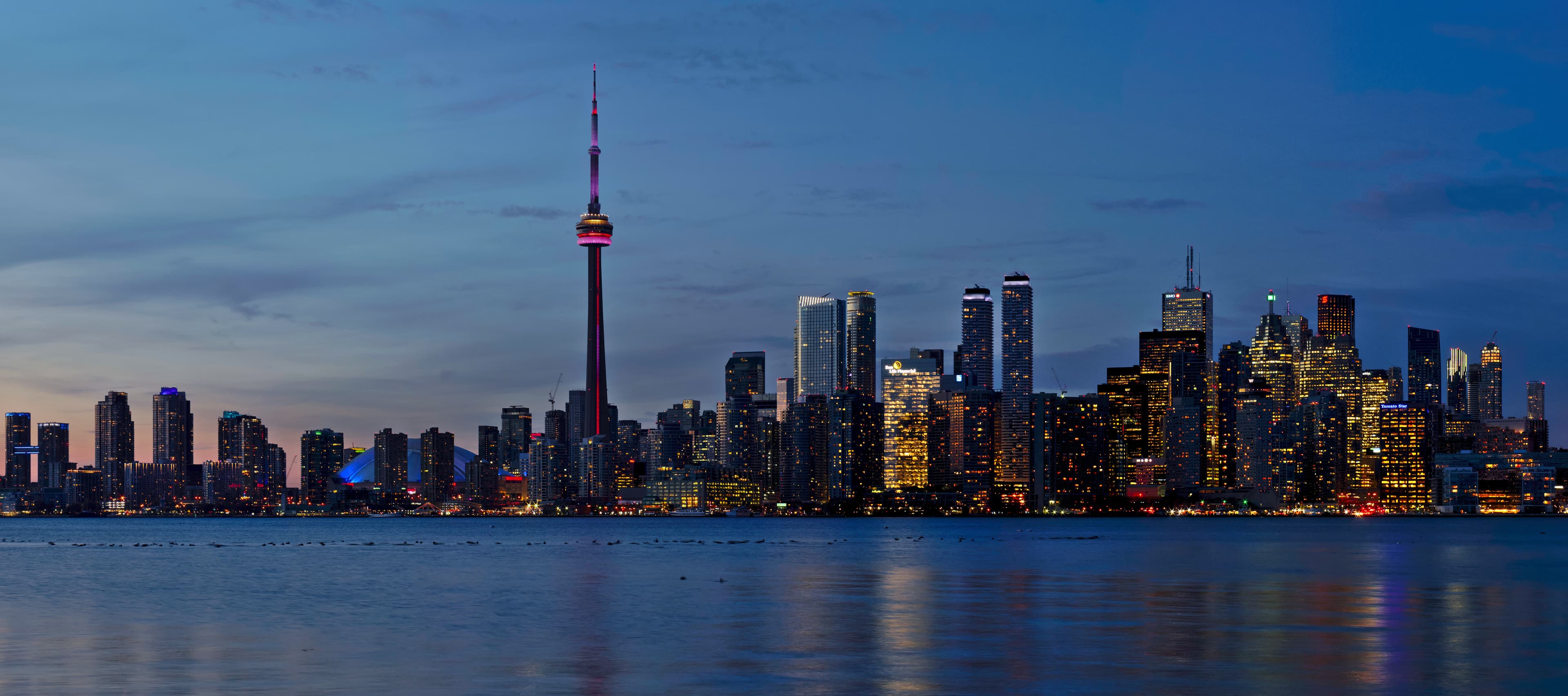
CN Tower. At 533 metres tall, the CN Tower is the third tallest free-standing structure in the world, and the tallest in North America.
Rogers Centre is a large multi-purpose stadium with a retractable roof. It is home to the Toronto Blue Jays of Major League Baseball.
Toronto City Hall. Two buildings forming a semi-circle overlooking Nathan Phillips Square. Architecturally stunning, and next door to Old City Hall (now a court house) which has a more classical architecture.
Parks
Toronto Zoo is Canada's premier zoo showcasing over 3,000 animals and over 300 species.
Do
Individual listings can be found in Toronto's district articles
Outdoors
Toronto is "the city within a park", with miles and miles of parkland following the streams and rivers that flow through the city. Edwards Gardens and the Toronto Botanical Gardens in the neighbourhood of North York might just be the place to start exploring this natural environment.
The City of Toronto has designated various Discovery Walks which highlight the natural and human history of the region. These can be found with brown circular signs along the route and highlight other regions such as the Belt Line, Garrison Creek and the Humber River as well as the downtown core.
Beaches. Toronto has three main sections of beach along Lake Ontario. The most popular of these is in the aptly-named Beaches neighbourhood. A less popular alternative is the beaches in the western end of the city in the Parkdale neighbourhood; this was once Toronto's Coney Island, with an amusement park and numerous beach-style attractions; however in the 1950s the city built the Gardiner Expressway along the lakeshore, effectively separating the beaches from the city and causing the demolition of the amusement park; over the years attempts have been made to re-energize this area, but the Gardiner remains a major barrier, as well as a source of noise and pollution to keep away would-be beach-goers. On the plus side, the beaches are largely empty most of the time, providing solitude for those who seek it. The third major beach area in the city runs along the south shore of the Toronto Islands. This area is pleasantly secluded, with most of the islands covered with parkland and a small amusement park. Hanlan's Point Beach on the western shore of the islands is the City of Toronto's only officially recognized clothing optional beach, and a popular gay hangout.
Eat
Toronto is generally considered to be one of North America's top food cities. It has the same variety as New York or San Francisco and the compact and safe downtown keeps them closer together. As one of the most (if not the most) multicultural cities in the world, Toronto has authentic ethnic cuisine like no other city in North America. It is easy to eat out in Toronto and have a superb meal for cheap.
A few of these cheap (i.e., can be easily procured for less than $20 or, in many instances, $10), iconic dishes are must-try meals for any visitor to Toronto—and represent the diversity that makes this city so special.
Peameal bacon sandwich
The closest thing to a classic local dish that Toronto has, this is a simple dish comprising slices of cured, unsmoked pork loin in a Kaiser roll, typically adorned with some mustard. The classic location to try this dish is in St Lawrence Market, with Carousel Bakery and Paddington's Pump its most famous purveyors.
Roti
Roti (never plural, and make the effort to pronounce the "T", like "row-tee") is probably the city's most iconic dish. Originating in Trinidad and Guyana, roti is essentially a curry wrapped in a roti shell, i.e., a thin paratha or dhalpuri flatbread. Typical curries found in roti include goat, chicken, lamb, beef, shrimp and a range of veggie options (channa, spinach, pumpkin, cabbage, potato). Occasionally you can find duck and oxtail options, if you're lucky. While the best roti is found in the outer suburbs of Scarborough and Brampton, a handful of shops persist in the city proper, including:
Drink
Historically, the majority of nightlife in Toronto has been centred on the appropriately named Clubland and in the Fashion District on Queen Street West. Nearly everywhere is packed to the brim with pubs and bars, but none so much as Adelaide and Queen Street in those districts. Clubs tend to operate on Richmond and Adelaide streets (both run east-west, 1 block apart); names change frequently, but the district keeps on going. John Street between Adelaide and Richmond is always a hub of activity, especially after Blue Jays games, and is a convenient spot for those staying downtown. Two other clubs of note outside this district: the (long-lasting) Phoenix (on Sherbourne) and Rebel (literally operating on part of Toronto's commercial port, but this place has an outstanding view of the city on warm summer nights, and boasts an extensive entertainment complex).
Some of Toronto's newest and hottest nightclubs have opened up in the King Street West/Liberty Village area. This area tends to attract a more mature (25 years and older) crowd; however this comes at a cost as drinks and admission into the venues are typically a bit more expensive here than in Clubland.
Hip art and music oriented crowds tend to gravitate towards Parkdale (Queen West past Bellwoods Park). The hipsters hangout in the wide array of bars, galleries and clubs that dot the area, including the Rhino, Happy Wine Bar, Tammy's, Motel, Pharmacy Bar, Danu, Food & Liquor, the Grand Trunk and the Drake and its poor cousin Gladstone Hotels. The same folks also frequent the Annex, Dundas West and Kensington Market areas of the city at night for club nights, casual drinks and art and music events. One of the main "corsos" of the city is Little Italy: College Street, between Bathurst and Ossington flows over with music, sidewalk cafes and excellent food and a crowd that enjoys the summer heat and the offerings. College Street, east of Bathurst, is home to many student hangouts, including Sneaky Dee's which is famous among locals for its nachos. The legal minimum drinking age is 19.
Get around
Toronto is huge, and most roads run for very long distances. Streetcar rail, subway rail, and intercity rail services are clean and efficient, and it's entirely possible to get around Toronto without a car, especially downtown. You may find it quicker and easier to drive, but the highways regularly back up during rush hour (7—10AM and 4—7PM). Toronto has plentiful parking garages downtown, but they are very expensive.
Many in Toronto travel by bicycle (especially in the warmer months) and this mode is very convenient for getting around the downtown district. Not all motorists will give way to cyclists, and not all cyclists comply with the rules of the road; caution is recommended.
By car
Getting around by car is the easiest method to get around outside of the downtown area. Roads are wide, have many lanes, and parking is free and plentiful. Arterial roads are generally laid out 2 kilometres (1.2 mi) apart, although they are closer in the west and east ends of the city.
Large-scale multi-car pileups frequently block traffic for several hours. Always check traffic conditions before you depart. The Ontario Ministry of Transportation provides an official traffic information website, https://511on.ca/, which has a page with details about current incidents, including images from traffic cameras if available. On the freeways, overhead electronic signs provide estimated driving times and warn drivers of accidents ahead.
Stay safe
Crime
The overall violent crime rate in Canada, and particularly in Toronto, is lower than that found in major cities in the United States. Petty crime is generally not a serious problem in Toronto, but be vigilant with your possessions. Car and bike theft are comparable to other large North American cities.
There are neighbourhoods which are known in the media and on the street as being more dangerous, though police statistics are not commonly used to justify these beliefs. Nevertheless, while assaults and other crimes can happen anywhere, especially late at night when few people are around, it is reasonable to avoid certain areas (again, generally late at night). These areas include in the old city and inner bouroughs: Crescent Town, Regent Park, parts of Parkdale, parts of St. Jamestown, Moss Park, Alexandra Park, Flemingdon Park/Victoria Village and Weston-Mount Dennis. Outer areas: Jane and Finch ("Jane Corridor"), Lawrence Heights, the Peanut (i.e., Don Mills and Sheppard), Rexdale/Jamestown Crescent, Malvern, Kingston and Galloway, Steeles-The Amoureaux, Dorset Park, Westminster-Branson and Eglinton East-Kennedy Park. Stay away from dodgy looking areas, where drugs, prostitution and violent crime such as armed robberies can occur. These neighbourhoods become noticeably worse from a visual standpoint, giving ample warning to turn around.
Practical facts for Canada
Taken from open data. Rules and numbers change, so check locally before you rely on them.
- Currency
- Canadian Dollar (CAD)
- Languages
- Canadian English, Canadian French, and Inuktitut
- Plugs and power
- Types A and B, 120 V at 60 Hz
- Traffic drives
- On the right
- Emergency numbers
- Any emergency911
- Country calling code
- +1
- Time zones
- America/Atikokan, America/Blanc-Sablon, America/Cambridge Bay, America/Creston, and 19 more
Official travel advice
Quoted from each government as published, with the date they last changed it. We do not add a verdict of our own.
UK Foreign, Commonwealth & Development Office
- No areas listed that it advises against travelling to
US Department of State
Level 1 of 4: Exercise normal precautions
Read the full adviceExercise normal precaution in Canada.
Canada is generally a safe destination for travelers.
Crime
• Petty crime is common, especially in popular tourist locations. Stay aware of your surroundings.
• Most crimes against foreigners are crimes of opportunity, like purse snatching, pickpocketing, and car break-ins or theft.
• Review our Travel Guidance for Canada to learn how to prepare for a safe trip.
Entry and visas
Entry rules depend on your passport and change without notice. Check the official pages before you book.
Sources