
Israel
A plan for Tel Aviv
Not a list of things to see in Tel Aviv — a day-by-day plan somebody could actually follow, built from places we can point to a source for. Make your own in about a minute.
- 2 nights
- Couple
- Balanced pace
- Mid-range budget
Every place here was checked on 2026-10-27 or later, and each one says where it came from.
The plan, day by day
Day 1
09:30
You arrive
13:00
שוק התקווה
Suggested because you chose food
- 1h
- Meal
14:30
Tel Aviv Museum of Art
Picked because you chose culture & museums + balanced energy
- 2h 30m
- Culture & museums
2h open
Nothing planned here. That was on purpose.
19:00
Frame
Suggested because you chose food
- 1h 30m
- Meal
20:30
Habima Theatre
Picked because you chose culture & museums + balanced energy
- 2h 30m
- Culture & museums
Day 2
08:00
The Streets
Suggested because it fits a mid-range budget
- 45m
- Meal
45m open
Nothing planned here. That was on purpose.
09:30
Museum of the Jewish People at Beit Hatfutsot
Picked because you chose culture & museums + balanced energy
- 2h 30m
- Culture & museums
1h open
Nothing planned here. That was on purpose.
13:00
שוק הפשפשים
Suggested because you chose food
- 1h
- Meal
14:30
Independence Hall
Picked because you chose culture & museums + balanced energy
- 2h 30m
- Culture & museums
17:00
Beit Gidi
Picked because you chose culture & museums + balanced energy
- 2h 30m
- Culture & museums
19:30
Yoko Sushi Bar
Suggested because you chose food
- 1h 30m
- Meal
21:00
צוותא
Picked because you chose culture & museums + balanced energy
- 2h 30m
- Culture & museums
Day 3
08:00
Abouelafia and Sons
Suggested because it fits a mid-range budget
- 45m
- Meal
45m open
Nothing planned here. That was on purpose.
09:30
Bialik House
Picked because you chose culture & museums and local experiences + balanced energy
- 2h 30m
- Culture & museums
1h open
Nothing planned here. That was on purpose.
13:00
שרונה מרקט
Suggested because you chose food
- 1h
- Meal
14:30
You leave
Weather through the year
Monthly averages from NASA's 25-year climate record, day and night together.
Best months: April, May, October, and November
| January | Mild, some rain: 11°C, 88 mm |
|---|---|
| February | Mild, some rain: 12°C, 62 mm |
| March | Cool and dry: 15°C, 37 mm |
| April | Mild and dry: 18°C, 21 mm |
| May | Mild and dry: 22°C, 5 mm |
| June | Warm and dry: 25°C, 1 mm |
| July | Warm and dry: 27°C, 1 mm |
| August | Warm and dry: 27°C, 0 mm |
| September | Warm and dry: 26°C, 2 mm |
| October | Mild and dry: 23°C, 14 mm |
| November | Mild, some rain: 18°C, 46 mm |
| December | Mild, some rain: 14°C, 83 mm |
From the Wikivoyage guide
Quoted from the travel guide anyone can edit, as it read on the day we took it.
Understand
The smallish Gulf of Jaffa was the site of a fortified port town for at least 4,000 years. During the 19th century the town’s population grew from about 2,500 (1806) to 17,000 (1886). The old city walls could no longer contain the population, and they were destroyed in the 1870s. New, more spacious neighborhoods started to appear.
Tel Aviv (meaning literally "Hill of Spring") was founded in 1909 by a group of distinguished Jewish residents of Jaffa. They envisaged a European-style garden suburb, with wide streets and boulevards. Leaving Jaffa wasn’t, however, only a question of an upgrade in lifestyle. Moving out of the Arab-dominated town also represented their belief in the Jewish national movement, Zionism. Before being a city, Tel Aviv was one of the many titles of Theodor Herzl's utopian Zionist book The Old New Land. Setting out with a grand vision, the 60 Tel Aviv founders started out by building the first Middle Eastern urban center with running water, no small wonder in that part of the world in 1909. Houses from this period can still be seen in the Neve Tzedek neighborhood.
Tel Aviv grew steadily under Ottoman law until World War I. By the end of the war the British took over the Holy Land, an event the Jewish community saw as encouraging, while the Muslim community viewed it as a turn for the worse after Islamic rule. Tel Aviv was seen by nearby Arabs as a symbol of the growing Jewish presence in their homeland. In May 1921, an Arab mob attacked a Jewish immigration center, killing dozens of Jews. Another group broke the windows of stores in the Jewish street in Jaffa, and a mob armed with knives and sticks made its way towards Tel Aviv. Before 1921 most Jews worked and lived in Jaffa; after the attack, thousands of the 16,000 Jews of Jaffa moved north to Tel Aviv. The suburb had become a city and within a decade, Tel Aviv had become the center of culture, commerce and light industry for the entire Jewish population of the country (and the British soldiers). 1938 marked the opening of Tel Aviv port, an important milestone in the end of its dependency on Jaffa. By this time, Tel Aviv was already the biggest city in the country, with 130,000 residents.
See
Individual listings can be found in Tel Aviv's district articles
Tel Aviv is a big place, and these listings are just some highlights of things that you really should see if you can during your visit. The complete listings are found on each individual district page alongside many more things to see in each district.
Starting in the North, the Tel Aviv Port is one of the most dynamic areas in Tel Aviv, including a multitude of shops, restaurants and nightclubs. Inland is Yarkon park, the city's central park along the Yarkon River.
Going into central parts of the city, you will encounter Rabin Square, the largest public square in Israel. Nearby is another important square, Habima Square. It is home to a number of cultural institutions such as the Habima Theatre, the Fredric R. Mann Auditorium and the Helena Rubinstein Pavilion for Contemporary Art.
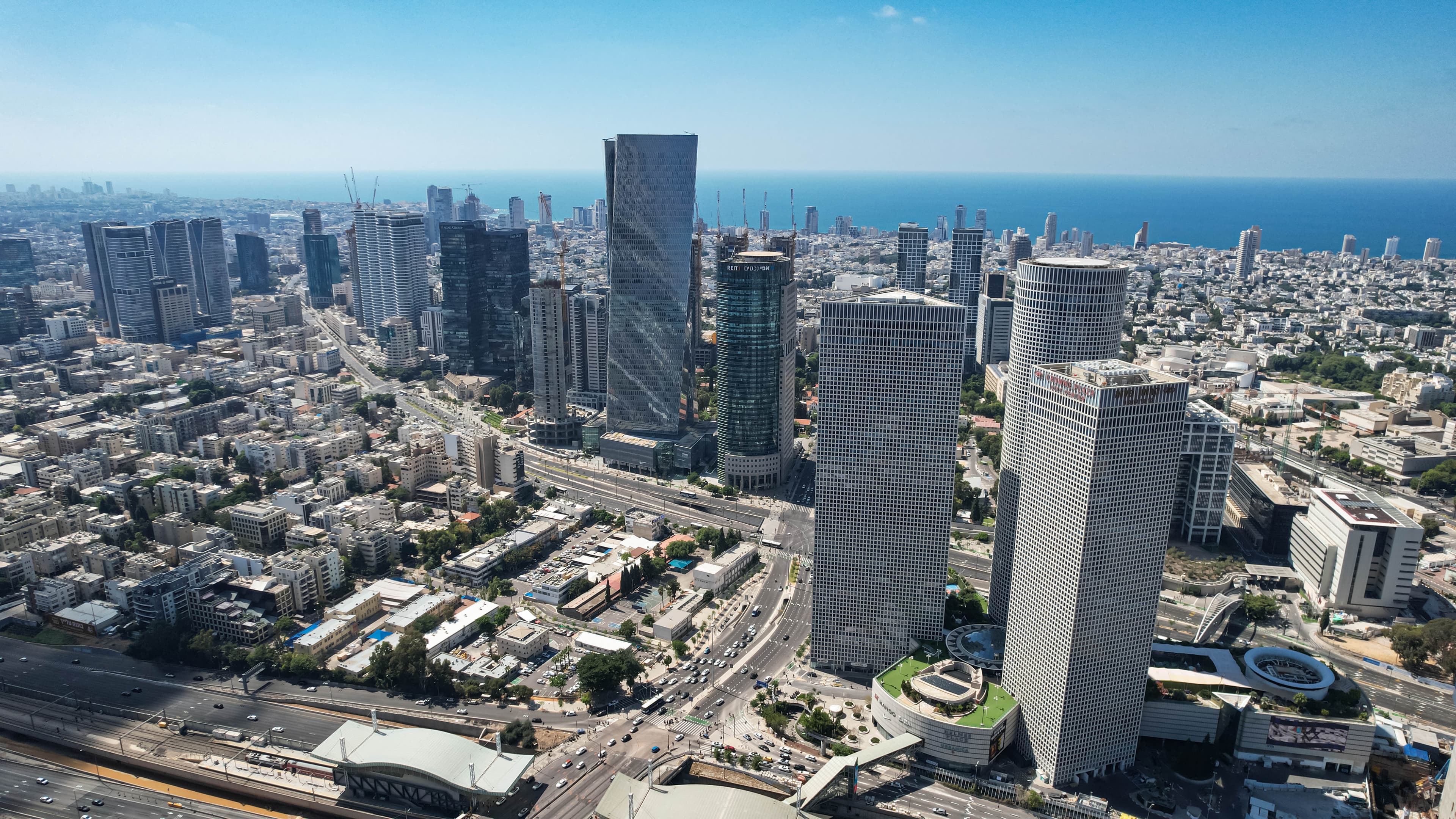
A bit west of Habima Square is the Dizengoff Centre, Israel's most iconic shopping centre with a very lively food market every Thursday and Friday. To the east, in turn, is the district of Sarona with restored German Templer architecture, known for its picturesque paths and buildings, upscale restaurants, and luxurious food market, and the Azriely Center Observatory that you can climb to the top of the mall for a nice view of the city.
Further south in central is the Rothschild Boulevard with a lot of Bauhaus architecture, restaurants and cafes in what's regarded as Tel Aviv's prettiest street. Towards the sea, you can find the Carmel Market and Nachalat Binyamin arts and crafts fair. The largest and most famous market in Tel Aviv, Carmel Market is open all week except Saturday. Nachalat Binyamin Arts and Crafts Fair is one of the most famous in the world.
Do
Individual listings can be found in Tel Aviv's district articles
There’s a lot to do in Tel Aviv. For the biggest selection, check out the individual district articles. These are some of the highlights.
Tel Aviv is known as the White City with the world's largest collection of Bauhaus architecture. Enjoy a guided tour of the Bauhaus district.
A visit to Tel Aviv isn't complete without a dip into its fantastic beach scene which is at its best in summer, especially during Friday afternoons, when crowds of buff beachgoers converge to take in the Brazilian drums, the smell of barbecues, the thwock, thwock of "matkot" as the sun sets. In early summer be careful as there may be jellyfish in the water. Ask the lifeguard or locals about the current conditions.
An interesting way of getting to see the city is to rent a bike and bike the length of the coastal boardwalk from Jaffa to Tel Aviv Port, then turning inland and biking along the Yarkon River banks, then returning to where you started. The entire trip is on paved bike paths, and can be as long as 13km each way, or shorter if you prefer.
Performing arts
Tel Aviv has the widest selection of performing arts in Israel.
Fans of classical music might enjoy Israel's Philharmonic Orchestra and the New Israel Opera.
The Barby (52, Kibutz Galuyot st., +972 3-5188123), and the Goldstar Zappa (24, Habarzel st., +972 3-6499550) present Israeli (and sometimes foreign) rock daily.
For more alternative and indie music with occasional jazz shows and electronic parties, head to Levontin 7 named after its street address or The OzenBar.
Tmuna Theater (8, Shontsino st., +972 3-5629462) alternates between local acts, both famous and unknown, and fringe theater productions in Hebrew.
Dance can be enjoyed in Suzanna Dellal Center in Neve Tzedek.
Theater is mostly performed in Hebrew, naturally, but English interpretation is available is some of the shows for extra-fees in Habima National Theater (+972 3-6295555) and HaCameri Municipal Theater.
Fans of jazz can find great shows at the Shablul club in the Tel Aviv harbor, with jam sessions every Monday at 22:30.
Eat
Individual listings can be found in Tel Aviv's district articles
Tel Aviv has an amazing variety of restaurants for every taste.
There are plenty of fast food restaurants, offering both international and local Israeli food. One can get a decent meal, including falafel or hummus on every street corner. You can also eat a toast, sandwich or some other snack at one of the cafes around the city. Many fruit juice parlors are around.
The city is also known for being one of the best destinations for plant based eating. More than 30 restaurants cater to vegans with a wide range of cuisines and price ranges. The landmarks are Meshek Barzilai in Neve Tzedek, Anastasia on Frishman street and 416 near Sarona. You will also find many plant based options on the menu of most restaurants.
Finally, Tel Aviv's ice cream parlors offer much more than basic flavors, as the taste buds are eclectic and strive for new flavors, such as Halva, poppy seed, and even a touch of alcoholic liqueurs in the ice cream (try these places: Vaniglia, Iceberg, Gelateria Siciliana, Dr. Lek and Aldo).
Like everything else in Tel-Aviv, food can be prohibitively expensive.
Drink
Individual listings can be found in Tel Aviv's district articles
Tel Aviv is called "The city that never stops" by tourists and locals alike. It has a wide range of pubs, bars, clubs and it is known worldwide for its nightlife. The entire city is crawling with nightlife attractions and you would actually have to work pretty hard to find yourself further than 500 meters away from a place to have a drink. People from all the surrounding region come to Tel Aviv to have a drink or a party so on weekends traffic is hectic at late hours and finding a parking spot is somewhere between hard and impossible (so sticking to cabs is not a bad idea). Buses stop running at sundown on Friday and only start again after sundown on Saturday, so if you go out on Friday night you may find yourself forced to take a cab if you cannot walk! But any day is a good day to party in Tel Aviv, not just the weekends.
New places are opening and closing every day and the "hottest spots" change every couple of months, so no internet guide will be able to direct you to the hippest place (even though some may try). Checkout up to date event and party sites. Many places in Tel Aviv have minimum age limitations that vary from 18 to 30. Usually the limitation is different between males and females and while some spots may be flexible others will be as strict as possible.
Israel has no unique drinking culture so any place with any self-respect will have the entire world wide alcohol selection available, from Wine and Beer to Tequila, Arak, Vodka, Whiskey and Cognac.
Pubs
The entire city is full of spots to hang out, and there are streets and areas that stand out with even more pubs/clubs, have a look at the districts detailing the scene.
There are a few well-known pubs that specifically cater to foreigners. Mike's Place, next to the American embassy, is an American-style bar which attracts a mostly-Anglo 20-30 something crowd. Molly Bloom's Irish pub and the English Pub, not far from Mike's Place, host many people from the UK and Republic of Ireland.
Get around
By bus
Tel Aviv has a modern, regular, cheap and widespread bus network run mostly by Dan. The main bus lines start at 05:00 AM and stops at 1 AM; on Thursday nights, Saturday nights, and during all July and August, the main lines run all night. Between November and March, the bus service stops on Friday at 15:00 and resumes on Saturday at 18:00, and between April and October the service stops on Friday at 17:00 and resumes on Saturday at 21:00.
Several smartphone apps, such as efoBus or Moovit or Google Maps, offer route maps and real-time bus arrival tracking and trip planning. Most buses and trains now have USB chargers.
Since Jan 2019, you can't pay cash on the bus. You need to buy a Rav-Kav smart card from the driver or Rav-Kav service center for ₪5 (if getting from service center, you may as well just issue a free personal card) plus either stored value to cover how many journeys you need, in ₪30 or ₪50 increments. If bought from bus driver (₪10.90), this will only include 1 trip (not stored value credit) which will be immediately used for the current ride, so to use it afterwards, you need to search for a recharging point or use the mobile app to recharge if you have a supported NFC module in your phone. See Public transit in Israel. The basic stored value fare up to 15 kilometers is 5.50 off the stored value balance; each ride includes 90 min transfers in the area. Or you may as well load up an appropriate periodic pass to cover your journeys. Think about how much is left on your card before travelling to an edge-of-city location that might not have a top-up point: your credit is shown after each validation on the validator screen.
Stay safe
In general, most tourist areas are completely safe for tourists even at night. However, try to avoid the Central Bus Station, especially at night. This bus station is a large building with many abandoned parts that brings with it many dodgy people. Instead, try to take a bus that arrives at "Terminal 2000" or outside the Azrieli Towers. The "HaHagana" train station is safe, but avoid walking around the nearby Neve Shaanan neighborhood at night (the area east of "Ha'Aliya" and "Menachem Begin" streets), as it contains many homeless refugees from Eritrea and many drug addicts.
Also watch out for scooters and electric bikes. It is not uncommon to see these vehicles traveling at a speed of 40 km/h (25 miles per hour). On the path next to the promenade on the beach, they travel at particularly high speeds due to the lack of intersections. Besides, they are found in all the central areas of the city In high quantities and you should pay attention to them, especially in places where there are no bicycle paths such as on Allenby Street and the Yemeni Vineyard.
In addition, when bathing in the sea, do not leave valuables out of reach. The chance of theft at the beach is high.
The usual warnings regarding being alert for bomb threats also pertain to Tel Aviv - beware of suspicious packages in public places (though don't over panic), and suspicious behavior on the part of people around you; if in doubt, report it! The local police are generally friendly, and many of the law-enforcers can speak passable English.
Security control checks are a necessary annoyance when entering shopping malls, markets around the central bus station, and most hotels, cafes and restaurant. You are frequently requested to let the guards look into your bag. It is best not to find it offensive or intrusive, and this check shouldn't take more than 20 seconds and end with a smile and a green light. It is also advised to carry some sort of identification documents on you at all times. Police officers may rarely stop and ask you for ID, and Israelis are required to carry an ID at all times.
Most Israelis aged 18-20 are doing mandatory army service. So teenagers in uniform are everywhere, and it is not unusual to see what appears to be a group of high school students, dressed like any other high schools students out on the weekend, all carrying rifles.
Practical facts for Israel
Taken from open data. Rules and numbers change, so check locally before you rely on them.
- Currency
- Israeli New Shekel (ILS)
- Languages
- Hebrew, Arabic (Israel), and English (Israel)
- Plugs and power
- Types C, D, and H, 230 V at 50 Hz
- Traffic drives
- On the right
- Country calling code
- +972
- Time zone
- Asia/Jerusalem
Official travel advice
Quoted from each government as published, with the date they last changed it. We do not add a verdict of our own.
UK Foreign, Commonwealth & Development Office
- Advises against all but essential travel to parts of the country
- Advises against all travel to parts of the country
Read the full adviceAreas where FCDO advises against travel
Gaza
FCDO advises against all travel to Gaza
Areas near Gaza
FCDO advises against all travel within 500m of the border with Gaza
The West Bank
FCDO advises against all travel to:
• Tulkarm Governorate, Jenin Governorate, and Tubas Governorate except Route 90
Northern Israel and Occupied Golan Heights
FCDO advises against all travel to:
• Areas north of Route 89 between Nahariyya and Dalton; north of a straight eastward line from Dalton to Route 91; and north of Route 91 across the Golan Heights, excluding routes 89 and 91 themselves
• Within 500m of the Area of Separation in the occupied Golan Heights (the ‘Alpha line’). Do not attempt to enter the occupied Golan Heights through Syria
• Sheba’a Farms and Ghajja
Areas where FCDO advises against all but essential travel
West Bank
FCDO advises against all but essential travel to:
• The rest of the West Bank, except for: East Jerusalem, Bethlehem Governate, Ramallah Municipality, Jericho municipality and all areas which lie south of it (this includes the Allenby crossing). Highway 1 that links Jerusalem and Tel Aviv and the areas that lie to the south and west of the Highway (this includes Highway 3), and Route 443 and Highway 45 which link Jerusalem and Tel Aviv
Find out more about why FCDO advises against travel.
US Department of State
Level 3 of 4: Reconsider travel
Read the full adviceReconsider travel to Israel due to terrorism and unrest. Some areas have increased risk. Read the entire Travel Advisory.
As of August 26, 2026, family members may join U.S. government employees who work in Israel.
U.S. government employee travel restrictions
U.S. government employees working in Israel are restricted from the following locations due to safety risks:
• Areas north of Route 85 to Route 90 (south) to Route 87;
• Within 11.3 kilometers/7 miles of the Gaza Strip; and
• Within 2.4 kilometers/1.5 miles of the Israel-Egypt border, except at the area of the Taba border crossing, also known as the Menachem Begin crossing.
Entry and visas
Entry rules depend on your passport and change without notice. Check the official pages before you book.
Sources