
Sweden
A plan for Stockholm
Not a list of things to see in Stockholm — a day-by-day plan somebody could actually follow, built from places we can point to a source for. Make your own in about a minute.
- 2 nights
- Couple
- Balanced pace
- Mid-range budget
Every place here was checked on 2026-10-27 or later, and each one says where it came from.
The plan, day by day
Day 1
09:30
You arrive
13:00
Rågsveds krog
Suggested because you chose food
- 1h
- Meal
14:30
Sankt Erik
Picked because you chose culture & museums and local experiences + balanced energy
- 2h 30m
- Culture & museums
2h open
Nothing planned here. That was on purpose.
19:00
Villa Godthem
Suggested because you chose food
- 1h 30m
- Meal
20:30
Oscarsteatern
Picked because you chose culture & museums + balanced energy
- 2h 30m
- Culture & museums
Day 2
08:00
Vete-Katten
Suggested because it fits a mid-range budget
- 45m
- Meal
45m open
Nothing planned here. That was on purpose.
09:30
Swedish Museum of Natural History
Picked because you chose culture & museums + balanced energy
- 2h 30m
- Culture & museums
1h open
Nothing planned here. That was on purpose.
13:00
Mäster Anders
Suggested because you chose food
- 1h
- Meal
14:30
Stockholm City Museum
Picked because you chose culture & museums and local experiences + balanced energy
- 2h 30m
- Culture & museums
17:00
Färgfabriken
Picked because you chose culture & museums + balanced energy
- 2h 30m
- Culture & museums
19:30
Lilla Ego
Suggested because you chose food
- 1h 30m
- Meal
21:00
Folkoperan
Picked because you chose culture & museums + balanced energy
- 2h 30m
- Culture & museums
Day 3
08:00
Café Fix
Suggested because you chose food
- 45m
- Meal
45m open
Nothing planned here. That was on purpose.
09:30
Junibacken
Picked because you chose culture & museums and local experiences + balanced energy
- 2h 30m
- Culture & museums
1h open
Nothing planned here. That was on purpose.
13:00
Ekstedt
Suggested because you chose food
- 1h
- Meal
14:30
You leave
Weather through the year
Monthly averages from NASA's 25-year climate record, day and night together.
Best months: June, July, and August
| January | Cold: -3°C, 47 mm |
|---|---|
| February | Cold: -3°C, 40 mm |
| March | Cold: 0°C, 39 mm |
| April | Cold: 5°C, 37 mm |
| May | Cold: 11°C, 50 mm |
| June | Mild, some rain: 15°C, 78 mm |
| July | Mild, some rain: 18°C, 70 mm |
| August | Mild, some rain: 17°C, 72 mm |
| September | Mild, some rain: 13°C, 55 mm |
| October | Cold: 7°C, 63 mm |
| November | Cold: 3°C, 61 mm |
| December | Cold: -1°C, 54 mm |
From the Wikivoyage guide
Quoted from the travel guide anyone can edit, as it read on the day we took it.
Understand
Due to the post-glacial rebound, Stockholm is slowly rising from the sea. Mälaren was a bay of the Baltic Sea throughout the Viking Age of the 9th and 10th centuries; today's Stockholm was the waterway for the first Swedish cities; Birka, Uppsala, and Sigtuna. As Sigtuna was sacked by pirates in AD 1187, the Swedes needed to fortify the strait.
As the rising land cut off Mälaren from the sea in the 13th century, Stockholm became an important trading post. The city is said to be founded by Birger jarl (jarl is a title corresponding to British earl), who had a fortress built on an island later known as Gamla Stan. The first known written records that mention Stockholm date from 1252; this is the considered year of foundation. In the 15th century Stockholm replaced Uppsala as the effective capital. Stockholm was an associate of the Hanseatic League, and since its liberation from Denmark by King Gustav Vasa in 1523, Stockholm has remained Sweden's most important center of commerce, although Gothenburg later became the largest international port. During the 17th century, Stockholm was the base of the Swedish Empire, with a land area twice the country's current size, nearly encircling the Baltic Sea.
See
Individual listings can be found in Stockholm's district articles
Buildings and structures
Untouched by wars for a long time, Stockholm has some great old architecture to see. The exception would be Norrmalm, where much was demolished in the 1950s and 1960s to give place to what was then more modern buildings. Looking at it the other way around, if interested in this kind of architecture this is the place to go.
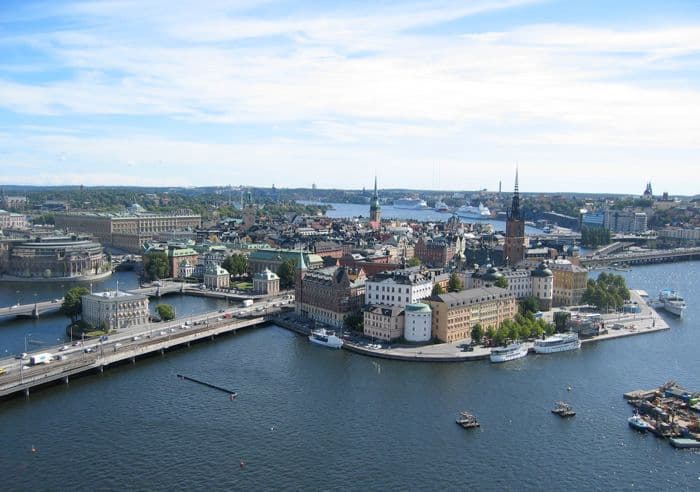
Stockholm's Old Town (Gamla Stan), is the beautifully preserved historical center, best covered on foot, dominated by the Stockholm Palace (Stockholms slott). Other highlights include Storkyrkan, the cathedral of Stockholm, which has been used for many royal coronations, weddings and funerals, and Riddarholmskyrkan, a beautifully preserved medieval church, which hosts the tombs of many Swedish kings and royals, surrounded by former mansions.
As a matter of fact, there's not only one royal palace in and around Stockholm but several others, Drottningholm (on Ekerö) and Haga (in Solna) being the most famous. Here visitors can get in close contact with traditions of the Swedish monarchy. The Drottningholm palace, a UNESCO World Heritage Site, is where the royal family lives; still much of it is open to the public. The surroundings are well worth a walk as well. In summer, there is a regular boat service from Stadshuskajen (the City Hall Quay) to Drottningholm.
Do
Individual listings can be found in Stockholm's district articles
Tours
There is a wide selection of guided tours available, by boat, by bus and on foot.
By boat
Hop On - Hop Off Boat. daily 10:00-16:00. Audio track in 11 languages. Two of the most frequented stops are at the Palace, and at the Gamla Stan, right across the canal from T Slussen. The recordings on this loop service are reasonably informative. 24-hr ticket from 180 kr. (updated Sep 2017)
Under the bridges of Stockholm. Departing from Strömkajen by Grand Hôtel and opposite the Royal Castle (T Kungsträdgården), this tour on both the sea and on lake Mälaren passes under 15 bridges and through two locks. Several departures every day, depending on the time of year. 1 hour 50 min. From 260 kr. (updated Sep 2017)
Royal Canal Tour. Departs from Strömkajen and takes you around the eastern parts of the city, passing through the lush Djurgården canal. 50 min. From 200 kr. (updated Sep 2017)
Historical Canal Tour. Departs from Stadshusbron next to the City Hall (T T-Centralen), and passes Kungsholmen and other western islands of the city. 50 min. From 275 kr. (updated Sep 2017)
Stockholm Grand Tour. Combines a boat and a bus tour. 3 hours 30 min, 450 kr. From 432 kr. (updated Sep 2017)
By bus
City Tours and Open Top Tours (also divisions of the Strömma group) offers bus tours:
Stockholm Panorama. A tour of some major sights that departs from Gustaf Adolf Torg (T T-Centralen). 1 hour 30 min, 300 kr.
The Hop-on Hop-off Bus is a tour with open top double decker buses that allows you to get on and off the bus as often as you want at bus stops along the route. The tour passes some major sights, but only in the central and eastern part of the city. 24-hour travel pass from 270 kr.
Stockholm Excursions also has a few specialized bus tours.
By taxi
Taxi Stockholm, +46 8 15 00 00, offers a multimedia guided tours, allowing up to 3 people for a flat fare of 950 kr to explore sites and experiences in Stockholm linked to some poignant historic moments of its past, usually the dark ones, like the assassination of Olof Palme.
By bicycle
Talk of the town offers self-guided bike tours in six languages.
Eat
Individual listings can be found in Stockholm's district articles
Stockholm features a large variety of restaurants, and the dining scene has markedly improved since the turn of the century, both in terms of quality and variety. However, dining in Stockholm can be expensive if you aim for something else than the fast food bars, the run-of-the-mill British-style pubs or the ethnic restaurants that dominate the budget bracket. Be prepared to pay around 175–250 kr or more for most main courses at quality restaurants. If you are on a tight budget, self-catering is a good option.
Most hotels and hostels have a good breakfast buffet, in many cases included with the room.
A lot of restaurants have "dagens rätt" – a lunch offer, normally including a lower- or non-alcoholic drink, bread, butter, salad and coffee – usually M–F 11:00–14:00. Expect to pay around 100–150 kr, generally more in the centre and less in the suburbs. Many Asian, Indian and fast food restaurants offer rather cheap "all you can eat" lunch buffets.
Many restaurants' kitchens close at 22:00 even on weekends, so don't get out too late. A glass of house wine costs in the range 60– kr, 400–700 kr for a bottle. Sweden has enforced non-smoking in all bars, pubs, restaurants and enclosed areas.
Quite a few restaurants are closed for vacation for a few weeks in July or early August. In December, many restaurants offer a Christmas buffet (julbord), a variation of the classic Swedish smörgåsbord with traditional Christmas dishes, including Christmas ham, pickled herring and stockfish from cod or ling, prepared with lye (lutfisk). This is a great way to sample a traditional Swedish festive meal for about 300–600 kr; you need to book in advance.
In this cosmopolitan city, traditional Swedish cuisine, known as husmanskost ("every man's food"), can be hard to get by. Many fine diners have a not-too-expensive husmanskost course: some other places to eat Swedish are the Nystekt strömming wagon on Kornhamnstorg (Gamla stan), Ät gott (S:t Göransgatan 74, (Kungsholmen)) and Tennstopet (Dalagatan 50, (Vasastan)).
Drink
Individual listings can be found in Stockholm's district articles
Retail drinks
Drinking retail alcohol is allowed in most public areas. Among the exceptions are schools, playgrounds, indoor malls, some city squares, and public transport areas. In some parks, drinking is prohibited from 22:00 or midnight. Map of dry areas
Systembolaget. Generally open Mon-Wed 10:00-18:00, Thu-Fri 10:00-19:00, Sat 10:00-15:00, all stores closed Sun. Systembolaget is the government monopoly chain for selling alcohol. The stores have a wide assortment and helpful, knowledgeable staff. Tax makes beer and hard liquor expensive. Surprisingly, high-end wines can be a bargain. Central locations include:
Drottninggatan (T T-Centralen), Drottninggatan 22. Mon-Fri 10:00-19:00, Sat 10:00-15:00, Sun closed.
Klarabergsgatan (T T-Centralen), Klarabergsgatan 62. Extra late hours: Closes 20:00 all weekdays.
Regeringsgatan (T T-Centralen), Regeringsgatan 44. The largest Systembolaget store in Stockholm, with a special selection of exclusive wines
Vasagatan (T T-Centralen), Vasagatan 25.
Nybrogatan (T Östermalmstorg), Nybrogatan 47.
Folkungagatan (T Medborgarplatsen), Folkungagatan 56.
Bars and nightclubs
The cost for drinking out in Stockholm varies a lot. Expect to pay around 30 kr in the cheapest pub (55-75 kr in a trendier club or pub) for a beer or cider, and at least 95-150 kr for a long-drink or cocktail in a club. Bars usually have no cover charge, but may have an arbitrarily set (and arbitrarily enforced) minimum age limit (usually 21 or 23, sometimes as low as 18, other times as high as 27), while clubs usually charge 50-200 kr at the door (or more at special performances). Long, and very slow moving lines tend to form outside most popular clubs - expect having to wait as much as 1 hour or more if going to a trendy place after midnight, even if raining or snowing. Don't forget to bring an ID, as bouncers will (almost) always ask for identification at the door in both pubs and clubs.
Stureplan is a district dominated by dancefloor nightclubs, at the crossing of Birger Jarlsgatan, Kungsgatan and Sturegatan, (T Östermalmstorg). The mushroom-shaped rain shelter is a common meeting point. High entrance fees (200 kr or more) and long lines.
Get around
Stockholm is easy to access by public transport, and on bicycle during the warm season. Travelling by car is suitable outside built-up areas.
By public transport
SL (Storstockholms Lokaltrafik) runs an extensive metro, commuter train and bus system, as well as some light rail and ferry services. They serve Stockholm County, with Sigtuna and Norrtälje in the north, and Södertälje and Nynäshamn in the south, with extensions to Uppsala, Gnesta and Bålsta for an extra fee (see below).
The SL website has up-to-date detailed ticket and price information in English, and a journey planner.
Tickets
The simplest way to pay for tickets is to simply use your credit/debit card to pay for tickets, by tapping at entry gates and electronic readers. Tickets cannot be bought on buses by cash. As you board a public transport vehicle (most prominently this applies to buses), you will be required to validate your trip every time by swiping the payment card at the rectangular validators in the vehicle (you should hear a beep and see a green light). The same principle goes for the underground and commuter rail, with the main difference being that this procedure is done as you're entering the platform part of the station. For light rail, there are validators on the platforms.
All SL services use an integrated ticket system with an RFID card (SL-kortet), which triggers entry gates and other electronic readers. As of July 2026 the card costs 50 kr to purchase and can hold all types of SL tickets.
Stay safe
For its size, Stockholm is a safe city by international standards. Still, travellers should use common sense to avoid crime.
While police officers can be spread thin, Stockholm has patrolling security guards (ordningsvakt) in central neighbourhoods. These are usually helpful to visitors. Security staff at nightclubs might be more harsh, especially at intoxicated patrons. Drunkenness is less accepted in bars and clubs than in smaller towns, and could lead to the security staff forcibly ejecting the trouble-maker. Bouncers in Stockholm are stricter than in other European cities, and you may be kicked out for no reason.
Most crimes against travellers are crimes of opportunity, such as pickpockets, bicycle theft, auto theft, and auto vandalism. As always, do not leave valuable items in your car, and watch your bag in crowded places. Most shops and all major taxi companies accept credit and debit cards, so there is no need to carry a lot of cash.
Stockholm's road traffic is not too dangerous. Use common sense, and beware of slippery roads when temperature is around zero (which can happen from November to March). Animal collisions are a risk factor even in the inner suburbs; watch out for deer in particular.
Taxis are required to post pricing information in the rear side window. The comparison price is for a 15 km ride and not the maximum price, which could be a lot more when venturing outside the inner city. While some independent driver charge the maximum allowed (499 kr), major cab companies (Taxi Stockholm, Taxi Kurir, Taxi 020/Sverigetaxi and Topcab) are around 300 kr. With these cabs, you also have a better chance of having belongings lost in the car returned to you.
During summer, groups of street gamblers try to scam their audience in other touristed areas, by planting a few of their own in the crowd. Don't play, you will lose.
Respect
When using escalators, stand on the right and reserve the left side for walking. Standing still on the left side might annoy people. On train and metro platforms, passengers should be allowed to leave the car before passengers who want to board. When waiting in lines, be patient and polite. Swedes never jump queues - but make sure you actually stand in the line. If unsure, ask.
Avoid walking in the cycle lane. Dedicated cycle paths are clearly marked, but sometimes run directly next to the sidewalk. Stockholm cyclists are subject to a comparatively hilly landscape and are unwilling to slow down and lose momentum.
As most other Nordic people, Swedes value privacy and usually do not start unprompted conversations in public, especially in public transport. This means people are unlikely to approach a confused tourist to offer help on their own, but most will gladly help you if you ask for assistance or directions. If you are lucky enough to be invited to someone's home, you will discover that Swedes behave very differently and will be very social.
Practical facts for Sweden
Taken from open data. Rules and numbers change, so check locally before you rely on them.
- Currency
- Swedish Krona (SEK)
- Languages
- Swedish (Sweden), Northern Sami, Southern Sami, and Finnish (Sweden)
- Plugs and power
- Types C and F, 230 V at 50 Hz
- Traffic drives
- On the right
- Emergency numbers
- Any emergency112
- Country calling code
- +46
- Time zone
- Europe/Stockholm
Official travel advice
Quoted from each government as published, with the date they last changed it. We do not add a verdict of our own.
UK Foreign, Commonwealth & Development Office
- No areas listed that it advises against travelling to
US Department of State
Level 2 of 4: Exercise increased caution
Read the full adviceExercise increased caution in Sweden due to terrorism.
There is risk of terrorist violence, including terrorist attacks and other activity in Sweden. Visit the U.S. Department of State's country reports on terrorism to learn more.
Terrorists may attack without warning and target:
• Tourist locations
• Transportation hubs (airports)
• Markets and shopping malls
• Local government facilities
• Hotels, clubs, and restaurants
• Places of worship and religious sites
• Parks
• Major sporting and cultural events
• Educational institutions
• Other public areas
• Review our travel guidance for Sweden to learn how to prepare for a safe trip.
Entry and visas
Entry rules depend on your passport and change without notice. Check the official pages before you book.
Sources