
United States
A plan for Seattle
Not a list of things to see in Seattle — a day-by-day plan somebody could actually follow, built from places we can point to a source for. Make your own in about a minute.
- 2 nights
- Couple
- Balanced pace
- Mid-range budget
Every place here was checked on 2026-10-27 or later, and each one says where it came from.
The plan, day by day
Day 1
09:30
You arrive
13:00
Ray's Boathouse and Café
Suggested because you chose food
- 1h
- Meal
14:30
Burke Museum of Natural History and Culture
Picked because you chose culture & museums + balanced energy
- 2h 30m
- Culture & museums
2h open
Nothing planned here. That was on purpose.
19:00
Tai Tung Restaurant
Suggested because you chose food
- 1h 30m
- Meal
20:30
5th Avenue Theatre
Picked because you chose culture & museums + balanced energy
- 2h 30m
- Culture & museums
Day 2
08:00
Caffe Vita
Suggested because you chose food
- 45m
- Meal
45m open
Nothing planned here. That was on purpose.
09:30
Henry Art Gallery
Picked because you chose culture & museums + balanced energy
- 2h 30m
- Culture & museums
1h open
Nothing planned here. That was on purpose.
13:00
The Pink Door
Suggested because you chose food
- 1h
- Meal
14:30
Museum of Pop Culture
Picked because you chose culture & museums + balanced energy
- 2h 30m
- Culture & museums
17:00
Olympic Sculpture Park
Picked because you chose culture & museums and local experiences + balanced energy
- 2h 30m
- Beach
19:30
Ooink Ramen
Suggested because you chose food
- 1h 30m
- Meal
21:00
De Luxe Bar & Grill
Picked because you chose food and local experiences + balanced energy
- 1h 30m
- Food
Day 3
08:00
The Crumpet Shop
Suggested because it fits a mid-range budget
- 45m
- Meal
45m open
Nothing planned here. That was on purpose.
09:30
Seattle Asian Art Museum
Picked because you chose culture & museums + balanced energy
- 2h 30m
- Culture & museums
1h open
Nothing planned here. That was on purpose.
13:00
Matt's in the Market
Suggested because it fits a mid-range budget
- 1h
- Meal
14:30
You leave
Weather through the year
Monthly averages from NASA's 25-year climate record, day and night together.
Best months: June, July, August, and September
| January | Cold: 4°C, 174 mm |
|---|---|
| February | Cold: 5°C, 108 mm |
| March | Cold: 7°C, 138 mm |
| April | Cold: 9°C, 95 mm |
| May | Mild, some rain: 13°C, 70 mm |
| June | Mild, some rain: 15°C, 51 mm |
| July | Mild and dry: 18°C, 19 mm |
| August | Mild and dry: 18°C, 30 mm |
| September | Mild, some rain: 15°C, 58 mm |
| October | Cold: 11°C, 125 mm |
| November | Cold: 7°C, 188 mm |
| December | Cold: 4°C, 175 mm |
From the Wikivoyage guide
Quoted from the travel guide anyone can edit, as it read on the day we took it.
Understand
History
The first humans are believed to have entered the region nearly 4,000 years ago. Englishman George Vancouver mapped the area in the 1790s, but the first white settlers didn't arrive until 1851. Luther Collins led a party of settlers to the mouth of the Duwamish River (in what is today southern Seattle), followed shortly by a party led by the more notable Arthur A. Denny of Chicago, who settled at Alki Point in West Seattle. Confrontations between the original settlers initially flared, only to die out as the groups settled together on the Elliott Bay. The area was then named Seattle by David Maynard, in honor of Chief Si'ahl of the Duwamish & Suquamish tribes, and later officially established as a city in 1869.
By the 1880s, development of a modern city came to life with the erection of buildings, a streetcar system, and a lumber mill at the end of a timber skid row (what is now Yesler Way), only to be destroyed by fire in 1889. The city came alive again in 1897 during the Klondike Gold Rush, when Seattle served as the departure city for miners bound for Alaska and the Yukon. Entire hills were sluiced into Elliott Bay to make flat land for development, and the Lake Washington Ship Canal was dug to connect Lake Washington to the Puget Sound. Beyond the gold rush alone, Seattle became a transshipment point in this era, for instance for the Alaskan salmon trade, a role it still plays to this day.
The city's economy slowed down again during the Great Depression, but experienced a renewed fervor starting in World War II, as the Boeing aircraft company emerged as a major manufacturer and largest employer in the region. Seattle hosted the 1962 World's Fair, which opened the gates for modernization of the city. By then, Seattle had practically become a company town for Boeing, leaving it vulnerable to its cyclical downturns, particularly during the 1970s oil crisis.
See
Individual listings can be found in Seattle's district articles
Seattle has a lot to see, be it prominent sights or attractions tucked away in quiet neighborhoods. For more information, look at each district's individual articles.
Seattle CityPASS. A discount pass that includes admission to five attractions for half the normal fee combined. You are entitled to up to two visits (within 24 hours) to the Space Needle and a visit to the Seattle Aquarium. You also get three choices of an Argosy Cruises Harbor Tour, admission to the Museum of Pop Culture, the Woodland Park Zoo, the Pacific Science Center the Museum of Flight, or Chihuly Garden & Glass. A CityPASS is valid for 9 consecutive days starting with the use of your first ticket. Transportation and parking are not included. $127 for adult, $97 for children (ages 5-12), plus tax and a $2 processing fee per ticket. (updated Jul 2024)
Landmarks
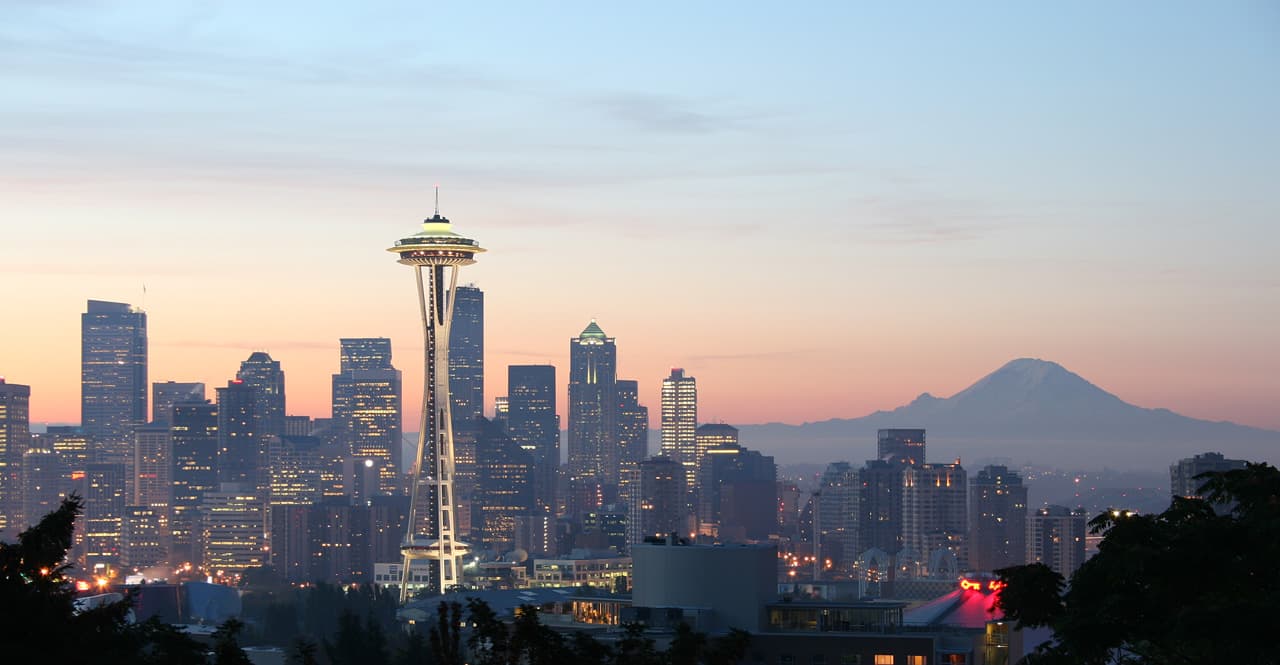
The first thing that pops into most people's minds when they think of Seattle is the Space Needle, north of Downtown in the Seattle Center. Although it's not the tallest building in Seattle, it still has a wonderful 360-degree view of both the city and the surrounding landscape. It is best to visit at sunset, when the mountains and sky will be lit up in beautiful colors. For a cheaper and less crowded option, head to the observatory at the Columbia Center building, which is higher than the Space Needle! For a better view of the waterfront and the downtown area, go aboard the Seattle Great Wheel.
Downtown, the Pike Place Market is Seattle's largest tourist area. Home to the famous fish market, the original Starbucks Coffee shop, produce stands, and a dedicated lane each for florists and foods. Don't forget to visit Post Alley, just a block away from Pike Place as you walk away from the shore, as there are some excellent food and souvenir places tucked away.
Do
Individual listings can be found in Seattle's district articles
Tours
Kenmore Air, 950 Westlake Ave N, ☏ +1-866-435-9524. 20 minute plane tours over Seattle that are narrated by the pilot, with spectacular views of the city. Tours begin and end at the west side of Lake Union. Reservations required. $99.50 per person.
Pioneer Square has a variety of tours of the Seattle Underground, the below-street-level corridors that were created when the district was raised by one floor during rebuilding after a massive fire in 1889. These informative tours are a great way to learn about Seattle's early history.
Water tours and cruises
Argosy Cruises, 1101 Alaskan Way, Pier 55. Cruise schedule varies by season. Ticket booth: Daily 10AM-4:05PM. Boat tour company with special dinner and sightseeing cruises. The most common tour is the hour-long Harbor Cruise on Elliott Bay, which offers excellent views of the Space Needle, Downtown skyline, freight harbor, and usually some sea lions, with a barrage of informative commentary about local history or interesting ships or cargo passing through that day. The Locks Cruise is a 2-hour one-way trip (in alternating directions) through the locks separating Elliot Bay and Lake Union, with an optional bus ride if you prefer a round trip. Seasonal cruises include the Summer Views Cruise with a sunset on Puget Sound, and Husky Football Cruises on Lake Washington before the games. Most cruises offer a decent full-service bar with large drinks and some snacks. Harbor cruise $30.50. Locks cruise $42.50, bus connection $5 additional. Discounts for kids 4-12 and seniors. (updated Mar 2018)
Eat
Individual listings can be found in Seattle's district articles
Typical of a big city, Seattle has a diverse range of fare representative of cuisines from around the world. Local chains and hole-in-the-wall restaurants dominate the city's dining atmosphere, and hearty. Prices are expensive by American standards; expect a counter-service lunch to set you back about $20, and a full service restaurant meal to cost a minimum of $30 after tax and tip.
Local specialties
Seattle's proximity to Alaska and the waters of the Pacific Ocean make it an excellent place to enjoy seafood. Look for salmon during the late summer months as options are abundant and the prices are among the cheapest on the West Coast, especially the red (sockeye) salmon. Shellfish are a prized resource of the Puget Sound, where the cool, clean waters provide an optimal habitat. Clams, mussels and oysters can be found easily, but other specialties like geoducks (pronounced GOO-ey-ducks) are sometimes available for the more adventurous. The Dungeness crab, named for a nearby town on the Sound, is a popular seafood prized for its sweet, tender flesh and high ratio of meat. The Dungeness is a commercially important crab in Washington's waters but other crab species are also common. The Alaskan king crab, caught from the deep cold waters of the Pacific Ocean near Alaska, has a more frequent presence here than the rest of the lower 48.
Drink
Individual listings can be found in Seattle's district articles
Few, if any, American cities can challenge Seattleites' love of coffee. This is perhaps best signified by the Seattle-based international chain Starbucks, but locals aren't satisfied by recognized chains alone, as evidenced by the hundreds of good locally owned coffeehouses. The best places to look for coffee are in Capitol Hill or Queen Anne Hill, where they take matters of coffee very seriously. Local favorites include Cafe Ladro, Vivace, Victrola, Caffe Vita, and Zoka, all of whom do their own roasting. Seattle coffee shops have their own slang: drip-brewed coffee is called simply "drip", two shots of espresso in a cup is a "doppio", and a "shot in the dark" is a shot of espresso poured into a cup of coffee, for a boost of extra caffeine. Some independent shops offer free cupping (tasting) classes, to educate customers about specialty beans.
If you prefer tea, many coffee shops offer a selection of teas, and specialty tea shops offer a large catalog and can help you with recommendations. Like any other city with a large Asian population, bubble tea or boba milk tea shops exist, and are popular among young people. Bubble tea is basically milk tea with various flavors and tapioca balls. Many of these shops also offer Asian snacks and delicacies. If you are thirsty and hungry, and budget is your main concern, this can be a good option. Most of these can be found in the University District as well as a few in the International District.
Get around
Seattle's public transportation system, while no rival for Chicago or New York City, is the most convenient and simple way to get around most of the city. While public transportation is also good in suburbs such as Bothell and Everett, if you plan on visiting those areas you may wish to use a car. Driving a car in Seattle is possible, but the frequent and awful traffic congestion can leave you frustrated. Parking for free in Downtown and many of the adjacent neighborhoods, such as Capitol Hill, is all but impossible. Seattle is also one of the most bicycle-friendly cities in the country, although you should be aware of the hilly terrain of the city that often makes cycling difficult. Carsharing services such as Zipcar, and ridesharing services such as Lyft and Uber, are also convenient and safe transportation options.
Orientation
Seattle's street designations are generally easy to remember once you understand them. Most of the city is laid out in a grid, with north-south roads called Avenues and east-west roads being Streets. There are occasional irregularities: Ways are long roads that don't always conform to the grid, Drives are long, circuitous routes, and there's the occasional very short Place or Court.
Stay safe
Statistically, the crime in Seattle is similar to other major cities in the United States. Auto break-ins and theft are a notable problem, so never leave your valuables visible in a car and always lock your car doors. The rough parts of Seattle are fairly safe compared to the worst parts of other American cities, and you are unlikely to get into trouble by being in the wrong neighborhood during the day. However, there are areas to avoid walking around at night, including along Aurora Ave and Lake City Way in North Seattle, the International District, and parts of South Seattle.
Downtown Seattle has a sizable population of homeless people (many neighborhoods have forced their homeless into Seattle's downtown core). While many beg for change or seem unstable, only a few are actually dangerous. Some places to be careful near major tourist areas include 3rd Ave downtown (especially between Pine St. and Pike St.), around Pioneer Square, and the International District (especially near 12th Ave and Jackson St).
On Friday and Saturday nights, take caution in the bar districts, including Belltown and the Pike/Pine corridor of Capitol Hill. You should be safe as long as you are not looking for trouble, but drunken and unruly behavior, in very rare cases, can lead to assault or shooting.
Drivers in Seattle are typically nice but indecisive. As long as you're careful as a pedestrian, you don't run a high risk of getting hit. Cyclists should be extra wary of traffic and opening doors of parked cars, especially Downtown.
Cannabis
Recreational cannabis (marijuana) is legal to buy and consume in Washington state for persons 21 and older. There are plenty of dispensaries in Seattle to buy from.
Purchasers are limited to one ounce of usable marijuana (the harvested flowers or "bud"), 16 ounces of marijuana-infused edibles in solid form, 72 ounces in liquid form, or 7 grams of marijuana concentrates.
It is illegal to consume marijuana in public, including on public transportation and at street festivals. This law is not often enforced, although tourists may want to ask a local for advice before they attempt to consume.
Practical facts for United States
Taken from open data. Rules and numbers change, so check locally before you rely on them.
- Currency
- US Dollar (USD)
- Languages
- American English, Spanish (United States), Hawaiian, and French
- Plugs and power
- Types A and B, 120 V at 60 Hz
- Traffic drives
- On the right
- Emergency numbers
- Any emergency911
- Country calling code
- +1
- Time zones
- America/Adak, America/Anchorage, America/Boise, America/Chicago, and 25 more
Official travel advice
Quoted from each government as published, with the date they last changed it. We do not add a verdict of our own.
UK Foreign, Commonwealth & Development Office
- No areas listed that it advises against travelling to
Read the full adviceThis travel advice also covers American Samoa, Guam, Northern Mariana Islands, Puerto Rico, and United States Virgin Islands.
Entry and visas
Entry rules depend on your passport and change without notice. Check the official pages before you book.
Sources