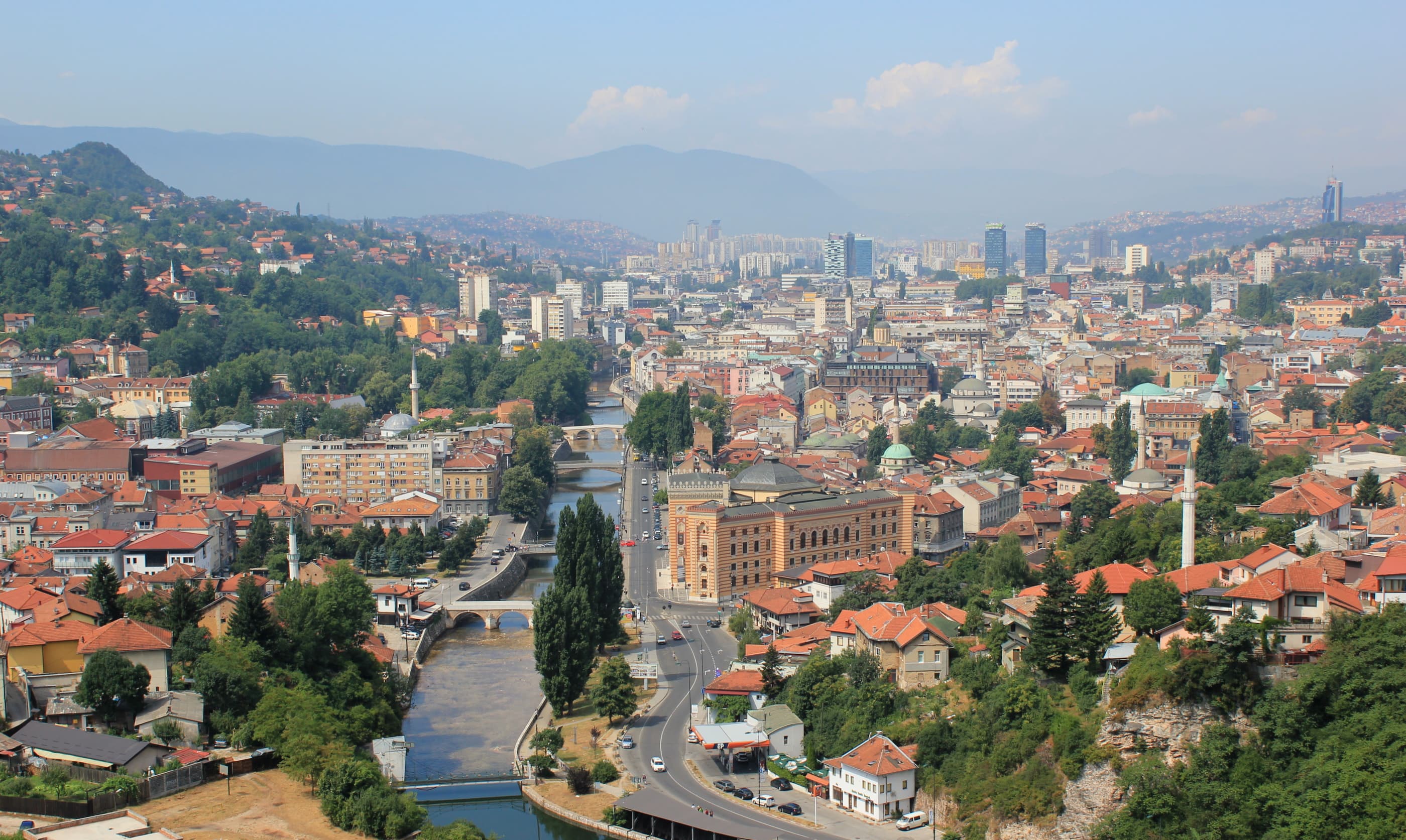

Bosnia & Herzegovina
A plan for Sarajevo
Not a list of things to see in Sarajevo — a day-by-day plan somebody could actually follow, built from places we can point to a source for. Make your own in about a minute.
- 2 nights
- Couple
- Balanced pace
- Mid-range budget
Every place here was checked on 2026-10-27 or later, and each one says where it came from.
The plan, day by day
Day 1
09:30
You arrive
13:00
Gazi Husrev-begov bezistan
Suggested because you chose food
- 1h
- Meal
14:30
Old Synagogue in Sarajevo
Picked because you chose culture & museums + balanced energy
- 2h 30m
- Culture & museums
2h open
Nothing planned here. That was on purpose.
19:00
Inat kuća
Suggested because you chose food
- 1h 30m
- Meal
20:30
Bosnian Cultural Center
Picked because you chose culture & museums + balanced energy
- 2h 30m
- Culture & museums
Day 2
08:00
Palma
Suggested because it fits a mid-range budget
- 45m
- Meal
45m open
Nothing planned here. That was on purpose.
09:30
War Childhood Museum
Picked because you chose culture & museums + balanced energy
- 2h 30m
- Culture & museums
1h open
Nothing planned here. That was on purpose.
13:00
Ćevabdžinica Nune
Suggested because you chose food
- 1h
- Meal
14:30
Museum of Sarajevo 1878–1918
Picked because you chose culture & museums + balanced energy
- 2h 30m
- Culture & museums
2h open
Nothing planned here. That was on purpose.
19:00
Kibe
Suggested because you chose food
- 1h 30m
- Meal
20:30
Kamerni teatar 55
Picked because you chose culture & museums + balanced energy
- 2h 30m
- Culture & museums
Day 3
08:00
Mrvica
Suggested because you chose food
- 45m
- Meal
45m open
Nothing planned here. That was on purpose.
09:30
11/07/95 Gallery
Picked because you chose culture & museums + balanced energy
- 2h 30m
- Culture & museums
1h open
Nothing planned here. That was on purpose.
13:00
Ćevabdžinica Ferhatović - Petica
Suggested because you chose food
- 1h
- Meal
14:30
You leave
Weather through the year
Monthly averages from NASA's 25-year climate record, day and night together.
Best months: June, July, and August
| January | Cold: -2°C, 77 mm |
|---|---|
| February | Cold: -1°C, 74 mm |
| March | Cold: 3°C, 74 mm |
| April | Cold: 8°C, 68 mm |
| May | Mild, some rain: 12°C, 81 mm |
| June | Mild, some rain: 17°C, 82 mm |
| July | Mild, some rain: 19°C, 54 mm |
| August | Mild, some rain: 20°C, 55 mm |
| September | Mild, some rain: 14°C, 78 mm |
| October | Cold: 10°C, 76 mm |
| November | Cold: 5°C, 91 mm |
| December | Cold: -0°C, 89 mm |
From the Wikivoyage guide
Quoted from the travel guide anyone can edit, as it read on the day we took it.
Understand
Sarajevo has 420,000 citizens in its urban area (2013). Sarajevo metropolitan area has a population of 555,000 and includes some neighbourhoods of "East Sarajevo" that are a part of Republika Srpska.
The city is commonly nicknamed "Jerusalem of Europe" or "Jerusalem of the Balkans" due to its long history of religious and cultural diversity, where mosques, synagogues, Catholic, and Orthodox churches have lived together for centuries.
History
Sarajevo is one of the most historically interesting and diverse cities in this part of Europe. It is a place where the Western and Eastern Roman Empire split; where the people of the Roman Catholic west, Eastern Orthodox east and the Ottoman south, met, lived and warred. It is both an example of historical turbulence and the clash of civilizations, as well as a beacon of hope for peace through multicultural tolerance. The city is traditionally known for its religious diversity, with Muslims, Orthodox Christians, Catholics and Jews coexisting here for centuries. Additionally, the city's vast historic diversity is strongly reflected in its architecture. Parts of the city have a very Central-European look, while other parts of the city, often blocks away, have a completely distinct Ottoman, some Soviet-like or Socialist modernism feel.
Some important events in Sarajevo's history include the 1914 assassination of Austrian Archduke Franz Ferdinand, which led to World War I; the 1984 Winter Olympics; and the 1992-1996 siege.
See
With the exception of the Tunnel Museum and the Bosna spring, all landmarks are in or within walking distance of Old Town. Several walking tours are available, a free/tip based walking tour starts every day at 10:30 at the crossing of Gazi Husrev begova street and Mula Mustafa Baseskija street (address: Velika Avlija 14) and covers most of the Baščaršija (takes two hours).
The municipality of Sarajevo provides an app called "Guide2Sarajevo" (Android, ios). It contains a map with sights and restaurants as well as several themed routes to walk in the city (ranging from 2 to 6 hours) on which you use your phone as audio guide (works even without mobile internet, because the files are downloaded on installation). It's remarkably well made.
1 Avaz Twist Tower, Tesanjska 24a (100 m east of railway station), ☏ +387 33 281 350. 07:00-22:00. The easiest way to orient yourself in the city is to look for this distinctive 176 m twisted tower, completed in 2008, and hosting the media company Dnevni avaz. There's a café-bar & restaurant on Level 35, reached by lift (free access). From there you pay 2 KM in coins to pass the turnstile and walk upstairs to Level 36, which has an observation deck with outside walkway. The café-bar and restaurant are smoky and the food & service aren't up to much. 2 KM. (updated Jul 2019)
Baščaršija
Baščaršija is the historic district of Sarajevo. The cobbled streets, mosques and oriental-style shops at the heart the city feel like a world away from Europe when the call to prayer starts. You could be walking by a Catholic church, Orthodox church or a synagogue and hear the Islamic call to prayer at the same time. In this old bazaar you can find dozens of shops selling copperware, woodwork and sweets. Many historic monuments are situated around Gazi Husrev-begova street.
Do
Cable car (From Franjevačka south of the river, a short walk over the river from the City Hall.). Mon–Tue 10:00–20:00; Wed–Sun 09:00–20:00. Restored in 2018, this cable car runs up to the former 60 Ski Station. The area boasts views, hilltop strolls, and a decent cafè. However, the ride could be considered a bit overpriced. Forest paths lead to the Pino Hotel (accessible by road, e.g. by taxi) and the pictureque and Instagram-heavy Trebevic Bobsled Track, which mad off-road bikers hurtle down, and which is being restored for winter sports. You could walk one direction to see the bobsled track, and use the cable car the other direction, since the slide is pretty much between the Ski Station and the city. 30 KM return, 20 KM one-way (locals pay less than a third). (updated Sep 2024)
1 National Theatre (Narodno pozorište), Obala Kulina bana 9 (tram-stop Pošta), ☏ +387 33 226-431, info@nps.ba. The National Theatre has a regular programme of plays, concerts and opera. It was built in 1899 as a "Gentlemen's Club" by Czech architect Karel Pařík, who contributed to over 160 buildings in and around Sarajevo. (updated Jul 2019)
Fox in a Box, Sime Milutinovica 15/I (Next to Museum of Literature & Performing Arts, off Zelenhi berekti), ☏ +38 761 10 10 07, info@foxinabox.ba. 09:30-22:30. Escape room games. In "Mr Fox's Secret Study", you try to escape from the office by solving riddles. In "The Bank Job", you try to steal diamonds from the bank safe, in the dark by torch. In "The Bunker", you try to avert an accidental nuclear war. 60 KM. (updated Jul 2019)
Eat
It is said in Bosnia that some people eat to be able to drink, others eat to be able to live and work, but true Bosnians work and live to eat. A lot of attention is devoted to the preparation and consumption of food in Sarajevo. Gastronomy in the city was developed under Eastern and Western influences, and Bosnian cuisine focuses on local produce like meat, vegetables, fruits and dairy products. For information on typical Bosnian foods, see Bosnia#Eat.
Budget
Cheap food on the go, from a myriad small shops and cafés, is burek, ćevapi or pita. Burek is meat pie. Ćevapi are grilled meats; the word derives from "kebab" and the traditional Sarajevo style is minced beef and mutton in a somun flatbread. Pita is a filo pasty or pie, typical varieties being meat (meso), cheese (sirnica, similar to ricotta), cheese and spinach (zeljanica), pumpkin (tikvenica) and spicy potato (krompirusa).
City centre around the Gazi Husrev-beg Mosque
1 Buregdžinica Bosna, Bravadžiluk 11, ☏ +387 33 538-426. Daily 08:00-23:00. Pita & burek café, sandwiched between Mrkva and Bosnian House. (updated May 2022)
2 Fan Ferhatović, Čizmedžiluk 1. Pleasant ambience in the bazaar, good local food, friendly staff. (updated May 2022)
3 Ćevabdžinica Željo 3, Ćurčiluk veliki 34. Traditional Bosnian barbecue food. The atmosphere is great. (updated May 2022)
4 Sač, Bravadžiluk mali 2. Authentic Bosnian cuisine with yummy burek and excellent pies. (updated May 2022)
5 Teraza, Strossmayerova 8, ☏ +387 61 569 513. Pizzas and Bosnian sandwiches. Excellent location just heart of the city center with unique retro design makes you feel calm and relax. The food and the service are good. (updated May 2022)
6 The Epicentrum, Muvekita 11. Excellent homemade food, paradise tomato soup. (updated May 2022)
City centre around the Vječna vatra memorial
7 Pizzeria Ago, Mula Mustafe Baseskije 17, ☏ +387 33 203-900. 08:00-23:00. Good value pizzas, and pancakes at only 2 KM. Excellent pizzeria, great service and staff. (updated May 2022)
Drink
Sarajevo has a vibrant night life with plenty of small thematic bars. Clubs are usually opened until early morning. Although many venues are open all week, Thursday, Friday and Saturday are the most frequented. There are numerous cafés in the city, centred primarily around the old town. Look out for the traditional Bosnian-style coffee!
Cafés
1 Cafe Slastičarna "Palma", Porodice Ribar br.5, ☏ +387 33 714 700, info@palma.ba. Coffee and pastry shop, located in the part of town called Hrasno, started in 1970. In 1985 "Palma" received the CD -Diplomatic Consular Code. (updated Sep 2017)
2 Ministry of Ćejf, Kovači 26, ☏ +387 61 482 036. Great espresso and well trained baristas. Also has karak and good cakes. (updated Sep 2017)
3 Miris Dunja, Ulica Čizmedžiluk 9, ☏ +387 62 922 900. Coffee, including Bosnian coffee, and fruit juices. On a typical day the Bosnian coffee is very good, and on a good day it is extraordinary. Bosnian coffee: 2 KM. (updated Aug 2019)
4 Mrvica, Paromlinska 58h (located in the Novo Sarajevo residential area, near "Vjetrenjača" (Windmill)), ☏ + 387 62 887 777, info@mrvica.ba. Coffee, brunch or even lunch (updated Sep 2017)
5 Mrvica Old Town, Ulica Jelića 5 (near the Sacred Heart Cathedral "Katedrala Srca Isusova"). Coffee and different types of cakes and desserts. No Bosnian coffee served, only "modern" coffee styles. (updated Sep 2017)
6 Opera Bar/Café, B Sarajeva 25 (opposite the city's Opera house), ☏ +387 33 831-647. 07:00-12:00. Fast WiFi connection, but the staff can be unfriendly and inattentive. Attracts a community of casual actors and musicians. Espresso: 2 KM. (updated Jul 2017)
Bars
7 Café de Paris, Hamdije Kreševljakovića 61 (South end of Ćumurija bridge, in the green-and-yellow building.), ☏ +387 33 211-609. 07:00–22:00. You might not have expected to find an IPA in the Balkans, but Café de Paris serves a selection of craft beers from Sarajevo microbreweries. They also have a range of very smooth local rakijas (try the quince). Riverside, outdoor seating looks out upon impressive architecture from the Austro-Hungarian times. Craft beer 3–4 KM. (updated Oct 2016)
8 Tre Bicchieri Wine Store & Tasting Bar, Cobanija 3, ☏ +387 33 223-230. Long list of Italian wines. Very cozy and comfortable place. Good music & relaxing atmosphere. (updated Jul 2017)
Get around
Sarajevo is a medium-sized, beautiful city with many landmarks. Getting lost is always possible, but much less so if you have a map; however, getting lost in Bascarsija's winding streets can be part of the fun, and may reveal some interesting surprises.
Very good free maps can be obtained from the tourist information office, shopping centres and hotels. Some bookshops may also sell printed maps of the city. Map apps on a smartphone are particularly useful.
Asking Sarajevans for directions is an exercise in futility. People might not know the names of streets a block from the building they've lived in all their lives. Taxi drivers can't be expected to find anything other than the most obvious addresses unless you tell them where to go, in Bosnian; showing the driver on your map may be necessary.
Avoid driving in the Old Town. The steep and narrow streets, with a one way system, means you are likely to get lost and possibly damage your car. Also, it is next to impossible to find a parking spot.
For destinations farther from the center, such as Ilidža or Vogošća, trams and trolleybuses(tram line 3 and trolley line 105 respectively) provide good connections.
On foot
In Sarajevo, street signs are few and far between, and small and on the sides of buildings too far away to see when you're standing on a street corner. Building numbers are more or less consecutive. The city is mostly walkable, especially the city centre and the part of the city which is built on the slopes of Mt. Trebević.
By tram
Sarajevo’s tram network, operated by KJKP GRAS, is one of the oldest in Europe and forms the backbone of public transport in the city. The main line runs from in the west to the city center and the railway and bus stations, following the main boulevard and passing through and Marijin Dvor. Trams 1 and 4 serve the central loop route, while Tram 3 continues the full length of the line to Ilidža.
The entire tram track network has undergone a major renovation, improving safety and comfort. GRAS has also procured 25 brand-new trams from the Swiss manufacturer Stadler, gradually replacing older vehicles. An extension of the tram line from Ilidža to the suburb of Hrasnica is under construction, with completion expected in early 2026.
Stay safe
There are still many minefields and unexploded ordnances in the broader Sarajevo area (although not in any urban area). Never go into damaged buildings (which are really rarely seen) and always stick to paved surfaces avoiding grassy hills that surround the city. As of 2020, Trebević has been completely demined. Areas that are not cleared are marked by yellow tape or signs, but still not all minefields have been identified due to the lack of resources and the lack of international help. Paved roads are always safe.
Bosnia and Herzegovina has double the traffic fatality rate in Europe as a whole, and in the early 2020s there have been a few high-profile accidents with pedestrians. Be alert whether driving or crossing the street.
Most of the city is safe to visit, with crime against foreigners being very rare, but avoid areas such as Alipašino Polje, Švrakino and the surrounding areas of the Novi Grad municipality, as those are mainly dangerous zones with high crime rates, shootings, violence and poverty. Go there only with locals, and not during the night. It is unlikely you will go there anyway; said neighbourhoods are far from the city centre and any of the sights in outlying areas.
There are a number of pickpockets working in the city and very few police officers on patrol; police are rarely seen. Although said pickpockets are typically easy to spot, it is still worth staying alert. Be aware of them especially on public transportation.
Due to being surrounded by hills the air in Sarajevo in winter months (November-February) can be noticeably thick with pollution, so that asthmatics or those with other chest problems may find themselves short of breath a lot of the time, particularly at night. Ensure you have ample medication, just in case.
Emergency services
General emergency number, ☏ 112.
Police, ☏ 122.
Fire, ☏ 123.
Ambulance, ☏ 124.
Mountain Rescue, ☏ +387 33 61 29 94 43, toll-free: 121.
Respect
Sarajevo’s cultural heritage blends influences from the Ottoman, Austro-Hungarian, and Yugoslav periods, resulting in a uniquely multicultural and multireligious city. Mosques, churches, and synagogues often stand within walking distance of each other, reflecting the city’s long tradition of coexistence. Visitors are generally welcomed warmly regardless of background, and showing respect for different faiths and customs is always appreciated.
When visiting mosques, modest clothing is expected, men and women should cover their shoulders and knees, and women are advised to wear a headscarf. Scarves are usually available for visitors to borrow at the main tourist mosques. Many locals identify culturally with their faith rather than practicing it strictly; for instance, some Muslims may drink alcohol or eat pork, while others refrain entirely.
While the Bosnian War (1992–1995) left deep marks on the city, Sarajevo today is peaceful and forward-looking. Conversations about the war, politics, or ethnicity can still be sensitive subjects, especially for those who experienced the siege firsthand. It’s best to approach such topics respectfully and only if your conversation partner initiates them. Locals generally prefer to focus on the city’s recovery, cultural life, and its growing role as a vibrant European capital.
Practical facts for Bosnia & Herzegovina
Taken from open data. Rules and numbers change, so check locally before you rely on them.
- Currency
- Bosnia-Herzegovina Convertible Mark (BAM)
- Languages
- Bosnian, Croatian (Bosnia & Herzegovina), and Serbian (Bosnia & Herzegovina)
- Plugs and power
- Types C and F, 230 V at 50 Hz
- Traffic drives
- On the right
- Country calling code
- +387
- Time zone
- Europe/Sarajevo
Official travel advice
Quoted from each government as published, with the date they last changed it. We do not add a verdict of our own.
UK Foreign, Commonwealth & Development Office
- No areas listed that it advises against travelling to
Read the full adviceTravel disruption
The border crossing at Gradiška has been relocated to a new facility. Travellers should plan ahead and check local advice before crossing by car.
The European Union’s (EU) new Entry/Exit System (EES) is now being implemented across the Schengen area. The EES may take each passenger extra time, so it is important to be prepared to wait longer than usual at EU country borders and allow more time for immigration controls if travelling to and from the Schengen area.
US Department of State
Level 2 of 4: Exercise increased caution
Read the full adviceExercise increased caution in Bosnia and Herzegovina due to risk of crime, landmines, and terrorism.
• Recent unrest has been politically related. While it has not impacted tourists or members of the international community, there is a risk that bystanders can be affected.
• Review our Travel Guidance for Bosnia and Herzegovina to learn how to prepare for a safe trip.
Crime
• Sarajevo has a high rate of property-related crime, including robberies, residential and vehicle break-ins, and theft.
• Petty crime is common, especially in popular tourist locations. Stay
aware of your surroundings.
Entry and visas
Entry rules depend on your passport and change without notice. Check the official pages before you book.
Sources