
Brazil
A plan for Rio de Janeiro
Not a list of things to see in Rio de Janeiro — a day-by-day plan somebody could actually follow, built from places we can point to a source for. Make your own in about a minute.
- 2 nights
- Couple
- Balanced pace
- Mid-range budget
Every place here was checked on 2026-10-28 or later, and each one says where it came from.
The plan, day by day
Day 1
09:30
You arrive
13:00
Cervantes
Suggested because you chose food
- 1h
- Meal
14:30
Teatro Municipal
Picked because you chose culture & museums and local experiences + balanced energy
- 2h 30m
- Culture & museums
2h open
Nothing planned here. That was on purpose.
19:00
Adega Pérola
Suggested because you chose food
- 1h 30m
- Meal
20:30
Beco do Alemão
Picked because you chose food and local experiences + balanced energy
- 1h 30m
- Food
Day 2
08:00
Armazém do pão
Suggested because it fits a mid-range budget
- 45m
- Meal
45m open
Nothing planned here. That was on purpose.
09:30
Centro de Tradicoes Nordestinas Luiz Gonzaga
Picked because you chose culture & museums and local experiences + balanced energy
- 1h 30m
- Culture & museums
2h open
Nothing planned here. That was on purpose.
13:00
Zazá Bistrô
Suggested because you chose food
- 1h
- Meal
14:30
Prainha
Picked because you chose local experiences + balanced energy
- 3h
- Beach
1h 30m open
Nothing planned here. That was on purpose.
19:00
Sushi Leblon
Suggested because you chose food
- 1h 30m
- Meal
20:30
Bar do Adão
Picked because you chose food and local experiences + balanced energy
- 1h 30m
- Food
Day 3
08:00
Cafe Ao Leu
Suggested because it fits a mid-range budget
- 45m
- Meal
45m open
Nothing planned here. That was on purpose.
09:30
Sítio Roberto Burle Marx
Picked because you chose culture & museums and local experiences + balanced energy
- 2h 30m
- Culture & museums
1h open
Nothing planned here. That was on purpose.
13:00
Viva Gastronomia
Suggested because it fits a mid-range budget
- 1h
- Meal
14:30
You leave
Weather through the year
Monthly averages from NASA's 25-year climate record, day and night together.
Best months: June, July, August, and September
| January | Wet season: 26°C, 208 mm |
|---|---|
| February | Rainy: 26°C, 152 mm |
| March | Rainy: 25°C, 173 mm |
| April | Rainy: 24°C, 101 mm |
| May | Mild, some rain: 22°C, 71 mm |
| June | Mild, some rain: 22°C, 49 mm |
| July | Mild, some rain: 21°C, 45 mm |
| August | Mild, some rain: 21°C, 42 mm |
| September | Mild, some rain: 22°C, 69 mm |
| October | Rainy: 23°C, 108 mm |
| November | Wet season: 23°C, 220 mm |
| December | Wet season: 25°C, 232 mm |
From the Wikivoyage guide
Quoted from the travel guide anyone can edit, as it read on the day we took it.
Understand
It is a common mistake to think of Rio as Brazil's capital, a distinction it lost on April 21, 1960 when the national government officially moved to Brasilia. Beaches such as Copacabana and Ipanema, the Christ The Redeemer (Cristo Redentor) statue, the stadium of Maracanã and Sugarloaf Mountain (Pão de Açúcar) are all well-known sights of what the inhabitants call the "marvelous city" (cidade maravilhosa), and are also among the first images to pop up in travelers´ minds, along with the Carnaval celebration.
The South Zone holds most of Rio's landmarks and world-famous beaches, in an area of only 43.87 square kilometres (16.94 sq mi). Many of them are within walking distance of each other (for instance, the Sugarloaf lies about 8 km (5.0 mi) from Copacabana beach). Most hotels and hostels are located in this part of the city, which is compressed between the Tijuca Range (Maciço da Tijuca) and the sea. There are important places in other regions as well, such as Maracanã stadium in the North Zone and the many fascinating buildings in the centre.
Sadly, most people also know Rio for its violence and crime, especially related to drugs. And social problems, as slums or favelas, areas of poor-quality housing and living; these slums are usually located on the city's many mountain slopes, juxtaposed with middle-class neighbourhoods.
See
Sights
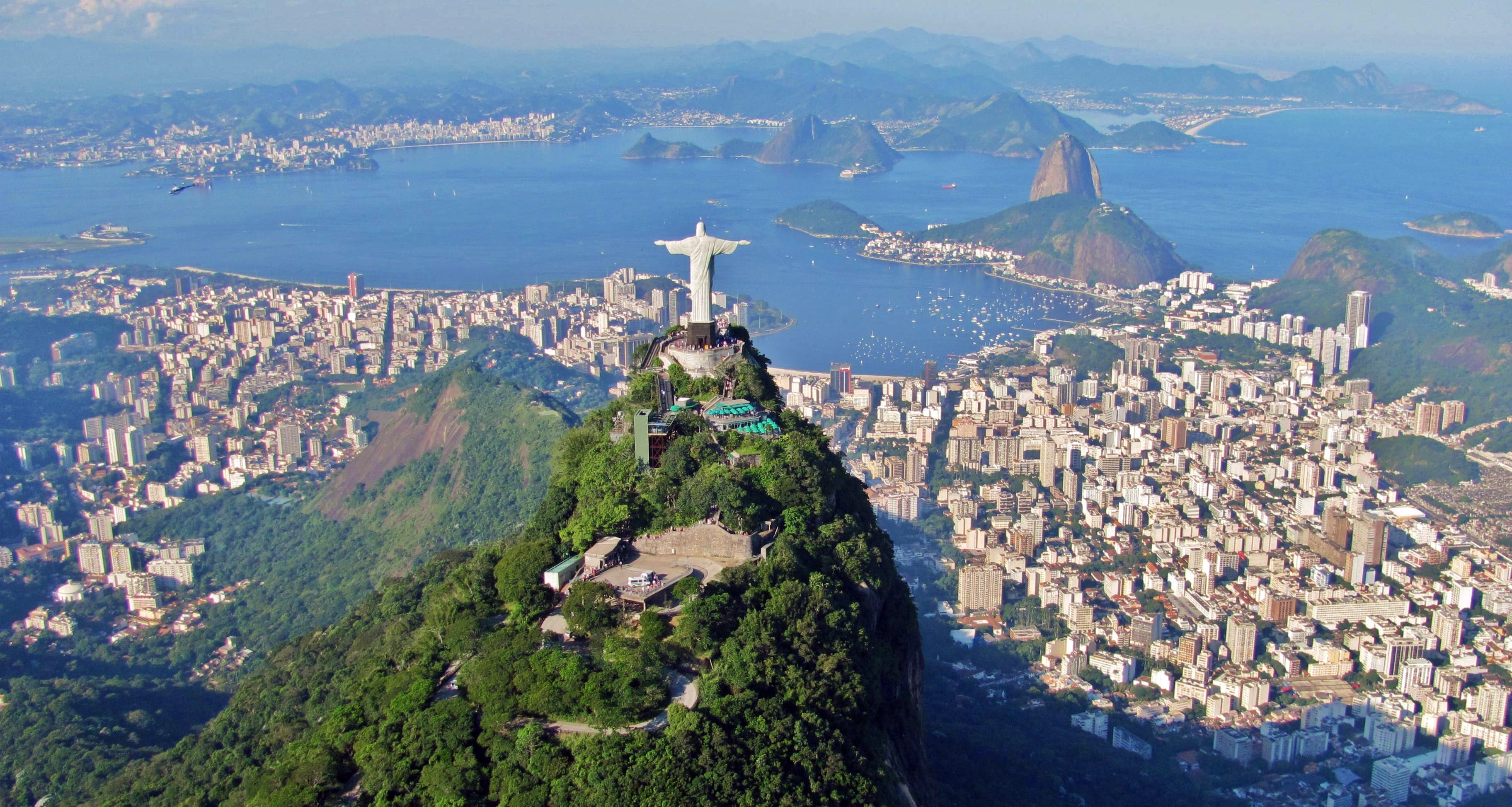
Corcovado, the 710 m (2,330 ft) granite peak located in the Tijuca Forest in central Rio is known worldwide for the Cristo Redentor statue. The funicular train up to Cristo Redentor is definitely worth the view. The queue for the train, in Cosme Velho, can get rather long though. There's also a hiking trail that begins at Parque Lage and gets there (see Hiking and Trekking on the 'Do' section below).
Pão de Açúcar, the Sugarloaf Mountain (one taller, the other shorter), Brazil's top landmark, with a two-stage aerial tramway to the top; a definite must-see. There is also an unsigned trail leading to the second station. Do not make the mistake of thinking you have seen enough once you have seen the view from Cristo Redentor. Try Sugarloaf at sunset for a truly mind-blowing experience.
Lagoa Rodrigo de Freitas is a large lagoon in the middle of South Zone, with great views to Corcovado and Ipanema and Leblon beaches; you can jog or cycle all the way round; there are skating areas and you can hire little pedal-operated boats.
Maracanã the largest football stadium in South America and once the largest on Earth. It is in a state of disrepair following the Summer 2016 Olympics, and daily tours have been suspended. There is also a Soccer Museum inside it.
Streetcar of Santa Teresa, Brazil's only remaining metropolitan heritage streetcar.
Jardim Botânico, the Botanical Garden, planted in the 1800s. It is both a park and a scientific laboratory contains a huge collection of plants from all over the world, not only tropical ones.
Parque Lage a small park containing some interesting plants and wildlife as well as strange concrete structures that will entertain the kids. The park is the beginning of a hiking trail Corcovado, through sub-tropical rain forest.
Parque do Flamengo, also known as Aterro do Flamengo is along the bay between Flamengo and Glória. 1.2 million square metres with broad walkways, Flamengo Beach, various monuments, and over 10,000 trees.
Buildings
Paço Imperial is the former imperial palace (though impressively modest), colonial architecture, in downtown, next to aça XV.
Casa França Brasil (1820) is the French cultural centre, with gallery and video hall (in downtown, next to CCBB).
Do
Carnaval
Still the greatest reason for visiting Rio seems to be the Carnaval. This highly advertised party lasts for almost two weeks and it is well known for the escolas de samba (samba schools) that parade in Centro, on a gigantic structure called Sambódromo (Sambadrome). During Carnaval, Rio has much more to offer though, with the blocos de rua, that parade on the streets. There are now hundreds of these street "samba blocks", that parade almost in every neighborhood, especially in Centro and the South Zone, gathering thousands of people. Some are very famous, and there are few cariocas that have not heard of "Carmelitas", "Suvaco de Cristo", "Escravos da Mauá" or "Simpatia É Quase Amor".
The rest of the year, samba shows are popular with tourists, and are held at several venues like Plataforma and Scala. These are expensive and not really representative of Brazilian culture, they present a lot of almost naked women and bad musicians, a tourist trap (much like the real thing.) Much more interesting and genuine, though, are the night practice sessions held by the various samba schools in the months leading up to Carnaval. You will find only a small number of tourists here, and you will be served the best caipirinhas of your trip! These go on into the wee hours of the morning, with the fun really only starting at 01:00-02:00. A good cab driver should be able to hook you up, and cabs will be available to take you back when you are samba-ed out. Salgueiro and Mangueira are good choices, as they are two of the larger samba schools, and are located relatively close to the tourist areas in a fairly safe area.
Eat
In Rio de Janeiro you can probably find something to fit any craving. A good approach to local food is "comida a kilo" – buffet style restaurants where you pay by the weight of the food on your plate.
Don't miss the most famous Brazilian dish, feijoada (fay-zho-AH-da), a black bean stew filled with big chunks of meat, like sausage, pork and beef. Along with the "feijoada", you also get some colorful side dishes that come with it, such as rice, cassava (roasted manioc), collard greens, fried pork rinds, and some orange slices, to sweeten things up a bit. This is bonafide, authentic carioca culinary excellence, almost worth the trip alone! Best while sipping down a "caipirinha".
For the hungry, nothing beats a good rodízio (all-you-can-eat service). These are available in numerous types, although the most well-known are the churrascaria, all-you-can-eat grilled meats. At various restaurants around town, you can also find rodízio style dining featuring seafood, pizza, or various appetizer-style snacks. The defining element of rodízio is that unlike an all-you-can-eat buffet, the servers continuously bring skewers of various meats.
If you like meat but want an alternative to the rodizios, a good place to eat at is Filé de Ouro (Rua Jardim Botânico, 731, Jardim Botânico; ☏ +55 21 2259-2396; see Google Maps for directions). The place is simple and cozy. During the weekends there are usually big lines, but the steak is delicious. Try "Filé à Oswaldo Aranha", with toasted garlic.
Brazil has the largest population of Japanese outside of Japan, and sushi has become widely popular in Rio too. If you are a sashimi and sushi lover, you will find a great deal of options in Rio de Janeiro.
As a former ex Portugal colony, Brasil has maintained many influences of this country on its culinary. Therefore, you will find great authentic Portuguese restaurants in Rio.
Because its huge coast, many Brazilian specialties are in the seafood area. They are very rich in shrimps, lobster, calamaris, shellfish, clams, mollusks and many other tasty fishes. So, once in this land, don't miss the opportunity to order those lovely dishes.
Travellers with fatter pockets may also splash out a bit at the Dias Ferreira street in Leblon, Rio's up-and-coming restaurant row.
Drink
What
Botequim (pronounced 'boo-chi-KEEN') also well known as boteco. These unpretentious bars with simple appetizers and lots of ice-cold chope (draft beer) are everywhere and are almost inseparable from the carioca lifestyle. Try Bracarense (85, José Linhares street, Leblon), one of the most traditional.
Juice bars - Of particular note for an often hot and muggy city are the refreshing juice bars, found on nearly every corner in the city. Choose from dozens of freshly squeezed fruit juices - mix two or three fruits together or simply try the freshly squeezed orange juice. For a delicious Brazilian special try the açaí, a smoothie made from a deep purple fruit from the Amazon.
Caipirinha, a drink made of cachaça (a Brazilian liquor made of sugarcane juice), lime, sugar and ice cubes.
Where
Kiosks along the boardwalk at Copacabana and Ipanema beach stay open all night.
Devassa, which has nine locations in Rio, serves well-crafted microbrews, a tropical take of English ale styles.
Neighborhoods:
Lapa - A good bet for Thursdays, several bars and clubs, but the party is in the street. There you will find people dancing and playing Samba, Choro (soft rhythm with flutes and mandolin), Reggae and Hip Hop, as well as ballroom dancing (gafieira), but no Rock (except for some underground, which doesn't happen often or in the same place, but usually in some less known places of Lapa) or Pop music. While drinks are sold in the bars and clubs, vendors also roam the streets wearing coolers full of beer for even cheaper prices. It can also be a very exciting and packed place on Friday and Saturday nights. Be sure not to bring valuables, as there are a lot of pick-pockets operating in the area. Don't take it for the neighborhood with the same name in São Paulo, which is totally different.
Get around
Rio de Janeiro possesses an extensive and complex, highly multi-modal public transportation system, adapted to the city's unique topography – large areas covered by mountains surrounded by pockets of densely populated flat lands. Among the public transportation modes, there is subway, heavy rail, light rail, bus rapid transit, local buses, microbuses, cable cars and ferry boats.
The city uses a prepaid transport SmartCard, the RioCard Bilhete Único Carioca, which costs as much as a single ride (R$4,70) and gives access to nearly all available public transportation (mostly excluding tourist rides), also offering discounts if the user takes more than one transportation within a 2-hr time period and stays within the Rio de Janeiro municipality. Cards can be returned with getting the money on it back. This can be a good way to get cash off credit cards that have a minimum cash withdrawal of like US$40, but in case you only need another R$40 before leaving the country.
Unfortunately, the RioCard cannot be returned at the airport or at most stations. It can only be returned at a RioCard store which only exist in certain major stations.
It is very convenient to get a Bilhete Único if you plan to use public transport on a regular basis during your stay in Rio, as it saves you the hassle of constantly figuring out which type of integration ticket to buy. If you stick to subway, heavy rail, bus rapid transit and local buses (not including executive buses), a public transport trip using the Bilhete Único shall cost between US$1–2.
By boat
Ferry boats depart from 6 Praça XV. Station (Estação das Barcas), Praça Quinze de Novembro. The city ferry network include: Eight stations (Praça XV, Praça Arariboia, Charitas, Paquetá, Cocotá, Ilha Grande, Mangaratiba, Angra dos Reis). - Six lines are: Praça XV - Praça Arariboia (20 min., R$ 4,80); Praça XV - Charitas (20 min, R$13); Praça XV - Paquetá (50-70 min, R$4,80); Praça XV - Cocotá (55 min, R$4,80); Ilha Grande - Mangaratiba (80 min, R$14); Ilha Grande - Angra dos Reis (80 min, R$14)
Stay safe
Rio de Janeiro's reputation as a dangerous city was cemented internationally by the critically acclaimed movie Cidade de Deus — a reputation that's not entirely unwarranted.
Although most visitors to the city have a great time with no incidents, Rio can be dangerous. As a traveler, even if you don't leave the "Zona Sul" (which includes Copacabana, Ipanema, Leblon, Gávea, Jardim Botânico, Flamengo, Laranjeiras, Botafogo, Urca) or Western Suburbs (Barra, Recreio), you may experience a palpable tension over security.
Generally, tourists (also called "gringos", which is not derogatory but means "outsiders") and teenagers are considered "easy" targets for criminals. Day-to-day living has also been affected by this. For example, banks all have security doors and armed guards. Rio can be a dangerous city and it is wise to follow the advice below even if it seems exaggerated.
Don't walk around with lots of money in your pocket. ATMs are everywhere (stick to the ones inside shopping centers) and credit/debit cards are widely accepted. But don't walk around without any money: you may need something to give to the bad guys in case you are mugged. Not having money to give a mugger can be dangerous as they may get angry and resort to violence. An excellent idea is to buy a "capanga" (literally meaning bodyguard), that is, a small pouch worn under your shirt, normally used to carry your wallet and keys.
Avoid showing visible signs of wealth (cameras, jewelry, etc.) at any time of the day, as these attract attention. Thieves have been known to run past targets and tear off necklaces, rings, and earrings without stopping. Earrings are particularly dangerous as tearing them off often harms the owner.
Practical facts for Brazil
Taken from open data. Rules and numbers change, so check locally before you rely on them.
- Currency
- Brazilian Real (BRL)
- Languages
- Brazilian Portuguese, Spanish, English, and French
- Plugs and power
- Types C and N, 127 or 220 V at 60 Hz
- Traffic drives
- On the right
- Country calling code
- +55
- Time zones
- America/Araguaina, America/Bahia, America/Belem, America/Boa Vista, and 12 more
Official travel advice
Quoted from each government as published, with the date they last changed it. We do not add a verdict of our own.
UK Foreign, Commonwealth & Development Office
- Advises against all but essential travel to parts of the country
Read the full adviceAreas where FCDO advises against all but essential travel
Amazonas State
FCDO advises against all but essential travel to the following river areas towards the west of Amazonas State:
• along the Amazonas (Amazon) River and its tributaries west of the town of Codajás and east of the town of Belém do Solimões in Amazonas State
• along any part of the Itaquaí River in Amazonas State
• along any part of the Japurá River or its tributaries in Amazonas State
• along the Rio Negro (Black River) and its tributaries north or west of the town of Barcelos in Amazonas State
Find out more about why FCDO advises against travel.
US Department of State
Level 2 of 4: Exercise increased caution
Read the full adviceExercise increased caution in Brazil due to crime and kidnapping. Some areas have increased risk. Read the entire Travel Advisory.
Crime
Violent crime occurs in urban areas, day and night. Crimes include murder, armed robbery, and carjacking.
• Gang activity and organized crime are widespread. and are often tied to the illegal drug trade.
• Assaults are common, including with sedatives or drugs placed in drinks, especially in Rio de Janeiro.
• Criminals target foreigners through dating apps or at bars before drugging and robbing their victims.
Entry and visas
Entry rules depend on your passport and change without notice. Check the official pages before you book.
Sources