
Czechia
A plan for Prague
Not a list of things to see in Prague — a day-by-day plan somebody could actually follow, built from places we can point to a source for. Make your own in about a minute.
- 2 nights
- Couple
- Balanced pace
- Mid-range budget
Every place here was checked on 2026-10-27 or later, and each one says where it came from.
The plan, day by day
Day 1
09:30
You arrive
13:00
U Fleků
Suggested because you chose food
- 1h
- Meal
14:30
Klausen Synagogue
Picked because you chose culture & museums + balanced energy
- 2h 30m
- Culture & museums
2h open
Nothing planned here. That was on purpose.
19:00
Konvikt
Suggested because you chose food
- 1h 30m
- Meal
20:30
Estates Theatre
Picked because you chose culture & museums + balanced energy
- 2h 30m
- Culture & museums
Day 2
08:00
Grand Café Orient
Suggested because it fits a mid-range budget
- 45m
- Meal
45m open
Nothing planned here. That was on purpose.
09:30
Planetárium Praha
Picked because you chose culture & museums + balanced energy
- 2h 30m
- Culture & museums
1h open
Nothing planned here. That was on purpose.
13:00
Vinohradský pivovar
Suggested because you chose food
- 1h
- Meal
14:30
National Museum in Prague
Picked because you chose culture & museums + balanced energy
- 2h 30m
- Culture & museums
2h open
Nothing planned here. That was on purpose.
19:00
El Centro
Suggested because you chose food
- 1h 30m
- Meal
20:30
Municipal House
Picked because you chose culture & museums + balanced energy
- 2h 30m
- Culture & museums
Day 3
08:00
Osada
Suggested because you chose food
- 45m
- Meal
45m open
Nothing planned here. That was on purpose.
09:30
Villa Müller
Picked because you chose culture & museums + balanced energy
- 2h 30m
- Culture & museums
1h open
Nothing planned here. That was on purpose.
13:00
U Mlynáře
Suggested because you chose food
- 1h
- Meal
14:30
You leave
Weather through the year
Monthly averages from NASA's 25-year climate record, day and night together.
Best months: June, July, August, and September
| January | Cold: -2°C, 42 mm |
|---|---|
| February | Cold: -1°C, 32 mm |
| March | Cold: 3°C, 39 mm |
| April | Cold: 9°C, 36 mm |
| May | Mild, some rain: 14°C, 69 mm |
| June | Mild, some rain: 18°C, 78 mm |
| July | Mild, some rain: 20°C, 79 mm |
| August | Mild, some rain: 20°C, 81 mm |
| September | Mild, some rain: 14°C, 53 mm |
| October | Cold: 9°C, 46 mm |
| November | Cold: 4°C, 43 mm |
| December | Cold: -1°C, 41 mm |
From the Wikivoyage guide
Quoted from the travel guide anyone can edit, as it read on the day we took it.
Understand
This city of bridges, cathedrals, gold-tipped towers and church domes, has mirrored on the surface of the swan-filled Vltava river for more than ten centuries. Almost undamaged by World War II, Prague's compact medieval centre remains a wonderful mixture of cobbled lanes, walled courtyards, cathedrals and countless church spires all in the shadow of her majestic 9th century castle that looks eastward as the sun sets behind her. Prague is also a modern and vibrant city full of energy, music, cultural art, fine dining and special events catering to the independent traveller's thirst for adventure.
Regarded as one of Europe's most charming and beautiful cities, Prague has become the most popular travel destination in Central Europe along with Budapest and Kraków. Millions of tourists visit the city every year.
Prague was founded in the later 9th century, and soon became the seat of the Kings of Bohemia, some of whom ruled as Emperors of the Holy Roman Empire. The city thrived under the rule of Charles IV, who ordered the building of the New Town in the 14th century. Many of the city's most important attractions date back to that age. In 1348 Prague became a university town, which it has remained ever since. The University, which is sometimes claimed to be the oldest in Central Europe was split into a German and a Czech language part in 1882 with the German language part shut down in 1945, thus ending the claim of the "oldest German university" Prague might have reasonably held until then. The city also went under Habsburg rule and became the capital of a province of the Austro-Hungarian Empire. It had a German-speaking majority well into the 19th century, and even after then, maintained a significant German-speaking minority until the expulsion of ethnic Germans from Czechoslovakia following World War II.
See
Individual listings can be found in Prague's district articles
Lesser Town offers beautiful streets leading to the Castle and churches (of which St. Nicholas Church is the most renowned). The Prague Castle is the biggest ancient castle in the world and offers beautiful views of the areas below. Also on site is the St. Vitus Cathedral with its lookout tower, the Castle Picture Gallery, several palaces and museums and the beautiful Royal Garden, among others. Petřín Lookout Tower has an observation platform. Two of the Czech National Gallery's most important collections are in the Sternberg Palace (up to the Baroque), and St George Convent (Czech Baroque and Mannerism) near and in the castle respectively. The third us in Veletržní Palace on the West bank, which exhibits 19th century and modern art.
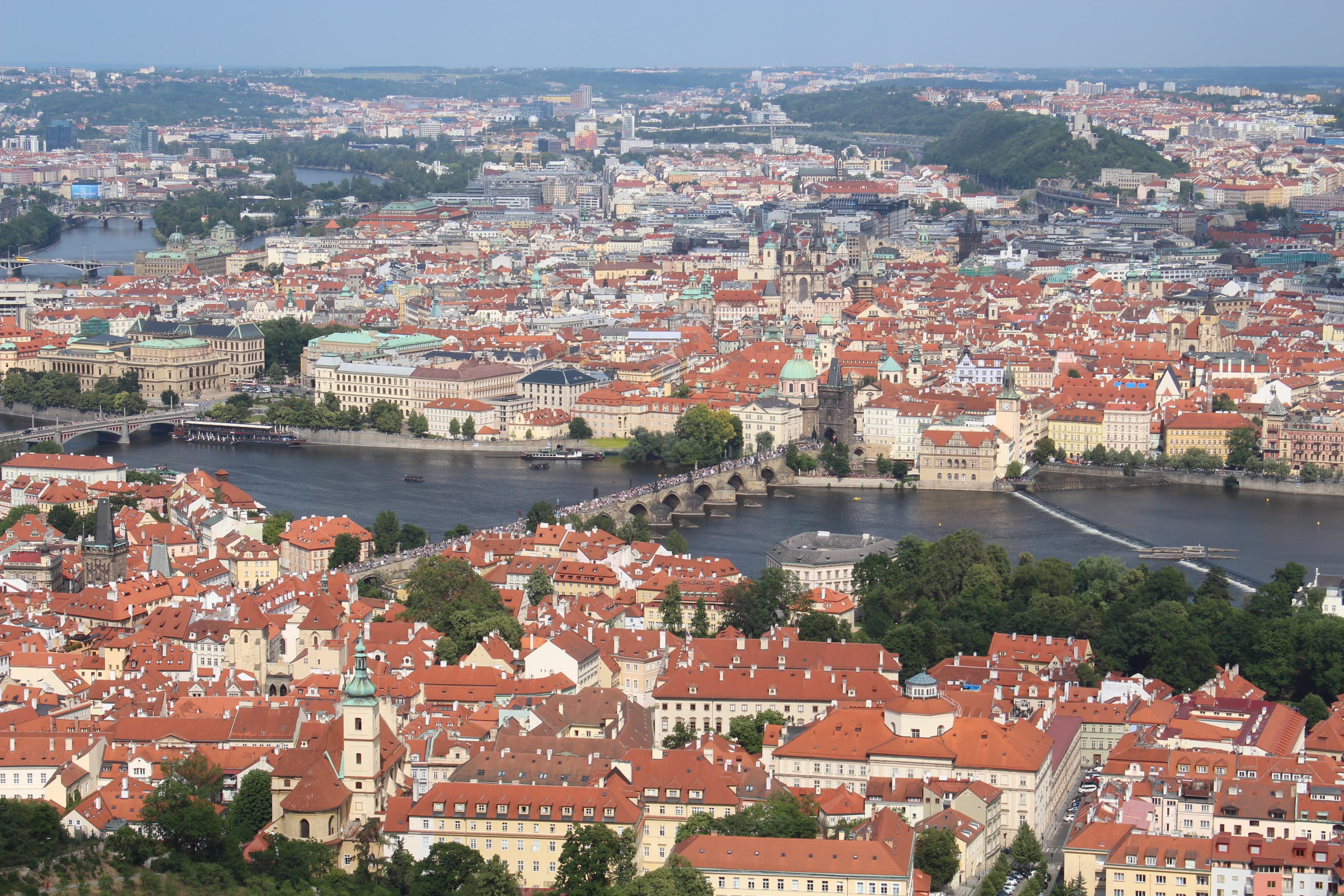
The Charles Bridge connects Old Town with Lesser Town. It is one of Prague's most beautiful structures. During the day, it is a bustling place of trade and entertainment, as musicians busk and artists sell their paintings and jewellery.
Old Town is Prague's historic centre, full of numerous historic buildings and monuments, most notably the famed Astronomical Clock, the pure Gothic Týn Church, the mural-covered Storch building, and the Jan Hus monument. Nearby, the Estate Theatre is a neoclassical theatre where Mozart's opera Don Giovanni was first performed. Old Town features many historical churches (St. James Church, Church of Our Lady before Týn among others) and some other interesting historical buildings like the Old Town Hall, and the Convent of St Agnes of Bohemia. The Museum of Czech Cubism is also in Old Town, while the Prague City Gallery is split between Old Town and the East bank.
Josefov, the historic Jewish ghetto, is interesting for its well preserved synagogues. The Old New Synagogue (Czech: Staronová synagoga) is Europe's oldest active synagogue. The Spanish Synagogue is a very ornamental building of Moorish style. Other attractions include the Old Jewish Cemetery, which is the oldest in Europe, and Kafka's house.
Prague Zoo, and the nearby Troja Chateau (Trojský Zámek) with a large garden displaying various sculptures and a Botanic Garden (Botanická zahrada Troja) with a tropical greenhouse.
Do
Individual listings can be found in Prague's district articles
Strolls
Take a walk along the Royal Way of Prague.
Culture
Opera and ballet have quite a tradition in the city, even though there are often overlooked by young locals and instead frequented by tourists. The main opera and ballet venues are operated by the National Theatre company, which is owned by the government. Tickets can be bought on the company website, the best seats tend to sell out, so it is better to shop in advance. It is customary to wear decent clothing when going to National Theatre venues (black suit), but this is not enforced.
The National Opera hosts mainly operas and ballets. The Estates Theatre is the oldest theatre building still standing in the city. Mozart's Don Giovanni opera is often on the repertoire, as are other operas, plays and ballets.
There are many other theatres in Prague, but they usually only offer plays in Czech language. Classical music concerts are often conducted in numerous churches, especially in the centre.
Festivals
1 Prague Spring. The most famous classical music festival in the Czech republic.
Prague Advent Choral Meeting.
Signal Festival. A weekend in October, during which many historic buildings are lighted by spectacular video-mappings and many light-and-sound installations are set up at different places in the city centre, Vinohrady and Karlín. (updated Oct 2023)
River cruises
River cruises are both popular and varied, from one hour cruises to long evening cruises with dinner or music. To get the right price, find a boat only, do not buy anything from the touts near Charles Bridge. If you want to cruise the river for the smallest price possible, you can use a public transportation ferry.
Wine Boat, ☏ +420 777 221 514, info@wineboat.cz. The 1-hour cruise includes a visit of Prague Venice river canal as well as wine tasting of local wines.
Prague Steam Boats (Pražská paroplavba), ☏ +420 605295111, pps@paroplavba.cz. Offer one hour cruises, as well as cruises to the Zoo and full day cruises to Slapy water dam. If you have the time for a 3-hour dinner cruise, you will certainly enjoy viewing the city from the river, while savouring a great dinner. (updated Oct 2018)
Cruise Prague. Offers a wide range of regular and private cruises.
EVD.
JazzBoat. Combines cruising and jazz concerts.
Eat
Individual listings can be found in Prague's district articles
Lunch is traditionally the main meal in Prague. Czech cuisine is typically based around pork or beef with starchy side dishes such as dumplings, potatoes, or fries. Fish is not as popular, though these days it is widely available. Svíčková, beef simmered in a thick sauce made of cream and a variety of vegetables is probably the classic traditionalist Prague meal. Popular Czech desserts include fruit dumplings (ovocné knedlíky), crêpes or ice cream. Trdelník has become popular in Prague among tourists, with many small bakeries selling the sweet bread encrusted with sugar and chopped walnuts, but it is not a traditional Czech dish, likely originated in Transylvania and only started appearing in the 1990s; most locals avoid it, and Trdelník is sometimes used as a synonym for "simpleton" in Czech. Most restaurants become very crowded during lunch and dinner, so consider making a reservation or eating earlier than the locals.
Tipping is generally not expected, and it's primarily used as a sign of appreciation when the food and service is good. It's common to round up the bill by a few crowns to make it even (289 Kč to 300 Kč for example).
Taxes are always included in the price by law. Many restaurants in heavily-touristed areas (along the river, or with views near the castle) will charge a cover or "kovert" in addition to your meal charge. If this is printed in the menu, you have no recourse. But a restaurant will often add this charge to your bill in a less up-front manner, sometimes after printing in the menu that there is no cover. Anything brought to your table will have a charge associated with it (bread, ketchup, etc.) If you are presented with a hand-scrawled bill at the end of the meal, it is suggested that you take a moment to clarify the charges with your server. This sort of questioning will usually shame the server into removing anything that was incorrectly added. Some waiters might be impolite especially to people from eastern Europe. Pay no attention to this, and simply find another restaurant.
Drink
Individual listings can be found in Prague's district articles
Pubs (in Czech "hospoda") abound throughout Prague, and indeed are an important part of local culture. The exact brand of beer usually vary from pub to pub, and recommendations are difficult to give as natives are usually willing to argue at lengths about their preferences. The most internationally recognized beers are Pilsner Urquell (Plzeňský Prazdroj) and Budweiser Budvar (Budějovický Budvar). There are other brands famous among Czechs like Svijany. If you are looking for a beer brewed in Prague, go for Staropramen. Usual prices for a half-liter glass are between 25 and 40 Kč, based on the brand and locality, while certain restaurants at tourist areas like the Old Town Square are known to charge more than 100 Kč for a euro-sized glass. There's also a booming craft beer scene with many brewpubs in the city.
In Prague it is customary, especially at beer halls, to sit with a group of people if there are no free tables, so go ahead and ask if you can join.
There are also numerous night-clubs in Prague. Not all of them are good, it is often quite difficult even for locals to find the right one, as some are often overpriced, empty or just bad. Locals tend to go to clubs at around midnight, mostly on Friday and Saturday, but Wednesdays and Thursdays are often also OK. In summer, any day of the week should be fine, as there are many foreigners. Most of the night-clubs are in the centre of Prague, although there are some a bit further, mostly aimed at local students. Nightclubs are generally much more expensive than pubs, with beer costing between 50 and 100 Kč. Entrance fees should be small, do not pay more than 100 Kč for entrance unless there is some really good DJ playing.
Get around
Public transportation is very convenient in most of the areas visitors are likely to frequent. Public transport buses do not enter the historic districts (Old Town, New Town, Lower Town, etc.) to prevent air and noise pollution. One must transfer to a cleaner and quieter electric-powered tram or a metro before reaching historic areas.
On foot
Prague is renowned as a very walkable city. For those who enjoy seeing the old and new city by foot, one can easily walk from Wenceslas Square to the Old Town Square, or from the Old Town to Charles Bridge and the Castle District. However almost all of the streets are cobbled, rendering it very difficult for disabled or elderly travellers to get around effectively. Also, pedestrians should enter crossings carefully in Prague, as drivers are not as likely to yield as they are in other European cities.
Pedestrians are obligated to use a nearby pedestrian crossing, and jaywalking is punishable by a fine of 1000 Kč – this includes crossing the street on a "don't walk" signal (red man), even when there is not a single car around.
The historic center consists largely of cobblestone streets, so wearing comfortable walking shoes is highly recommended."
By public transport
The public transport around Prague consists of three metro lines ( A , B , C ), over twenty tram lines (numbered 1–31 & 91–99 for night trams), trolleybuses (numbered 51–59), buses (3-digit numbers), ferries, a few train lines (numbered S1, S2, S49,…), all using the same time tickets. Public transport schedules and fares are integrated by Pražská Integrovaná Doprava (abbreviated PID).
The tram and bus schedules are posted at the stops, and the metro (its schedule is posted in station) operates from early in the morning (around 05:00) until approximately midnight. Buses (lines no. 100-299) and trams (lines no. 1-31) start earlier and end later to connect to metro. Around midnight, some trams carrying passengers take different routes to get to their garage. When traveling at night, always check schedules on-line beforehand, and you may even find a shorter route to your destination than normally available.
Stay safe
Prague is a very safe city. You're less likely to be victim of a serious crime in Prague than in most Western European or US cities. There are no 'no-go zones' and it is safe for women to venture out alone, even in the dead of night. Generally, violence in Prague is not random or opportunistic.
The most common crimes in Prague by far are car theft and pickpocketing; in particular, the prevalence of car theft and vandalism pushes up the crime statistics of Prague. As a party destination, it is common to encounter drunk partygoers, but most of the time the rowdy ones will be fellow tourists; exercise the same caution you would when dealing with any drunk person. The only area with a high concentration of homeless people is in front of the central station.
Theft and pickpocketing
Begging occurs at the city's top tourist attractions and in some of the main public transport hubs. Don't carry a wallet or purse in the back pocket of your pants, always keep an eye on your items, don't put all your money in one place, don't show your money or valuable things to anybody. Understand that the number of 'not truly homeless' professional beggars is high.
Be aware of teams of pickpockets that lurk outside metro stations, overcrowded trams, Charles Bridge, Wenceslas Square and the Old Town Square. They usually work in teams of 3-5 and look for lost or distracted tourists. Backpacks are especially interesting to them. Many of those groups use underage children as pickpockets because they are not liable according to Czech criminal law.
Due to the low incidence of violent crime, the threat of pickpockets has been played up as a great problem. However, common sense and basic precautions can keep most people safe from pickpockets. If you have a camera, try not to wear it openly. Always close and secure your backpack and try to keep an eye on it. Be especially careful not to fall asleep in the tram or on the metro. Wear your wallet in a safe place (like inner pocket of your coat), never put it into your rear pocket or any other place where it can be easily stolen.
Be astute on sleeper trains, as bag robberies are on the increase between major stations. Ask for ID from anyone who asks to take your ticket or passport, and lock backpacks to the luggage racks. Keep valuables on you and maintain common sense.
Respect
Because of Prague's liberal attitude and cheap prices, it's often considered "the drinking capital of Europe". This has raised many issues, with tourists being loud and making the centre of Prague generally unlivable. This issue has spread to local politics, and it's likely that it will cause many regulations, with great impact on both tourists and party-going locals. Some regulations have already been enacted. However, it's possible to party in Prague without angering locals too much. To do so, it is often enough to use common sense, but please keep the following in mindː
When staying in a residential building, such as via short-term rental, be mindful of your neighbours. If you are loud, your neighbours might call the police on you – this will not just cause problems for you, but also for this kind of lodging business overall. If you go to Prague to party, it might be worth considering staying in a party hostel (there are many of them) and leaving short-term rentals to couples and families.
If you head to a pub or club, use their smoking room (clubs have them) or just don't smoke. If you really need to smoke outside, be quiet (especially after 22:00). Crowds of loud people in front of a club or pub might cause them to be fined or even closed.
When renting an electric bike or similar, use designated routes for cyclists or streets. Inconsiderate or illegal use of bike, such as riding on the sidewalk or in pedestrian zones, could lead to them being banned, as happened with Segways, or e-scooters. The rider may also incur a large fine.
If you are quiet and polite, the police probably won't mind your drinking alcohol in the street or smoking weed openly, even though this is forbidden. If you are not, you won't just run the risk of a run-in with the police but also might contribute to Prague losing its liberal attitude.
Practical facts for Czechia
Taken from open data. Rules and numbers change, so check locally before you rely on them.
- Currency
- Czech Koruna (CZK)
- Languages
- Czech and Slovak
- Plugs and power
- Types C and E, 230 V at 50 Hz
- Traffic drives
- On the right
- Country calling code
- +420
- Time zone
- Europe/Prague
Official travel advice
Quoted from each government as published, with the date they last changed it. We do not add a verdict of our own.
UK Foreign, Commonwealth & Development Office
- No areas listed that it advises against travelling to
US Department of State
Level 1 of 4: Exercise normal precautions
Read the full adviceExercise normal precaution in Czechia.
Czechia is generally a safe destination for travelers. Travelers should remain vigilant against petty crime, such as pickpocketing and other minor theft, especially in tourist areas and on public transportation. Follow local laws and guidance from Czech authorities during your stay.
Review our travel guidance for the Czech Republic to learn how to prepare for a safe trip.
Entry and visas
Entry rules depend on your passport and change without notice. Check the official pages before you book.
Sources