
Japan
A plan for Osaka
Not a list of things to see in Osaka — a day-by-day plan somebody could actually follow, built from places we can point to a source for. Make your own in about a minute.
- 2 nights
- Couple
- Balanced pace
- Mid-range budget
Every place here was checked on 2026-10-27 or later, and each one says where it came from.
The plan, day by day
Day 1
09:30
You arrive
13:00
Melbourne Coffee
Suggested because you chose food
- 1h
- Meal
14:30
Osaka Museum of History
Picked because you chose culture & museums + balanced energy
- 2h 30m
- Culture & museums
2h open
Nothing planned here. That was on purpose.
19:00
Endo Sushi
Suggested because you chose food
- 1h 30m
- Meal
20:30
National Bunraku Theatre
Picked because you chose culture & museums + balanced energy
- 2h 30m
- Culture & museums
Day 2
08:00
うさぎとぼく
Suggested because you chose food
- 45m
- Meal
45m open
Nothing planned here. That was on purpose.
09:30
Osaka Science Museum
Picked because you chose culture & museums + balanced energy
- 2h 30m
- Culture & museums
1h open
Nothing planned here. That was on purpose.
13:00
Jo-Terrace
Suggested because you chose food
- 1h
- Meal
14:30
National Museum of Art, Osaka
Picked because you chose culture & museums + balanced energy
- 2h 30m
- Culture & museums
2h open
Nothing planned here. That was on purpose.
19:00
Namba Okonomiyaki Ajinoya Honten
Suggested because you chose food
- 1h 30m
- Meal
20:30
Namba Grand Kagetsu
Picked because you chose culture & museums + balanced energy
- 2h 30m
- Culture & museums
Day 3
08:00
MONDIAL KAFFEE 328 Gold Rush
Suggested because it fits a mid-range budget
- 45m
- Meal
45m open
Nothing planned here. That was on purpose.
09:30
Fujita Art Museum
Picked because you chose culture & museums + balanced energy
- 2h 30m
- Culture & museums
1h open
Nothing planned here. That was on purpose.
13:00
LE PONT DE CIEL
Suggested because you chose food
- 1h
- Meal
14:30
You leave
Weather through the year
Monthly averages from NASA's 25-year climate record, day and night together.
Best months: May and October
| January | Cold: 3°C, 66 mm |
|---|---|
| February | Cold: 4°C, 80 mm |
| March | Cold: 7°C, 116 mm |
| April | Rainy: 12°C, 135 mm |
| May | Rainy: 17°C, 159 mm |
| June | Wet season: 21°C, 213 mm |
| July | Wet season: 25°C, 220 mm |
| August | Rainy: 26°C, 178 mm |
| September | Wet season: 22°C, 225 mm |
| October | Rainy: 16°C, 192 mm |
| November | Cold: 11°C, 93 mm |
| December | Cold: 5°C, 76 mm |
From the Wikivoyage guide
Quoted from the travel guide anyone can edit, as it read on the day we took it.
Understand
If Tokyo is Japan's capital, one might call Osaka its anti-capital. Ask a local, and they'll proudly tell you that while Tokyoites are reserved, polite and boring, Osakans are warm, friendly and colorful, in speech, clothing and spirit. The Osakan rallying cry is kuidaore (食い倒れ), bringing yourself to ruin through extravagance in food, drink and more – a far cry from the austere Zen discipline often associated with Japan.
Osaka dates back to the Asuka and Nara period. Under the name Naniwa (難波), it was the capital of Japan from 683 to 745, long before the upstarts at Kyoto took over. Even after the capital was moved elsewhere, Osaka continued to play an important role as a hub for land, sea and river-canal transportation. (See "808 Bridges" infobox.)
Hirano, located southeast of present-day Osaka city center, was a "free city" during the Sengoku period, with numerous shrines, temples, and roads converging there. It formed an alliance with Sakai, another free city, to resist the power of the daimyo. During the Edo period, merchants from Hirano played a major role in the construction of Osaka. Afterwards, it prospered as a "cotton city," and like Osaka, its townspeople built a lavish culture.
During the Tokugawa era, while Edo (now Tokyo) served as the austere seat of military power and Kyoto was the home of the Imperial court and its effete courtiers, Osaka served as "the Nation's Kitchen" (天下の台所 tenka-no-daidokoro), the collection and distribution point for rice, the most important measure of wealth. Hence it was also the city where merchants made and lost fortunes and cheerfully ignored repeated warnings from the shogunate to reduce their conspicuous consumption.
See
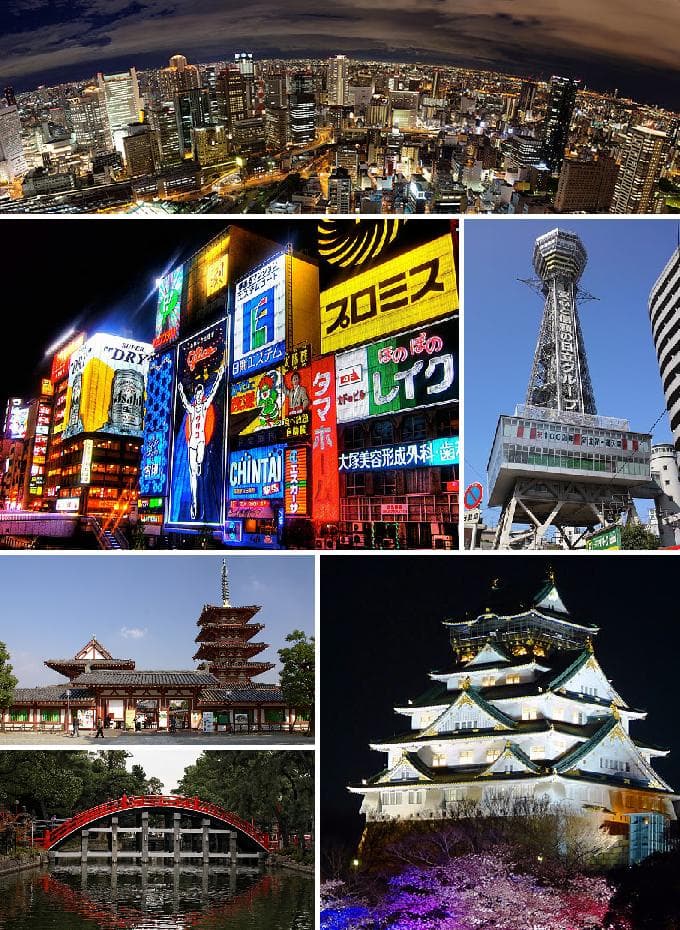
Osaka's best known sight is the Osaka Castle. While it is a reconstruction, it is pretty and has a nice castle park. The reconstruction is basically only skin deep. The interior is a generic late 20th century building, with some display cases containing artifacts related to the original structure. To learn more about the history of Osaka, you can head to the nearby Osaka Museum of History.
Hirano Old CIty (平野旧市街) in Hirano is a well-saved historical city which was originally independent from Osaka. There are many temples and shrines in the city.
Osaka Science Museum (大阪市立科学館) on Nakanoshima is an interactive activity center with planetarium and cinema.
The Umeda Sky Building is a weirdly shaped building with an observation deck and an escalator suspended between two buildings mid-air. It is near the Osaka station.
The Sumiyoshi Shrine is south of the city center. It is one of Japan's oldest Shinto shrines and has a very unusual architecture. It is also famous for a bridge arching over a pond.
Japan Mint is in Osaka and is especially famous for the nearby cherry blossom tunnel road, a prime spot to see the annual cherry blossom.
The Tsūtenkaku landmark tower in the Shinsekai area with an observation platform at 91 meters.
The Shitennōji temple is near the Tennōji station. It is regarded as maybe the first Buddhist temple in Japan dating back to the 6th century. The building of today's temple however, are a reconstruction.
In Ryokuchi Park is the Open Air Museum of Old Farmhouses, a collection of Edo period farmhouses. This gives a good insight in the lives of the common people during this period. It is north of the city center.
The Kamigata Ukiyoe Museum in Namba is dedicated to ukiyoe, Japanese woodblock prints.
Tobita Shinchi in the South is Japan's largest red-light district that can easily compete with Amsterdam's one. It is well worth a visit, even though not everyone's taste.
Do
Osaka Aquarium Kaiyukan is one of the world's largest aquariums, with 11,000 tons of water and plenty of sharks (including a whale shark), dolphins, otters, seals, and other sea creatures. Nearby are the Tenpozan Ferris Wheel, the Suntory Museum, a mall, and the ferry to Universal Studios across the water.
Sumo Spring Grand Tournament of Japan's national sport, sumo wrestling, is usually held mid-March at Osaka Prefectural Gymnasium.
Universal Studios Japan in the Osaka/Bay Area is Japan's second-largest theme park.
Spa World in Tennoji offers gender-separated European and Asian-themed spas and saunas, and a pool for the family with slides and fun. Outdoor onsen, bar, gym, massages and body scrubs.
National Bunraku Theater, near the Osaka Castle, is one of the last places in the world where bunraku, a form of intricate puppet theater from the Edo period, can be seen live. The large puppets, which require three operators each, are accompanied by traditional music and narration, and act out great Japanese plays of the 1600s and 1700s.
Osaka Shiki Musical Theater in Kita, is the home of the Shiki Theatre Company, proposing plays and musicals. Kita ward is also the place to head to see jazz at Billboard Live Osaka or pop shows at Zepp Namda.
The festival hall in Nakanoshima, near Umeda, and the symphony hall in Umeda host modern and classical recitals, while Umeda Koma in Umeda, and Shin-Kabukiza in Uehommachi host Enka performances. For more independent or underground music, try Banana Hall in Umeda or Big Cat in Amerika-mura.
ROR Comedy is an English-language stand-up comedy playhouse in Minami.
Touring the Ecomuseum of Hirano, called Hirano Machigurumi Museum (平野町ぐるみ博物館) is a good way to feel city history and ninjo (人情) of Hirano Old City.
Eat
Individual listings can be found in Osaka's district articles
The widest selection of restaurants is in Osaka's main entertainment districts, with the highest concentration of all in the Umeda and Dotombori areas.
Even in a nation of obsessive gourmands Osaka is known as an excellent place to eat, exemplified by the Osakan maxim kuidaore, "eat yourself into ruin". The best place for trying out kuidaore is probably Dōtonbori (道頓堀) and neighboring Hōzenji-yokochō (法善寺横町) or Soemon-cho (宗右衛門町), the whole area containing nearly nothing but one restaurant after another.
Some typically Osakan foods worth trying include:
Battera (バッテラ), is a block type sushi, with mackerel put on rice and squeezed very hard in a wooden box, cut into pieces when served. Battera sushi is a variant and direct descendant of primitive sushi, this one from Osaka is unique for its squarelike shape. Available not only in sushi restaurants but also as take-away in department stores and train stations.
Okonomiyaki (お好み焼き), fried cabbage cakes that resemble a cross between a pancake, pizza, and omelette.
Takoyaki (たこ焼き), bits of octopus inside fried eggy dumplings. The quintessential Osakan street food snack.
Kushikatsu (串かつ), battered and deep-fried skewers of various sorts of food (meat, vegetables, cheese, etc), dipped in a runny black sauce and washed down with beer. Osaka's working class answer to fancy tempura.
Doteyaki (どて焼き), bits of beef tendon stewed in miso broth until they fall apart. Fatty, gelatinous and a common accompaniment to kushikatsu.
Okonomiyaki is best eaten in hole-in-the-wall restaurants, while takoyaki is best eaten from street vendors' carts, which can be found all over the major districts around nightfall. The best place to find kushikatsu (串カツ) is in Shinsekai, between Dobutsuen-mae and Ebisucho stations on the Sakaisuji subway line.
For fine dining fans, Osaka is the birthplace of kappo omakase (割烹料理 kappō ryōri), where you sit at an intimate dining counter and the chef prepares each dish in front of you. While superficially similar to Tokyo's Edomae-sushi, the dishes served in kappo omakase are not limited to just sushi, and you can expect to be served a multi-course meal of raw and cooked dishes.
Drink
Individual listings can be found in Osaka's district articles
There are many nightlife districts in Osaka. Nightlife in Osaka is very popular.
Kitashinchi (北新地)
This area, south of JR Osaka station, is the most famous nightclub and entertainment district of contemporary Osaka. It's just like Tokyo's Ginza, filled with many hundreds of high-class bars, clubs and small restaurants where Japanese businessmen entertain their clients.
Dotonbori (道頓堀)
This area is the centre of nightlife.
Hozenji-Yokocho (法善寺横丁)
Unlike Tokyo's Kabukicho, Osaka's main red-light district Tobita Shinchi does not have much in the way of nightlife if you are looking to keep your pants on.
Get around
If you are planning to travel beyond city limits you might consider using the tickets from Surutto Kansai. For use in Osaka and other cities in the west of Japan, there are some other useful tickets.
ICOCA smart card. These rechargeable smart cards are available at vending machines at all transport hubs, and can be used on virtually all rail, subway and bus networks in Kansai area. If you're coming from Tokyo and already have a Suica or Pasmo card, they can be used in and around Osaka as is, so there's no need to buy an ICOCA. Similarly, an ICOCA card can be used interchangeably with Suica and Pasmo cards in Tokyo. ¥2000, including a refundable ¥500 deposit and ¥1500 travel credit.
Unlimited Kintetsu Rail Pass (Purchase at the Kansai Airport Agency Travel Desk in Kansai International Airport.). This pass is good for unlimited travel within the Kansai region for up to 5 consecutive days. The Kansai region covers Kyoto, Nara, Nagoya, Mie, and more. ¥1800/3000/4700 for 1/2/5 days.
Subway and bus one-day Passes. The "Enjoy Eco Card" (adults ¥820) offers unlimited one-day travel on all subways and buses, and includes about 30 discounts around town. "Osaka Rakuyu Pass" (大阪楽遊パス, ¥2400/\3000 for 1/2 days) allows entrance to more than 25 tourist spots.
By metro
The Osaka Metro is Japan's second-most extensive metro network after Tokyo, which makes the underground the natural way to get around. The Midosuji Line (colored red on the map) is Osaka's main artery, linking up the massive train stations and shopping complexes of Shin-Osaka, Umeda, Shinsaibashi, Namba and Tennoji.
The signage, ticketing and operation of the Osaka Metro are identical to its larger counterpart in Tokyo, and Tokyo's Pasmo/Suica smartcards are accepted as well. You can use the metro with a contactless payment card (credit, debit, prepaid) or a smartphone linked to an eligible card. Fares ¥200-350, depending on distance. Station arrivals are displayed and announced in Japanese and English. Keep your ticket when you enter the train — it is required when you exit.
When using escalators, stand to the right to allow people in a hurry to pass you on the left.
Stay safe
Crime
Osaka has a reputation among the Japanese for being crime-ridden, but it is still remarkably safe compared to any Western city of similar size. However, some areas in the southern suburbs, particularly Shinsekai and Tobita Shinchi, may be a little dodgy at night and the Airin/Kamagasaki area — Japan's largest slum, home to a lot of jobless and/or homeless people — south of Shin-Imamiya is best avoided after dark.
Incidentally, despite the movie stereotype of gangsters speaking in Osakan dialect, the actual base of Japan's biggest yakuza families is neighboring Kobe — and the most gang violence occurs in Tokyo. Unless you're dealing drugs or engaging in prostitution, you're unlikely to get involved with the local mafia.
Bicycles
Osaka is a city where people use bicycles heavily, so much and chaotic that even traffic police regular does "raids" along bicycle ways to check whether cyclist adhere to the rules.
As a pedestrian it can become quite nerve-wrecking to have cyclist speeding on the sidewalk while you are trying to enjoy your travels.
It's better to pay a little more attention in Osaka when changing route or sidewalks. And always try to walk at one side of the sidewalk and not in the middle, so cyclists don't run you over.
Practical facts for Japan
Taken from open data. Rules and numbers change, so check locally before you rely on them.
- Currency
- Japanese Yen (JPY)
- Language
- Japanese
- Plugs and power
- Types A and B, 100 V at 50 or 60 Hz
- Traffic drives
- On the left
- Country calling code
- +81
- Time zone
- Asia/Tokyo
Official travel advice
Quoted from each government as published, with the date they last changed it. We do not add a verdict of our own.
UK Foreign, Commonwealth & Development Office
- No areas listed that it advises against travelling to
Read the full adviceGlobal travel impacts due to escalation in the Middle East
Escalation in the Middle East has caused widespread travel disruption, including airspace closures, delayed and cancelled flights.
US Department of State
Level 1 of 4: Exercise normal precautions
Read the full adviceExercise normal precaution in Japan.
U.S. citizens should always exercise caution when traveling abroad. Use these general tips to stay safe.
Entry and visas
Entry rules depend on your passport and change without notice. Check the official pages before you book.
Sources