
France
A plan for Nice
Not a list of things to see in Nice — a day-by-day plan somebody could actually follow, built from places we can point to a source for. Make your own in about a minute.
- 2 nights
- Couple
- Balanced pace
- Mid-range budget
Every place here was checked on 2026-10-27 or later, and each one says where it came from.
The plan, day by day
Day 1
09:30
You arrive
13:00
Marché du Cours Saleya
Suggested because you chose food
- 1h
- Meal
14:30
Musée Masséna
Picked because you chose culture & museums and local experiences + balanced energy
- 2h 30m
- Culture & museums
2h open
Nothing planned here. That was on purpose.
19:00
Le Panama
Suggested because you chose food
- 1h 30m
- Meal
20:30
Théâtre de verdure de Nice
Picked because you chose culture & museums + balanced energy
- 2h 30m
- Culture & museums
Day 2
08:00
Bar A Choux
Suggested because it fits a mid-range budget
- 45m
- Meal
45m open
Nothing planned here. That was on purpose.
09:30
Musée des Beaux-Arts Jules Chéret
Picked because you chose culture & museums + balanced energy
- 2h 30m
- Culture & museums
1h open
Nothing planned here. That was on purpose.
13:00
Lavomatique
Suggested because you chose food
- 1h
- Meal
14:30
musée d'art moderne et d'art contemporain de Nice
Picked because you chose culture & museums + balanced energy
- 2h 30m
- Culture & museums
2h open
Nothing planned here. That was on purpose.
19:00
Flaveur
Suggested because you chose food
- 1h 30m
- Meal
20:30
Palais Nikaia
Picked because you chose culture & museums + balanced energy
- 2h 30m
- Culture & museums
Day 3
08:00
Vergnano
Suggested because it fits a mid-range budget
- 45m
- Meal
45m open
Nothing planned here. That was on purpose.
09:30
musée Marc-Chagall
Picked because you chose culture & museums + balanced energy
- 2h 30m
- Culture & museums
1h open
Nothing planned here. That was on purpose.
13:00
Nomad
Suggested because you chose food
- 1h
- Meal
14:30
You leave
Weather through the year
Monthly averages from NASA's 25-year climate record, day and night together.
Best months: May, June, July, and September
| January | Cold: 11°C, 55 mm |
|---|---|
| February | Cold: 11°C, 53 mm |
| March | Mild, some rain: 12°C, 62 mm |
| April | Mild, some rain: 14°C, 56 mm |
| May | Mild, some rain: 17°C, 48 mm |
| June | Mild and dry: 21°C, 29 mm |
| July | Mild and dry: 24°C, 17 mm |
| August | Warm and dry: 24°C, 23 mm |
| September | Mild, some rain: 22°C, 47 mm |
| October | Mild, some rain: 18°C, 88 mm |
| November | Rainy: 15°C, 123 mm |
| December | Mild, some rain: 12°C, 81 mm |
From the Wikivoyage guide
Quoted from the travel guide anyone can edit, as it read on the day we took it.
Understand
Nice's origins can be found among the Gallo-Roman ruins of Cimiez, in the hills up the boulevard de Cimiez from downtown. Cimiez also contains a monastery and some museums, but nowadays, most of the city's inhabitants live closer to sea level. Nice was part of the Italian Duchy of Savoia and then the Kingdom of Sardinia until it was ceded to France in 1860. The ancient local language is Nissart, and some of the street signs are bilingual. However very few people speak Nissart, and even the elderly know and speak French. Don't assume everyone you encounter will speak English — an effort at French will always be appreciated.
Climate
Nice has a Mediterranean climate with mild winters and warm summers. Due to the movements of the winds, the winter months are generally characterized by chilly, sunny days alternating with periods of milder, cloudy weather. Compared to other Mediterranean climates in the area such as Marseille or Genoa, Nice’s spring features quite a slow warm-up, and there can still be winter-like temperatures well into April. Summer is warm, dry and sunny, assuring beach weather on most days. The autumn months have very distinct temperatures, with September staying generally warm, October being variable, and November presenting a mix of mild and cool weather.
See
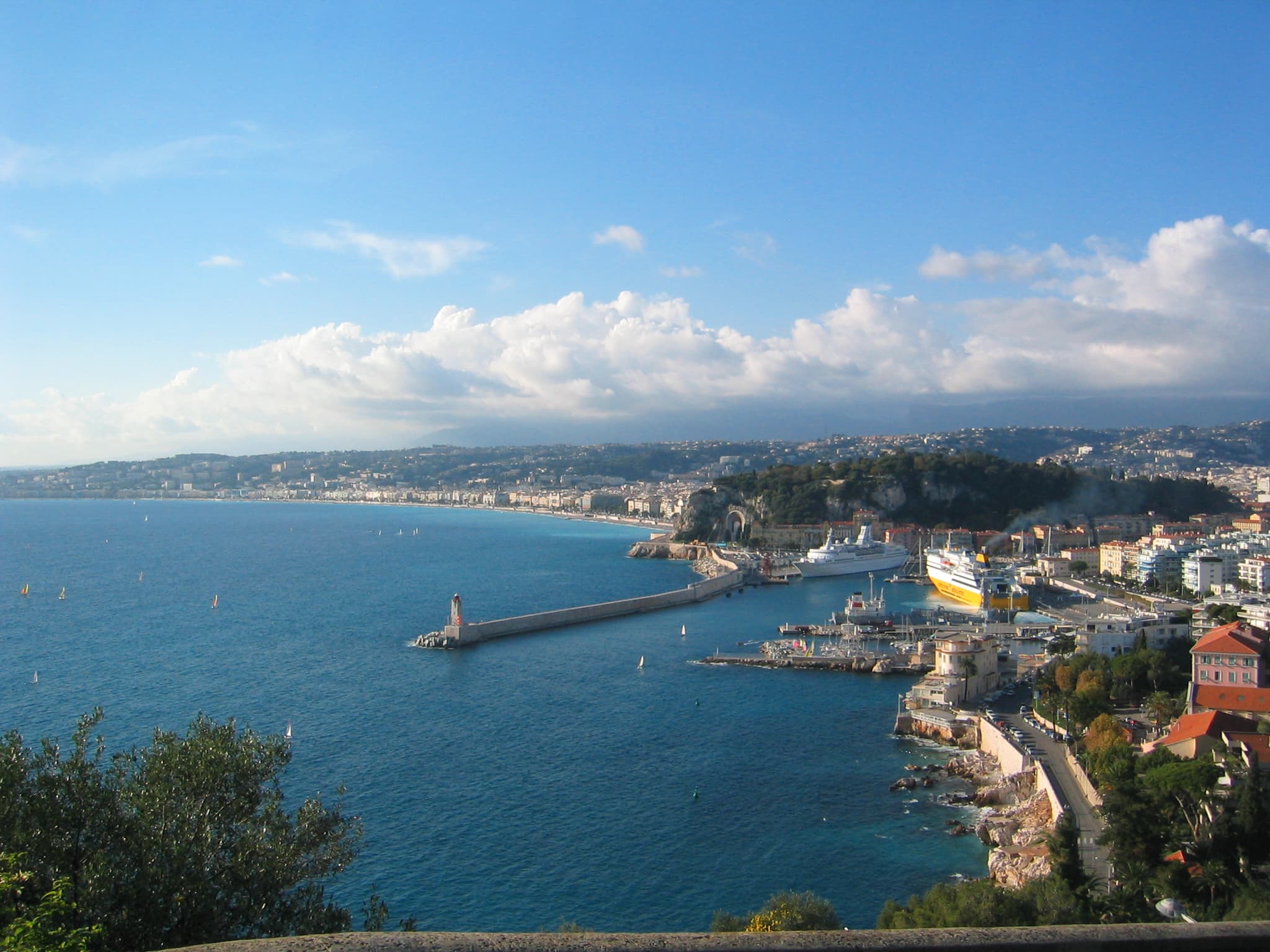
The greatest thing to see in Nice is the views along the Promenade des Anglais, which skirts the seacoast for over 5 km, then ends at Nice Airport. These are the views you will have seen in dozens of postcards and in paintings by the 20th-century artist Henri Matisse, who spent so many years living in Nice, but whether you've seen pictures or not, you owe it to yourself to walk along some of this stretch if you have made it to Nice.
The old town (Vieux Nice) beneath the hill is a maze of streets and alleys, with many picturesque houses, boutiques and home to the daily flower and fruit market of the Cours Saleya. In addition, the local cathedral, the Baroque Cathédrale Sainte-Réparate, in the heart of Vieux Nice, is pretty. You'll want to walk through the Place Sainte-Réparate, anyway, while you're in the old city. If the doors are open, go in and look at the interior and paintings.
1 Colline du Château. The castle hill overlooking the Baie des Anges and harbour offers a spectacular vantage point overlooking the city. Not much is left of its ruined castle besides crumbling walls. Still, climbing up the stairs to reach the platforms 90 m above Nice is well worth the view. There is also a lift (ascenseur) which will take you three quarters of the way up. The castle hill park closes at around sunset. Expect to be escorted outside if you stay longer.
2 Parc Phoenix, 405 Promenade des Anglais, ☏ +33 4 92 29 77 00, fax: +33 492 29 7701, parcphoenix@ville-nice.fr. Daily, Apr-Sep: 09:30-19:30, Oct-Mar: 09:30-18:00. 2500 different plants in botanical garden and tropical glass house. Also various animals. €5.20, 12-18 €3, under 12 free, Nice museums pass-holder €3. (updated Oct 2023)
Museums and art galleries
Nice is also known for several museums. Some of the most famous are in Cimiez, the older, upper part of the city which in a previous century was a favourite of Queen Victoria.
Do
Beaches
If you go to Nice for bathing or general lounging on the beach, you may wish to think again. The beaches of Nice consist entirely of large flat stones (gallets). A few private beaches have added a layer of sand, but the free public beaches are a stony experience. Besides towels or mats, you should definitely bring sandals, since walking on the stones can be painful, and a cushion if you want to sit. Free showers are provided on all public beaches and there is a beach volleyball area that is netted off with white sand.
Although the beaches are mainly pebbles, many visitors enjoy the beautiful light blue sea for a swim. If you can bear to walk for a few steps on the pebbles it is definitely an opportunity for swimming rather than playing in the water as the beach drops quickly and the tidal pull can be very strong, and not for beginners. Lying on the beach for a sun tan or relaxation is also manageable as long as you rearrange the rocks/pebbles to a comfy surface for sitting and lying. Private beaches offer various services from restaurants and /bars to the rental of lounge chairs and towels.
Much nicer beaches exist in other towns close by, such as Villefranche-sur-Mer, Antibes and Cannes, which are far more sandy. Villefranche is a particularly preferred beach choice, especially if travelling with children, only 20 minutes away by the Zou! 100 bus.
However, for walks by the seaside with great views, the Promenade des Anglais is arguably unparalleled.
Beautiful landscapes
For views of Nice the best vantage point is the heights of Mont Boron (bus 14). From the derelict old Fort and the nearby villa of Sir Elton John there are fine views over the city to the mountains and east over Villefranche and Cap Ferat.
Eat
Nice specialities
Many restaurants and cafés serve local food. You might consider preparing some simple meals chez vous or take home some local Nice delicacies to enjoy on your balcony.
Street food is widely available in Nice. A combination of choices could easily replace a lunch without paying restaurant prices.
Socca, a chickpea flour flat bread snack, lightly fried, warm and ready to take away (about €3) in a paper wrap to enjoy on a bench overlooking the sea on the Promenade des Anglais
Pan bagnat is a tuna fish sandwich with olives, sliced hard boiled eggs and fresh vegetables
Pizza can be a 'street food' take away but might be better served directly from a wood-fired oven. It would be fun to compare.
Pissaladiere is a simple form of pizza topped with sweet sauteed, caramelized onion, olives, garlic and anchovies; it does not include tomatoes or cheese. Don't worry about anchovies. Anchovies are salty, offset the sweet onion flavour and add a wonderful complexity to this otherwise simple dish.
Tourtes aux blettes sweet tarts are made with Savoy cabbage (Swiss chard), raisins, nuts, and powdered sugar
Barbajuan is an appetizer found in the eastern part of the French Riviera and Northern Italy. The dough is stuffed with Swiss chard and ricotta among other ingredients and fried
Glace (gelato or ice cream) No visit to Nice would be complete without a visit to Fennocchio's, 2 place Rossetti (within Place Rosetti), ☏ +33 4 93 80 72 52. Mar-Nov: daily 10:00-12:00 (one store closed on Tue). Serves ice creams and Italian-style ices. It's a tough choice to select just one or two of the 94 flavours, which include classics like chocolate or vanilla and less usual ones like thyme, cactus or lavender. 2 locations in the Old Town. €2.50 for glace. (updated Jun 2024)
Nice culinary staples - Neither street food nor restaurant dishes, these culinary staples should not be overlooked when visiting Nice. A picnic lunch can be quickly assembled from a market with among other delicacies, olives, cheese, a baguette, a fruit tart and a bottle of light rosé wine. In packing to visit Nice, don't forget to add a corkscrew, pocket knife and napkins for picnics. Borrow glasses from your hotel (but return them, please).
Drink
With the hot Niçois summers, carrying a bottle of water is almost a must. Bear in mind the largest single complaint to the municipal authority tourist department is the offering in restaurants of branded water bottles whose seal has been broken – i.e. refilled with tap water – and charged as Perrier or Evian.
You can save a lot of money by buying alcoholic drinks and such in a normal supermarket instead of the vendors geared towards tourists. Carrefour has a huge selection and unlike the other supermarkets has a policy of buying in wine show "prize winners" distinguished by their gold, silver or bronze medal stickers.
Wine in restaurants is often ferociously expensive, so do as the locals and order it by the "pichet" – usually a 50-centilitre jug. However, if you fancy quality appellation French wine to drink back home, Les Caves Caprioglio at 16 Rue de la Prefecture in Vieux Nice has a fabulous cellar of the wines you usually only read about in the fine wines books but rarely see. To see French wine making, the Chateau's Bellet and Cremat in the Var are nearest to Nice and will do tours by arrangement (reachable via the tiny narrow-gauge train from the Chemin de Fer de Provence).
Some popular places to go out for a drink include:
Ma Nolan's. Right in the heart of the 'Old Town' and next to the opera, Ma Nolan's has everything you would expect from an Irish pub: live music every night, major sporting events on four screens, really good food and very friendly staff.
Akathor Pub. — Big Scandinavian/Irish pub with live music every night. On two floors with a large terrace this place is expensive but chill. Many of the larger hotels (such as the Holiday Inn) have 2-for-1 drink coupons which can be easily obtained even if you are not a guest.
Get around
By bus and tram
Warning: The following text is outdated as of 2026.
Each main town on the French Riviera has its own local bus network, for Nice it is Lignes d'Azur (Antibes has Envibus, Cannes has Bus Azur, and so on), and the 100 or more Lignes d'Azur routes are the main form of urban transport for locals going to work or school. Of more interest to tourists, an inter-urban network, Zou! connects all the Eastern Riviera towns between Cannes and Menton and all the main villages like Èze and Vence. Its terminal is at 16 Avenue des Diables Bleus. Bus fares are only €1.70 (2023) with a change to a non-return connecting service also permitted within 74 min, so it is worth mastering the bus system to get around.
The Lignes d'Azur and Zou! routes overlap in and around Nice, so the ticket and tariff system is integrated to a common ticket zone, in which the local Lignes d'Azur tickets and passes are accepted on the longer distance Zou! buses (only between Cagnes-sur-Mer to the west and Cap d'Ail short of Monaco to the east). The fare is identical on both networks - €1.70 for any distance - but with Zou!, you must always tell the driver your intended destination, so he can judge whether you should purchase a Zou! ticket or a Ligne d'Azur. Outside the common zone, Ligne d'Azur passes are not valid and you need to pay the €1.70 fare in cash.
Tram line 1 takes a U-shaped route from Las Planas to the northeast to Pont St Michel to the northwest. It links the main train station, bus station, downtown and the university, but it is primarily a mass transit system for commuters and shoppers. Trams use the same tickets as the buses, but you need to buy them from the machines at tram stops (unlike buses, where it is usual to pay the driver or show your pass on entering the bus).
Always validate your ticket, especially card-like tickets with magnet bands.
Stay safe
Nice's crime rate is comparable to other cities in western countries. Nevertheless, locals have been grumbling about a number of issues since the 2000s, often with good reasons. Basic precautions are needed at times.
Nice is known to be the city in France with the highest number of police officers per capita – and since the tragic 2016 terrorist attack by the promenade, Nice hosts a large number of military patrols. They can be somewhat intimidating to meet, especially in the middle of the night, however they are there to maintain an air of control. Most French people maintain their weapons are fake, and they will normally never interact with you.
As with other larger cities, Nice has areas that must be avoided. The most commonly cited areas are:
The neighbourhoods of Arianne and Pasteur, located in the eastern parts of the city, and the neighbouring town of la Trinité are known hotbeds for gang violence and drug dealing. It is highly discouraged to wander there at night.
Some of the neighbourhoods immediately north of the airport have been the stages of pickpocketing.
The Thiers neighbourhood, immediately south of the Nice-Ville train station, has a few unsavoury streets.
A few tips to stay safe are:
Don't take unlicensed "taxis"! That applies doubly so at times like the Film Festival, especially if you are female and have been drinking and partying late.
Take precautions against pickpockets, who are a constant and serious problem on the Côte d'Azur. They operate usually in teams in any crowded areas like buses, train stations, and tourist sites. Be vigilant at the tram station, Gare Thiers, where pickpockets prey on travel-weary tourists. They may well look like harmless fellow passengers, but they are extremely skilled and will lift your wallet from either your front or back pants pocket without your noticing. You are strongly advised not to carry anything valuable or annoying to replace in your pockets. Use pouches underneath your clothing for anything valuable, including cash. In restaurants and cafés, opportunist theft of handbags is a constant risk - keep them close at hand.
Practical facts for France
Taken from open data. Rules and numbers change, so check locally before you rely on them.
- Currency
- Euro (EUR)
- Languages
- French (France), Arpitan, Breton, Corsican, and 3 more
- Plugs and power
- Types C and E, 230 or 400 V at 50 Hz
- Traffic drives
- On the right
- Country calling code
- +33
- Time zone
- Europe/Paris
Official travel advice
Quoted from each government as published, with the date they last changed it. We do not add a verdict of our own.
UK Foreign, Commonwealth & Development Office
- No areas listed that it advises against travelling to
Read the full adviceDemonstrations
There is an increased likelihood of demonstrations, political gatherings and marches taking place across France, sometimes at short notice.
Whilst most demonstrations are peaceful, you should remain aware of your surroundings. Stay away from areas with large crowds or a significant police presence, and follow the advice of police and local authorities.
Demonstrations may disrupt local transport services and authorities may impose public safety measures, including partial and localised curfews in some areas. Monitor local media for the latest information about measures in your area.
US Department of State
Level 2 of 4: Exercise increased caution
Read the full adviceExercise increased caution in France due to terrorism and unrest.
Violence and rioting have recently occurred in France and may continue. Avoid demonstrations and areas of unrest. Stay away from areas with large crowds or significant police activity.
Pickpocketing and phone thefts are common, especially in crowded places. Terrorist groups continue to plan possible attacks in France and may attack with little to no warning. There are also regular, peaceful protests and strikes in Paris and other cities throughout France.
Entry and visas
Entry rules depend on your passport and change without notice. Check the official pages before you book.
Sources