
Russia
A plan for Moscow
Not a list of things to see in Moscow — a day-by-day plan somebody could actually follow, built from places we can point to a source for. Make your own in about a minute.
- 2 nights
- Couple
- Balanced pace
- Mid-range budget
Every place here was checked on 2026-10-27 or later, and each one says where it came from.
The plan, day by day
Day 1
09:30
You arrive
13:00
Москворецкий рынок
Suggested because you chose food
- 1h
- Meal
14:30
House on Embankment
Picked because you chose culture & museums and local experiences + balanced energy
- 2h 30m
- Culture & museums
2h open
Nothing planned here. That was on purpose.
19:00
Fresco
Suggested because you chose food
- 1h 30m
- Meal
20:30
Bolshoi Theatre
Picked because you chose culture & museums + balanced energy
- 2h 30m
- Culture & museums
Day 2
08:00
Пушкинъ
Suggested because it fits a mid-range budget
- 45m
- Meal
45m open
Nothing planned here. That was on purpose.
09:30
Vernadsky State Geological Museum
Picked because you chose culture & museums + balanced energy
- 2h 30m
- Culture & museums
1h open
Nothing planned here. That was on purpose.
13:00
Преображенский рынок
Suggested because you chose food
- 1h
- Meal
14:30
Palace of Kuskovo
Picked because you chose culture & museums and local experiences + balanced energy
- 2h 30m
- Culture & museums
17:00
The Old English Inn
Picked because you chose culture & museums and local experiences + balanced energy
- 2h 30m
- Culture & museums
19:30
Savva
Suggested because you chose food
- 1h 30m
- Meal
21:00
Moscow State Circus
Picked because you chose culture & museums and local experiences + balanced energy
- 2h 30m
- Culture & museums
Day 3
08:00
288
Suggested because it fits a mid-range budget
- 45m
- Meal
45m open
Nothing planned here. That was on purpose.
09:30
State Historical Museum
Picked because you chose culture & museums + balanced energy
- 2h 30m
- Culture & museums
1h open
Nothing planned here. That was on purpose.
13:00
Ленинградский рынок
Suggested because you chose food
- 1h
- Meal
14:30
You leave
Weather through the year
Monthly averages from NASA's 25-year climate record, day and night together.
Best months: June, July, and August
| January | Cold: -11°C, 48 mm |
|---|---|
| February | Cold: -10°C, 42 mm |
| March | Cold: -4°C, 43 mm |
| April | Cold: 4°C, 49 mm |
| May | Mild, some rain: 13°C, 86 mm |
| June | Mild, some rain: 16°C, 86 mm |
| July | Mild, some rain: 19°C, 93 mm |
| August | Mild, some rain: 17°C, 75 mm |
| September | Mild, some rain: 12°C, 64 mm |
| October | Cold: 4°C, 69 mm |
| November | Cold: -2°C, 58 mm |
| December | Cold: -8°C, 52 mm |
From the Wikivoyage guide
Quoted from the travel guide anyone can edit, as it read on the day we took it.
Understand
Moscow is the financial and political centre of Russia and the countries formerly comprising the Soviet Union. It has a population of around 13 million and an area of 2,511 square kilometres (970 sq mi) after an expansion in 2012. Moscow is the second most populous city in Europe, after Istanbul, and has the most populous metropolitan area in Europe, with some 21 million residents, comprising roughly one-seventh of the population of Russia. Moscow is in the UTC+3 time zone; there is no daylight saving time.
Many years since the break up of the Soviet Union, the economy has improved, and the modern era has brought upon a wide variety of construction projects, modern architecture and newer transport systems. The Moscow Metro, in particular, is the longest and busiest subway system in Europe. The city also features Europe's largest concentration of skyscrapers.
Geography
Moscow is a large metropolis on the Moskva River, which bends its way through the city. The historical center is on the northern bank of the river. The other major waterway is the Yauza River, which flows into the Moskva east of the Kremlin.
Much of Moscow's geography is defined by the 3 'Ring Roads' that circle the city at various distances from the centre, roughly following the outline of the walls that used to surround Moscow. With Red Square and the Kremlin forming the very centre, the innermost ring road is the Boulevard Ring (Bulvarnoye Koltso), built in the 1820s where the 16th century walls used to be. It runs from the Christ the Savior Cathedral in south-west central Moscow, to the mouth of the Yauza in south-east central Moscow.
The next ring road, the Garden Ring (Sadovoe Koltso), derives its name from the fact that landowners near the road in Tsarist times were obligated to maintain gardens to make the road attractive. In Soviet times, the road was widened, and there are now no gardens there.
See
Individual listings can be found in Moscow's district articles
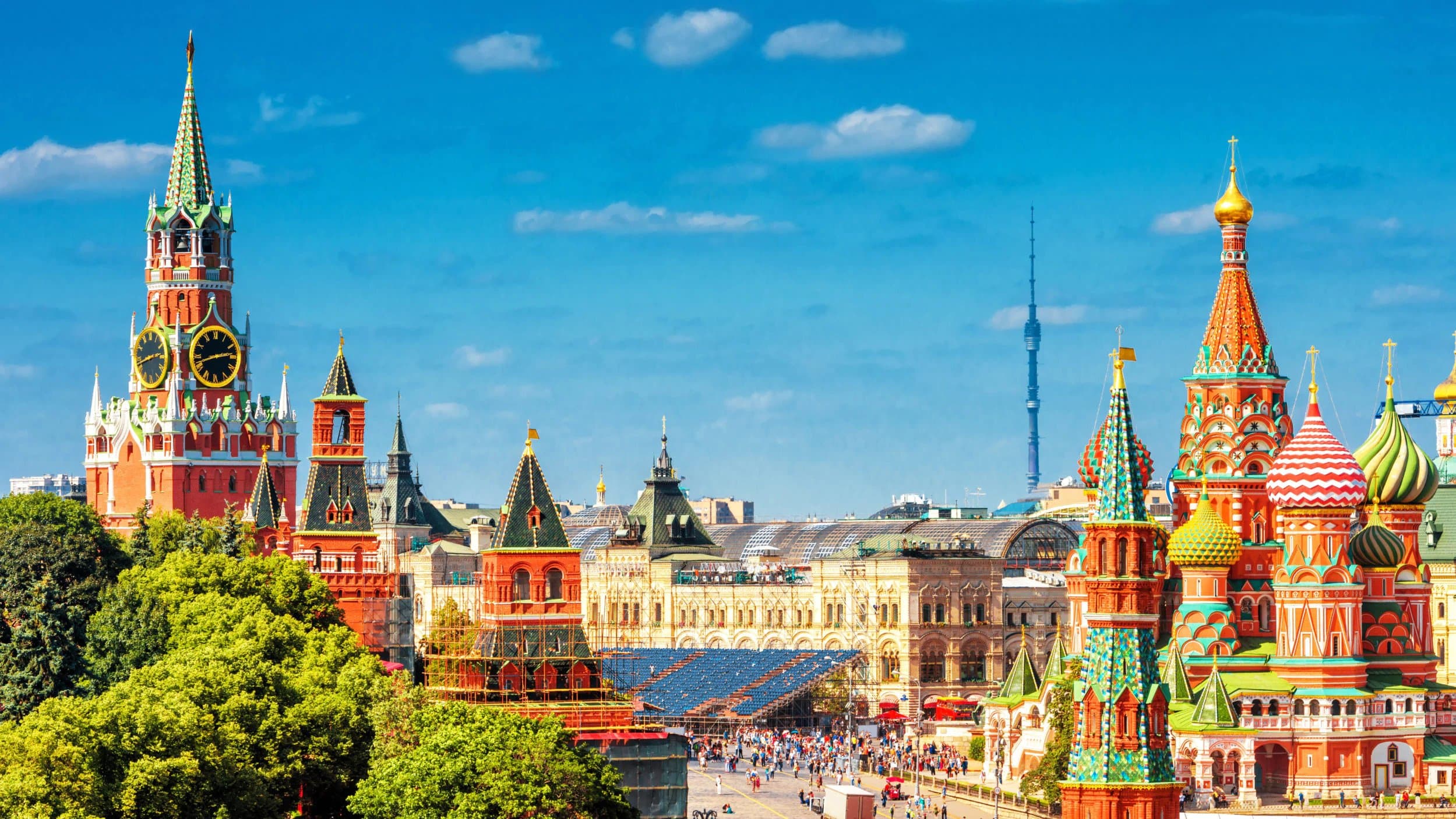
Moscow's architecture is world-renowned. Moscow is the site of Saint Basil's Cathedral, with its elegant onion domes, as well as the Cathedral of Christ the Savior. and the Seven Sisters. Look out for the monumental Stalinist architecture, most famously the Seven Sisters. Also check out a preserved collection of monumental buildings centred within the historic areas of the Kremlin and Red Square.
Moscow is a very green city: Gorky Park along the Moskva river contains estrades, children's attraction, dancing, tennis courts and other sports facilities.
Moscow has many notable art museums. The Tretyakov Gallery houses works in the classic Russian tradition and the works of Soviet artists. The Pushkin Museum of Fine Arts has a cross-section of exhibits on world civilisations, and paintings from every major Western era; works by Claude Monet, Paul Cézanne, and Pablo Picasso are present in the museum's collection. The State Historical Museum of Russia has exhibitions that range from relics of the prehistoric tribes inhabiting present-day Russia, through priceless artworks acquired by members of the Romanov dynasty.
Do
Moscow has many attractions, but many of them are not friendly to a non-Russian-speaker. The Moscow Times is an English-language newspaper help to navigate towards English-language friendly attractions and services; however, it may be hard to access due to its political stance.
Make sure you visit a Russian bathhouse (banya) while in Moscow, as it's an important Russian tradition and some Russians, especially those over 40 years old, go at least once a week. Have a hot steam, followed by a good whipping with birch branches. While it's not the most pleasant experience, the benefits you'll receive afterward will enable you to understand why Russians are loyal to their banya.
The Great Moscow State Circus in Moscow's outskirts has 5 arenas (equestrian, water, illusionist, ice rink, and light-effect) 18 m below the floor. Moscow Nikulin Circus is in Moscow/Central-North.
The Bolshoi Theatre in Moscow/Central-North is one of the most famous in the world, in the center of the city. Includes ballet, opera, and classical music performances.
The Sun of Moscow in Moscow's outskirts is Europe's tallest Ferris wheel (140 m height). The Moscow Zoo, also in Moscow's outskirts, is the oldest zoo, dating to 1864, and the biggest zoo in Russia, has over 6,000 animals representing about 1000 species and covers an area of about 21.5 hectares.
You can go ice skating in Moscow's outskirts at the Gorky Central Park of Culture and Leisure, and Luzhniki aka Kristall skating ring.
Moscow has four football teams playing in the Premier League, the top tier of Russian football. Russian football clubs were suspended from FIFA and UEFA competitions due to the 2022 Russian invasion of Ukraine. This ban has been extended to the 2025-26 season. All four play in stadiums in Moscow's outskirts.
Eat
Dining establishments in Moscow range from food stalls near metro stations to quick canteen-style 'Stolovaya' eateries to American-style fast food chains to overpriced restaurants catering to tourists to high-end restaurants where you can spend 10,000 руб.
Restaurants and cafes promising "European and Caucasus cuisine" generally cater to tourists and are usually bad; seek a restaurant that specializes in a single region instead (Georgian, Russian, Italian, French, etc.).
Many small restaurants offer lunch specials costing 200-250 руб. These deals are valid from 12:00 to 15:00 and include a cup of soup or an appetizer, a small portion of the main dish of the day, bread and a non-alcoholic beverage.
For information on tipping in restaurants, see Russia#Eat.
Authentic ethnic food from countries of the nearby Caucasus (Azerbaijan, Georgia, Armenia) is common in Moscow. Japanese food, including sushi, rolls, tempura, and steakhouses are very popular in Moscow. Other Asian cuisines including Vietnamese, Thai, and Chinese are becoming increasingly more common.
Budget
Street food
Free-standing kiosks serving sausages, meat pies, or kebobs are plentiful, although the origins of the meat served is questionable and the food has been known to occasionally make people sick.
Muscovites are also fond of their ice cream, consumed in any weather, even in the dead of winter, cheap and usually of superior quality; kiosks can be found all over the center and near all Metro stations.
Fast food chains
Burger King and Rostics have locations near almost every shopping mall. It is common to pay extra for condiments.
Black Star Burger - Restaurant chain specializing in burgers with locations throughout Russia.
Kroshka-Kartoshka – These green kiosks sell microwave-baked potatoes as well as toasted sandwiches and a few drinks. Hot and filling, but rather expensive for a potato.
Riksha Ivan ("Ivan the Rickshaw") – Quick Chinese-like cuisine; fried rice with meat to go.
Drink
Individual listings can be found in Moscow's district articles
Clubs
Nightlife in Moscow is bustling, intense and exciting. It starts quite late; it's common for the headliners to start at 02:00-02:00. Most noticeable are areas near Solyanka street and Krasniy Oktyabr' place. At summer time a lot of clubs opening open-air terraces called "verandas". Most of clubs in Moscow are very picky of who they let in, so make sure you have a positive attitude and dress up if you are going to a fancy club.
Cafes
Moscow has several café chains with great coffee including Coffeemania and Coffee Bean. Moscow also has a good selection of tea saloons. High-quality infusion teas such as Newby, are widely available in cafes, both in packets and loose.
Asking to add boiling water to the tea you ordered earlier is a practice that some cafes don't welcome, but normally it's acceptable.
Get around
By public transport
Yandex Maps is the best mobile app for planning journeys on public transport.
The metro is comprehensive, boasts some great architecture, and is relatively cheap. City buses, trolleybuses, trams and metro operated under "Moskovskii transport" franchise by different operators but common fare system.
The cheapest way to use the public transportation system is to purchase a plastic Troika re-loadable debit card. The card costs 50 руб and can be redeemed for cash at the end of your trip. You can "top up" your balance at any metro station. For each trip taken, 57 руб will be deducted from your card. If you make a change from the metro to a ground transport or other way around within the next 90 minutes of your trip, the next shoulder will cost you only 22 руб. The Troika card also can also be used via a mobile app. Troika cards can also be used to pay an Aeroexpress tickets, Velobike bike sharing, the entrance to the Moscow Zoo, the Tretyakov Gallery and the Lunarium Museum of the Moscow Planetarium. Alternatively, red paper cards can be purchased at metro stations at a cost of 70 руб per trip or 340 руб for 24-hours.
Also there is unlimited tickets for 1, 3, 30, 90 or 365 days which is very useful, if you plan to use public transport a lot.
By metro
The Metro is open from 05:30-01:00. Station entrances are closed at 01:00, and at this time the last trains depart from all of the termini stations. After 01:00, many locals will enter the train station using the exits, which are still open. Service on the ring line runs until 01:30, although entrances are closed at 01:00. The down escalators are also shut off at 01:00.
There is signage in the Metro stations in English and the Latin alphabet, but these signs are not everywhere. Each train carriage has a map in Latin script and there is one near the entrance to each station. Note the direction of the train before you alight. A map of the metro system in both Cyrillic and Latin letters is available online.
All trains in the system have free WiFi onboard, but you will need to have a Russian phone number to get the authorization code to access the WiFi. Some of the older train cars are not climate controlled.
Stay safe
Moscow enjoys a relatively low crime rate.
Drunk people are the most likely sources of problems. In the past years, lots of policemen were corrupt, and it was best to avoid them. Nowadays Moscow has a Tourist Police force, whose officers are able to speak foreign languages and help tourists. Police officers are equipped with body-cameras.
It is preferable to avoid some parts of the outer districts of Moscow, especially in the south. Some of those areas are notorious for gopniks (drunkards notorious for muggings and starting fights with strangers, and will do so seemingly unprovoked), who normally hang out in sparse residential areas and in industrial zones. The same problems can be witnessed in the surrounding regions and in other Russian cities as well.
While traveling in Moscow, as in the rest of Russia, you should always have your passport with you. If you look non-white, your papers may get checked more often than otherwise. The police may demand to see your papers to check if you have been registered within 7 business days of your arrival into Moscow. Always remember that if you stay in a hotel then you are automatically registered and will be handed a confirmation paper at a time of check-in, so don't worry in this case. The police are usually looking for migrants from Central Asia and unless you fit this profile, you are unlikely to be questioned.
Women should take caution walking alone late at night since they may receive unwanted attention from drunk men. Women should also stay clear of large companies of men in front of bars, restaurants, etc. It is best to walk with a friend if possible.
Streets can become very slippery in winter. Wear shoes or, even better, boots with decent grip to prevent twisted ankles. Ice patches can be hard to spot. A waterproof raincoat is also sensible.
Traffic is poorly handled, and vehicle accident rates are very high.
Practical facts for Russia
Taken from open data. Rules and numbers change, so check locally before you rely on them.
- Currency
- Russian Ruble (RUB)
- Languages
- Russian, Tatar, Kalmyk, Adyghe, and 16 more
- Plugs and power
- Types C and F, 220 V at 50 Hz
- Traffic drives
- On the right
- Country calling code
- +7
- Time zones
- Asia/Anadyr, Asia/Barnaul, Asia/Chita, Asia/Irkutsk, and 22 more
Official travel advice
Quoted from each government as published, with the date they last changed it. We do not add a verdict of our own.
UK Foreign, Commonwealth & Development Office
- Advises against all travel to the whole country
Read the full adviceFCDO advises against all travel to Russia
FCDO advises against all travel to Russia due to the risks and threats from its continuing invasion of Ukraine, including:
• security incidents, such as drone attacks, and Russian air defence activity
• lack of flights to return to the UK
• limited ability for the UK government to provide support
There is an increased risk of British nationals being detained in Russia, including if the Russian authorities suspect you of engaging in or supporting activities against Russian law, even if activities took place outside Russia. See ‘Risk of arrest and detention’ on ‘Safety and security’.
Russia has a track record of targeting foreign nationals and holding them in detention as leverage over other countries. FCDO’s ability to assist you in these circumstances is extremely limited.
There is also a high likelihood terrorists will try to carry out attacks, including in major cities. See ‘Safety and security’.
Ongoing drone attacks and associated Russian air-defence activity may increase risks to civilian aviation and can lead to short-notice restrictions on airspace use and airport operations. See ‘Safety and security’
Limited UK government support
The British Embassy in Moscow and British Consulate in Ekaterinburg are open, but the situation could change at short notice.
US Department of State
Level 4 of 4: Do not travel
Read the full adviceDo not travel to Russia for any reason due to terrorism, unrest, wrongful detention and other risks.
U.S. citizens in Russia should leave immediately
The U.S. government has limited ability to help U.S. citizens in Russia, especially outside of Moscow. The U.S. Embassy in Moscow has reduced its staff. The Russian government has also restricted travel for embassy personnel. All U.S. consulates in Russia have suspended operations, including consular services.
Entry and visas
Entry rules depend on your passport and change without notice. Check the official pages before you book.
Sources