
Mexico
A plan for Mexico City
Not a list of things to see in Mexico City — a day-by-day plan somebody could actually follow, built from places we can point to a source for. Make your own in about a minute.
- 2 nights
- Couple
- Balanced pace
- Mid-range budget
Every place here was checked on 2026-10-27 or later, and each one says where it came from.
The plan, day by day
Day 1
09:30
You arrive
13:00
Mercado de Coyoacán
Suggested because you chose food
- 1h
- Meal
14:30
Plaza Manuel Tolsá
Picked because you chose culture & museums and local experiences + balanced energy
- 2h 30m
- Culture & museums
2h open
Nothing planned here. That was on purpose.
19:00
Luna Coyoacán
Suggested because you chose food
- 1h 30m
- Meal
20:30
Teatro de la Ciudad
Picked because you chose culture & museums + balanced energy
- 2h 30m
- Culture & museums
Day 2
08:00
Café de Tacuba
Suggested because you chose food
- 45m
- Meal
45m open
Nothing planned here. That was on purpose.
09:30
San Ildefonso College
Picked because you chose culture & museums + balanced energy
- 2h 30m
- Culture & museums
1h open
Nothing planned here. That was on purpose.
13:00
Salón España
Suggested because you chose food
- 1h
- Meal
14:30
Palace of the Inquisition
Picked because you chose culture & museums and food + balanced energy
- 2h 30m
- Culture & museums
17:00
Polyforum Cultural Siqueiros
Picked because you chose culture & museums and local experiences + balanced energy
- 2h 30m
- Culture & museums
19:30
Contramar
Suggested because you chose food
- 1h 30m
- Meal
21:00
La Faena
Picked because you chose food and local experiences + balanced energy
- 1h 30m
- Food
Day 3
08:00
Cafe El Popular
Suggested because it fits a mid-range budget
- 45m
- Meal
45m open
Nothing planned here. That was on purpose.
09:30
Franz Mayer Museum
Picked because you chose culture & museums + balanced energy
- 2h 30m
- Culture & museums
1h open
Nothing planned here. That was on purpose.
13:00
Quintonil
Suggested because you chose food
- 1h
- Meal
14:30
You leave
Weather through the year
Monthly averages from NASA's 25-year climate record, day and night together.
Best months: April and May
| January | Cold: 11°C, 9 mm |
|---|---|
| February | Cool and dry: 12°C, 12 mm |
| March | Cool and dry: 14°C, 15 mm |
| April | Mild and dry: 16°C, 22 mm |
| May | Mild, some rain: 17°C, 55 mm |
| June | Rainy: 16°C, 135 mm |
| July | Rainy: 15°C, 154 mm |
| August | Rainy: 15°C, 154 mm |
| September | Rainy: 14°C, 148 mm |
| October | Mild, some rain: 13°C, 64 mm |
| November | Cool and dry: 12°C, 19 mm |
| December | Cold: 11°C, 6 mm |
From the Wikivoyage guide
Quoted from the travel guide anyone can edit, as it read on the day we took it.
Understand
The greater Mexico City metropolitan area is one of the world's largest and the largest city in North America, with 22 million people living in the metropolitan area in 2020. It sits in the Valley of Mexico. It is shaped roughly like an oval of about 60 km by 40 km with large parts of it built on the dry bed of Lake Texcoco, and surrounded on three sides by tall mountains and volcanoes such as the Ajusco, the Popocatepetl and the Iztaccihuatl. Mexico City proper (with an estimated population of 9.2 million) is the country's capital, and since 2016 has been a "federal entity" with the same powers as the states of Mexico, though still separate from the states. Confusingly, the rest of the metropolitan area extends beyond Mexico City into the State of Mexico, which surrounds Mexico City on the west, north and east, and Hidalgo further north. Practically speaking, Mexico City refers to the city proper and is the area where tourists will spend all or most of their time.
The city center is 2,230 m (7,320 ft) above mean sea level, and some outlying areas reach up to 3,000 m (9,800 ft). This is far higher than any metropolitan area in the United States or Europe, and some people have breathing difficulties because of this. If you live closer to sea level, you may experience difficulty breathing due to altitude and pollution. Air quality has, however, been improved in the last few years.
Mexico City is the wealthiest city in all of Latin America, with a GDP per capita of US$27,000, and has the lowest poverty rate in all of Mexico. More than a third of the total Mexican economy is concentrated here. Most of the country's large and multinational corporations have headquarters in the city, mainly in the Polanco and Santa Fe districts.
See
Downtown Mexico City has been an urban area since the foundation of Tenochtitlán in 1325, and the city is filled with historical buildings and landmarks from every epoch since then. It is also known as the City of Palaces, because of the large number of stately buildings, especially in the Centro. Mexico City has three World Heritage Sites: the Centro Histórico and Xochimilco, the house of architect Luis Barragán and the University City campus of UNAM. In addition, Mexico is one of the cities with the largest number of museums in the world.
Landmarks
Plaza de la Bellas Artes (Centro Historico). Commonly known as Palace of Fine Arts or Cathedral of Arts in Mexico, host of art events and art exhibitions, along with a number of enormous murals including Diego Rivera's El hombre controlador del universo and Jorge González Camarena's Liberación. (updated Feb 2026)
Plaza de la Constitución (Centro Historico). Commonly known as Zócalo, it is one of the largest squares in the world, surrounded by historic buildings, including the City Hall and the Cathedral.
Catedral Metropolitana de la Ciudad de México (Centro Historico). Next to El Zocalo in the city center. The biggest cathedral in the Americas. Containing many altars, its principal altar is made from solid gold.
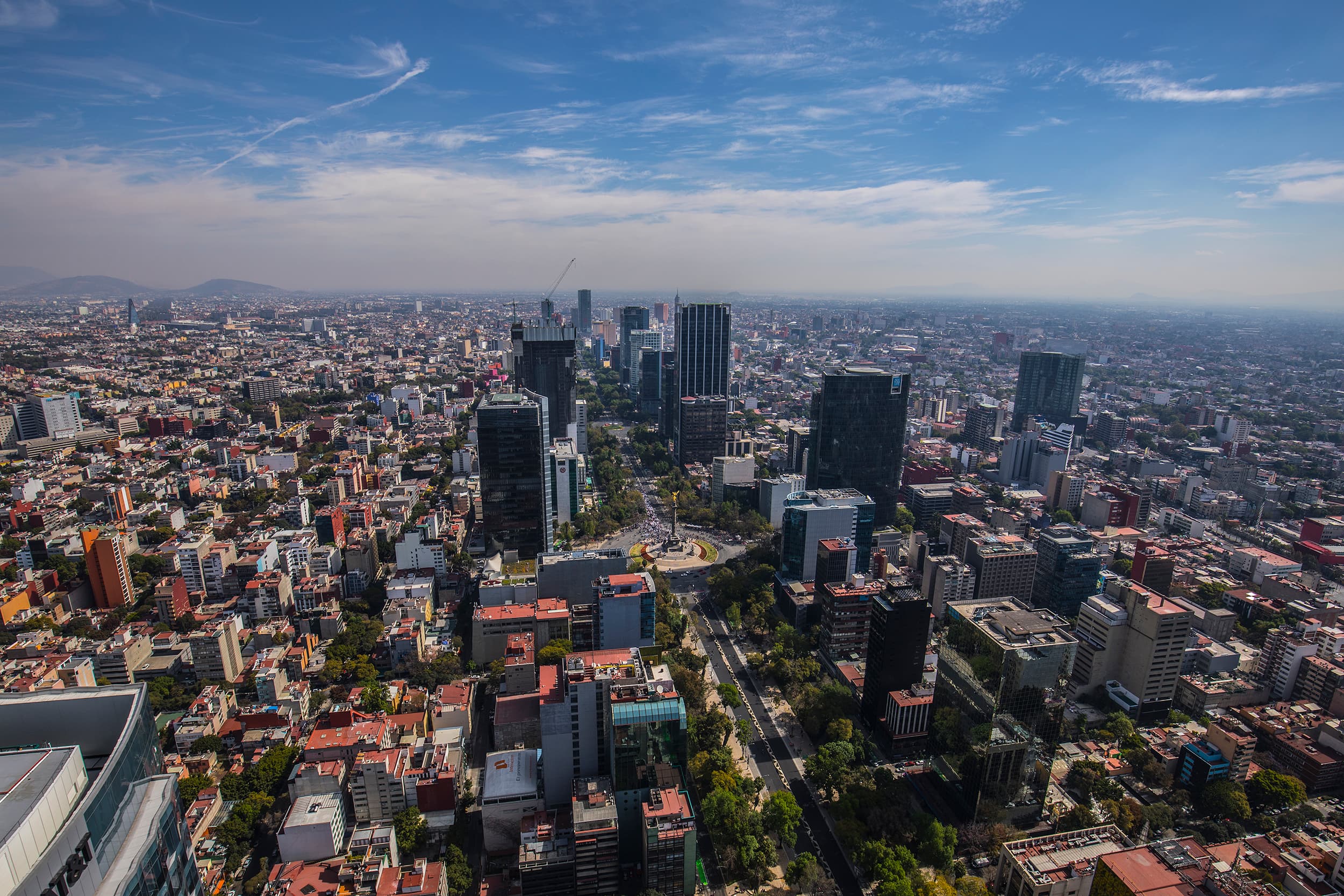
Angel de la Independencia (El Angel) (Zona Rosa). A monument in Reforma Avenue that celebrates Mexico's independence in 1810.
Basílica de Guadalupe (La Villa de Guadalupe). Catholicism's holiest place in the Americas, and the destination of pilgrims from all over the world, especially during the yearly celebration on the 12th of December. It is the shrine that guards the poncho of Juan Diego that contains the image of Our Lady of Guadalupe, and is in the northernmost part of the city.
Ciudad Universitaria (Coyoacán). The main campus of the Universidad Nacional Autónoma de México, the National Autonomous University of Mexico. Located on Insurgentes Sur Avenue, it is one of the world's largest universities, with more than 270,000 students every semester. In 2007 it was declared a UNESCO World Heritage Site.
Coyoacán. Historic Colonial Arts district which was home to Frida Kahlo, Leon Trotsky, and Diego Rivera, among others.
Do
As the world's 7th largest city, Mexico City offers something for everyone and for every budget. Attractions in Mexico City focus less on lazing on the beach (there are no beaches in Mexico City!) and more on exploring the culture and urban culture of Mexico.
Itineraries
Traveling in Mexico City with children
Festivals and events
Wise Men's day. January 6. Most Mexican kids receive toys from the Three Wise Men (Reyes Magos). This is a celebration that pays homage to the aforementioned Bible story. To celebrate it the family gather to eat the "Rosca de Reyes", a sort of bundt cake filled with plastic baby Jesus figures. Traditionally, people who get a figure in their slice of cake are expected to host a feast with tamales on Candelaria Day, February 2. The surroundings of the Alameda Central park are filled with costumed Reyes Magos on the days leading to January 6.
Art Week. early February (Feb. 3 - 9 in 2025). Each year in February, the world of contemporary art focuses on Mexico City's Art Week when parties, celebrations, special gallery exhibitions and myriad galas take place throughout the city. The event takes place at the same time as two other major art events, ZsONA MACO, and Feria Material as well as numerous other events at galleries and museums throughout the city.
Independence Day "Yell". September 15. In the evening, the President of the country (or the city mayor) salutes the crowds from the presidential balcony in the National Palace in the Constitution Square (Zocalo) and shouts the famous "Viva Mexico". The Zocalo (and the rest of the city) is decorated with ornaments and lights. This is an incredible expression of Mexican patriotism combined with a party mood. Expect big crowds with a big revelery. If you want smaller crowds, the squares at the center of every borough usually host similar celebrations.
Eat
You can find almost any kind of food in this city. There are regional specialties from all over Mexico as well as international cuisine, including Japanese, Chinese, French, Polish, Italian, Argentinean, Belgian, Irish, you name it. The main restaurant areas are in Polanco, Condesa, Centro, Zona Rosa, along Avenida Insurgentes from Viaducto to Copilco and more recently Santa Fe.
There are several Mexican chain family restaurants that can be assumed to be safe and similar no matter where you are, including Vips, Toks, La Casa de Toño and the more traditional Sanborns, all reminiscent of Denny's in the United States. They are uniformly good (if never excellent) and relatively approachable to those who have trepidation around Mexican cuisine. El Globo, a French-style bakery, has locations throughout the city selling both French and traditional Mexican pastries, like orejas (little ears), éclairs, empanadas, and rosca during New Year's. It can't be beat for a quick snack or bagful of pastries to eat later.
If you're on a budget, you can also try one of the myriad comida corrida (set menu) restaurants, frequented by many office workers. Some of these offer very good food, are usually safe, and should range between M$70-110 (March 2022).
Perhaps the most ubiquitous type of food almost anywhere in Mexico city are fast food outlets, located on the ground floor of a street-facing building, or puestos, street stands located on a sidewalk or almost anywhere there is room. Most of these serve the usual tacos or tortas, and they can be very cheap. Hygiene varies from good to abysmal, so eat at a place that has plenty of people. Given that most of these establishments cook entirely in view, you can tell if it's going to be okay or not. Often, a street taco stand is going to have better food than a sit down restaurant.
Drink
Mexico City's nightlife is like all other aspects of the city; it is huge. There is an enormous selection of venues: clubs, bars, restaurants, cafes, and variations and combinations thereof to choose from. There is incredible variation, from ultramodern lounges in Santa Fe and Reforma, to centuries-old dance halls in Centro and Roma. There are also pubs in Tlalpan and Coyoacán and clubs of every stripe in Insurgentes, Polanco, Condesa and the Zona Rosa.
Traveling by yourself at night in certain areas of Mexico City is not a good idea, especially in Plaza Garibaldi, where pickpocketers are ever ready to relieve you of your unguarded cash. One of the ways you can check out the night life safely is by doing a Night Club Tour. These tours will typically take you to a few clubs and include transportation. Mexicans are for the most part very friendly and enjoy socializing.
The typical Mexican place to go to drink is the cantina, a bar where food is usually free, and you pay for drinks (exact policies and minimums vary). Cantinas serve a wide range of Mexican and foreign drinks, with prices usually reasonable compared to prices in the US, and you'll be continually served various Mexican foods, such as tacos (you should ask for 'Botana'). If your tolerance for Mexican music (mariachi or otherwise) and lots of noise is low however, this may not be your kind of place. Cantinas are open moderately late, usually past midnight at the very least. However some cantinas, like La Victoria, near the Plaza Garibaldi, are also open at midday for lunch.
A lower-end traditional option is going to a pulquería, where you can drink pulque, a fermented agave drink that was once sacred to the Aztecs. After being on a steep decline for decades, many are finding a new surge in popularity with young people, and pulque can now be found at hipster bars from time to time. They can be found in the Centro Histórico and around Xochimilco. If you don't like pulque, they usually serve beer as well.
Get around
Mexico City is a huge place, but driving is definitely not a way to see it even if tourist attractions are scattered throughout the city. There are several public transport options.
The city government operates the Metro and Metrobús bus rapid transit (BRT) system, which are cheap and reliable but can be very crowded during rush hour. It also operates a light rail line, RTP bus system and electric trolleybuses.
There are plenty of franchised private buses, minibuses and vans, known as peseros and combis, which are less reliable and safe but reach more destinations. In the metropolitan area, there is a commuter train line and the Mexibús bus rapid transit system, but most destinations are only served by private minibuses and vans.
There are thousands of taxis, painted in white and magenta, and several ride-hailing services with surprisingly cheap rates.
If you get lost and are far away from your hotel, hop into a pesero (mini bus) or bus that takes you to a Metro station (look for the sign with the stylized metro "M" in the front window). Using the wall maps, you can get back to a more familiar place (such as Zocalo or Bellas Artes). If it's after midnight, taking a taxi is your best bet.
By metro
The Sistema de Transporte Colectivo, known as the Metro, is one of the largest and most patronized subway systems in the world, with 12 lines that measure more than 190 km (120 mi) and carry 4.4 million people every day. The metro is relatively quick and efficient, especially as an alternative to taxis during rush hours when the streets are essentially parking lots.
Operating hours are from 05:00 to 00:00 on weekdays (starts at 06:00 on Saturday and 07:00 on Sunday). A last train leaves every terminal station at midnight. The metro trains run every couple of minutes, so if you just miss it, you won't have long to wait until another arrives.
Stay safe
Despite its reputation, travel in Mexico City is generally safe and most people find it surprisingly non-threatening. Areas around the historic center and other places where tourists usually go are generally well-lit and patrolled in the early evening. Much of your travel within the city will be done via public transportation or walking.
Most people in Mexico City are quite hospitable and some will speak English, and people who work for hotels and other hospitality-oriented businesses will always help. This will help in avoiding confusion, becoming lost or stranded. Also, you can ask a local for advice to get somewhere, though you might need basic Spanish to do this. In the Polanco, Sante Fe and Lomas districts, some police officers and many business people and younger children speak English, as it is very common to learn it in school.
The least safe places where tourists often go are around the north part of the Centro Historico, such as around Garibaldi Square. Be extra vigilant if you go there at night. There is a detailed crime map based on official statistics.
In case of emergency, dial 911, the number for all emergencies (fire, police and medical).
Theft
Mexico City is an immensely crowded place. As with any major metropolitan area, stay aware of your surroundings.
Do not show money in front of others as this generally attracts pickpockets. Carry just the money you need for the daily expenses and a credit card. Place items in a hotel safe, or tuck them away inside your clothes. A money belt might be a good option.
Protect your personal information, such as your ATM PIN when entering it at an ATM or bank terminal. When paying at a restaurant, it's best if you don't let your card be taken away but instead ask for the terminal to be brought to you or go where it is located.
Do not leave anything of value visible from your car window, always use the trunk, even things that could be considered to hold something of value (for example, an empty gift box) might prompt a broken window.
Avoid ostentation: do not wear jewelry or eye-catching accessories when going out.
Practical facts for Mexico
Taken from open data. Rules and numbers change, so check locally before you rely on them.
- Currency
- Mexican Peso (MXN)
- Language
- Mexican Spanish
- Plugs and power
- Types A and B, 127 V at 60 Hz
- Traffic drives
- On the right
- Emergency numbers
- Any emergency911
- Country calling code
- +52
- Time zones
- America/Bahia Banderas, America/Cancun, America/Chihuahua, America/Ciudad Juarez, and 8 more
Official travel advice
Quoted from each government as published, with the date they last changed it. We do not add a verdict of our own.
UK Foreign, Commonwealth & Development Office
- Advises against all but essential travel to parts of the country
Read the full adviceAreas where FCDO advises against all but essential travel
State of Baja California
FCDO advises against all but essential travel to the city of Tijuana, except:
• airside transit through Tijuana airport
• the Cross Border Xpress bridge from the airport linking terminals across the Mexican-US border
• the federal toll road 1D and Via Rápida through Tijuana to the border
FCDO advises against all but essential travel to the city of Tecate in Baja California, including roads between Tijuana and Tecate.
There is another state called Baja California Sur that is unaffected by these warnings.
State of Chihuahua
FCDO advises against all but essential travel to the state of Chihuahua, except:
• the city of Chihuahua
• the border crossing in Ciudad Juárez (accessed by federal toll road 45)
US Department of State
Level 2 of 4: Exercise increased caution
Read the full adviceExercise increased caution in Mexico due to terrorism, crime, and kidnapping. Some areas have increased risk. Read the entire Travel Advisory.
• Many violent crimes take place in Mexico. They include homicide, kidnapping, carjacking, sexual assault, and robbery. There is a risk of terrorist violence, including terrorist attacks and other activity in Mexico. Visit the U.S. Department of State’s country reports on terrorism to learn more.
Entry and visas
Entry rules depend on your passport and change without notice. Check the official pages before you book.
Sources