
France
A plan for Lyon
Not a list of things to see in Lyon — a day-by-day plan somebody could actually follow, built from places we can point to a source for. Make your own in about a minute.
- 2 nights
- Couple
- Balanced pace
- Mid-range budget
Every place here was checked on 2026-10-27 or later, and each one says where it came from.
The plan, day by day
Day 1
09:30
You arrive
13:00
Brasserie Georges
Suggested because you chose food
- 1h
- Meal
14:30
Contemporary Arts Museum of Lyon
Picked because you chose culture & museums + balanced energy
- 2h 30m
- Culture & museums
2h open
Nothing planned here. That was on purpose.
19:00
La Mère Brazier
Suggested because you chose food
- 1h 30m
- Meal
20:30
Bourse du Travail (Lyon)
Picked because you chose culture & museums + balanced energy
- 2h 30m
- Culture & museums
Day 2
08:00
Wallace
Suggested because it fits a mid-range budget
- 45m
- Meal
45m open
Nothing planned here. That was on purpose.
09:30
Museum of Fine Arts of Lyon
Picked because you chose culture & museums + balanced energy
- 2h 30m
- Culture & museums
1h open
Nothing planned here. That was on purpose.
13:00
Balthaz'art
Suggested because you chose food
- 1h
- Meal
14:30
Institut Lumière
Picked because you chose culture & museums + balanced energy
- 2h 30m
- Culture & museums
2h open
Nothing planned here. That was on purpose.
19:00
Chez M'man
Suggested because you chose food
- 1h 30m
- Meal
20:30
Opéra Nouvel
Picked because you chose culture & museums + balanced energy
- 2h 30m
- Culture & museums
Day 3
08:00
René Nardone Glacier
Suggested because it fits a mid-range budget
- 45m
- Meal
45m open
Nothing planned here. That was on purpose.
09:30
Gadagne (museums)
Picked because you chose culture & museums + balanced energy
- 2h 30m
- Culture & museums
1h open
Nothing planned here. That was on purpose.
13:00
L'Art et la Manière
Suggested because you chose food
- 1h
- Meal
14:30
You leave
Weather through the year
Monthly averages from NASA's 25-year climate record, day and night together.
Best months: June, July, August, and September
| January | Cold: 2°C, 62 mm |
|---|---|
| February | Cold: 3°C, 50 mm |
| March | Cold: 7°C, 61 mm |
| April | Cold: 11°C, 66 mm |
| May | Mild, some rain: 15°C, 84 mm |
| June | Mild, some rain: 19°C, 71 mm |
| July | Mild, some rain: 22°C, 69 mm |
| August | Mild, some rain: 21°C, 74 mm |
| September | Mild, some rain: 17°C, 60 mm |
| October | Mild, some rain: 12°C, 85 mm |
| November | Cold: 7°C, 87 mm |
| December | Cold: 3°C, 73 mm |
From the Wikivoyage guide
Quoted from the travel guide anyone can edit, as it read on the day we took it.
Understand
Founded by the Romans, with many preserved historical areas, Lyon is the archetype of the heritage city, as recognised by UNESCO. Lyon is a vibrant metropolis which starts to make the most out of its unique architectural, cultural and gastronomic heritage, its dynamic demographics and economy and its strategic location between Northern and Southern Europe. It is more and more open to the world, with an increasing number of students and international events.
The city has about 470,000 inhabitants. However, the direct influence of the city extends well over its administrative borders. The figure which should be compared to the population of other major metropolises is the population of Greater Lyon (which includes 57 towns or communes): about 1,200,000. Lyon and its metropolitan area are rapidly growing and getting younger, because of their economic attractiveness.
History
All periods of Lyon's 2,000-year history have left visible traces in the city's architectural and cultural heritage, from Roman ruins to Renaissance palaces to contemporary skyscrapers. It never went through a major disaster (earthquake, fire, extensive bombing) or a complete redesign by urban planners. Very few cities in the world boast such diversity in their urban structure and architecture.
See
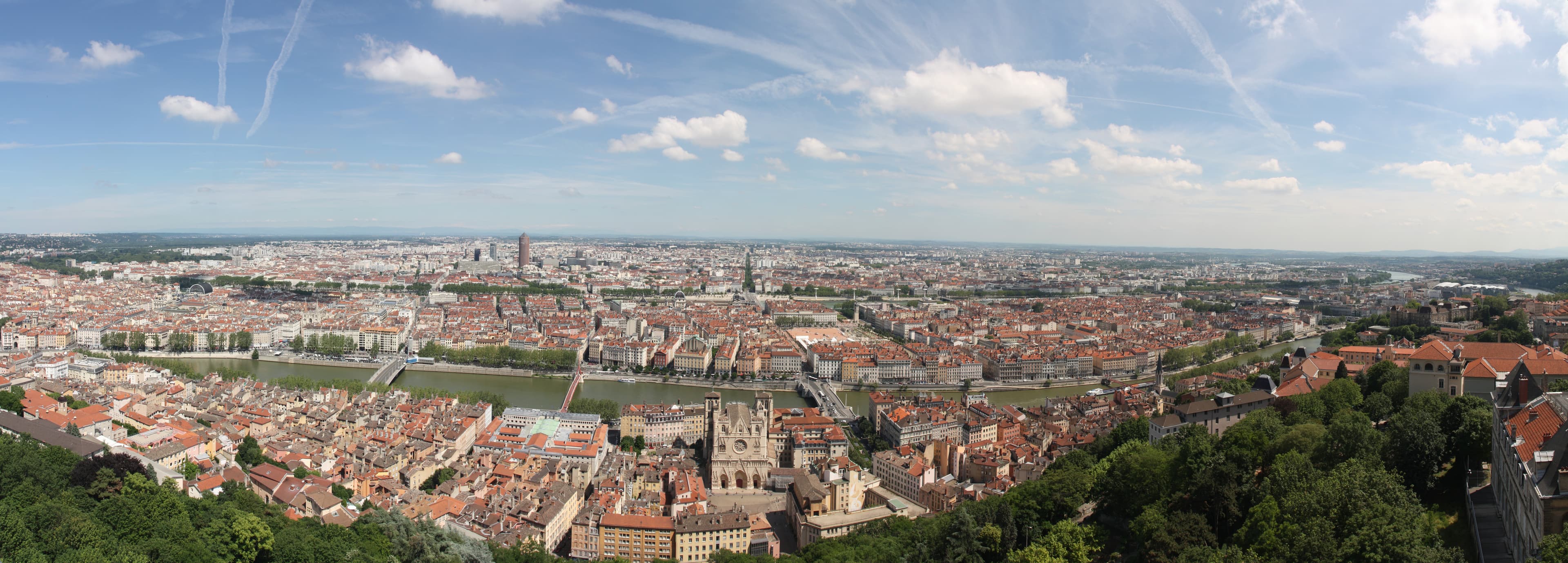
Lyon may not have world-famous monuments such as the Eiffel tower or the Statue of Liberty, but it offers very diverse neighbourhoods which are interesting to walk around in and which hide architectural marvels. As time goes by, the city also becomes more and more welcoming for pedestrians and cyclists. So a good way to explore it may be to get lost somewhere and enjoy what comes up, and not to always follow the guide...
A good point for visitors is that most attractions will not cost you a cent: churches, traboules, parks, etc. For those intending to visit several museums (which are almost the only attractions you cannot see for free), the Lyon City Card may be of interest. Available from the Tourist office and some hotels, it costs €29 for one day, €39 for 2 days, €49 for 3 days, and €59 for 4 days (10% discount if you order online and pick-up). It includes unlimited rides on the public transport network, free or reduced entry fee to major museums and exhibitions and one guided tour per day per person (Vieux Lyon, Croix-Rousse, etc.). The price is still a bit high, so count before you buy to see if this is a good deal considering your plans.
Do not hesitate to buy a detailed map with a street index from a book shop or a newsagent; many places of interest or good restaurants are in small streets that you will not find on simplified maps, such as the ones you can get from the Tourist office.
Whatever the time of year (except for the Fête des Lumières), tourists are not very numerous yet, but they concentrate in a few small areas, especially Fourvière and Vieux Lyon, where the pedestrian streets are just as crowded as the Champs-Élysées sidewalks on sunny weekends.
Highlights
The view from Fourvière basilica, and the basilica itself.
Streets and traboules in Vieux Lyon, St Jean cathedral.
Traboules in Croix-Rousse.
Musée Gadagne.
Parc de la Tête d'Or.
Off the beaten path:
Musée urbain Tony Garnier and États-Unis neighbourhood.
St Irénée church, Montée du Gourguillon, St Georges neighbourhood.
A drink on Place Sathonay.
St Bruno church.
Parc de Gerland.
Gratte-ciel neighbourhood in Villeurbanne.
Do
Cultural events are listed by the weekly magazine Le Petit Bulletin (free, available in cinemas, theatres, some bars, etc. and online).
Early booking is often necessary for the major institutions (Auditorium, opera house, Célestins and Croix-Rousse theatres). The big names sell out months in advance. Unlike London or New York, there is no place in Lyon where you can buy reduced-price tickets for same day shows. (There used to be one but it was very short-lived, possibly because it had too few seats to sell.)
Music, dancing and opera
Auditorium, 84 rue de Bonnel (M: Part-Dieu), ☏ +33 4 78 95 95 95. The Lyon National Orchestra plays in this impressive, modern concert hall which also hosts some jazz and world music concerts.
Opera house, 1 place de la Comédie (M: Hôtel de Ville), ☏ +33 4 72 00 45 00. The old opera house was completely redesigned by Jean Nouvel in the 1990s and hosts opera and dancing shows, along with a few other concerts (especially jazz) in the smaller "Amphithéâtre" room.
Transbordeur, boulevard Stalingrad, Villeurbanne (B: C1-Palais des Congrès), ☏ +33 4 78 93 08 33. The medium-sized hall (capacity 1,500) for rock or popular music concerts.
Ninkasi, 267 rue Marcel Mérieux (M: Stade de Gerland), ☏ +33 4 72 76 89 00. This is a modern-day institution in Lyon. Ninkasi has two places for live music: Kafé (free shows, essentially electronic music) and Kao (a concert hall dedicated to rock and electronic music). It is also a beer brewery and has bars all over the Presqu'île, and also in Villeurbanne.
Maison de la Danse, 8 avenue Jean Mermoz (T: Bachut), ☏ +33 4 72 78 18 18. A theatre dedicated to modern dancing. Also a fine example of architecture of the 1960s.
Theatre
Lyon has a large number of theatres ranging from tiny "cafés-théâtres" to big municipal institutions. You can enjoy any type of show from comedy to classical drama to avant-garde productions.
Théâtre des Célestins, Place des Célestins (M: Bellecour), ☏ +33 4 72 77 40 00. The historical theatre, in a beautiful 19th century building by Gaspard André. Serious programme.
Théâtre de la Croix-Rousse, place Joannès Ambre (M: Hénon), ☏ +33 4 78 27 90 42. 'The other' theatre, with a more avant-garde programme.
Eat
Restaurants have their menus with prices displayed outside. As everywhere in France, the prices always include service, bread and tap water (ask for a carafe of water). Tipping is rare and only expected if you are particularly satisfied with the service. This is especially true in budget or mid-range restaurants, maybe less so in expensive places where it may be considered more appropriate; nothing is compulsory, though. Typical tips depend, of course, on the price of the menu and your level of satisfaction but they are generally not as high as in the US, for example. If you pay by card and wish to add a tip, you can tell the cashier how much to charge your card.
Meal times are generally 12:00–14:00 for lunch and 19:30–22:00 for dinner. Visitors from areas such as North America and Northern Europe might be surprised to find many places still closed at their usual dinner times. Places offering all-day service are to be found in tourist areas, and are unlikely to serve quality fresh food. Late-night service is quite rare in quality restaurants, but you can always get the usual fast-food or kebab.
The traditional restaurants in Lyon are called bouchons; the origin of the word is unclear (it literally means "cork"). They appeared at the end of the 19th century and flourished in the 1930s, when the economic crisis forced wealthy families to fire their cooks, who opened their own restaurants for a working-class clientele. These women are referred to as mères (mothers); the most famous of them, Eugénie Brazier, became one of the first chefs to be awarded three stars (the highest ranking) by the famous Michelin gastronomic guide. She also had a young apprentice called Paul Bocuse. Eating in a good bouchon is certainly a must-do. They serve the typical local dishes, many of which make good use of affordable ingredients like offal:
Salade lyonnaise (Lyon salad): green salad with bacon cubes, croutons and a poached egg
Saucisson chaud: a hot, boiled sausage; can be cooked with red wine (saucisson beaujolais) or in a bun (saucisson brioché)
Quenelle de brochet: dumpling made of flour and egg with pike fish and a crayfish sauce (Nantua sauce)
Tablier de sapeur: marinated tripes coated with breadcrumbs then fried, even locals often hesitate before trying it
Drink
Lyon offers some nice nightlife. A good starting point is Place des Terreaux and then upwards towards the Croix Rousse (M/B: Hôtel de Ville - Louis Pardel, 1th arr). In the streets that climb the hill there are many nice places. These is also numerous bars in pedestrian streets of Le Vieux Lyon (the Old Lyon), all around St-Jean Cathedral (M: Vieux Lyon, 5th arr).
English and Irish pubs
Foreign students often gather in English or Irish pubs, which are more particularly concentrated in the Vieux Lyon area. English-speaking staff everywhere, of course.
1 Kelly's Pub, 12 quai Romain Rolland (M : Vieux Lyon), ☏ +33 4 78 85 53 31, kellysirishpub@gmail.com. 15:00-03:00 daily. Irish pub, live music on Saturday, Irish music sessions on Thursday, quiz every Monday, pool, darts, Irish and English pub food, air conditioning.
2 Paddy's Corner, 4 rue de la Terrasse (M: Croix-Rousse), ☏ +33 9 52 11 21 76. 09:00-02:00. Perfect little pub in the Croix-Rousse area, off the beaten track. Live music sessions every Thursday, Pub Quiz on Tuesdays.
3 Johnny Walsh's, 56 rue St Georges (M: Vieux Lyon), ☏ +33 4 78 42 98 76. Tue-Thu 19:00-02:00, Fri-Sun 19:00-03:00. Nice, authentic Irish pub with good music and some live performances.
4 Wallace, 2 rue Octavio Mey (B: C3-Gare St Paul), ☏ +33 4 72 00 23 91. Daily 11:00-03:00. Comfortable beer and whisky bar with a nice terrace, live sports, pub quiz on Thursdays.
5 The Smoking Dog, 16 rue Lainerie (B: C3-Gare St Paul), ☏ +33 9 64 06 68 90. English pub. Pub quiz on Tuesdays. Air conditioning.
Live music
6 Hot Club de Lyon, 26 rue Lanterne (M: Hôtel de Ville), ☏ +33 3 78 39 54 74 (at night). Tue-Thu 21:30; Fri Sat 22:00. Jazz club (since 1948), in an old typical cellar, with good live jazz 5 nights/week.
Others
7 L'Abreuvoir, 18 rue Ste Catherine (M: Hôtel de Ville), ☏ +33 4 78 30 17 90. Daily 17:00-01:00. There you can join some crazy French listening to crazy French music. Definitely an experience, though not everyone's cup of tea.
Le Perroquet Bourré (The Drunk Parrot), 18 Rue Saint Catherine. Cheap rum, the inside is decorated as a pirate ship.
Get around
On foot
The city centre is not so big and most attractions can be reached from each other on foot. The walk from Place des Terreaux to Place Bellecour, for example, is about 20 min. The rule of thumb is that metro stations are generally about 10 min walk apart.
Be careful when crossing major axes: traffic is dense and running red lights is a very popular sport.
By public transport
Lyon's public transportation system, known as TCL, is regarded as one of the most efficient in the country. Central areas are very well served; so are the campuses and eastern suburbs, where many jobs are concentrated. The western suburbs are more residential and can be difficult to reach. As everywhere in France, the network can be perturbed by strikes from time to time. The network is divided into 6 fare zones 1-5 plus an external zone. Zones 1 & 2 cover the central areas including all the métro.
By far the easiest way to travel is to tap on with any contactless bank card (Visa, Mastercard, CB), including Google/Apple Pay. As of 2026, you will be charged €2.10 per 1-hr journey, up to a cap of €6.30/day. Journeys include unlimited transfers between all modes of transport.
If this is not an option, you can buy a rechargeable ticket for €0.20 at any TCL vending machine or office (agences TCL), then use it for loading single tickets or 24/48/72h tickets (from €6.50). A "booklet" (carnet) of 10 singles costs €19.50 and can be used by groups. Tickets can be purchased from vending machines in the stations, but the only payment methods accepted are credit/debit cards and coins; paper money is not accepted. Tobacco shops and newsagents showing a "TCL" sign also sell tickets. Single tickets can be purchased from bus drivers but the price is €2.30 in that case. Group tickets are available from the tourist office, as is the Lyon City Pass, which gives unlimited travel and free admission to many museums. Weekly and monthly passes are only available to residents.
Make sure to validate your ticket every time you board a bus or tram, even when transferring, or else you could be fined. Look for a grey machine near the doors.
Stay safe
Real security problems in the city centre are rare, but the usual advice applies.
Rue Ste Catherine, behind Place des Terreaux, is locally famous for its bars; on weekend nights there are a lot of drunk people on the street, who might be violent. The police keep a close watch but it is probably better to avoid the area if you are on your own, especially after 3AM when the bars are closed. Similar problems may be encountered in Vieux Lyon.
In populated places such as Rue de la République or outside Part-Dieu station, you may come across people advertising for charities; they can be recognised by their specific, coloured clothing. They will not ask you for money but rather give you information documents which encourage you to donate. Homeless people sell newspapers such as Macadam or Sans-abri which help them making some money without begging; they should have an ID card issued by the editors. But there are also people trying to con you and get money for some imaginary charity, sometimes by selling postcards or other items. Never give money directly to someone on the street who claims to be working for charity and does not have official documents, or if the documents look doubtful.
Some areas with a reputation for insecurity are way off the beaten track. But if you do decide to venture outside the city center, avoid wandering in Guillotière, Gerland, Vergoin, and La Duchère. Beyond, the city limits, stay clear of major suburbs like Villeurbanne and Vénissieux.
Emergency numbers
Police, ☏ 17.
Fire brigade, ☏ 18.
Medical emergency, ☏ 15.
The European emergency number, ☏ 112 (should be used on mobile phones).
Practical facts for France
Taken from open data. Rules and numbers change, so check locally before you rely on them.
- Currency
- Euro (EUR)
- Languages
- French (France), Arpitan, Breton, Corsican, and 3 more
- Plugs and power
- Types C and E, 230 or 400 V at 50 Hz
- Traffic drives
- On the right
- Country calling code
- +33
- Time zone
- Europe/Paris
Official travel advice
Quoted from each government as published, with the date they last changed it. We do not add a verdict of our own.
UK Foreign, Commonwealth & Development Office
- No areas listed that it advises against travelling to
Read the full adviceDemonstrations
There is an increased likelihood of demonstrations, political gatherings and marches taking place across France, sometimes at short notice.
Whilst most demonstrations are peaceful, you should remain aware of your surroundings. Stay away from areas with large crowds or a significant police presence, and follow the advice of police and local authorities.
Demonstrations may disrupt local transport services and authorities may impose public safety measures, including partial and localised curfews in some areas. Monitor local media for the latest information about measures in your area.
US Department of State
Level 2 of 4: Exercise increased caution
Read the full adviceExercise increased caution in France due to terrorism and unrest.
Violence and rioting have recently occurred in France and may continue. Avoid demonstrations and areas of unrest. Stay away from areas with large crowds or significant police activity.
Pickpocketing and phone thefts are common, especially in crowded places. Terrorist groups continue to plan possible attacks in France and may attack with little to no warning. There are also regular, peaceful protests and strikes in Paris and other cities throughout France.
Entry and visas
Entry rules depend on your passport and change without notice. Check the official pages before you book.
Sources