
Peru
A plan for Lima
Not a list of things to see in Lima — a day-by-day plan somebody could actually follow, built from places we can point to a source for. Make your own in about a minute.
- 2 nights
- Couple
- Balanced pace
- Mid-range budget
Every place here was checked on 2026-10-27 or later, and each one says where it came from.
The plan, day by day
Day 1
09:30
You arrive
13:00
Houlihan's
Suggested because you chose food
- 1h
- Meal
14:30
National Museum of Archaeology, Anthropology, and History of Peru
Picked because you chose culture & museums + balanced energy
- 2h 30m
- Culture & museums
2h open
Nothing planned here. That was on purpose.
19:00
Don Tito
Suggested because you chose food
- 1h 30m
- Meal
20:30
Felipe Pardo y Aliaga Theatre
Picked because you chose culture & museums + balanced energy
- 2h 30m
- Culture & museums
Day 2
08:00
Tostadora
Suggested because you chose food
- 45m
- Meal
45m open
Nothing planned here. That was on purpose.
09:30
Museum of Italian Art
Picked because you chose culture & museums + balanced energy
- 2h 30m
- Culture & museums
1h open
Nothing planned here. That was on purpose.
13:00
Astrid y Gastón
Suggested because you chose food
- 1h
- Meal
14:30
Lima Art Museum
Picked because you chose culture & museums + balanced energy
- 2h 30m
- Culture & museums
2h open
Nothing planned here. That was on purpose.
19:00
El Rincon del Gordo
Suggested because you chose food
- 1h 30m
- Meal
20:30
Teatro Plaza Norte
Picked because you chose culture & museums + balanced energy
- 2h 30m
- Culture & museums
Day 3
08:00
Caffe Gianfranco
Suggested because it fits a mid-range budget
- 45m
- Meal
45m open
Nothing planned here. That was on purpose.
09:30
Museum of the Nation
Picked because you chose culture & museums + balanced energy
- 2h 30m
- Culture & museums
1h open
Nothing planned here. That was on purpose.
13:00
La Barra de Chiki Cevichería Resto-Bar
Suggested because you chose food
- 1h
- Meal
14:30
You leave
Weather through the year
Monthly averages from NASA's 25-year climate record, day and night together.
Best months: January, February, March, and April
| January | Mild and dry: 19°C, 3 mm |
|---|---|
| February | Mild and dry: 20°C, 5 mm |
| March | Mild and dry: 20°C, 4 mm |
| April | Mild and dry: 19°C, 1 mm |
| May | Mild and dry: 18°C, 1 mm |
| June | Mild and dry: 17°C, 1 mm |
| July | Mild and dry: 17°C, 1 mm |
| August | Mild and dry: 17°C, 1 mm |
| September | Mild and dry: 17°C, 1 mm |
| October | Mild and dry: 18°C, 1 mm |
| November | Mild and dry: 18°C, 2 mm |
| December | Mild and dry: 19°C, 3 mm |
From the Wikivoyage guide
Quoted from the travel guide anyone can edit, as it read on the day we took it.
Understand
Lima is a growing metropolis of about 11 million people. Many of these people have migrated from the highlands to find work in Lima, without success, leading to widespread poverty and unemployment, and sprawling shanty towns on the outskirts of the city.
Lima's pre-Hispanic and colonial architecture is beautiful and the city has several museums (such as the Museo Larco) that tells the story of a country with a long history that produced a large number of coastal and Andean civilizations (such as the Moche, Chavin, and the Incas) and many local cultures. There are several archaeological sites in and around the city (locally known as huaca).
Climate
The city is in a valley surrounded by an extremely arid desert, receiving on average no more than 3 cm of rain per year. The city is surprisingly green with many parks and trees, but all of them are artificially watered by the municipality! In the summer months, December to February, the weather is usually sunny and hot, with a UV index that is invariably extreme. Even a layer of factor 50 sun block won't offer protection for long, and it's recommended to stick to shaded areas as much as possible, which is problematic when visiting archaeological sites in the scorching sun. The rest of the year, the weather in Lima is overcast, and temperatures are between 20 - 30 C° during day time, which seems chillier when combined with the general dampness. Air pollution in the streets of Lima can be very bad due to a combination of weather and older poorly-maintained vehicles.
See
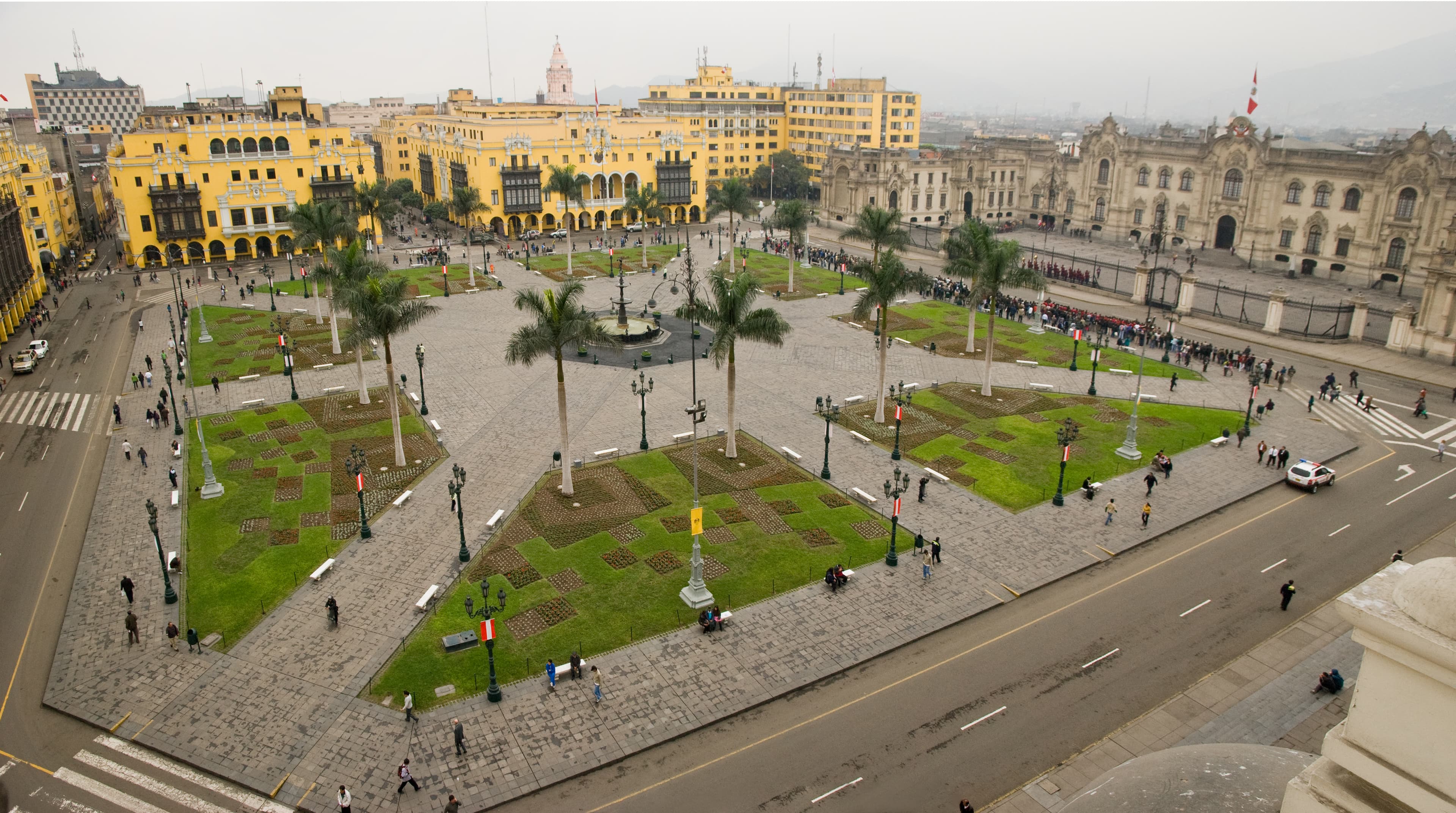
The historic downtown, which is a UNESCO World Heritage Site.
The Circuito Mágico del Agua (Magic Water Tour), a fountain and light display in the Parque de la Reserva and Parque Fermín Tangüis.
The Parque del Amor (Lovers' Park) in Miraflores.
The Costa Verde, Lima's impressive green coast stretches between San Miguel and Chorrillos.
The tourist-friendly districts of Barranco, Miraflores and Santiago de Surco.
The historical sites of Pueblo Libre, including the Cruz del Viajero, a monumental Christian cross dating from the era of the Conquistadores.
Lima's best shopping malls: Plaza Norte, Jockey Plaza, Larcomar, Mall Aventura Plaza, Real Plaza Salaverry.
Historical churches: Lima´s Cathedral, Santo Domingo (San Martín de Porres), Santa Rosa (Santa Rosa de Lima), Nazarenas (Señor de los Milagros), San Francisco.
Museums: Museo nacional de Arqueología, Antropología e Historia (Pueblo Libre), Museo de Arte (Paseo Colón), Museo Pedro de Osma (Barranco), Museo Rafael Larco (Pueblo Libre).
Parque Kennedy in the center of Miraflores. This park is right in the entertainment district and is famous for the large number of cats that used to live there.
Huaca Pucllana : Pre-Inca temple of the Lima culture (around 500 AD). This archaeological site is located in the Miraflores district, and is one of the most popular tourist attractions in the city. Open every day except Tuesday and Sunday, from 09:00 to 15:30. Guided tour required. 15 soles / person.
Do
Bike Tours of Lima, Calle Bolivar 150, Miraflores, ☏ +51 1 445-3172. Mon–Fri 09:30–18:00; Sat Sun 09:30–14:00. A variety of 'public' and private bicycle, walking and food tours of Lima by English-speaking guides. Prior booking is required. It is the number 1 activity in Lima on Tripadvisor. Biking tours US$35–US$90, other prices vary, pay in U.S. dollars.
The Lima Gourmet Company, Miraflores, Lima, Peru, ☏ +51 1 446-6829. 24. A combined city and culinary tour of Lima. Travellers will visit a local market, have a hands-on cooking class and try different Peruvian dishes while they tour the city's main districts and historical points of interest. Great if you don't have much time in Lima.
Exquisito Perú, Av Grau 715, Barranco, ☏ +51 915 155 430. 24. Explore Peruvian gastronomy through fun and interactive walking food tours in different parts of the city. Also available in Arequipa and Cusco. $59 to $159 depending on the food tour. (updated Dec 2022)
Folkloric dance shows, Heroes de Tarapacá 168 (First left off Av. Brasil from Plaza Francisco Bolognesi), ☏ +51 1 7156960, ventasymarketing@brisasdeltiticaca.com. Almuerzo: Fri Sat 13:00–17:30; Noches de Foclore: Tue Wed 21:00–00:15; Thu 21:45–01:35; Fri Sat 22:00–14:00. Live shows of local dance with dinner or lunch included. Choose between Almuerzo (lunchtime) Shows, Noches de Folclore (folklore evenings) and periodic special shows. Range from S/39.50–68 per person. (updated Jan 2016)
Mirabus bus and road train tours, Tourist information booth in Parque Kenedy, Miraflores, ☏ +51 1 242-6699. Information booth open every day 09:00–19:00. Various themed day and night bus tours of Lima and the surrounding region, including excursions to Caral and Pachacamac. They also operate a road train around the main sights of Centro. Most bus tours: adults S/70, children (4–10 years) S/50, under 4s free. City centre road train: adults S/5, children (4–10 years) S/3, under 4s free. Other prices S/10–220 per person.. (updated Jan 2016)
Eat
Gastronomy has been, since the days of the Spanish vice royalty, an essential aspect of life in Lima. During the last few years, the city's dining reputation has experienced a huge leap in the eyes of the world, due in part to the International Summit of Gastronomy (Madrid Fusión) in 2006, which declared Lima to be the "Gastronomy Capital of the Americas". The offerings in Lima are nowadays more varied and cover a wide range of types and cuisines, both regional and international.
Despite the wide range of choice in Lima's many restaurants, ceviche is surely number one on the list of dishes you must get to know, not only because it happens to be the Peruvian national dish, but because of its unparalleled delicious taste. With the increasing interest in the Peruvian cuisine, ceviche is quickly making its way onto tables all over the world. But if you want to enjoy the real thing, don't miss it during your stay here in ceviche's mecca. There is at least one cevichería in every neighbourhood. Moreover, most criollo restaurants include ceviche on their menus; indeed the dish is so popular that it is even offered at many of the more upscale nouvelle-cuisine restaurants.
In some places, Peruvian food tend to be spicy and heavy. Try it and ask if any dish is picante (spicy), which usually means it is going to be very spicy! A full meal may be really heavy even if it's perfectly nice and well-prepared with fresh ingredients.
A second must goes to Chinese and Japanese cuisines, which predictably, have a strong Peruvian influence. Chifas - that is, Chinese restaurants- - which can be counted by the hundreds if not thousands, are usually down-to-earth neighbourhood eateries, offering a fare rich in seafood and chicken. Japanese restaurants, on the contrary, are less widespread, and more upscale and expensive. Their forte is, of course, a year-round supply of the freshest and most varied seafood.
Travellers longing for a delicious falafel or shwarma sandwich will be pleased to learn there is an excellent café in Parque Kennedy that serves these types of Middle Eastern foods at reasonable prices.
Drink
Pisco Sour is the national drink of Peru, made with Pisco, a brandy made of grapes. It is highly recommended that all visitors to Peru try this drink at least once. Visitors might be amused to learn that Chileans claim Pisco Sour is their own, but it isn't true. There are some variations that are offered in several bars around town. Just be careful; the fresh and sweet flavour makes it very easy to drink too much, and you can so easily get drunk on it.
Inca Kola is the most popular soft drink in Peru, one of few sodas that Coca Cola couldn't defeat (until they bought the company). It's a yellow-fruit flavored drink that tastes like hierba luisa.
Jugos You can find great fresh fruit drinks all over Lima. Starting from S/0.50 for a fresh orange juice at the market to some more expensive ones. Surtidos, containing several different fruits, are quite tasty.
Chicha Morada A refreshing, purple, non-alcoholic drink high in antioxidants. It's made by boiling purple corn with pineapple, cinnamon, clove, and sugar.
Emoliente is a hot drink prepared with barley, herbs, sugar and lemon juice. It's often sold by street vendors at night for around S/1. It's especially great in winter.
Starbucks Coffee is predictably widespread if you really need your daily caffeine fix.
Get around
By public transit
Lima's public transport network consists of a single metro line, modern buses, coasters and combis (which are called "micros" by the locals). The system can be confusing for foreign tourists.
Metro
The 1 Lima Metro. is a newish subway system that is being developed. As of 2022, only Line 1 exists; it serves 33 stations through 11 districts. It is an elevated line, which runs in the general north-south direction in the eastern part of the Lima metropolitan areas (2-3 km east of Lima's historical center and Miraflores), and, as such, does not serve many locations where tourists are likely to stay of visit.
Line 2, to run in the east-west direction toward Callao, is under construction, and is expected to open in 2024; once it's opened, the attractiveness of the metro system for the visitors is likely to significantly increase.
Bus rapid transit (Metropolitano)
The Metropolitano. is a modern rapid transport bus system, operated with fully wheelchair-accessible articulated ("bendy") buses. The stations are spaced at 1 km or so, and the buses mostly travel on their own dedicated lanes on expressways, which means that traveling on this system is indeed much faster than on regular buses.
It operates similarly to a subway system: you enter a station through a card-operated turnstile, travel as you wish within the system, and exit your destination system via a turnstile as well. (A card is not needed for exit, as the fare is flat is not distance-based).
There is basically one route, running from the northern suburbs to Lima's city center to the southern suburbs of San Isidro and Miraflores, although it splits in two for a short stretch in the city center. There are different "services", however, which differ primarily at which stations they stop (express vs. limited stops vs. local), and at which branch they take around the downtown.
Stay safe
If you witness a crime being committed, do not intervene unless you are really sure of what you are doing: many criminals, even pickpockets, carry guns, knives, etc., and may use them if feeling threatened.
In general, a tried-and-true technique for staying safe in Lima is to maintain a low profile. Leave your fancy watch at home, don't wear a fine suit and don't carry a laptop when hailing taxis on the street, and keep a relaxed, friendly, smiling attitude. If you do need to go out dressed like a tourist, call a taxi rather than hire one in the moment - the few moments you wait and the few extra soles you pay will be worth it.
Thieves
While there is not much violent crime against tourists, opportunistic theft is rampant. Watch out for pickpockets constantly. If you carry a purse, a camera, a backpack or just a pair of sunglasses hang on to them at all times. In crowded areas, put your back pack on your front and hold shopping close to you. Just keep your eyes open and be aware of people around you. In any case, if someone extremely friendly approaches (even wanting to stretch your hand), just try not to talk that much, and they'll go away. It's normal to find polite people around trying to help tourists, but stay away from the extremely friendly ones.
Practical facts for Peru
Taken from open data. Rules and numbers change, so check locally before you rely on them.
- Currency
- Peruvian Sol (PEN)
- Languages
- Spanish (Peru), Quechua, and Aymara
- Plugs and power
- Types A, B, and C, 220 V at 60 Hz
- Traffic drives
- On the right
- Country calling code
- +51
- Time zone
- America/Lima
Official travel advice
Quoted from each government as published, with the date they last changed it. We do not add a verdict of our own.
UK Foreign, Commonwealth & Development Office
- Advises against all but essential travel to parts of the country
Read the full adviceAreas where FCDO advises against all but essential travel
Within 20km south of the Peru-Colombia border
FCDO advises against all but essential travel to areas within 20km south of the Putumayo River and the border between Peru and Colombia (Loreto region) except for:
• the Amazon River
• the area of the triple border with Brazil and Colombia from and including the towns of Caballococha in Peru up to the actual triple border at Santa Rosa de Yavari town
Valley of the Apurímac, Ene, and Mantaro Rivers (VRAEM)
FCDO advises against all but essential travel to the Valley of the Apurímac, Ene, and Mantaro Rivers, also known as the VRAEM region.
We advise against all but essential travel to these two areas for safety and security reasons.
Find out more about why FCDO advises against travel.
US Department of State
Level 2 of 4: Exercise increased caution
Read the full adviceExercise increased caution in Peru due to risk of crime, unrest, kidnapping, and terrorism. Some areas have increased risk. Read the entire Travel Advisory.
• U.S. government employees working in Peru need special authorization to travel to the Colombia-Peru border area in the Loreto Region due to safety risks.
• U.S. government employees working in Peru need special authorization to travel to the Valley of the Apurímac, Ene, and Mantaro Rivers (VRAEM), due to safety risks.
• U.S. government employees working in Peru need special authorization to travel to the VRAEM’s boundary cities of Abancay, Ayacucho, Huancavelica, and Huancayo due to safety risks.
Entry and visas
Entry rules depend on your passport and change without notice. Check the official pages before you book.
Sources