
Malaysia
A plan for Kuala Lumpur
Not a list of things to see in Kuala Lumpur — a day-by-day plan somebody could actually follow, built from places we can point to a source for. Make your own in about a minute.
- 2 nights
- Couple
- Balanced pace
- Mid-range budget
Every place here was checked on 2026-10-20 or later, and each one says where it came from.
The plan, day by day
Day 1
09:30
You arrive
13:00
Jalan Alor
Suggested because you chose food
- 1h
- Meal
14:30
National Museum of Malaysia
Picked because you chose culture & museums + balanced energy
- 2h 30m
- Culture & museums
2h open
Nothing planned here. That was on purpose.
19:00
Passage Thru India
Suggested because you chose food
- 1h 30m
- Meal
20:30
Petronas Philharmonic Hall
Picked because you chose culture & museums + balanced energy
- 2h 30m
- Culture & museums
Day 2
08:00
Ho Kow Hainam Kopitiam
Suggested because you chose food
- 45m
- Meal
45m open
Nothing planned here. That was on purpose.
09:30
Istana Negara, Jalan Istana
Picked because you chose culture & museums + balanced energy
- 2h 30m
- Culture & museums
1h open
Nothing planned here. That was on purpose.
13:00
Glutton Street Market
Suggested because you chose food
- 1h
- Meal
14:30
Islamic Arts Museum Malaysia
Picked because you chose culture & museums + balanced energy
- 2h 30m
- Culture & museums
17:00
Royal Malaysian Police Museum
Picked because you chose culture & museums + balanced energy
- 2h 30m
- Culture & museums
19:30
Horizon Grill
Suggested because you chose food
- 1h 30m
- Meal
21:00
Istana Budaya
Picked because you chose culture & museums + balanced energy
- 2h 30m
- Culture & museums
Day 3
08:00
Bunn Choon
Suggested because it fits a mid-range budget
- 45m
- Meal
45m open
Nothing planned here. That was on purpose.
09:30
Tun Abdul Razak Memorial
Picked because you chose culture & museums + balanced energy
- 2h 30m
- Culture & museums
1h open
Nothing planned here. That was on purpose.
13:00
Soong Kee Beef Noodle Lao You Ji Porridge
Suggested because you chose food
- 1h
- Meal
14:30
You leave
Weather through the year
Monthly averages from NASA's 25-year climate record, day and night together.
Best months: February, June, July, and August
| January | Wet season: 25°C, 206 mm |
|---|---|
| February | Rainy: 25°C, 157 mm |
| March | Rainy: 26°C, 194 mm |
| April | Wet season: 26°C, 250 mm |
| May | Rainy: 26°C, 172 mm |
| June | Rainy: 26°C, 155 mm |
| July | Rainy: 25°C, 169 mm |
| August | Rainy: 25°C, 184 mm |
| September | Rainy: 25°C, 195 mm |
| October | Wet season: 26°C, 263 mm |
| November | Wet season: 25°C, 314 mm |
| December | Wet season: 25°C, 263 mm |
From the Wikivoyage guide
Quoted from the travel guide anyone can edit, as it read on the day we took it.
Understand
As in most of Malaysia’s larger cities, Malaysian Chinese form a majority of the population, at 55%, in Kuala Lumpur. Malays (who form the majority of Malaysia's population, overall), Malaysian Indians and Eurasians (people of mixed European and Asian descent) are also present in large numbers in the city. There is also a substantial number of foreign residents, including more recent immigrants and workers from South and Southeast Asia and expatriates from Western countries and the Middle East. The result is a mix of cultures that meld together to make Kuala Lumpur a modern and cosmopolitan capital.
Electricity is 230V using Type G plugs. Visitors from countries with different plugs will need an adapter.
History
Founded in 1857 under British rule as a tin mining outpost, Kuala Lumpur is fairly new as far as Malaysian cities go and lacks the rich history of George Town or Malacca. Due to the success of tin mining, Kuala Lumpur began to flourish but had problems with gang fighting in the late 1800s. Following this, Kuala Lumpur faced further misfortune after much of the city burnt down in a large fire as most buildings were built from wood and thatch. As a result buildings in Kuala Lumpur were required to be built with brick and tile. After these rough early years, Kuala Lumpur began to prosper and was made capital of the Federated Malay States in 1896.
See
Individual listings can be found in Kuala Lumpur's district articles
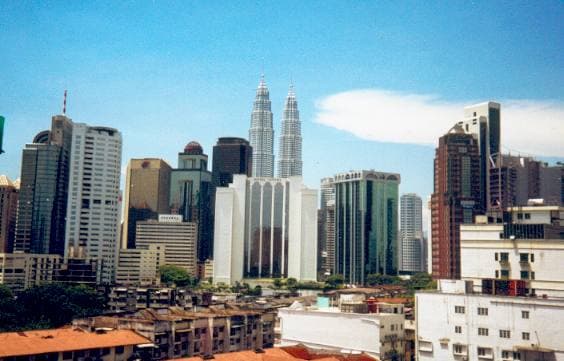
When people think of Kuala Lumpur the first thing that comes to mind is probably the Petronas Towers, which is in the Golden Triangle. Whilst they most certainly are an architectural delight (particularly at night), there is much more to be discovered in Kuala Lumpur. Competing with the Petronas Towers are Merdeka 118 (a supertall skyscraper) and KL Tower (Menara KL), which looks oddly similar to other famous skyscrapers. The real joy of Kuala Lumpur lies in wandering randomly, seeing, shopping and eating your way through it.
Being part of a former British colony, many colonial buildings are scattered throughout, with many borrowing themes from British, Indian and North African architecture. The grandest colonial buildings lie in the city centre including the old Kuala Lumpur Railway Station, the charming Masjid Jamek at the confluence on the Klang River and the former offices of the Colonial Secretariat (now the Sultan Abdul Samad Building) on Merdeka Square (Dataran Merdeka). To top it off on Merdeka Square's west side, you will find the Royal Selangor Club, looking like a rejected transplant straight from Stratford-upon-Avon.
The National Mosque, Masjid Negara, (1965) celebrates the bold ambitions of the newly independent Malaysia. The National Monument in the pretty Botanical Garden is inspired by the Iwo Jima Memorial in Arlington, Virginia. Also in the Botanical Garden is Carcosa Seri Negara, the former residence of the British High Commissioner, which now houses an upmarket hotel and colonial-style tea rooms.
Within the city centre is also the fascinating narrow streets of Chinatown, Kuala Lumpur's traditional commercial district, with its many Chinese shops and places to eat.
Do
Individual listings can be found in Kuala Lumpur's district articles
Kuala Lumpur is well known for its wide range of shopping and eating options, which are adequately covered in the Eat and Buy sections of this article and listings within the district articles. Skyscraper Gazing is the obvious option, with glass and steel abound and excellent views available from the Petronas Towers or the KL Tower (Menara KL) viewing decks, both located in the Golden Triangle.
Arts & Culture
Like much of Kuala Lumpur, there is an interesting mix of arts and culture to experience, ranging from traditional Malay to Islamic to modern. Several good theatres and performance halls have emerged as part of Malaysia's drive to encourage greater cultural expression. These include the National Theatre (Istana Budaya) and the Kuala Lumpur Performing Arts Centre in the northern part of the city, the Malaysian Philharmonic Orchestra (Dewan Filharmonik) in the Twin Towers, and the Actors Studio at Lot 10. Leading museums in the Old City Centre are the National Museum, which covers the region's history, and the well-regarded Islamic Arts Museum, which houses a small but captivating collection.
Pampering
Pampering and spas can be found in several five-star hotels and independent centres in the Golden Triangle. There's also nail parlours and beauty salons, which are generally good value, there's also high-end ones offering similar services for a premium. Reflexology and foot massage places are everywhere, especially in Bukit Bintang in the Golden Triangle and in Chinatown.
For those who are willing to be a bit more adventurous, try hunting down a fish foot spa and relax whilst fish nibble away at your feet. However do be careful which one you go to as some are of low standard and you may get an infection or even a blood borne disease. Try a fish spa in a tourist area as these tend to be better maintained.
Sports
Urban sports such as golfing, cycling, running, jogging and horse riding are common in Kuala Lumpur. If you’re into rock climbing, the Batu Caves in the Northern suburbs is popular. However, given Malaysia's stunning terrain, you’re better off heading to other places for anything more strenuous or challenging.
Eat
Individual listings can be found in Kuala Lumpur's district articles
Malaysian food is amazing, making Kuala Lumpur an excellent place to eat as it hosts cuisine from all around the country and beyond. Most restaurants close by 10PM, but in the city centre, there are always a few 24-hr kedai mamak (curry houses) or fast food places if you get stuck.
Delicious food can be very cheap too: just head to the ubiquitous roadside stalls or kedai kopi (literally coffee shop, but these are all about the food). These shops operate like a food court with many stalls selling a variety of food. Some coffee shops have tables and chairs by the roadside. Chinatown (especially Jalan Sultan, Jalan Hang Lekir and Jalan Petaling) in the city centre and Jalan Alor in the Golden Triangle have some of the greatest concentrations of coffee shops and stalls. They mostly open only at night. Pudu is also a famous area among locals for its street food stalls, though tourists typically do not go there.
One famous collection of streetside Mamak stalls is at Jalan Doraisamy near the Heritage Row in Chow Kit. Along with full-blown curries, these places also serve roti canai (generally RM1 each), a filling snack that is almost half chapati, half pancake but certainly wholly delicious. It is served with dhal and curry sauce.
Shopping malls' food courts provide cheap Malaysian food in more comfortable and hygienic conditions, although the prices will be a little higher. However, most Malaysians consider the quality of dishes at a food court to be inferior to those at roadside stalls.
The Golden Triangle, Bangsar and Midvalley, Heritage Row and some areas in Damansara and Hartamas are the usual places for people looking to dine out with a bit of flair.
Drink
Individual listings can be found in Kuala Lumpur's district articles
Kuala Lumpur has quite a vibrant night-life and the Golden Triangle is the epicentre of most of the partying which goes on in the city. Jalan P. Ramlee, just south of KLCC, is Kuala Lumpur's central clubbing area, while the action also spills onto Jalan Sultan Ismail, Jalan Ampang, Jalan Pinang and Jalan Perak. Nearby Bukit Bintang also throbs with action, and its neon-lit nightclubs, many of them with hostesses, certainly have a more Asian feel to them.
Heritage Row, in the Chow Kit district, is fast catching up as a popular nightspot. It occupies a row of refurbished colonial-era shop houses and is now home to one of Kuala Lumpur's swankiest clubs and trendy bars; strictly for well heeled visitors and locals. Bangsar has long been one of the busiest places in Kuala Lumpur after the sun goes down. The action is around Jalan Telawi and its side streets, and is definitely the place to go for drinks and deafening music.
Sri Hartamas and Mont Kiara in the Damansara and Hartamas district have popular pubs and some clubs as well as nice coffee places. You may be able to find live performances in some of the outlets.
After a tiring night out, Malaysians like to head to Mamak stalls - street side stalls or shops operated by Indian Muslims - which offer a range of non-alcoholic beverages like teh tarik (frothed tea) and light food. In fact, these stalls have also become night hangouts in their own right, and many outlets have installed wide-screen projectors and TV where they screen football matches. Most outlets are open 24 hours. They are found all over the city and are a wonderful part of the Malaysian night scene.
Another trend that has hit Malaysia is the kopitiam fad, a more upmarket version of the traditional Chinese coffee shop. These mostly open during the day and offer some of the best tea and coffee and light meals and snacks like nasi lemak (coconut flavoured rice with fried anchovies and peanut) and the ever popular toast with kaya (coconut curd, used as a spread). If you prefer Western style coffee, there are many coffee outlets in Kuala Lumpur: most of them are part of international and local chains like Starbucks, Coffee Bean and Tea Leaf and San Francisco Coffee. Most of them can be found in shopping malls.
Get around
Kuala Lumpur's public transport system is fairly efficient and convenient, but much room for improvement lies in its integration. The city suffers from paralysing traffic jams throughout the day. Consider combining various methods of public transport to avoid this.
Fares
Touch 'n Go is a reloadable smart card that can be used to pay for all public transport throughout the city. The card costs RM10 plus the amount you wish to load. The card can be purchased at all RapidKL ticket counters (lines 3, 4, 5, 8, 9, 11, 12), some convenience stores (FamilyMart, MyNews), some gas stations, or at the Touch 'n Go service centre in Nu Sentral shopping mall (KL Sentral station). Self service reload machines are available at some RapidKL stations. There is a discounted rate on travel if one uses the card instead of a token.
Mastercard, Visa, AMEX, JCB and UnionPay contactless cards are accepted for travel on KTM and ERL lines (lines 1, 2, 6, 7, 10). Simply tap your card on the fare gates and away you go, no ticket required. Contactless cards are not yet accepted for travel on RapidKL lines (lines 3, 4, 5, 8, 9, 11, 12) as of 2026.
By train
The rail network is operated by RapidKL (lines 3, 4, 5, 8, 9, 11, 12), KTM (lines 1, 2, 10) and ERL (lines 6, 7).
The lines follow intervals that change with the time of the day and the day of the week. Line frequencies are typically 4-7 minutes on weekends, and 2-3 minutes at peak hours. Expect a slightly longer wait for the monorail. Service disruptions on rapid transit are relatively rare.
Signposts and announcements are your friend; they are normally extremely clear and are in both Malay and English. The Kajang, Seremban and Port Klang lines have special women-only carriages; male passengers will be fined for riding in them. The system can take a while to get familiar with, due to sometimes illogical design decisions e.g. some interchanges. Don't hesitate to ask a member of the station staff (most will be able to speak English decently) for directions, or a fellow commuter (those who are smartly dressed are most likely to speak English fluently).
Most lines travel through Kuala Lumpur's main transport hub, KL Sentral.
Stay safe
Crime is not rampant in Kuala Lumpur. The perception of crime is high, but the Malaysian police have managed to reduce crime significantly in and around urban Kuala Lumpur. Reports of violent crime against foreigners are uncommon but instances of pickpocketing and bag snatching have risen.
Kuala Lumpur is generally very safe for travellers (it is locals who are often the targets of crime), but be wary of over-friendly locals trying to con you. Police presence, particularly around tourist areas and at night has increased.
Walking in the city is usually fine but, as anywhere, caution must be exercised, especially if alone. Indeed, your greatest danger whilst walking will be sidewalks that end abruptly in massive holes, or impassable 6-lane roads that you must cross. Snatch thieves can be rather ruthless: women have been knocked unconscious by bag snatchers on motorbikes. If this happens to you, let go of the bag rather than be dragged several metres and risk injury. Hold your bag away from the street side and try not to appear flashy if possible. Be wary in alleyways or parking grounds that appear dark and deserted, as petty thieves with knives or firearms might mug you.
During the rains, pavements and streets become small rivers and crossing a street can be an adventure. Pavements become as slippery as ice so wear proper footwear.
Be careful of a poker scam that involves friendly locals. They normally target lone tourists in popular tourist places. It starts with a friendly approach and an invitation to their home to chat and learn about your country. Then comes poker, accumulated losses and the loss of your cash and jewellery. Such scams can also happen through couchsurfing.
The bogus cop scam is usually run by Middle-Easterners. You will be stopped by "plain-clothed police officers" on the pretext of checking your travel documents. You will be brought to a secluded area in the process and made to hand over your wallet. Should you be stopped, you have the right to insist that you be taken to the nearest police station before saying/showing anything.
Malaysian law requires that visitors carry their passport at all times, and both police and "RELA" (civil volunteers) carry out spot checks for illegal immigrants.
Respect
Kuala Lumpur is ostensibly a liberal city by Malaysian standards and wearing revealing clothes will rarely cause major problems. However, avoiding overly revealing clothes goes a long way towards blending in.
Many mosques and temples require covering up, and you will get more respect from officialdom if you dress up a little. Many places of worship including all mosques will require you to take your shoes off before entering.
When eating with hands rather than cutlery, do not touch the food with your left hand, as it is reserved for handling dirty things.
If you can speak just a few words of the four main local languages, namely Malay, Chinese (especially Cantonese), Tamil and English, it will ingratiate you a lot with the locals.
While alcohol consumption is legal for non-Muslims, public drunkenness is not tolerated.
Practical facts for Malaysia
Taken from open data. Rules and numbers change, so check locally before you rely on them.
- Currency
- Malaysian Ringgit (MYR)
- Languages
- Malay (Malaysia), English, Chinese, Tamil, and 4 more
- Plugs and power
- Type G, 240 V at 50 Hz
- Traffic drives
- On the left
- Country calling code
- +60
- Time zones
- Asia/Kuala Lumpur and Asia/Kuching
Official travel advice
Quoted from each government as published, with the date they last changed it. We do not add a verdict of our own.
UK Foreign, Commonwealth & Development Office
- Advises against all but essential travel to parts of the country
Read the full adviceAreas where FCDO advises against all but essential travel
Eastern Sabah coastal islands
FCDO advises against all but essential travel to all islands and dive sites off the coast of eastern Sabah from Sandakan to Tawau, including Lankayan Island, due to the threat of kidnapping. This does not apply to the mainland of Sabah.
Find out more about why FCDO advises against travel.
Global travel impacts due to escalation in the Middle East
Escalation in the Middle East has caused widespread travel disruption, including airspace closures, delayed and cancelled flights.
Your travel plans may be affected, even if your destination is not in the Middle East. Before you travel:
• check travel advice for any countries or territories you are transiting through
• check for the latest updates from your airline or tour operator
• review your travel insurance policy for coverage
• monitor local and international media for the latest information and sign up for travel advice email alerts.
US Department of State
Level 1 of 4: Exercise normal precautions
Read the full adviceExercise normal precaution in Malaysia. Some areas have increased risk. Read the entire Travel Advisory.
Malaysia is generally a safe destination for travelers.
Exercise increased caution on islands and maritime areas off the coast of Eastern Sabah from Kudat in the north to Tawau in the south due to risk of kidnapping.
Entry and visas
Entry rules depend on your passport and change without notice. Check the official pages before you book.
Sources