
India
A plan for Kolkata
Not a list of things to see in Kolkata — a day-by-day plan somebody could actually follow, built from places we can point to a source for. Make your own in about a minute.
- 2 nights
- Couple
- Balanced pace
- Mid-range budget
Every place here was checked on 2026-10-27 or later, and each one says where it came from.
The plan, day by day
Day 1
09:30
You arrive
13:00
Flurys
Suggested because you chose food
- 1h
- Meal
14:30
Indian Museum
Picked because you chose culture & museums + balanced energy
- 2h 30m
- Culture & museums
2h open
Nothing planned here. That was on purpose.
19:00
Prema Vilas
Suggested because you chose food
- 1h 30m
- Meal
20:30
Hashtag
Picked because you chose food and local experiences + balanced energy
- 1h 30m
- Food
Day 2
08:00
Raj's Spanish Cafe
Suggested because you chose food
- 45m
- Meal
45m open
Nothing planned here. That was on purpose.
09:30
State Archaeological Museum
Picked because you chose culture & museums + balanced energy
- 2h 30m
- Culture & museums
1h open
Nothing planned here. That was on purpose.
13:00
Kwality
Suggested because you chose food
- 1h
- Meal
14:30
Smaranika Tram Museum
Picked because you chose culture & museums + balanced energy
- 2h 30m
- Culture & museums
2h open
Nothing planned here. That was on purpose.
19:00
Mirch Masala
Suggested because you chose food
- 1h 30m
- Meal
20:30
Sisir Mancha
Picked because you chose culture & museums + balanced energy
- 2h 30m
- Culture & museums
Day 3
08:00
Cha Bar
Suggested because it fits a mid-range budget
- 45m
- Meal
45m open
Nothing planned here. That was on purpose.
09:30
Birla Industrial & Technological Museum
Picked because you chose culture & museums + balanced energy
- 2h 30m
- Culture & museums
1h open
Nothing planned here. That was on purpose.
13:00
India Restaurant
Suggested because you chose food
- 1h
- Meal
14:30
You leave
Weather through the year
Monthly averages from NASA's 25-year climate record, day and night together.
Best months: January, February, November, and December
| January | Mild and dry: 17°C, 13 mm |
|---|---|
| February | Mild and dry: 22°C, 20 mm |
| March | Warm and dry: 27°C, 31 mm |
| April | Hot: 31°C, 50 mm |
| May | Hot: 32°C, 144 mm |
| June | Wet season: 30°C, 231 mm |
| July | Wet season: 29°C, 333 mm |
| August | Wet season: 28°C, 309 mm |
| September | Wet season: 28°C, 259 mm |
| October | Rainy: 26°C, 146 mm |
| November | Mild and dry: 22°C, 23 mm |
| December | Mild and dry: 18°C, 9 mm |
From the Wikivoyage guide
Quoted from the travel guide anyone can edit, as it read on the day we took it.
Understand
Kolkata (Bengali: KOHL-kah-tah) is the main business, commercial and financial hub of eastern India. Spread along the eastern banks of the Hooghly River, Kolkata was once the administrative centre of the British Raj, governing a vast region that stretched from Pakistan to Burma (Myanmar) and the "second city of the British Empire after London".
Name
The name "Kolkata" is derived from Kolikātā (কলিকাতা), the name of one of the three villages in the area before the arrival of the British. There has been much debate regarding the origin of the name. Some say the name derives from Kālīkhyetro (কালীক্ষেত্র), meaning the "land of [the goddess] Kali". Another theory is that the place used to specialise in quicklime (কলি koli) and coir rope (কাতা kātā).
The name was officially changed from Calcutta to Kolkata in 2001 by the then-left Government of West Bengal. However, the name "Calcutta" still survives in the names of certain institutions.
History
Kolkata's history is intimately related to the British East India Company, which arrived in 1690, and to British India, of which Calcutta became the capital in 1772. Job Charnock was widely known as the founder of Calcutta. There were 3 villages named Sutanuti, Gobindapur and Kalikata. Later the village Kalikata became the city of Kolkata. But some Indian historians have disputed this claim, arguing that Kolkata developed naturally over a period, centred on the ancient Kali temple at Kalighat and the port at Kidderpore.
See
Due to 190 years of British rule in India, Kolkata has a lot of great attractions—so many, that it would be impossible to list them all here. Only an overview of Kolkata's attractions is given here; details can be found in district articles.
Landmarks
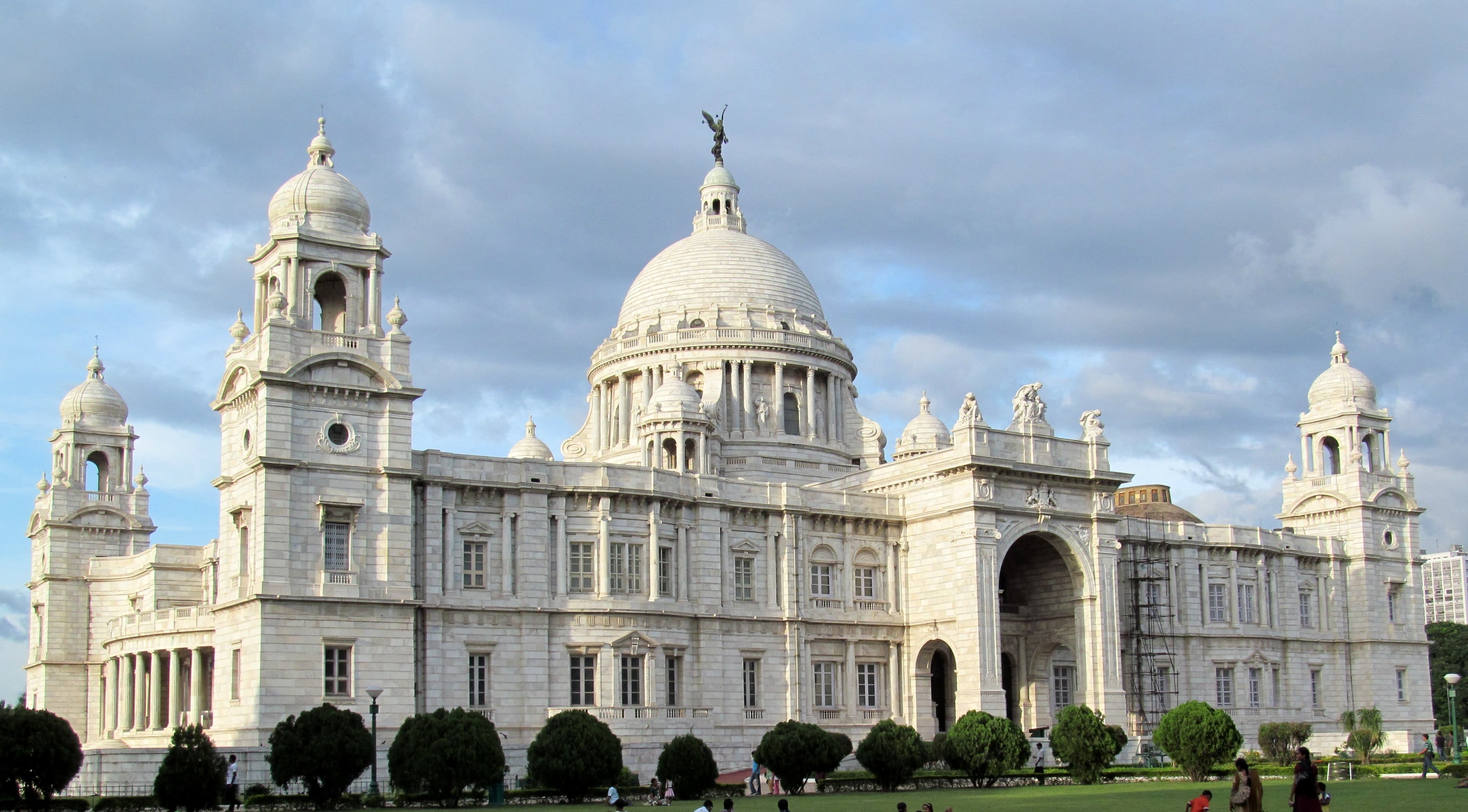
The Victoria Memorial is perhaps the most iconic building in Kolkata. Built at the southern edge of the Maidan in memory of Queen Victoria, the building houses a museum documenting the city's history. It is perhaps the most difficult attraction to access in the city due to crowds and long queues. Nearby St. Paul's Cathedral is the city's largest church and is noted for its Indo-Gothic architecture.
Further north, BBD Bagh (Dalhousie Square) was the heart of British India and holds various historical attractions, most notably the GPO (General Post Office) with its imposing dome, as well as the Writers' Building, once the centre of Indian independence movement and the politics of West Bengal till 2013. The Calcutta High Court is the iconic centre of West Bengal's judiciary, and the neoclassical Lok Bhavan (Government House) houses the state governor.
East of BBD Bagh, in Esplanade, the iconic Metropolitan Building is a department store. This neo-baroque emporium—with domes, a clock tower and arched recessed windows—exemplifies fashionable shopping during the British Raj in British India.
Towards North Kolkata, the Howrah Bridge is the most iconic bridge of the city, offering interesting views of the Hooghly River and the twin cities Kolkata and Howrah. The Jorasanko Thakur Bari was the residence of Rabindranath Tagore and his family. The Marble Palace is a classic example of a European mansion that was built in the city. Further north, there are various aristocratic residences that become popular during Durga Puja.
Museums and galleries
Kolkata has different kinds of museums and galleries. The Victoria Memorial itself is a museum, and the Indian Museum houses large collections that showcase Indian natural history and Indian art. The Academy of Fine Arts has an extensive collection of Bengali art. The Alipore Museum in the South commemorates the freedom fighters of India. The sprawling Science City in the East contains a science museum, science park and auditoriums.
Do
Individual listings can be found in Kolkata's district articles
Take a tram ride in Kolkata. The city has the only active tram service in India and has become an icon of Kolkata. They move slowly on the laid tracks in traffic-jammed streets.
Several modern cinemas are dotted around the city, including INOX with several locations, Fame at Metropolis Mall in Highland Park, and RDB Adlabs at RDB Boulevard, Near Infinity Building in Sector-V, Bidhannagar, all showing Indian and American blockbusters. Kolkata also has many established theatre houses, which host events by international theatre groups frequently. Such events draw people from around the globe as it offers a unique opportunity to share culture and ideas.
Events
Durga Puja (দুর্গাপূজা Durgāpūjā), a festival honouring the Hindu goddess Durga, takes place between September and October. The biggest festival for Hindus in Bengal, Kolkata takes on an almost carnival-like ambience. Streets shut down for the construction of pandals (প্যান্ডেল, pyānḍel), large stands that depict events from the Ramayana and crowds flock to the biggest and best ones. Durga Puja in Kolkata has been listed as a UNESCO Intangible Cultural Heritage in 2021. A good time to visit, unless you have a fear of crowds.
The Kolkata Book Fair (বইমেলা boimelā or পুস্তকমেলা pustokmelā) is India's oldest book fair. It takes place from the last week of January to the first week of February. It is the largest book fair in Asia and is a significant event in the city. Central Park in Salt Lake is the venue of the Kolkata Book Fair since 2022. The similarly named but smaller Kolkata District Book Fair takes place at Netaji Indoor Stadium in May. Behala, North Kolkata, Dum Dum and New Town also have their own book fairs.
Eat
Individual listings can be found in Kolkata's district articles
Kolkata has old traditions about eating out. Wilson's Hotel (which later became the Great Eastern Hotel) is credited to have been the first western-style hotel/restaurant in Kolkata, serving what was then forbidden food for Indians, particularly Hindus. One could be treated as an out-caste if caught eating there, but the idea caught on and others followed. Many of the restaurants that line the streets in the Esplanade area have been around for more than a hundred years.
The joy of food in Kolkata is in its Indian foods. Nizam's (23/24, Hogg St), close to New Market, is credited with the invention of the famous "kathi kebab roll" and still serves up the best of the best. For Mughlai dishes, there are several places to eat in the Park Circus area and there are others all over the city.
In terms of sweet, Kolkata is best known for its "rosogollas" (রসগোল্লা rasagollā), consisting of balls of "chhena" (a moist, softer cheese than paneer) cooked and permeated in a light rose-scented syrup. Although the origin of rôsogolla is disputed between Odisha and Bengal, the first canned rosogollas were sold in this city in 1930, after which they took off in popularity across South Asia. A variant of the dish is "rosomalai" (রসমালাই rasamālāi) where the chhena balls are immersed in sweet thickened milk instead of syrup, providing a creamier feel to the sweet.
Besides Bengali foods, Kolkata is also the home of Indian Chinese food. Chinese restaurants are everywhere so try the Indian variant of hot and sour soup and the famous Indian Chinese dish of chilli chicken. The best place to have Chinese is to visit Chinatown near Tangra, East Kolkata. It serves the best of the Chinese dishes and you will find plenty of large, small & medium restaurants. There are some restaurants serving Thai, Mediterranean or Italian food.
Drink
Individual listings can be found in Kolkata's district articles
There are plenty of places to buy alcohol around the city. Kolkata has many pubs and bars, which are frequented by youngsters as well as its older residents. Some pubs have live concerts or DJs. All pubs are supposed to shut shop by midnight or 1AM. So go early if you want to enjoy yourself in the club.
Get around
Kolkata has a very comprehensive public transport network. Despite residents' perpetual grumbling about unreliability, public transport is often the best option for getting anywhere for visitors and residents alike. In general, use metro or suburban rail as they are separated from the city's road traffic, and use auto-rickshaws and taxis for last-mile connectivity. Buses are fine on some roads where metro does not ply, like APC Road and Gariahat Road.
Road transport shuts down in some places for roadworks and during Durga Puja. However, metro is usually available in those occasions.
By metro
The oldest rail rapid transit system in India, the Kolkata Metro is the fastest, cleanest, most reliable, least crowded (though still rather crowded) and most efficient of all the transportation Kolkata has to offer. As of 2025, five lines are operational and more are under construction.
The four-seat sections at each end of a coach are reserved for senior citizens and the physically challenged. The two middle seat sections, between the general seat sections on each side, are reserved for women. Smoking is also strictly prohibited on the metro premises. Violating any of these incurs a penalty.
By train
Many daily commuters rely on the extensive Kolkata Suburban Railway network of the Eastern Railway (ER), commonly referred to as "local trains". The Circular Railway in particular covers many touristy areas like Bagbazar and Sovabazar in North Kolkata, and BBD Bagh and Prinsep Ghat in Central Kolkata.
Depending on the route, local trains can be extremely crowded. It is less expensive to travel around by train as compared to private cabs or taxis. Men must not enter the Ladies compartment and all-women "Matribhumi" locals, even as a family.
Stay safe
For any emergency dial ☏ 112. This number connects to police, fire, ambulance, women and child helplines as well as the coast guard for incidents on the river. You will be asked which of these services you require before being connected to the relevant operator.
Kolkata is one of the safest cities in India. People here are friendly and helpful and accept people of different cultures warmly. Taking normal precautions for the safe keeping of your personal possessions is enough, as you would do in any Indian city.
Police
The Kolkata Police (KP) is responsible for policing the city except New Town and Salt Lake, which are the responsibility of the Bidhannagar City Police, and much of the Northern Suburbs, which are the responsibility of the Barrackpore Police Commissionerate. In addition, the Kolkata Metro is patrolled by the Railway Protection Force (RPF).
For non-emergencies, or to report a crime, visit the nearest police station. See the district articles for police stations.
Crime
Violent crime in Kolkata is more or less like any other large Indian city, including begging and theft. Be on guard for anybody trying to help you by giving you unsolicited directions or travel advice. Do not blindly rely on the advice of taxi and auto drivers. Carry your cash and cards in a secure money belt, with only enough cash for a few hours at a time in your wallet or other accessible place. Beware during the rush hours in bus terminals and railway stations as many pickpockets will try to get your belongings.
Visitors to Kolkata are often magnets for beggars and touts. They often knock at the glass windows of cars. It does little good to get angry or to say "No" loudly. The best response is to look unconcerned and ignore the behaviour. The more attention you pay to a beggar or tout, positive or negative, the longer they will follow you hoping for a donation.
Women travellers
While Kolkata is significantly safer for women travellers compared to Delhi, sexual harassments still happen, including molestation, rape and murder. In addition, Sonagachi in North Kolkata is Asia's largest red-light district. Take usual precautions like in any Indian city.
Respect
Clothing
While casual and liberal attire are very common in Kolkata, dressing conservatively may garner more respect in the eyes of citizens, especially in North Kolkata. The traditional Bengali clothing is dhoti-kurta (ধুতি-পাঞ্জাবি dhuti-pānjābi) for men and a sari (শাড়ি shāṛi) for women. Younger men often wear tight-fitting trousers (পাজামা pājāmā) as they are easier to wear than a dhoti, and younger women often wear shalwar kameez (সালোয়ার কামিজ sālōār kāmij) as it is easier to wear than a sari.
Controversial topics
The Partition of India (দেশভাগ Deshbhāg) is a very emotional subject among former East Bengal refugees and their descendants, who may blame Muslims for uprooting them from ancestral homes. Unless you want to start an argument, the topic is best avoided.
Bengalis have diverse opinions on political parties like CPM (Communist Party of India (Marxist)) and TMC (Trinamool Congress). Some may appreciate either for their stable governance (CPM: 1977–2011, TMC: 2011–2026), while others express frustrations with their policies. There are also different opinions on the Tata Nano controversy whereby Tata was unable to set up a motor factory near Kolkata in 2006 due to local protests. As always, it is better to listen than to express firm opinions, and tread carefully if you do.
Practical facts for India
Taken from open data. Rules and numbers change, so check locally before you rely on them.
- Currency
- Indian Rupee (INR)
- Languages
- English (India), Hindi, Bangla, Telugu, and 20 more
- Plugs and power
- Types C and D, 230 V at 50 Hz
- Traffic drives
- On the left
- Country calling code
- +91
- Time zone
- Asia/Kolkata
Official travel advice
Quoted from each government as published, with the date they last changed it. We do not add a verdict of our own.
UK Foreign, Commonwealth & Development Office
- Advises against all travel to parts of the country
Read the full adviceAreas where FCDO advises against travel
India-Pakistan border area
FCDO advises against all travel within 10km of the India-Pakistan border. The Wagah-Attari border crossing is closed except for the daily border retreat ceremony.
Union Territory of Jammu and Kashmir
FCDO advises against all travel to the Union Territory of Jammu and Kashmir (including Pahalgam, Gulmarg, Sonamarg, the city of Srinagar and the Jammu-Srinagar national highway), except for:
• travel by air to and from the city of Jammu
• travel within the city of Jammu
Manipur
FCDO advises against all but essential travel to the state of Manipur including the capital, Imphal. Curfews and restrictions continue in parts of Manipur following ongoing ethnic violence since May 2023.
Find out more about why FCDO advises against travel to these regions.
Global travel impacts due to escalation in the Middle East
Escalation in the Middle East has caused widespread travel disruption, including airspace closures, delayed and cancelled flights.
US Department of State
Level 2 of 4: Exercise increased caution
Read the full adviceExercise increased caution in India due to crime and terrorism. Some areas have increased risk.
Violent crime and terrorism occur in India.
• Rape is one of the fastest growing crimes in India.
• Violent crimes, including sexual assault, happen at tourist sites and other locations.
• Terrorists may attack with little or no warning. They target:
• Tourist locations
• Transportation hubs
• Markets and shopping malls
• Government facilities
The U.S. government has limited ability to provide emergency services to U.S. citizens in rural areas.
• These areas stretch from eastern Maharashtra and northern Telangana through western West Bengal.
Entry and visas
Entry rules depend on your passport and change without notice. Check the official pages before you book.
Sources