
Germany
A plan for Köln
Not a list of things to see in Köln — a day-by-day plan somebody could actually follow, built from places we can point to a source for. Make your own in about a minute.
- 2 nights
- Couple
- Balanced pace
- Mid-range budget
Every place here was checked on 2026-10-27 or later, and each one says where it came from.
The plan, day by day
Day 1
09:30
You arrive
13:00
Brauhaus Sion
Suggested because you chose food
- 1h
- Meal
14:30
Wallraf–Richartz Museum
Picked because you chose culture & museums + balanced energy
- 2h 30m
- Culture & museums
2h open
Nothing planned here. That was on purpose.
19:00
Ausschank Brauerei zum Pfaffen
Suggested because you chose food
- 1h 30m
- Meal
20:30
Gürzenich
Picked because you chose culture & museums + balanced energy
- 2h 30m
- Culture & museums
Day 2
08:00
Park-Café
Suggested because you chose food
- 45m
- Meal
45m open
Nothing planned here. That was on purpose.
09:30
Schokoladenmuseum Köln
Picked because you chose culture & museums + balanced energy
- 2h 30m
- Culture & museums
1h open
Nothing planned here. That was on purpose.
13:00
Bierhaus en d'r Salzgass
Suggested because you chose food
- 1h
- Meal
14:30
Museum Ludwig
Picked because you chose culture & museums + balanced energy
- 2h 30m
- Culture & museums
2h open
Nothing planned here. That was on purpose.
19:00
Em Kölsche Boor
Suggested because you chose food
- 1h 30m
- Meal
20:30
Kölner Philharmonie
Picked because you chose culture & museums + balanced energy
- 2h 30m
- Culture & museums
Day 3
08:00
Romeo! Romeo!
Suggested because it fits a mid-range budget
- 45m
- Meal
45m open
Nothing planned here. That was on purpose.
09:30
Museum für Angewandte Kunst
Picked because you chose culture & museums + balanced energy
- 2h 30m
- Culture & museums
1h open
Nothing planned here. That was on purpose.
13:00
El Inca
Suggested because you chose food
- 1h
- Meal
14:30
You leave
Weather through the year
Monthly averages from NASA's 25-year climate record, day and night together.
Best months: June, July, August, and September
| January | Cold: 1°C, 74 mm |
|---|---|
| February | Cold: 2°C, 62 mm |
| March | Cold: 5°C, 59 mm |
| April | Cold: 10°C, 44 mm |
| May | Mild, some rain: 13°C, 64 mm |
| June | Mild, some rain: 17°C, 68 mm |
| July | Mild, some rain: 19°C, 75 mm |
| August | Mild, some rain: 19°C, 79 mm |
| September | Mild, some rain: 15°C, 57 mm |
| October | Cold: 11°C, 61 mm |
| November | Cold: 6°C, 71 mm |
| December | Cold: 2°C, 77 mm |
From the Wikivoyage guide
Quoted from the travel guide anyone can edit, as it read on the day we took it.
Understand
Orientation
Cologne lies on both sides of the river Rhine, which flows through it in a northerly direction. The left hand, or western side, is Cologne proper with the Old Town (Altstadt), the famous cathedral and most landmarks and museums. The right side, or eastern side, used to be a separate town called Deutz, now it is a neighbourhood and a train station.
Cologne is divided into 9 districts (Stadtbezirke), numbered from 1 to 9. Stadtbezirk 1, called Innenstadt ("inner city"), is probably the one most tourists will spend all of their time in, as it contains most of the city's points of interest. It is also the only district that lies on both sides of the Rhine, as it includes Deutz. Districts 2, 3, 4, 5 and 6 are on the western bank of the Rhine, and districts 7, 8 and 9 on the eastern bank, surrounding the Innenstadt.
Every Stadtbezirk is further divided into Stadtteile (literally "city parts", or "neighbourhoods"). The Innenstadt includes Altstadt-Nord and Alstadt-Süd, two parts of the historic Old Town of Cologne facing the Rhine, divided by the L111 thoroughfare running from east to west (with the street names Cäcilienstraße – Neumarkt – Hahnenstraße), starting from Deutzer Brücke (bridge over the Rhine). The Altstadt is surrounded by a ring of wide avenues running over the former city walls of Cologne. They all have street names ending with the word Ring.
The part of Innenstadt lying on the outer side of the ring is the Neustadt, or "new town". Neustadt is further divided into Neustadt-Nord and Neustadt-Sued, also separated by L111 (Aachener Straße). Both parts of the Neustadt form a crescent embracing the Altstadt and reaching the Rhine on either side thereof. Finally, facing the Altstadt and Neustadt on the other (eastern) side of the Rhine is the Stadtteil of Deutz, which completes the Innenstadt.
See
Religious buildings
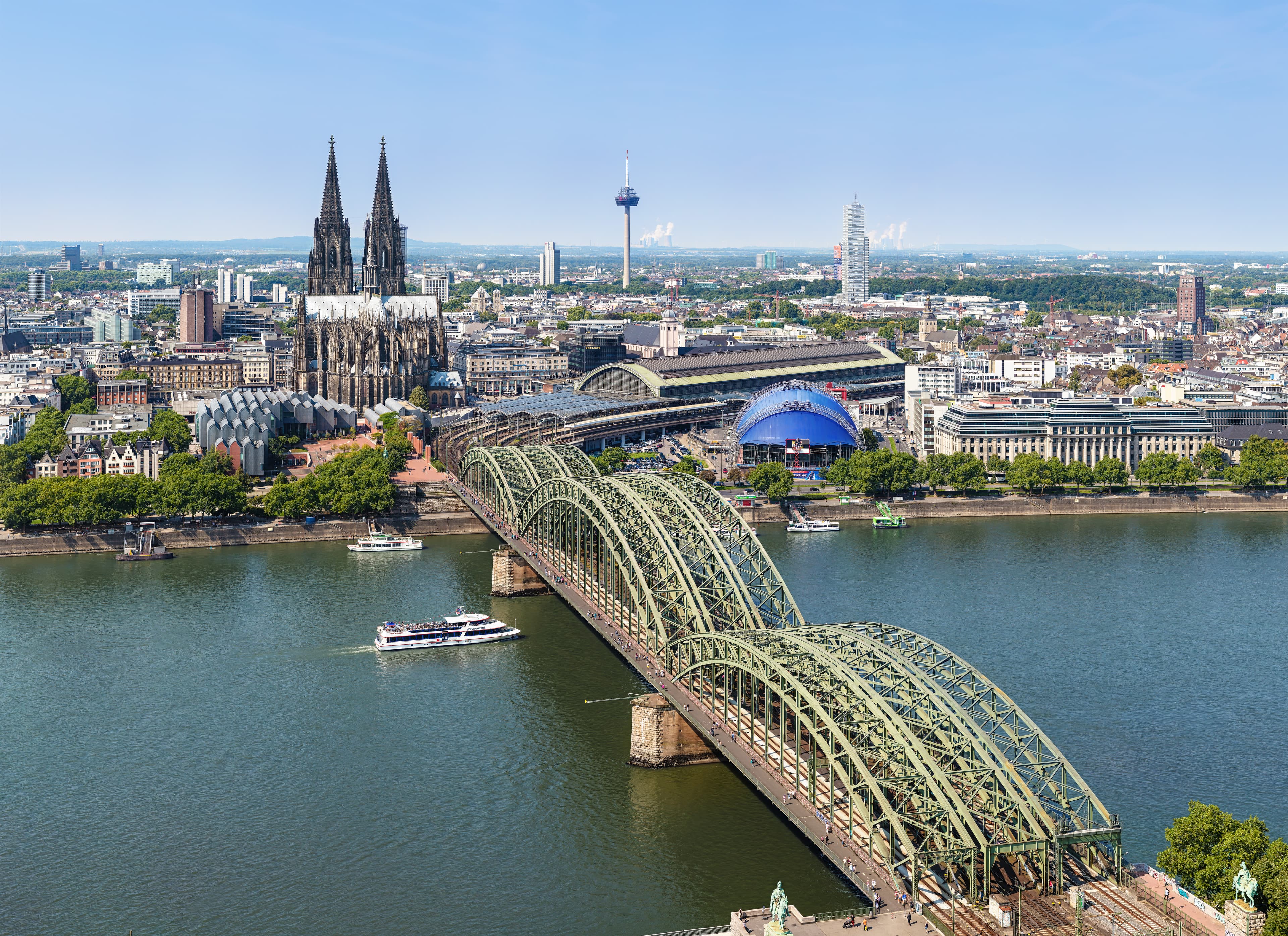
1 Kölner Dom (Cathedral) (U-Bahn: Dom / Hbf). Mon-Sat 10:00-17:00; Sun 13:00-16:00. A UNESCO World Heritage site, this monumental cathedral took 632 years to complete, finally being consecrated in 1880. Cologne's Dom is the first thing you will notice when leaving through the main exit of the central station. If you don't see it, you've likely taken the back exit. If you are in good shape, you can climb the 509 stairs to the top of the south tower. The round trip takes about an hour and requires comfortable shoes, but the panoramic view is well worth the hike. Touring the cathedral is forbidden during Mass; to ensure the doors are open for visitors, check the liturgical calendar: koelner-dom.de. Admission to the cathedral is free, a 'sightseeing fee' for tourists is being introduced in July 2026 (worshippers and those attending Mass still enter for free). Admission to the South Tower costs €8 (reduced €4, family €20), and admission to the Treasury is also €8 (reduced €4, family €20). A combined ticket for the tower and the treasury is available for €12 (reduced €6, family €30).
No luggage or large bags may be carried inside; lockers are available at the nearby station or the service centre. (updated Apr 2026)
12 Romanesque Churches - Between 1150 and 1250, numerous churches were built in the Romanesque style.
2 Basilica of St. Cunibert (St. Kunibert's Church), Kunibertsklostergasse 2, ☏ +49 221 788 075 0, st.agnes@katholisch-in-koeln.de. 10:00-17:00. St. Kunibert is the youngest of Cologne’s 12 Romanesque churches, famous for the Kunibertuspütz. According to local legend, Cologne’s babies are born in this crypt well rather than being delivered by the stork. The church is a treasure trove of medieval art, housing the city's oldest stained-glass windows (c. 1230) and the golden shrines of Saint Kunibert and the Ewaldi brothers. (updated Apr 2026)
Do
Cologne's strong side is its cultural life. For latest information on what is happening around in town, get the StadtRevue for €2, Kölner for €2 or Live for free.
Culture
1 Kölner Philharmonie, Bischofsgartenstrasse 1. Central concert hall, opened in 1986. Main season September to June. Special summer shows. (updated Jun 2026)
2 Oper Köln, Rheinparkweg 1. Operas are performed in the Staatenhaus while the opera building at Offenbachplatz is being renovated. Season starts in Mid-September. (updated Jun 2026)
3 Stadtgarten, Venloer Straße 42 (U-bahn to Friesenplatz, walk 5 minutes). Concert centre for jazz and contemporary music, with a cafe and restaurant inside and a large beer garden outside which dates back to at least the 1950s. (Also the site of a great Christmas market.) (updated Jun 2026)
4 Metropolis Cinema, Ebertplatz 19, ☏ +49 221 722436. 15:00-24:00. If you want to go to the movies while visiting Cologne and you don't know German, this small cinema is for you. It shows movies in their native language, but mostly English. (However, most other cinemas will also show English versions several times a week, so check the listings.) (updated Jun 2026)
Rides, theme parks and parks
5 Kölner Seilbahn, Riehler Straße 180, ☏ +49 221 547-4183. Apr-Oct 10:00-18:00. Take a ride with the Aerial tramway across Rhine river. Adult one way €4.50, return €6.50; child (aged 4–12) one way €2.50, return €3.70.
6 Kölner Zoo, Riehlerstraße 173 (near Seilbahn, Tram Zoo/Flora), ☏ +49 221-567 99 100, INFO@KOELNERZOO.DE. Mar-Oct: 09:00-18:00; Nov-Feb 09:00-17:00. Established in 1860, the zoo of Cologne is home to more than 850 animal species from all over the world. Highlights include the Great Ape Jungle House, the Rainforest Hall, the Aquarium, and the houses for elephants, hippos and crocodiles. Adult €29.50, teenager or student €23, child (aged 4–12) €15. (updated Jun 2026)
7 Aqualand, Merianstrasse 1. Water park with water slides, pools, saunas and a wellness area. (updated Jun 2026)
Fishing
Fishing in the Rhine is possible, though a fishing licence is required.
Eat
Cologne has a wide variety of restaurants, German and otherwise.
Traditional scene
One can eat pretty well in most traditional-style Kölsch restaurants, and in fact as a visitor, you should try some of the local food, which is quite rustic, but tasty, hearty fare.
The brewery taps (Früh, Sion, Pfaffen, Malzmühle, etc., in the old town south of the Dom) are worth taking note of to that respect, although they tend to be expensive for what you get.
Places out of the way such as Schreckenskammer and Max Stark (north of the train station, the former being within crawling distance of the Station Backpackers Hostel), Päffgen (Friesenstraße) and both of the Cologne independent brewpubs (Hellers Brauhaus on Roonstraße and Braustelle in Ehrenfeld) offer cheaper, better food than the old town tourist traps. Besides, most of these places have tons of atmosphere, which doesn't hurt!
You may also experience the deadly dry wit of the Köbes (traditional name of the blue-clad waiters) in most of those places. If it happens to you, don't get upset, just enter the game, send the Köbes packing with a dig and a smile and you'll be all right.
You'll mostly find typical Rheinland dishes in those traditional Kneipen. Classics include:
Halve Hahn: nice big slab of Dutch gouda with a rye roll (Röggelchen)
Himmel un Äd mit Flönz: fried black pudding with mashed potatoes ("earth"), apple sauce ("heaven") and fried onions.
Soorbrode/Sauerbraten: joint marinated in vinegar with raisins, usually served with red cabbage and a kloss (potato dumpling). The joint may be beef or horsemeat, so you may want to ask first.
Dicke Bunne met Speck: boiled white beans with hefty boiled bacon slices on top.
Schweinshaxe (grilled); Hämchen (cooked): pig's leg, usually a bit of a monster (ranges from 600 to 1400 g, including the bone)
Rievkooche/Reibekuchen: flat fried potato cakes usually on offer once a week, and served with a variety of sweet or savoury toppings, which may include apple sauce, Rübenkraut (the beet-sourced equivalent to black treacle) or smoked salmon with horseradish cream.
Drink
Where
There are so many bars and pubs to choose from that you could spend most of the night going from one bar to the next.
For traditional breweries, head to the Altstadt around the Dom, where the Früh Kölsch brewery is the most famous with visitors and locals. You will find a younger crowd at Hellers Brauhaus on Roonstraße, near metro station Zülpicher Platz or Brauhaus Pütz on Engelbertstraße close to Rudolfplatz. Furthermore the Päffgen, on the all-bar street Friesenstraße close to the Friesenplatz, and the Mühlen near Heumarkt are traditional brewery pubs but less touristy than the "Früh". Also recommended is Sion, which is a lesser known brand, but hailed to be very good, although some beer enthusiasts have found it lacking character since 2007. Most Altstadt pubs are somewhat scorned as "tourist traps" by locals, however: prices here are usually higher than e.g. on Zülpicher Straße.
There are a lot of modern bars and lounges all around town. More mainstream ones are on Zülpicher Straße. For something more independent and funky on this street, try Umbruch (funky) or Stiefel (punky). The Low Budget on Aachener Straße next to Moltkestraße metro is a nice, unassuming, punky bar which features a fine selection of drinks and often hosts concerts, poetry or cabaret sessions. A lot of stylish places are in the so-called Belgian quarter between Aachener Straße and the Ring, e.g. famous M20 or the Hallmackenreuther.
Get around
By public transport
Cologne has an excellent public transport network consisting of trams, local trains and buses. Bicycles are also available for hire on the northern side of the Hauptbahnhof. Local transport systems rarely provide announcements in English, but network maps are commonly available to assist with your journey. Those wishing to explore areas away from the central city should plan their journey and potential connections before leaving. The KVB (Kölner Verkehrs-Betriebe) website is a good source of public transport information.
Tickets are valid for subway, tram, bus and regional train within the VRS-network. Trips within the city limits require zone 1b tickets (2026: single €3.80, 4-trip-ticket €13.60, 24-hour ticket €9.20, 24-hour ticket for up to 5 people €18.60), week ticket €37.60. For short trips of up to 4 stops on subway, tram or bus there is also the slightly cheaper "Kurzstrecke" (short trip ticket, 2026: €2.30). They offer mobile app tickets which allow buying tickets with a 3% discount. A popular alternative for longer stays is the Deutschlandticket (€63.00 per month). A map of the network can be found at most stops, inside all vehicles (check ceilings, back entrances) and online.
Cologne's subway and tram-system, or U-Bahn, is a mixture of systems: a subway line can go on street-level and end up as a tram or vice versa. There are vending machines or ticket-offices at larger stations. The trains and buses also have vending-machines. See the public bus, tram and subway-company KVB for printable maps of the bus/tram/subway system. For navigation, you can use their interactive stop map or the official city map of Cologne.
Stay safe
Cologne's safety levels are historically average by German standards, but since the mid-2010s, the city has been plagued with significant waves of crime and decay.
Tourists should take normal safety precautions, particularly in the city centre, where pickpockets are known to be active. Also, be careful on the Ring, which is full of clubs and night-time crowds in the streets. Day and night be careful in outlying neighbourhoods like Chorweiler, Porz, Seeberg, Ostheim, Bocklemünd, Ossendorf, and Vingst. In general, stay away from drunk people. At street crossings, watch the trams.
Practical facts for Germany
Taken from open data. Rules and numbers change, so check locally before you rely on them.
- Currency
- Euro (EUR)
- Language
- German
- Plugs and power
- Types C and F, 230 V at 50 Hz
- Traffic drives
- On the right
- Country calling code
- +49
- Time zones
- Europe/Berlin and Europe/Busingen
Official travel advice
Quoted from each government as published, with the date they last changed it. We do not add a verdict of our own.
UK Foreign, Commonwealth & Development Office
- No areas listed that it advises against travelling to
US Department of State
Level 2 of 4: Exercise increased caution
Read the full adviceExercise increased caution in Germany due to terrorism.
Terrorist groups and lone actors remain a constant threat in Germany and Europe, attacking people in public locations with knives, small arms, rudimentary explosive devices, and vehicles. Such attacks may occur with little or no warning and target:
• Tourist locations
• Transportation centers (airports, train, or bus stations)
Entry and visas
Entry rules depend on your passport and change without notice. Check the official pages before you book.
Sources