
Hong Kong SAR China
A plan for Hong Kong
Not a list of things to see in Hong Kong — a day-by-day plan somebody could actually follow, built from places we can point to a source for. Make your own in about a minute.
- 2 nights
- Couple
- Balanced pace
- Mid-range budget
Every place here was checked on 2026-10-27 or later, and each one says where it came from.
The plan, day by day
Day 1
09:30
You arrive
13:00
錦田紅磚屋 Kam Tin Red Brick House
Suggested because you chose food
- 1h
- Meal
14:30
Hong Kong Heritage Museum
Picked because you chose culture & museums + balanced energy
- 2h 30m
- Culture & museums
2h open
Nothing planned here. That was on purpose.
19:00
鏞記酒家 Yung Kee Restaurant
Suggested because you chose food
- 1h 30m
- Meal
20:30
Sunbeam Theatre
Picked because you chose culture & museums + balanced energy
- 2h 30m
- Culture & museums
Day 2
08:00
Cafe Corridor
Suggested because you chose food
- 45m
- Meal
45m open
Nothing planned here. That was on purpose.
09:30
Hong Kong Museum of the War of Resistance and Coastal Defence
Picked because you chose culture & museums and local experiences + balanced energy
- 2h 30m
- Culture & museums
1h open
Nothing planned here. That was on purpose.
13:00
大橋街市 Tai Kiu Market
Suggested because you chose food
- 1h
- Meal
14:30
Tung Chung Fort
Picked because you chose culture & museums and local experiences + balanced energy
- 2h 30m
- Culture & museums
17:00
Sam Tung Uk Museum
Picked because you chose culture & museums and local experiences + balanced energy
- 2h 30m
- Culture & museums
19:30
The Steak House
Suggested because you chose food
- 1h 30m
- Meal
21:00
Yaumati Theatre
Picked because you chose culture & museums + balanced energy
- 2h 30m
- Culture & museums
Day 3
08:00
蘭芳園 Lan Fong Yuen
Suggested because it fits a mid-range budget
- 45m
- Meal
45m open
Nothing planned here. That was on purpose.
09:30
Law Uk Folk Museum
Picked because you chose culture & museums + balanced energy
- 2h 30m
- Culture & museums
1h open
Nothing planned here. That was on purpose.
13:00
油麻地果欄 Yau Ma Tei Wholesale Fruit Market
Suggested because you chose food
- 1h
- Meal
14:30
You leave
Weather through the year
Monthly averages from NASA's 25-year climate record, day and night together.
Best months: January, February, November, and December
| January | Mild and dry: 16°C, 36 mm |
|---|---|
| February | Mild and dry: 18°C, 29 mm |
| March | Mild, some rain: 20°C, 72 mm |
| April | Rainy: 23°C, 104 mm |
| May | Wet season: 26°C, 210 mm |
| June | Wet season: 28°C, 282 mm |
| July | Rainy: 29°C, 185 mm |
| August | Wet season: 28°C, 218 mm |
| September | Rainy: 28°C, 161 mm |
| October | Mild, some rain: 25°C, 49 mm |
| November | Mild and dry: 22°C, 30 mm |
| December | Mild and dry: 17°C, 25 mm |
From the Wikivoyage guide
Quoted from the travel guide anyone can edit, as it read on the day we took it.
Understand
"Hong Kong" means "fragrant harbour" in Cantonese.
Although part of China, Hong Kong operates as a Special Administrative Region under the slogan "One Country, Two Systems" with a high degree of autonomy, retaining most laws and government structures from colonial times. Visa requirements, laws, currency, culture and language have a heritage from the time of British rule, so for most tourists Hong Kong feels like a different country. Hong Kong enjoyed many Western-style freedoms and many locals were proud of it. The ideals of a free and open society were firmly rooted here, but a significant degree of freedom was curtailed when security laws were imposed in 2020 and tightened in 2024.
History
The area of Hong Kong was incorporated into China during the Qin Dynasty in 214 BC. In 1841, Great Britain defeated China's then-ruling Qing Dynasty in the First Opium War, gaining possession of Hong Kong Island. After the defeat of China in the Second Opium War, the Kowloon Peninsula was ceded to Great Britain in 1860. The Opium War Museum is located across the border in Dongguan. The New Territories were leased to Great Britain in 1898 for a term of 99 years. Hong Kong was only a sparsely-populated backwater prior to the arrival of the British, but grew rapidly into one of the world's most densely populated areas following the establishment of a free port under British colonial rule.
When World War II broke out, British Prime Minister Winston Churchill declared that Hong Kong was an "impregnable fortress". However, Hong Kong was not given sufficient resources for its defence. After two weeks of fighting, Hong Kong was surrendered to the Japanese on 25 December 1941, and subject to a brutal occupation that lasted until the end of the war. Upon the resumption of British control, Hong Kong experienced an astonishingly swift post-war recovery.
See
Hong Kong doesn't have street benches to sit down. Whilst "sitting out areas" are around, these are generally infrequent. Additionally, restaurants (especially cheap and quick ones) will prefer quick table turnover. All this adds up to spending a considerable amount of time on your feet in any given day. Make sure you have a pair of comfortable shoes, as even a good pair of shoes will still leave your feet sore after a full day on your feet.
Itineraries
Hong Kong Culinary Tour — gives a short tour to discover the unique cuisine of Hong Kong
Hong Kong to Kunming overland — covers one route to or from Hong Kong
Guided walks
A list of guided tours is available on the website of the Hong Kong Tourism Board.
Victoria Peak
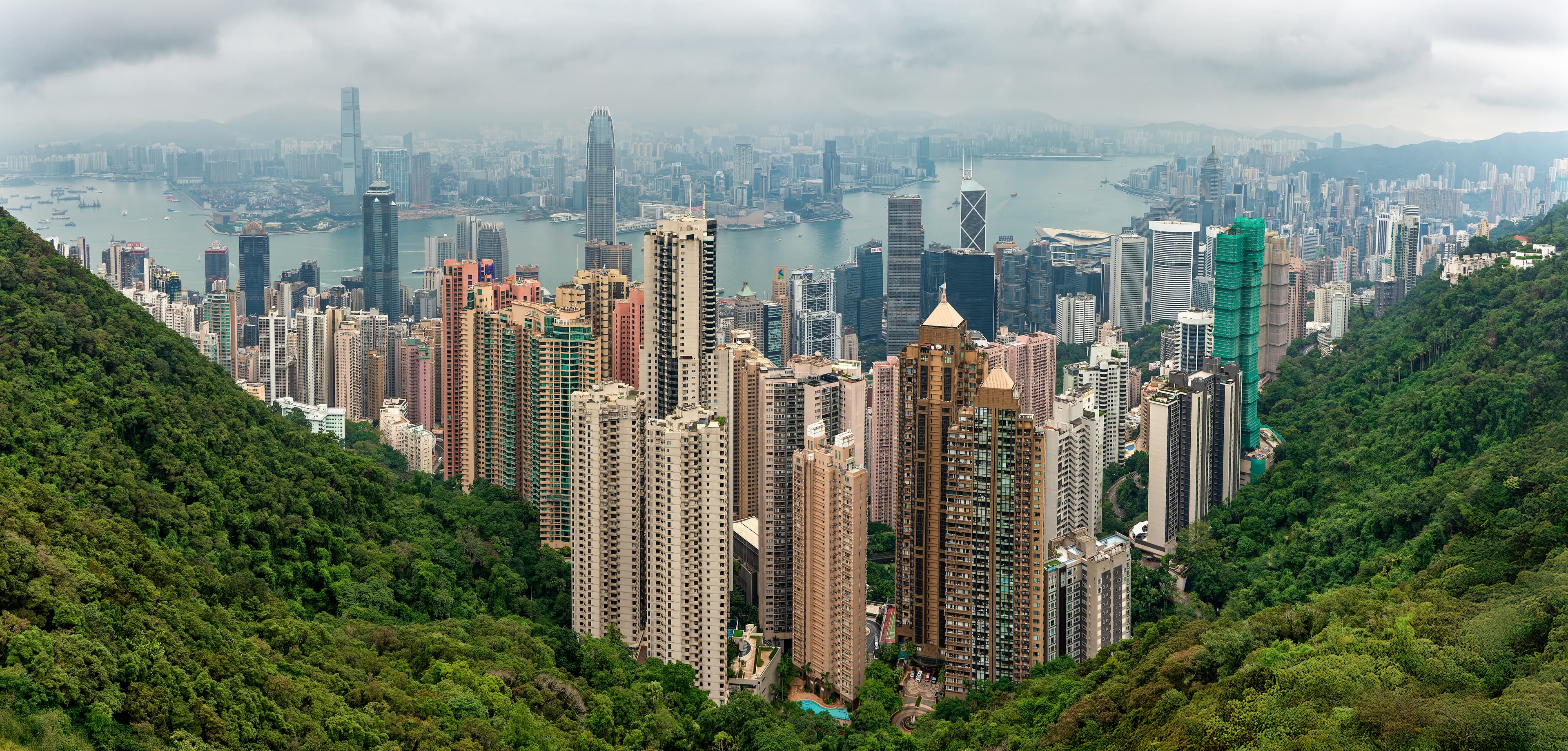
Get a stunning view of Hong Kong Island on Victoria Peak atop the giant, wok-shaped Peak Tower! Ever since the dawn of British colonisation, the Peak hosted the most exclusive neighbourhood for the territory's richest residents. Prior to World War II, non-white people weren't permitted to even set foot here (except for domestic servants of the resident white families). The Peak Tower has an observation platform and a shopping mall with shops, fine dining, and museums. Read more at Hong Kong/Central#Victoria Peak.
Horse racing
Horse racing was introduced by the British during the colonial period, and remains serious business in Hong Kong. There are live broadcasts over the radio and many people bet regularly. When people are listening to the races, expect no conversation or business to transpire for the 1-2 minute duration of the race.
Do
Pop culture
Hong Kong was one of the main centres of Chinese pop culture from the communist revolution in 1949 until the 2010s, having given rise to many famous singers and actors. Hong Kong action cinema is legendary among Chinese people around the world. The city also played a key role in popularizing the genre of Cantopop, and some Cantopop songs have achieved cult status across the Chinese-speaking world, even among people who do not speak Cantonese. Television dramas by local station TVB also enjoyed loyal following among ethnic Chinese around the world.
Since the 2010s, most of Hong Kong's top singers and actors have relocated to mainland China where they can make a lot more money. Nevertheless, the city continues to produce notable films on a regular basis, and Cantopop has experienced a revival of sorts in the 2020s, led by a new generation of local talent.
Music festivals
Clockenflap is Hong Kong's largest music festival, and includes popular artists, mainly from Europe and the US. It takes place in November on the Central Harbourfront Event Space.
Indie events
Cantopop is by far the most popular genre in Hong Kong and receives an immense amount of support from the media. Independent musicians and are often harassed and evicted from their rehearsal rooms and concert venues by the government because they are forced to illegally rent warehouse spaces due to unaffordable rents. A few small venues are open for indie shows, such as Hidden Agenda and The Wanch.
Comedy
Hong Kong is home to one of Asia's most vibrant stand-up comedy scenes, with the scene being anchored by Take Out Comedy Club, the first full-time comedy club in Asia, and Backstage Comedy. Some pubs also have open mic nights for aspiring stand-up comedy performers; see COMEDY.HK for the complete listing of live comedy shows in Hong Kong. Both Cantonese and English shows are performed regularly, so you should not have much difficulty finding an English show as a tourist.
Eat
Individual listings can be found in Hong Kong's district articles
Cuisine plays an important part in many peoples' lives in Hong Kong. Not only is it a showcase of various regional Chinese cuisines, but there are also excellent Asian and Western options, and creative fusion between the various cuisines. Although Western food is often adapted to local tastes, Hong Kong is a good place for homesick travellers who have had enough of Chinese food.
Due to its history as part of that region, unsurprisingly, much of the local cuisine in Hong Kong is very similar to that of neighbouring Guangdong. That being said, over a century of British rule means that the British have also left their mark on the local cuisine, with cakes and pastries being fairly popular among locals. Hong Kongers are also somewhat less adventurous than their fellow Cantonese speakers in mainland China, with several exotic ingredients such as dog and cat meat being banned in Hong Kong. Indian immigrants brought over by the British have also left their mark on Hong Kong cuisine, and curry (咖喱) is a popular condiment. While authentic Indian curries can certainly be found, Hong Kong curries are generally adapted for the Cantonese palate, with the spice level dialed down drastically.
Drink
Tea
As with the rest of China, tea is a popular beverage in Hong Kong, and is served at practically every eatery. Chinese teas are the most commonly drunk in Hong Kong, but there is also a distinct Hong Kong-style milk tea that is served in chaa chaan teng, and traditional English milk tea can be found in higher-end Western restaurants. In summer 'Ice Lemon Tea' is a common option that is rather bitter and needs some syrup to counter this.
Alcohol
Hong Kong does not have a culture of heavy drinking, and there are many neighbourhoods without much in the way of a bar or pub. Drinking alcohol with food is acceptable, but there is no expectation to order alcohol with your meal in any restaurant. A number of popular restaurants do not sell alcohol because of a licence restriction. In addition, alcohol in Hong Kong is expensive, and half a pint of beer in a bar or restaurant costs about $70 (in 2025).
Lan Kwai Fong (Central), Wan Chai, and Knutsford Terrace (Tsim Sha Tsui) are the three main drinking areas where locals, expats, and tourists come together.
Lan Kwai Fong is known for its lively, block party atmosphere, attracting many expats and tourists. The rooftop bar Faye on the 25th floor of the California Tower at Lan Kwai Fong is a hotspot for European exchange students. Some clubs in Lan Kwai Fong enforce dress codes, and tourists are expected to comply. As a rule, avoid wearing shorts or pants that are above knee length. Just a short walk away, Peel Street and the surrounding SoHo area have emerged as the preferred hangout for long-term expats, offering more relaxed bars, better cocktails, and a more laid-back atmosphere than the tourist-heavy clubs of LKF.
Get around
Hong Kong has an excellent and cheap public transport system. Unlike in mainland China, Google Maps can be used in Hong Kong.
Hong Kong has the world's highest use of public transport, with over 90% preferring the mode. The most convenient way to pay for this is the Octopus card, discussed below.
Contactless payments with Visa, Mastercard, UnionPay, and China T-Union are being progressively rolled out. As of June 2026, they have become available on the Airport Express, buses, trams, some ferries, and the MTR at the light blue fare gates. For most visitors, an Octopus card is still best for complete peace of mind.
By MTR
Hong Kong's Mass Transit Railway (MTR) is the fastest way to get around. (In HK, 'subway' refers to underground walkways, not to the MTR, and "metro" or "underground" will mostly not be understood). It is clean, safe, reliable, efficient and affordable, with most journeys costing $5–20. There are 10 lines (including the Airport Express) and a network of modern light rail lines in the Northwest New Territories. All signs are in Chinese and English and all announcements are made in Cantonese, Mandarin, and English. Staff in the station control room usually speak enough English to be able to help lost tourists.
The most important lines for many visitors are
The busy Tsuen Wan Line (red), which runs from Central to Kowloon via tunnel and then down Nathan Road towards Tsuen Wan in the New Territories,
The Island Line (blue) which runs along the north coast of Hong Kong Island.
The Tung Chung Line (orange) is the fastest ways to get to Lantau. This line can also be used to change to the Disneyland Resort Line (pink) at Sunny Bay, which is also the station to catch a shuttle bus to the Hong Kong port for those who want to travel by bus to Macau.
Stay safe
Hong Kong is one of the safest cities in the world, with a large high-density population with diverse socio-economic backgrounds managed very effectively. The city experienced significant large-scale protests against new legislation with increasingly violent clashes with police between 2014 and 2019. The arbitrariness and broad applicability of the National Security Law imposed by China in 2020 has ended most public protest.
Crime and other emergency services
Even female travellers usually do not encounter any problems roaming the streets alone at night. Violent crime is extremely rare, though petty crime occurs from time to time. Pickpockets operate in crowded areas; be particularly careful on public transport during peak hours.
The Hong Kong Police Force is Hong Kong's law enforcement agency. Most officers wear light blue uniforms, though higher-ranking officers wear white uniforms. All police officers are required to carry their warrant cards while on duty, and must present it to members of the public on request. English proficiency among lower ranking police officers can be limited, though they will always have English-speaking interpreters on call to assist you. Police corruption is exceedingly rare. Bribery is a crime that is punishable by imprisonment.
Hong Kong films have often portrayed triads (Chinese organised crime syndicates) as gun-wielding gangsters who fear nobody, but that only happens in the movies. Gang violence does occur, but is generally limited to rival triads. Stay away from the triads by avoiding loan sharks and illegal betting, and they will not bother you.
Respect
Manners and etiquette
See the Respect section of the China article for more details.
Hong Kong is a fast-paced society where the phrase "mm goi" (唔該), which literally means "I should not (bother you)", is used pervasively in a situation that you would say "Excuse me" or "Thank you".
mm goi mentality extends to a way that they don't want to bother anyone as long as possible. When you get a cough, always cover your mouth with the inner side of your elbow, as that area of your arm does not frequently come in contact with other people, thus avoiding the spread of pathogens. When having a fever, wear a mask. Spitting and littering, an offence subject to a penalty of $3,000, is considered rude because it disturbs others. Hong Kong is noisy due to its huge population density but adding more noises, which will certainly disturb others too, is not welcome. Speaking vociferously over the phone on the bus, for example, will be viewed as egocentric and boorish.
When entering people's homes, always be sure to remove your shoes before you do so.
Hong Kong follows the British tradition in that queue jumping is taboo and you may easily get into an argument or be denied service if you do so. Everyone wants to go orderly and speedily on their way with the least disturbance. Even if an arriving bus is empty, and there are only two people waiting in line, they are expected to enter the bus in order of queue. Jumping a queue in order to ask a question is not tolerated either.
When smoking in front of a non-smoker, always ask for permission. Many smokers will just walk away to smoke, even in a place where smoking is legally allowed.
Unlike public transport in some large cities where it is common to see passengers eat or drink, such behaviour is strictly prohibited in all areas of MTR stations, train compartments (except intercity trains), and most buses. This is due to concerns about maintaining cleanliness of public facilities. If someone asks you to stop consuming or even dispose of your food when you're eating it, obey the request and reply politely, and you'll always be out of trouble.
Practical facts for Hong Kong SAR China
Taken from open data. Rules and numbers change, so check locally before you rely on them.
- Currency
- Hong Kong Dollar (HKD)
- Languages
- Chinese (Hong Kong SAR China), Cantonese, Chinese, and English
- Plugs and power
- Type G, 220 V at 50 Hz
- Traffic drives
- On the left
- Emergency numbers
- Any emergency999
- Country calling code
- +852
- Time zone
- Asia/Hong Kong
Official travel advice
Quoted from each government as published, with the date they last changed it. We do not add a verdict of our own.
UK Foreign, Commonwealth & Development Office
- No areas listed that it advises against travelling to
Read the full adviceThis travel advice covers the Hong Kong Special Administrative Region (SAR). For mainland China, see travel advice for China and for Macao SAR, see Macao travel advice.
Dual Chinese-British nationality
Hong Kong does not recognise dual nationality, and does not recognise the BN(O) passport as a valid travel document or proof of identity. If you hold both British and Chinese nationality, local authorities may treat you solely as a Chinese citizen, even if you enter Hong Kong on a full “British citizen” passport or hold a British National (Overseas) passport. In such circumstances, the British Consulate-General may not be able to offer you consular assistance.
If you have formally renounced Chinese citizenship, carry evidence that you have done so.
See guidance on nationality in China.
US Department of State
Level 2 of 4: Exercise increased caution
Read the full adviceExercise increased caution when traveling to the Hong Kong Special Administrative Region (SAR) due to the arbitrary enforcement of local laws.
Exercise increased caution due to the arbitrary enforcement of local laws.
• Hong Kong SAR authorities have passed laws that limit people’s civil liberties. The laws apply to anyone in Hong Kong, including foreigners. Authorities have also issued arrest warrants for individuals, including U.S. citizens, located outside of Hong Kong for activities undertaken overseas.
• U.S. government employees must follow the policies established by their Department or Agency regarding official or personal travel to China, including to Hong Kong SAR.
Entry and visas
Entry rules depend on your passport and change without notice. Check the official pages before you book.
Sources