
Canada
A plan for Halifax
Not a list of things to see in Halifax — a day-by-day plan somebody could actually follow, built from places we can point to a source for. Make your own in about a minute.
- 2 nights
- Couple
- Balanced pace
- Mid-range budget
Every place here was checked on 2026-10-27 or later, and each one says where it came from.
The plan, day by day
Day 1
09:30
You arrive
13:00
Halifax Seaport Farmers’ Market
Suggested because you chose food
- 1h
- Meal
14:30
Art Gallery of Nova Scotia
Picked because you chose culture & museums + balanced energy
- 2h 30m
- Culture & museums
2h open
Nothing planned here. That was on purpose.
19:00
Henry House
Suggested because you chose food
- 1h 30m
- Meal
20:30
Bus Stop Theatre
Picked because you chose culture & museums + balanced energy
- 2h 30m
- Culture & museums
Day 2
08:00
Trident Booksellers and Cafe
Suggested because you chose food
- 45m
- Meal
45m open
Nothing planned here. That was on purpose.
09:30
Citadel Hill
Picked because you chose culture & museums and local experiences + balanced energy
- 2h 30m
- Culture & museums
1h open
Nothing planned here. That was on purpose.
13:00
Five Fishermen
Suggested because you chose food
- 1h
- Meal
14:30
Nova Scotia Museum of Natural History
Picked because you chose culture & museums + balanced energy
- 2h 30m
- Culture & museums
17:00
Canadian Museum of Immigration at Pier 21
Picked because you chose culture & museums + balanced energy
- 2h 30m
- Culture & museums
19:30
Willy’s
Suggested because you chose food
- 1h 30m
- Meal
21:00
Split Crow
Picked because you chose food and local experiences + balanced energy
- 1h 30m
- Food
Day 3
08:00
Steve-O-Reno's
Suggested because it fits a mid-range budget
- 45m
- Meal
45m open
Nothing planned here. That was on purpose.
09:30
Naval Museum of Halifax
Picked because you chose culture & museums + balanced energy
- 2h 30m
- Culture & museums
1h open
Nothing planned here. That was on purpose.
13:00
Ardmore Tea Room
Suggested because you chose food
- 1h
- Meal
14:30
You leave
Weather through the year
Monthly averages from NASA's 25-year climate record, day and night together.
Best months: July, August, and September
| January | Cold: -3°C, 107 mm |
|---|---|
| February | Cold: -3°C, 104 mm |
| March | Cold: -0°C, 101 mm |
| April | Cold: 4°C, 105 mm |
| May | Cold: 8°C, 100 mm |
| June | Rainy: 13°C, 109 mm |
| July | Mild, some rain: 18°C, 85 mm |
| August | Mild, some rain: 18°C, 90 mm |
| September | Mild, some rain: 16°C, 97 mm |
| October | Cold: 11°C, 135 mm |
| November | Cold: 6°C, 126 mm |
| December | Cold: 1°C, 141 mm |
From the Wikivoyage guide
Quoted from the travel guide anyone can edit, as it read on the day we took it.
Understand
Halifax is the provincial and regional hub of Nova Scotia. It is, however, a small city by North American standards (2024 pop. 463,000). Rather than feeling relegated to 'second-fiddle' status, this dichotomy is celebrated by residents who take pride in their slower pace and warm hospitality.
History
The area around Halifax has been inhabited by native Mi'kmaq for millennia. Modern Halifax was founded on June 21, 1749 as a British military outpost. Easily defended and featuring the world's second largest natural harbour, Halifax proved its worth during the Seven Years' War against the French and later in the American Revolutionary War, and as the base grew in size and importance, a significant population of merchants and other civilians sprung up in its wake.
On December 6, 1917, the collision of the SS Mont-Blanc, a freighter loaded with over 2,500 tons of explosives, and the SS Imo resulted in the Halifax Explosion, which killed over 2,000 people and levelled the northern half of the city. It was the largest artificial explosion before the invention of the nuclear bomb. There are numerous monuments around the city commemorating the explosion, including the Halifax Explosion Memorial Bell Tower in the North End and a piece of the Mont-Blanc's anchor over 3 km away.
The city was quickly rebuilt, and during World War II Halifax was busier than ever, with British supply convoys assembling to start their perilous journey across the Atlantic as German U-boats lurked offshore. After the war, over a million immigrants to Canada passed through Halifax.
See
1 Old Burying Ground, Barrington St and Spring Garden Rd. The graveyard was in use from 1749 to 1843 and there are moderately informative plaques and signs throughout.
2 St. Paul's Anglican Church (Historic St. Paul's on the Grand Parade), 1749 Argyle St (across the street from the Old Burial Grounds), ☏ +1 902-429-2240, office@stpaulshalifax.org. open to the public for self-directed visits from 9AM-4:30PM. St. Paul's is the oldest building in Halifax and the oldest existing Protestant place of worship in Canada. Founded by proclamation of King George II in 1749, the building was erected in the summer of 1750. On September 2, 1750 the Reverend William Tutty held the first service inside what was, according to Mr. Tutty, "not completely fitted up". The architectural plans were based on St. Peter's Church, Vere Street, London which was designed in 1722 by James Gibbs, a pupil of Sir Christopher Wren. The resemblance between the two churches is remarkable despite the addition of St. Paul's vestibule and steeple, 1812, the side wings, 1868, and the chancel, 1872. The timbers of St. Paul's were cut in Saco, Maine and shipped to Halifax. Most of the materials including the bricks to line the walls were made locally. Over 2½ centuries later, the original wooden structure remains as sound as the day it was built.
Do
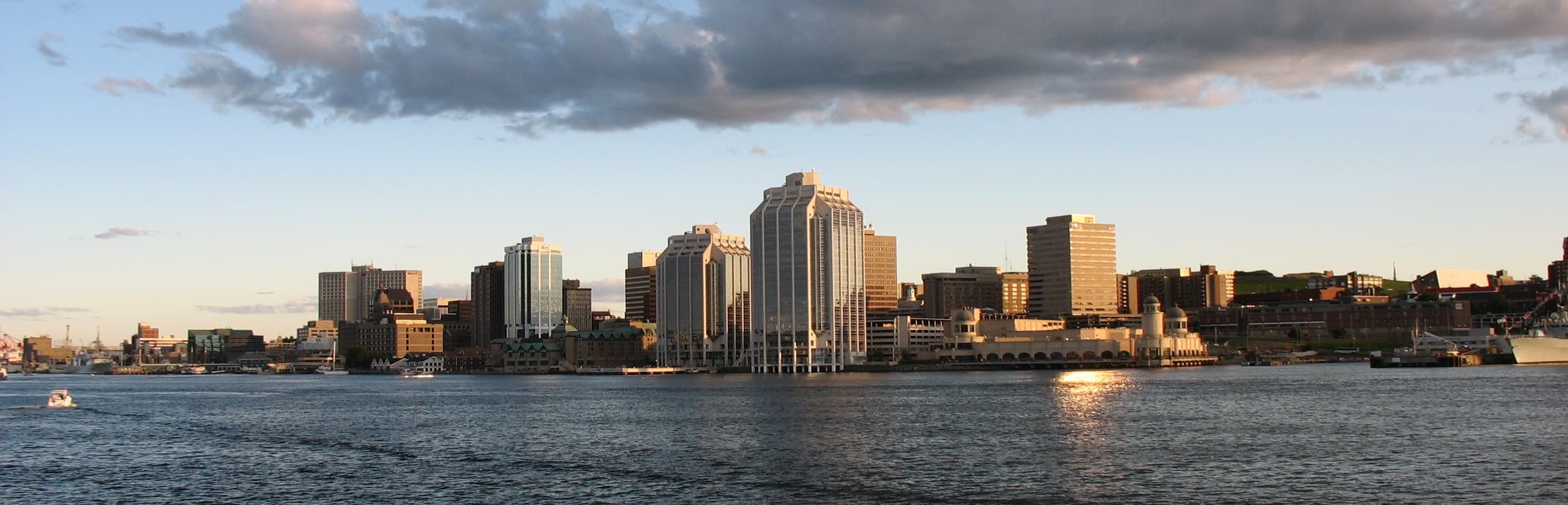
1 Waterfront. A beautiful 4.5 km boardwalk that runs from Pier 21 to Casino Nova Scotia is lined with historic buildings, shops, restaurants, art installations and other entertainment. The CSS Acadia, a former hydrographic surveying and oceanographic research ship, the World War II-era corvette HMCS Sackville, and a variety of other ships line the harbour. There are a multitude of boat tour options that launch from here during the summer months. (updated Jul 2023)
2 Harbour Hopper, 1549 Lower Water St (in lot on north side of Salter St at the waterfront), ☏ +1 902 916-0040. Guided tour of Halifax and harbour in an amphibious vehicle. Very informative and highlights major points of interest in the city in fun-filled hour. Adult $37.61, senior 65+ $34.39, youth (7-15) $24.87, child (2-6) $16.91, infant (0-1) free. (updated Sep 2022)
3 Boat Tours, ☏ +1 902-420-1015. Open seven days a week May-October. Murphy's the Cable Wharf is in the heart of the Halifax waterfront and offers a variety of boat tours including nature and whale watching, tall ship sailing, deep sea fishing, historical harbour tours and dinner cruises. (updated Apr 2016)
4 Canoe the Northwest Arm (St. Mary's Boat Club), 1641 Fairfield Road (off Jubilee), ☏ +1 902-490-4688. Sat Sun 11AM-7PM. Take a trip up the beautiful Northwest Arm to see the historic Dingle tower in Flemming Park, watch the numerous sailboats out for a weekend cruise or catch a regatta if you're lucky. Gawk at some of the mansions that line the water or for the ambitious, head all the way up to Point Pleasant Park, where the Northwest Arm meets Halifax Harbour. While swimming in parts of the harbour was briefly possible due to the installation of sewage treatment plants, they are down for repair and swimming is again not recommended unless a trip to hospital after is desired. Rent a canoe for $8/hour. (updated Apr 2016)
5 Halifax Mooseheads ice hockey. This Quebec Major Junior Hockey League team plays from October to April at the Scotiabank Centre. Rough, highly-skilled games are combined with a near-NHL level of presentation. See Ice hockey in North America for context. Tickets are $8-15, and are available at the Metro Centre box office. (updated Apr 2016)
Eat
Many restaurants in Halifax specialize in seafood dishes. Seafood is generally not much cheaper in the Maritimes than elsewhere, with the exception of mussels, which are generally good quality, cheap, and found on many appetizer menus. Another seafood worth having is scallops, as they are generally higher quality than the ones you get in many parts of North America (good scallops are the size of a golf ball or larger, and do not taste fishy). "Sea pie" is often a good deal when available, as are hearty eats like fish and chips or seafood chowder. Lobster in a restaurant will be expensive, so your best cheap bets are to buy one at the store and cook one yourself, or attend any of the numerous lobster dinners that are hosted by churches and community groups throughout the warmer months. Buying lobster from the various fishermans markets or directly from the fisherman themselves (who will often sell street side out of a car) will get you the best deal.
A plethora of foods that are native to Nova Scotia are easy to find in Halifax: one is the Halifax donair, which is similar to but distinct from the Turkish doner kebab. It is prepared using thinly sliced beef meatloaf and a sweet condensed milk garlic sauce and garnished with diced tomatoes and white onions. Other specialties include hodge podge (a creamy soup of fresh baby vegetables; rarely found in restaurants); blueberry grunt (blueberry baked with a sweet dumpling topping); and deep fried pepperoni (a bar snack often dipped in honey mustard sauce). Restaurants in Halifax and indeed Atlantic Canada offer a donair pizza featuring all the Halifax donair ingredients served on a pizza crust. In addition, one can normally find donair meat used in such offerings as donair sausage; donair egg rolls (an egg roll casing stuffed with donair meat); donair pogos (donair meat on a stick, battered and deep-fried, similar to a corn dog); donair calzones/panzerottis; and in donair poutine (an Atlantic adaptation of the Quebec snack dish).
Drink
There are a large number of good cafes, pubs, and other eateries all throughout downtown. Mostly clustered around the downtown, especially Argyle Street, and waterfront, but there are also excellent options across the harbour in Dartmouth and in the city's North End
Liquor purchases for private consumption are regulated by the provincially owned liquor monopoly called the NSLC (Nova Scotia Liquor Corporation). Stores can be found in stand-alone locations, malls, and grocery stores. Selection is often surprisingly large, but be prepared to pay: a 12-pack of beer can range from $17-20, and a pint of rum or vodka will set you back $12-14. All prices quoted include taxes and recycling deposits. Most stores close at 10PM Monday to Saturday and 5PM on Sundays. Stores are closed for holidays. The exception has been the sole drive-through outlet near the Dartmouth end of the MacDonald Bridge; it is frequently open holidays, but for drive-through service only. Port of Wines and several other micro-breweries are also permitted to sell their products from their outlets.
Pubs
Until a couple of decades ago, Halifax retained old British laws about the serving of alcoholic beverages. For example, if an establishment served hard liquor, it had to provide live entertainment; if it served draft beer, it also had to serve food. The heritage of those laws is a great deal of live entertainment and some very good deals on "pub food" which is priced low to get people in the door. Most "pub food" originates not far from the grill and deep fryer. Pubs that specialize in traditional-style music have "open mic" nights. Performers who attend will bring in their fiddles and bagpipes to jam---they are paid in drinks and food.
1 The Pint Public House, 1575 Argyle St, ☏ +1 902-492-8844.
2 Bearly's House of Blues and Ribs, 1269 Barrington Street. A mellow and low-key pub. Great live music!
3 East of Grafton, 1580 Argyle St, ☏ +1 902-428-5680. Tavern with pub fare, beer.
4 The Foggy Goggle, 2057 Gottingen St, ☏ +1 902-444-1414. Mon-Thu 11:30AM-midnight, Fri 11:30AM-2AM, Sat noon-2AM, Sun noon-midnight. A relaxed establishment serving local and international beers. Bluegrass night every Wednesday, no cover. (updated Jun 2019)
Get around
The Halifax Peninsula is quite dense and charming, owing to its 18th century street layout, however beyond the peninsula sprawl becomes more prominent. Public transit is limited and mostly impractical outside the peninsula. The downtown shopping and attractions will engage the average traveller for a day or two at most. Beyond this time frame, a car rental will significantly open up the surrounding area.
By foot
Founded in 1749, long before the automobile, Halifax is a very walkable city. The blocks are relatively small and the streets are mostly quite narrow, excellent for taking a comfortable stroll around the city's various neighbourhoods. The downtown and waterfront can (and should) be explored entirely on foot, there is an abundance of excellent shops, bars, and restaurants with patios, all catering primarily to pedestrians. Walking south of South Street (especially around the streets that branch off Inglis Street, South Park Street/Young Avenue) there are hundreds of Victorian homes and Registered Historic Properties which are best appreciated at a slow pace on foot. Further south you will reach Point Pleasant Park with 39 km of trails between dense forest and connecting National Historic Sites and various monuments.
Walking is safe in Halifax, most drivers are used to giving way to pedestrians at intersections, although they may not stop if crossing mid-block. Crimes against pedestrians are uncommon, although panhandlers can be persistent and drunk students are always around and can be boisterous.
Stay safe
Halifax is a generally safe city, but you should be aware when walking around certain areas of the city at night. The North End, including the Gottingen Street area, is relatively safe by international standards but has something of a rough reputation locally. In most cases, common sense should suffice.
Pedestrian crosswalks are highly respected by drivers in Halifax, and crossings can occur just about anywhere. This provides a double danger: for drivers to keep on the ball watching out for pedestrians; and for pedestrians to not be lulled into a false sense of security while crossing.
Rapidly changing weather means that black ice abounds in winter, and it's particularly nasty when combined with the city's hilly topography. Choose your steps and drive carefully.
Practical facts for Canada
Taken from open data. Rules and numbers change, so check locally before you rely on them.
- Currency
- Canadian Dollar (CAD)
- Languages
- Canadian English, Canadian French, and Inuktitut
- Plugs and power
- Types A and B, 120 V at 60 Hz
- Traffic drives
- On the right
- Emergency numbers
- Any emergency911
- Country calling code
- +1
- Time zones
- America/Atikokan, America/Blanc-Sablon, America/Cambridge Bay, America/Creston, and 19 more
Official travel advice
Quoted from each government as published, with the date they last changed it. We do not add a verdict of our own.
UK Foreign, Commonwealth & Development Office
- No areas listed that it advises against travelling to
US Department of State
Level 1 of 4: Exercise normal precautions
Read the full adviceExercise normal precaution in Canada.
Canada is generally a safe destination for travelers.
Crime
• Petty crime is common, especially in popular tourist locations. Stay aware of your surroundings.
• Most crimes against foreigners are crimes of opportunity, like purse snatching, pickpocketing, and car break-ins or theft.
• Review our Travel Guidance for Canada to learn how to prepare for a safe trip.
Entry and visas
Entry rules depend on your passport and change without notice. Check the official pages before you book.
Sources