
France
A plan for Grenoble
Not a list of things to see in Grenoble — a day-by-day plan somebody could actually follow, built from places we can point to a source for. Make your own in about a minute.
- 2 nights
- Couple
- Balanced pace
- Mid-range budget
Every place here was checked on 2026-10-27 or later, and each one says where it came from.
The plan, day by day
Day 1
09:30
You arrive
13:00
Marché Place Sainte-Claire
Suggested because you chose food
- 1h
- Meal
14:30
Museum of Grenoble
Picked because you chose culture & museums + balanced energy
- 2h 30m
- Culture & museums
2h open
Nothing planned here. That was on purpose.
19:00
La Fondue
Suggested because you chose food
- 1h 30m
- Meal
20:30
Chapelle Sainte-Marie-d'en-Bas
Picked because you chose culture & museums + balanced energy
- 2h 30m
- Culture & museums
Day 2
08:00
Le Bistrot
Suggested because you chose food
- 45m
- Meal
45m open
Nothing planned here. That was on purpose.
09:30
Museum of the Old Archbishopric
Picked because you chose culture & museums + balanced energy
- 2h 30m
- Culture & museums
1h open
Nothing planned here. That was on purpose.
13:00
La Cuisine des Tontons
Suggested because you chose food
- 1h
- Meal
14:30
Le Magasin des horizons
Picked because you chose culture & museums + balanced energy
- 2h 30m
- Culture & museums
2h open
Nothing planned here. That was on purpose.
19:00
Auberge Napoléon
Suggested because you chose food
- 1h 30m
- Meal
20:30
Chapelle du couvent des Minimes de Grenoble
Picked because you chose culture & museums + balanced energy
- 2h 30m
- Culture & museums
Day 3
08:00
Café de la Table Ronde
Suggested because it fits a mid-range budget
- 45m
- Meal
45m open
Nothing planned here. That was on purpose.
09:30
Musée de la Résistance et de la Déportation à Grenoble
Picked because you chose culture & museums + balanced energy
- 2h 30m
- Culture & museums
1h open
Nothing planned here. That was on purpose.
13:00
La Belle Idée
Suggested because you chose food
- 1h
- Meal
14:30
You leave
Weather through the year
Monthly averages from NASA's 25-year climate record, day and night together.
Best months: June, July, and August
| January | Cold: -1°C, 70 mm |
|---|---|
| February | Cold: -1°C, 57 mm |
| March | Cold: 3°C, 68 mm |
| April | Cold: 7°C, 65 mm |
| May | Cold: 11°C, 88 mm |
| June | Mild, some rain: 15°C, 65 mm |
| July | Mild, some rain: 17°C, 56 mm |
| August | Mild, some rain: 17°C, 58 mm |
| September | Mild, some rain: 13°C, 67 mm |
| October | Cold: 9°C, 85 mm |
| November | Cold: 4°C, 100 mm |
| December | Cold: 0°C, 77 mm |
From the Wikivoyage guide
Quoted from the travel guide anyone can edit, as it read on the day we took it.
See
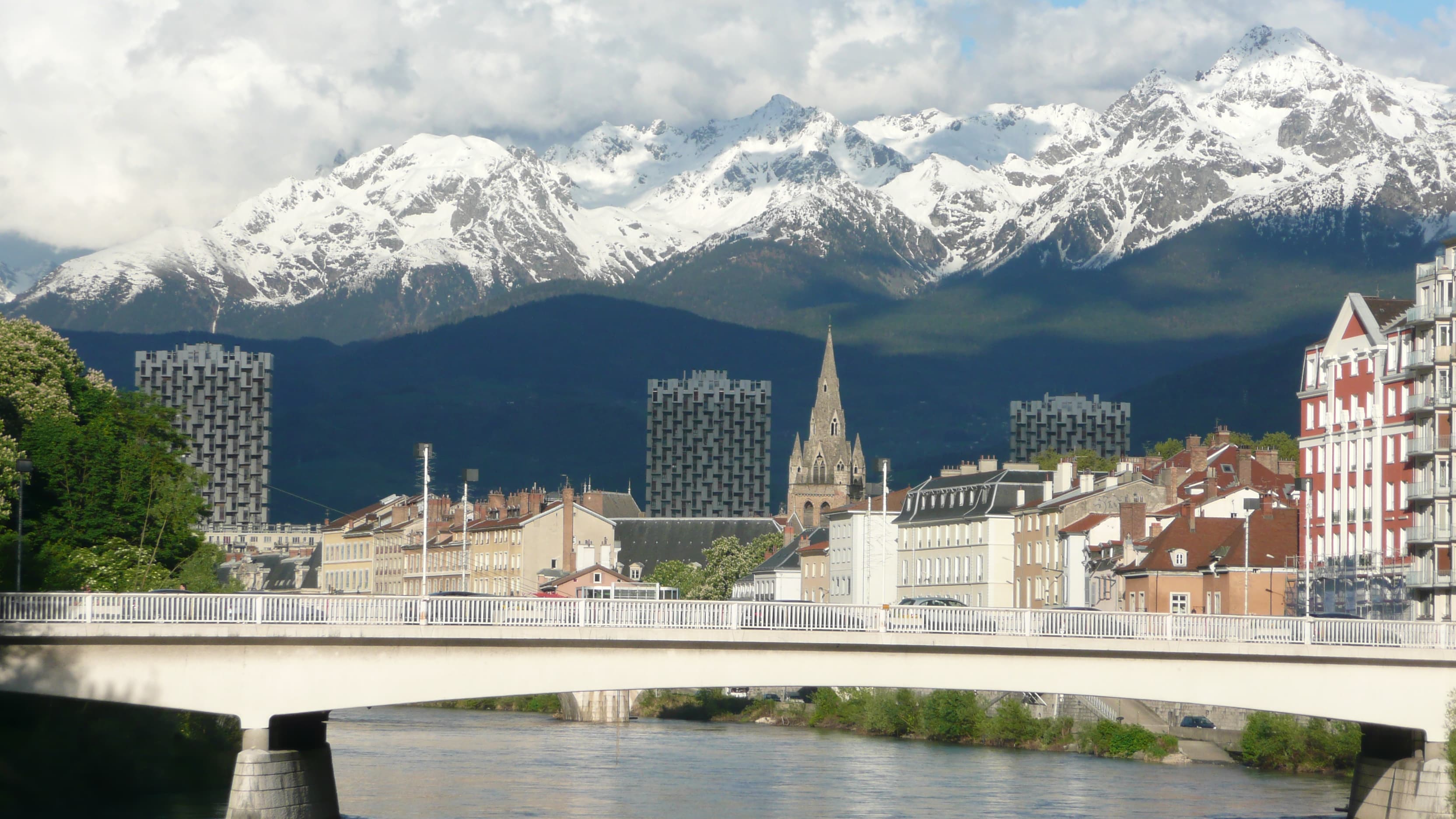
Grenoble has a reputation for being one of the ugliest cities in France, however this is mostly due to the suburbs located in the southern part of Grenoble, the Polygone in the north-west and the communes in the valleys surrounding Grenoble (particularly Echirolles and Saint-Martin-d'Hères), which were built during the time of the Winter Olympics in 1968 when Grenoble experienced very rapid urban expansion and whose architecture has not aged particularly well. Nonetheless the city centre remains as charming as any other French city, to say nothing about the mountains surrounding it. Even in the suburbs, some places still remain their charm where old isolated villages once stood, particularly the centre of Sassenage.
1 Bastille Hill. An ancient series of fortifications overlooking Grenoble. May be reached by cable car [10], round trip €8, or by a 40-minute hike. Enjoy the spectacular panoramic view of the city and surrounding mountains from the top. On the Saint-Laurent side, giant stairways are impressive to climb or descend. On the way up you will also encounter a building that used to house the Institut Dolomieu but has been abandoned and in ruins since 2001. You can still walk into some of the old classrooms and lecture theatres.
2 Parc Paul Mistral. A big park in the centre of the city. It includes a roller skating rink and people often play street hockey. The park also boasts extensive lawns and quiet tree-lined avenues. At the centre stands the tower Perret, built in 1925 for an international exposition about water-power. When illuminated at night with blue lights, it bears a considerable resemblance to both Dr. Who's sonic screwdriver and the Tower of Mordor. For at least 50 years, it has been impossible to go up due to safety problems. After renovations, the tower will reopen to the public in 2022.
Do
1 The cable car (French: téléphérique), Quai Stéphane Jay (if you're walking, follow the Isère in the direction of the centre of the town until you see the cables, you cannot miss them), ☏ +33 4 76 33 44 44, contact@telepherique-grenoble.com. Jan: closed 2-4 weeks for maintenance; Feb Nov Dec: Tue-Thu Sun 11:00-18:30, Fri Sat 11:00-00:00; Mar: Tue Wed Sun 11:00-18:30, Thu-Sat 11:00-00:00; Apr: Tue 11:00-19:00, Wed-Sat 09:15-00:00, Sun 09:15-19:00; May Jun Sep Oct: Mon Tue 11:00-19:00, Wed-Sat 09:15-00:00, Sun 09:15-19:00; Jul Aug: Mon 11:00-00:00, Tue-Sun 09:15-00:00. The cable car is the easiest way to see the town from above, and the trip in the plastic bubbles is impressive. At the summit (some 260 m above the town) is a 19th-century fortress, La Bastille. When you arrive at the top, you can explore the fortifications, have a meal or light refreshments, follow winding paths further up the mountainside or simply enjoy the view (on a clear day Mont Blanc is visible in the distance).
If you take the path (GR9) to the rear of the Bastille, you can walk approx 20-30 min further up to Mont Jalla to get an even better view, where there is a memorial to the mountain troops who fought in World War II and a monument erected on the 60th anniversary of the liberation of Grenoble (1944). You can also walk up to the Bastille via one of several paths or go by car from the city of La Tronche. Paths start from the Fountain of lion on the East side, (this path is called Montée Chalemont) or a park on the West, near the large arch (called Jardin des Dauphins). Roundtrip: adult €9; age 5-15, 75+ or disabled €4.80; one-way: two-thirds of the regular price. (updated Aug 2022)
Eat
If you'd like to have an extensive eatery guide with you on your travels, The Guide du Dahu is probably the best restaurant guide to Grenoble. The work of 20 students of Grenoble business school, it includes 300 pages covering restaurants, bars, culture, sport and nightlife. €2.50 from tabacs and bookshops in the city. The Petit Futé series also offers a Grenoble guide, which has an extensive list of restaurants and other businesses.
You can find many good restaurants in the city centre, roughly between the Train Station, Place Saint-André and Place Notre Dame. The St-Laurent neighborhood (on the northern side of the Isère river) has a number of Italian restaurants and pizzerias. There are also a number of restaurants that line the Rue Brocherie and the area surrounding Place aux Herbes. In the winter, try typical Alpine dishes such as fondue, raclette and the legendary tartiflette. La Ferme à Dédé, at 24, rue Barnave, has a menu with many local and regional specialties. A good traditional option for vegetarians is Ravioles du Dauphiné (cheese dumplings baked in gratin), although it is not unheard of for them to contain meat and you should always ask the waiter first.
Grenoble is also well-known for being the place of origin of the French taco (although a resident of Lyon will beg to differ and will claim the French taco as their own). These have absolutely nothing in common with Mexican or Tex-Mex tacos and are more closely related to kebabs, and if you try to order tacos at your average kebab shop in Grenoble you are far more likely to get the French variety than the Mexican variety. While worth a try for the novelty experience, and certainly better than the ones you get in O'Tacos that are available elsewhere in France, they are rather bad for you and should be consumed in moderation.
Budget
Boulangeries and Patisseries: These little bread and pastry bakeries not only have wonderful tarts and cakes, but they also sell small quiches, panini (grilled Italian sandwiches), and cold sandwiches. Grenoble is the walnut capital of France so look for small cakes (gateaux) with walnut cream, especially during the winter. Other specialties include Chartreuse (a herbal liquor traditionally made by the monks of Grande Chartreuse, a monastery high in the mountains about an hour from Grenoble).
Drink
There are bars and pubs in the downtown area, especially between Place Grenette and Place Notre Dame. Les Frères Berthom, near Place Notre Dame, offers a variety of local brews and a lively ambience. Couche Tard, Bukana, and London Pub cater to Erasmus, international, and American study abroad students.
At Place Saint-André, you will find La table ronde, founded in 1739 as the second oldest café in France to Le Procope in Paris.
In the nearby city of Voiron (25 km northwest of Grenoble) are the Caves de la Chartreuse (+33 4 76 05 81 77), where the famous liqueur is made by the Carthusian Monks. It is claimed to be the largest liqueur cellar in the world. Free guided tours are provided, with a tasting session in the end. Opening hours are 09:00-11:30 and 14:99-18:30 (closes at 17:30 and weekends from November to April, no lunch break in July and August). See [11] for more information.
O'Calaghan's Irish Pub, 2 place Berulle. This is a nice big family pub with a large terrace. One of the best pubs in Grenoble with plenty of Anglophones as well as locals.
Get around
By car
Avoid rush hour (07:00-09:00 and 17:00-18:00) on highways around the town as you are likely to lose time in traffic jams.
Car club
Alpes Autopartage [7] runs a car club in Grenoble. For a minimum duration of 3 months, and a nominal monthly fee of €12-15, you can use any of their 21 cars for as short as 1 hr to as long as several days. Some cars with winter tires in season, ski racks, etc.
By taxi
Taxis of Grenoble: +33 4 76 54 42 54; Fax +33 4 76 51 55 66
Suburban Taxis: +33 4 76 54 17 18; Fax +33 4 76 54 45 75
By regional bus
Many regional buses can take you from the bus station (gare routiere, by the train station) to ski stations and several towns in the surrounding countryside. For example, Grenoble to Chamrousse (bus 6010) ski station costs €2.70. It is better to buy tickets in advance for access to ski stations in high season- if the bus is crowded, you get priority. Tickets are sold at the main bus station and at the tourist information office (French: Maison du tourisme) which is on tram lines A and B (stop: Hubert Dubedout - Maison du Tourisme).
Information on regional buses VFD/ (in French only, but finding buses' schedules is easy). Be aware that the winter schedule (saison neige) is not the same as for the rest of the year.
By tram or city bus
Five tram lines cross the town with services every few minutes (less frequent on Sundays or at night) and an extensive bus network operates within the city itself, the suburbs and villages further out. The bus network typically stops service at 20:00 or 24:00 for the 7 CHRONO bus lines, whereas most of the tram network runs until 01:00. Individual tickets cost around €1.60 at the tram station or €2.10 or on the bus, less if bought by 10 or 30. Daily (€5), weekly and monthly passes are available with discounts for students. Tickets are valid for one hour of travel across the TAG network (bus and tram). Tickets can be bought in the bus from the driver, and from machines on the platform for tramways, or at the Maison du Tourisme. You must stamp (composter) your ticket for it to be valid: this is done on the platform at the tram stop or on entering a bus. Ticket inspections are frequent, even during weekends.
Information can be found at TAG and maps at [8] (in French).
Stay safe
Grenoble is generally a safe city for tourists, students, and residents. Like any urban area, it’s best to stay aware of your surroundings and take common-sense precautions, particularly at night or in less central areas.
River safety: The Drac River, while appearing calm, can rise rapidly due to upstream dam releases. Avoid walking too close to its banks, especially with children or pets, and respect posted warnings.
Crime awareness: Grenoble has had a reputation in French media for higher-than-average crime rates. However, this typically involves issues in specific residential districts and is unlikely to impact visitors. Violent crime is rare in tourist-friendly areas, and the city centre, campus zones, and major attractions are generally very safe.
Neighbourhoods to avoid at night: Visitors are advised to avoid wandering through Villeneuve, Village Olympique, and Échirolles after dark. While these areas have seen social tensions and sporadic unrest, they are not tourist destinations and have no key attractions. If you're using tram line A or line E, take extra care when passing through stops like La Bruyère, Arlequin, and Grand'Place late in the evening.
Tram and public transport: Pickpocketing is uncommon but can occur during busy times on tram and bus lines, especially at peak hours. Keep an eye on your belongings and use bags that zip or close securely.
Prostitution zones: While the Stade Lesdiguières area has historically seen some late-night solicitation, it's typically discreet and not a concern for most travellers.
As with any city, exercising basic caution—especially after dark—and avoiding confrontations will go a long way in keeping your visit smooth and trouble-free.
Practical facts for France
Taken from open data. Rules and numbers change, so check locally before you rely on them.
- Currency
- Euro (EUR)
- Languages
- French (France), Arpitan, Breton, Corsican, and 3 more
- Plugs and power
- Types C and E, 230 or 400 V at 50 Hz
- Traffic drives
- On the right
- Country calling code
- +33
- Time zone
- Europe/Paris
Official travel advice
Quoted from each government as published, with the date they last changed it. We do not add a verdict of our own.
UK Foreign, Commonwealth & Development Office
- No areas listed that it advises against travelling to
Read the full adviceDemonstrations
There is an increased likelihood of demonstrations, political gatherings and marches taking place across France, sometimes at short notice.
Whilst most demonstrations are peaceful, you should remain aware of your surroundings. Stay away from areas with large crowds or a significant police presence, and follow the advice of police and local authorities.
Demonstrations may disrupt local transport services and authorities may impose public safety measures, including partial and localised curfews in some areas. Monitor local media for the latest information about measures in your area.
US Department of State
Level 2 of 4: Exercise increased caution
Read the full adviceExercise increased caution in France due to terrorism and unrest.
Violence and rioting have recently occurred in France and may continue. Avoid demonstrations and areas of unrest. Stay away from areas with large crowds or significant police activity.
Pickpocketing and phone thefts are common, especially in crowded places. Terrorist groups continue to plan possible attacks in France and may attack with little to no warning. There are also regular, peaceful protests and strikes in Paris and other cities throughout France.
Entry and visas
Entry rules depend on your passport and change without notice. Check the official pages before you book.
Sources