
Canada
A plan for Edmonton
Not a list of things to see in Edmonton — a day-by-day plan somebody could actually follow, built from places we can point to a source for. Make your own in about a minute.
- 2 nights
- Couple
- Balanced pace
- Mid-range budget
Every place here was checked on 2026-10-27 or later, and each one says where it came from.
The plan, day by day
Day 1
09:30
You arrive
13:00
Town Square Brewing Co.
Suggested because you chose food
- 1h
- Meal
14:30
Alberta Railway Museum
Picked because you chose culture & museums and local experiences + balanced energy
- 2h 30m
- Adventure sports
2h open
Nothing planned here. That was on purpose.
19:00
Campio Brewing Co.
Suggested because you chose food
- 1h 30m
- Meal
20:30
Varscona Theatre
Picked because you chose culture & museums + balanced energy
- 2h 30m
- Culture & museums
Day 2
08:00
Cafe Sorrentino
Suggested because it fits a mid-range budget
- 45m
- Meal
45m open
Nothing planned here. That was on purpose.
09:30
Art Gallery of Alberta
Picked because you chose culture & museums + balanced energy
- 2h 30m
- Culture & museums
1h open
Nothing planned here. That was on purpose.
13:00
Nhon Hoa Sandwich Bar
Suggested because you chose food
- 1h
- Meal
14:30
Fort Edmonton Park
Picked because you chose culture & museums + balanced energy
- 2h 30m
- Culture & museums
17:00
Muttart Conservatory
Picked because you chose local experiences + balanced energy
- 2h 30m
- Local experiences
19:30
Julio's Barrio
Suggested because you chose food
- 1h 30m
- Meal
21:00
Francis Winspear Centre for Music
Picked because you chose culture & museums + balanced energy
- 2h 30m
- Culture & museums
Day 3
08:00
Cafe Mosaics
Suggested because you chose food
- 45m
- Meal
45m open
Nothing planned here. That was on purpose.
09:30
Royal Alberta Museum
Picked because you chose culture & museums + balanced energy
- 2h 30m
- Culture & museums
1h open
Nothing planned here. That was on purpose.
13:00
Remedy Cafe
Suggested because you chose food
- 1h
- Meal
14:30
You leave
Weather through the year
Monthly averages from NASA's 25-year climate record, day and night together.
Best months: July and August
| January | Cold: -10°C, 22 mm |
|---|---|
| February | Cold: -9°C, 18 mm |
| March | Cold: -4°C, 27 mm |
| April | Cold: 4°C, 40 mm |
| May | Cold: 11°C, 64 mm |
| June | Mild, some rain: 15°C, 85 mm |
| July | Mild, some rain: 18°C, 96 mm |
| August | Mild, some rain: 17°C, 55 mm |
| September | Cold: 11°C, 41 mm |
| October | Cold: 4°C, 29 mm |
| November | Cold: -4°C, 26 mm |
| December | Cold: -10°C, 19 mm |
From the Wikivoyage guide
Quoted from the travel guide anyone can edit, as it read on the day we took it.
Understand
History
The area around Edmonton, which sits in the geographic centre of the province, was home to native populations for thousands of years before the arrival of European settlers. In 1795, Edmonton House was constructed and work on Fort Edmonton began. The original site was near Fort Saskatchewan, but was relocated near the present day Legislature in 1830.
The town developed around the fur trade, and in the early days there was little to distinguish it from other such settlements in the area. The first hotel and hospital were built in the 1870s. The latter part of the century saw an influx of wealthy families, and in 1892 the Town of Edmonton was officially founded.
Early developments were centred around the Quarters area. In 1905, Edmonton was declared the capital of the province of Alberta, and a year later was designated a city. The 1907-1914 period saw the city experience an unprecedented boom, with the population rising from around 6,000 to 78,000. During this period, the University of Alberta was founded
In 1947 oil was discovered just outside of Edmonton in Leduc county, which spurred a second period of growth, leading to urban sprawl and the development of US-style malls. The Royal Alberta Museum opened in 1967.
The utilitarian office buildings and condos that dominate the downtown landscape today were mostly constructed in the 1970s.
Today, Edmonton is the hub for energy development and petrochemicals for Alberta. As well, it has become a centre of excellence in research through the University of Alberta and the high technology industries in the region like the National Institute for Nanotechnology.
Climate
If you want to spend time outdoors, the summer months offer the most opportunities for recreation and entertainment. In the summer, Edmonton offers great outdoor festivals, street entertainment, open-air concerts, and many other world-class entertainment opportunities. Winter is equally exciting, with snow sports for the outdoorsy, extensive indoors shopping in the many malls, and live sports, theatre, and music throughout the city.
See
A young city, Edmonton's historic structures are still relatively new. The City of Edmonton's Municipal Historic Resources are buildings or structures that have been designated by bylaw as buildings or structures legally protected from demolition and from inappropriate changes and alterations. For further reading about Edmonton's architecture from 1940-1969, Capital Modern is a book available from the Art Gallery of Alberta.
Here are some of the most popular attractions:
Alberta Legislature Building - This beautiful example of Beaux-Arts architecture dates back to 1911, built following Edmonton's selection as the provincial capital. Free tours are available. There are wading pools to cool off in during the summer and skating rinks beside walkways light up with tons of Christmas lights during the Christmas season. See Central. Its grounds are a beautiful area to relax in any time of the year, and are patrolled at night for visitor security.
Art Gallery of Alberta (formerly the Edmonton Art Gallery) - This modern facility explores all forms of art. The gallery has a unique selection of Canadian and international pieces and regularly brings in traveling exhibitions. See Central.
Muttart Conservatory - These four glass pyramids rising out of the river valley are a unique Edmonton landmark. Inside, they house three distinct climate zones and a fourth seasonal display, packed with several hundred plant varieties. See South Central.
TELUS World of Science - Edmonton's largest science museum has a unique architectural design and houses many science exhibits, a planetarium, and an IMAX theatre. See West End.
Royal Alberta Museum presents Alberta's history through paintings, statues, and more. Exhibits include the Syncrude Gallery of Aboriginal Culture, Wild Alberta, and the Natural History Gallery. See Central.
West Edmonton Mall is the largest shopping and entertainment complex in North America, with copious opportunities for shopping, a built-in hotel, restaurants and food courts, an amusement park, an artificial beach and indoor wave pool, casino, movie theatres, indoor lake and Santa Maria ship replica, and lots of visitors to share it with. See West End.
Do
Edmonton's summer brings many festivals, and with Canada's most impressive mountain parks 3.5-hr drive away, Edmonton is fun year-round. You can expect to find some kind of festival any weekend during the summer months and they are usually located in the central region either around Whyte Ave or downtown at the Legislature grounds or in front of City Hall.
Theatre and music
Edmonton has a vibrant performing arts community with notable accomplishments in live theatre and live music. The central area contains the Winspear or Francis Winspear Centre for Music, a new concert hall with stellar acoustics, and the Citadel Theatre, which has hosted major live theatre performances for over forty years.
South Central area is home to the theatre district with a number of venues, and the Jubilee Auditorium, a large concert hall. The west end has two dinner theatres, Jubilation's and Mayfield.
Recreation
Edmonton's river valley and Mill Creek area have an extensive network of trails, good for walking, biking, and cross-country skiing. At many points in the extensive ravines and forested areas in the river valley, you can't even tell you're in a city. Maps of walking and cross-country skiing trails are available at City Hall, Edmonton Tourism's Visitor Information Centres, and many bicycle and ski shops.
The Edmonton Bicycle Commuters' Society (EBC), a non-profit bicycle co-op, operates a staffed drop-in DIY workshop where rental bicycles are available. During the summer months, River Valley Adventure rents bicycles and operates Segway tours. Fun group rides occur during the summer, mostly organized by the Edmonton Bicycle and Touring Club (EBTC) and EBC. Most commercial bike shops organize training rides for those road cyclists who are interested in higher intensity workouts. Larger commercial bike shops include United Cycle, Western Cycle, and Revolution Cycle. Smaller ones include Velocity Cycle, Redbike, Hardcore Mountain Bikes, PedalHead Bikes, and Transition BMX.
Eat
See the district articles for specific listings of different restaurants and fast food joints.
There are three major dining centres:
Downtown and Wîhkwêntôwin- many restaurants both chains and independents, with a side range in pricing. 103 St., 102nd Avenue, 100 St. and Jasper Avenue have the highest concentration. Some of the most popular include: Lux Steakhouse, Sorrentino's, Famoso Neapolitan, Japanese Village, La Ronde, Sabor Divino, Corso 32 and La Tapa.
Whyte Ave. - a trendy area that has some good restaurants and many that are average, and the greatest concentration of bars and pubs in the city.
West Edmonton - whether in West Edmonton Mall or nearby, there are many restaurants, but few that will provide an above-average meal.
Edmonton is the birthplace of two major Canadian restaurant chains: Boston Pizza (Italian), and Earl's (Canadiana). These two have major locations across Canada. The city is also home to a lot of good quality fast food chains like Burger Baron and Fatburger.
Italian food is very high quality in Edmonton. Chianti's, Sicilian Kitchen, Sorrentino's, Fiore Cantina, and Tony's Pizza offer hearty and filling pasta. The best are Whyte Ave, Downtown, or in Little Italy.
Edmonton has some excellent ethnic restaurants. "Langano Skies" is a fabulous Ethiopian restaurant on Whyte Ave, "Syphay" offers spicy Thai cuisine on Calgary Trail and 62 Ave and "Padmanadi's" is a delicious Indonesian vegan restaurant in downtown.
Edmonton has its fair share of cheap Chinese food, most of which is concentrated in Chinatown. WokBox is another Edmonton-based chain, offering fair priced Chinese food in a fast food environment.
Drink
Alcohol
While the giant Labatt brewery makes beer in Edmonton (look for a giant beer can at Gateway Blvd and Whitemud Dr), if you're looking for a more unique (and usually pricier) brew, Edmonton is home to a growing number of smaller breweries. Alley Kat and Yellowhead brews are commonly on tap in bars.
There are many pubs, clubs, lounges, and bars clustered on Jasper Avenue (downtown) and Whyte Avenue (Old Strathcona). Some of the most popular in Old Strathcona include Hudson's', Filthy McNasty's, Tavern on Whyte and O'Byrne's.
For those looking for a more indie experience should journey to Black Dog Pub and The Buckingham who provide visitors with a less mainstream outing.
Downtown you will find a range of places to serve your drinking desires. Contemporary resto-lounges, such as Sherlock Holmes, Red Star Pub, and The Pint.
A variety of dance clubs can be located in the downtown area and these include: Vinyl Retro Dance Lounge (Retro Classics/Top 40), Oil City Roadhouse (Country), Treasury Vodka Bar (Top 40/Electronic), and Warehouse (Top 40)
Edmonton also has a prominent LGBT community and offers several establishments that cater to this particular group, including The Grindstone and Evolution Wonderlounge.
Further afield Edmonton also offers nighttime spots in less centralized locations. Midway Music Hall is a live music nightclub located in South Edmonton at 6107 104 Street. West Edmonton Mall located in West Edmonton provides visitors with a number of bars including Empire Ballroom a large vegas-style club, Whisky Jack's Urban Saloon yet another country music club, and Hudson's, the west end location of the Edmonton pub chain.
Get around
A large part of the city, built before and during the Second World War, is laid out in a grid pattern of straight streets, which makes for easy navigation by car or foot. There are a number of bridges, including the Walterdale Bridge and High Level Bridge, going in and out of the downtown core.
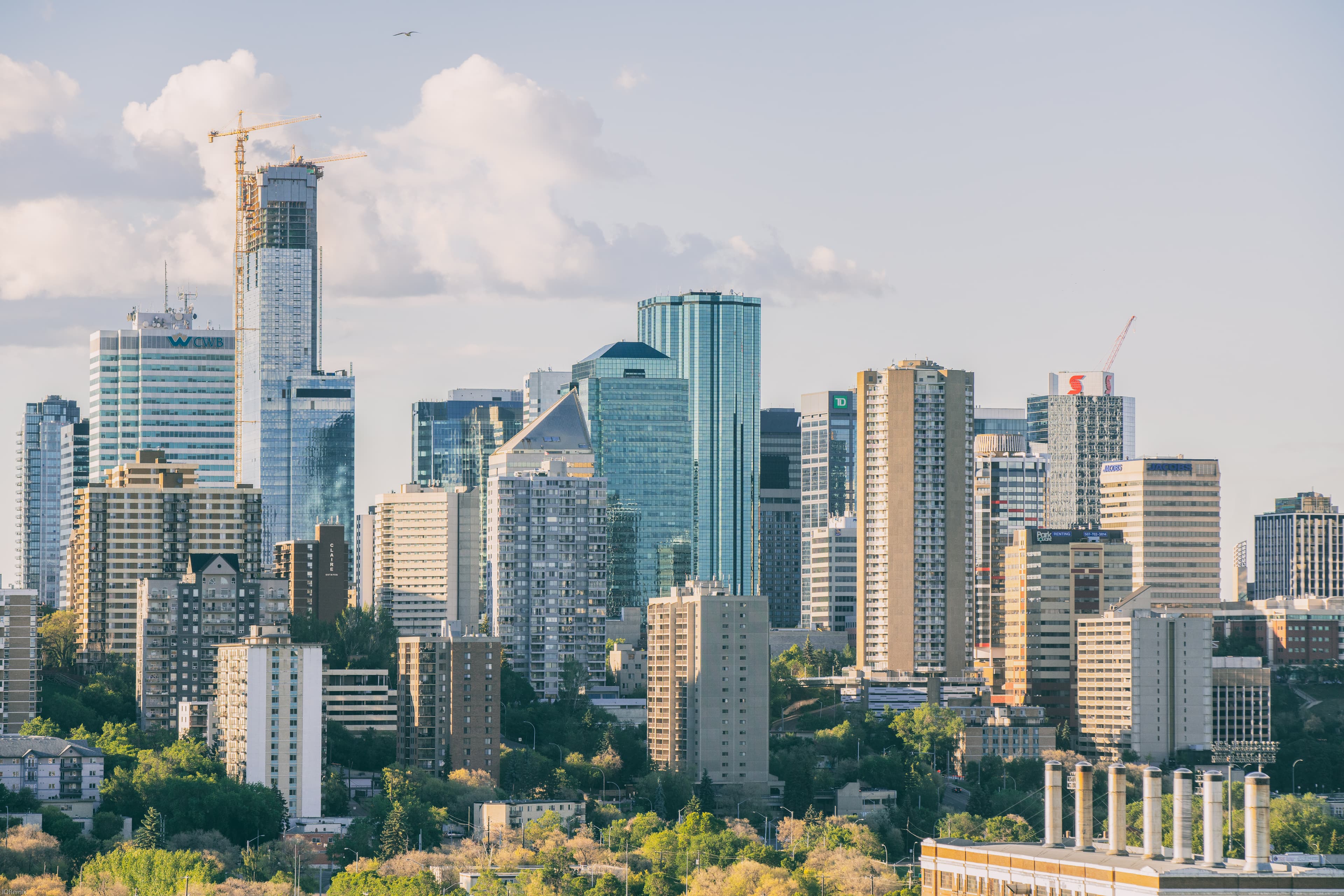
Edmonton's downtown is fairly eclectic, home to many Government of Alberta buildings and modern office towers, including the CN Tower near City Hall and the impressive, white marble-clad Bank of Montreal on 101 Street. Edmonton had some of the most architecturally significant buildings in the province, including the crimson-coloured Citadel Theatre and the church-like spires of Grant MacEwan University.
Edmonton streets are mostly numbered, although there are some named streets: usually major roadways and roads in the newer residential areas. Streets in Edmonton run north-south, while avenues run east-west. The downtown core of the city is centred near 101 St and Jasper Ave (which corresponds to 101 Ave), with streets increasing in number as you go west, and avenues increasing as you go north.
Addresses follow a regular system throughout Edmonton, with even-numbered address numbers are on the north side of avenues and west side of streets. The first two or three digits of a building or house number identify the street it lies just west of, or the avenue it lies north of. For example, 10219-101 Street would be on the east side of 101 Street, just north of 102 Avenue.
Some addresses end in "NE" or "SW", indicating a different quadrant. If there is none, it is safe to assume it is "NW"--almost all of the city's addresses are here. The NE quadrant of the city is mostly farmland, the SW is rapidly booming suburb and big-box stores, and there are no addresses in the SE quadrant. The grid starts are at Meridian Street (0 Street) on the east edge of the city and Quadrant Avenue (0 Avenue) near the south edge, but neither are major streets.
Stay safe
Visiting Edmonton is no more risky than visiting any other large city. There are some areas where increased caution is advised, particularly after dark:
The "inner city" area to the east of downtown (these neighbourhoods include: Boyle, Central McDougall, Chinatown, Little Italy, and Alberta Avenue) – a square bounded by Jasper Avenue (corresponds to 101 Avenue) on the south, 118 Avenue on the north, 97 Street on the west, and around 85th Street on the east – has parts that are best avoided. 118 Avenue and 107 Avenue feature numerous signs asking visitors to report prostitution by calling a 1-800 number. There is a large homeless and transient population in this area which has been followed with a serious drug and alcohol issue and gang violence. As well as the inner city, Stony Plain Road on the west side, 107 Avenue north of downtown, and a few areas in the city's northeast, particularly around 66th Street and Fort Road, and Abbotsfield (around 118 Ave and 34 Street) have higher crime rates and gang problems.
There has been an increase in alcohol-fuelled disturbances on weekends near 82nd (Whyte) Avenue between 103 Street and 109 Street (the city's most concentrated party zone). Use caution and common sense here, be somewhat wary of the closing-time outflow after midnight on Friday and Saturday nights. Try to be out of the bar and on your way home by 1AM, or, at the very least, don't linger on the street after closing time, also travel in groups if possible.
Since 2020, there has been an increase in the amount of crime taking place on the city's light rail transit (LRT) system, with incidents of illicit drug use and violence occurring at train stations and on the trains themselves. These incidents are mostly concentrated at the underground stations downtown, and mostly tend to happen when the sun goes down. Regardless, travelers who take the LRT are advised to be wary of their surroundings at all times, especially if they are going downtown.
Practical facts for Canada
Taken from open data. Rules and numbers change, so check locally before you rely on them.
- Currency
- Canadian Dollar (CAD)
- Languages
- Canadian English, Canadian French, and Inuktitut
- Plugs and power
- Types A and B, 120 V at 60 Hz
- Traffic drives
- On the right
- Emergency numbers
- Any emergency911
- Country calling code
- +1
- Time zones
- America/Atikokan, America/Blanc-Sablon, America/Cambridge Bay, America/Creston, and 19 more
Official travel advice
Quoted from each government as published, with the date they last changed it. We do not add a verdict of our own.
UK Foreign, Commonwealth & Development Office
- No areas listed that it advises against travelling to
US Department of State
Level 1 of 4: Exercise normal precautions
Read the full adviceExercise normal precaution in Canada.
Canada is generally a safe destination for travelers.
Crime
• Petty crime is common, especially in popular tourist locations. Stay aware of your surroundings.
• Most crimes against foreigners are crimes of opportunity, like purse snatching, pickpocketing, and car break-ins or theft.
• Review our Travel Guidance for Canada to learn how to prepare for a safe trip.
Entry and visas
Entry rules depend on your passport and change without notice. Check the official pages before you book.
Sources