
Germany
A plan for Dresden
Not a list of things to see in Dresden — a day-by-day plan somebody could actually follow, built from places we can point to a source for. Make your own in about a minute.
- 2 nights
- Couple
- Balanced pace
- Mid-range budget
Every place here was checked on 2026-10-27 or later, and each one says where it came from.
The plan, day by day
Day 1
09:30
You arrive
13:00
Ball- und Brauhaus Watzke
Suggested because you chose food
- 1h
- Meal
14:30
Green Vault
Picked because you chose culture & museums + balanced energy
- 2h 30m
- Culture & museums
2h open
Nothing planned here. That was on purpose.
19:00
Biergarten "Gohliser Windmühle"
Suggested because you chose food
- 1h 30m
- Meal
20:30
Staatsschauspiel Dresden
Picked because you chose culture & museums + balanced energy
- 2h 30m
- Culture & museums
Day 2
08:00
Café Toscana
Suggested because it fits a mid-range budget
- 45m
- Meal
45m open
Nothing planned here. That was on purpose.
09:30
Bundeswehr Military History Museum
Picked because you chose culture & museums + balanced energy
- 2h 30m
- Culture & museums
1h open
Nothing planned here. That was on purpose.
13:00
Brauhaus am Waldschlösschen
Suggested because you chose food
- 1h
- Meal
14:30
Albertinum
Picked because you chose culture & museums + balanced energy
- 2h 30m
- Culture & museums
2h open
Nothing planned here. That was on purpose.
19:00
Schillergarten
Suggested because you chose food
- 1h 30m
- Meal
20:30
Semperoper
Picked because you chose culture & museums and local experiences + balanced energy
- 2h 30m
- Culture & museums
Day 3
08:00
Café Europa
Suggested because you chose food
- 45m
- Meal
45m open
Nothing planned here. That was on purpose.
09:30
Gemäldegalerie Alte Meister
Picked because you chose culture & museums + balanced energy
- 2h 30m
- Culture & museums
1h open
Nothing planned here. That was on purpose.
13:00
Curry am Schloss
Suggested because you chose food
- 1h
- Meal
14:30
You leave
Weather through the year
Monthly averages from NASA's 25-year climate record, day and night together.
Best months: June, July, August, and September
| January | Cold: -2°C, 61 mm |
|---|---|
| February | Cold: -1°C, 41 mm |
| March | Cold: 3°C, 48 mm |
| April | Cold: 8°C, 38 mm |
| May | Mild, some rain: 13°C, 64 mm |
| June | Mild, some rain: 17°C, 73 mm |
| July | Mild, some rain: 20°C, 87 mm |
| August | Mild, some rain: 19°C, 81 mm |
| September | Mild, some rain: 14°C, 58 mm |
| October | Cold: 9°C, 54 mm |
| November | Cold: 4°C, 56 mm |
| December | Cold: -0°C, 56 mm |
From the Wikivoyage guide
Quoted from the travel guide anyone can edit, as it read on the day we took it.
Understand
History
Dresden is over 800 years old, having become a city in 1206. Many Saxon princes, dukes and kings called Dresden home, the most famous of them being August der Starke (Augustus the Strong), who was also King of Poland. The many buildings and rich art collections that date from this era, are testimony to the monarchs' extreme wealth. Raphael's Sistine Madonna, a famous oil painting of the Virgin Mary, was bought by the son of August the Strong, and is on display in Dresden. The last Saxon king abdicated in 1918, famously saying "macht doch euern Dregg aleene" (roughly translated from the original Saxon as "do your dirty work yourselves") when he did so.
Three quarters of the historical centre of Dresden was destroyed by Allied bombing on 13 February 1945. Between 20,000 and 30,000 people died in the firestorms; the exact number is unknown. There were fewer victims than those of bombings in other cities, both in absolute terms and as a percentage of the population, but Dresden is the only major German city where the air raids are still a major aspect of public debate and city politics. The bombings are still remembered each year in processions and ceremonies, but the anniversary has also been used by Neo-Nazis for demonstrations, which in turn attracted anti-fascist counter-demonstrations. For many years the ruins of the Frauenkirche (now rebuilt) with its gold cross donated by a British charity called the Dresden Trust - acted as a call for peace among the nations of the world. The city's historical centre has largely been restored to its former glory, with other areas still being rebuilt. The reconstruction generally did not use historical building techniques, and so much of the new construction is only as deep as the facade.
See
Dresden is a very beautiful, light-spirited city, especially in summer, when you can appreciate the serene setting of the historic centre. Although Dresden is larger than Munich when measured by area, the historic centre is quite compact and walkable.
Innere Altstadt
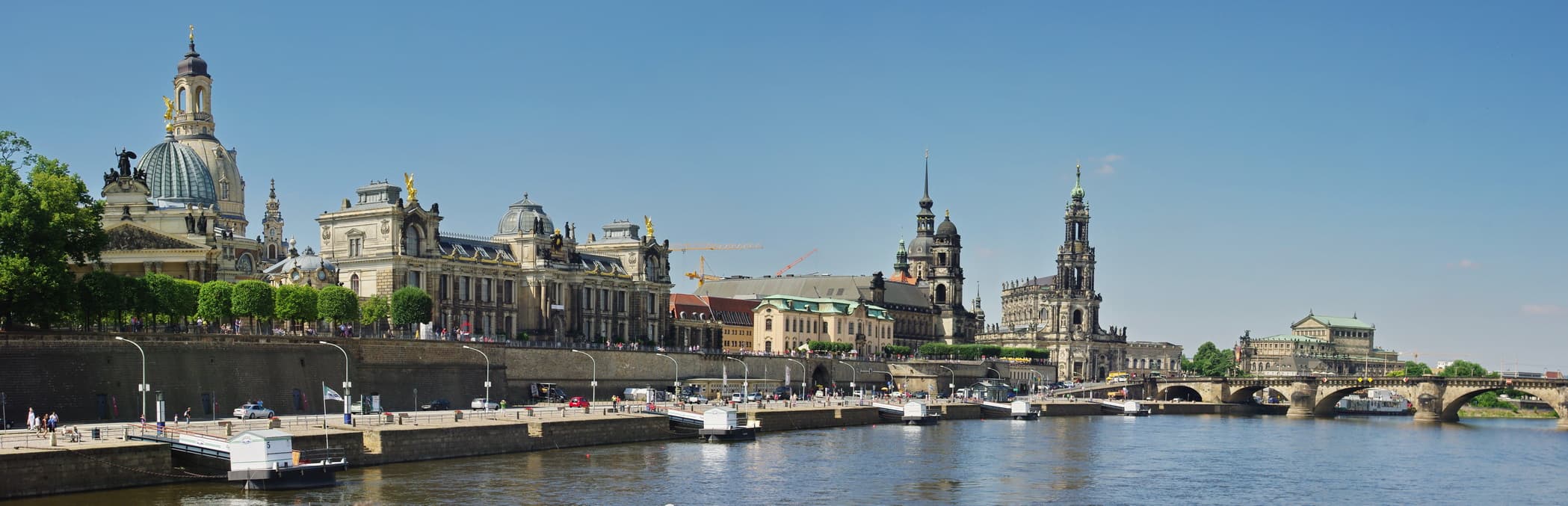
1 Frauenkirche, An der Frauenkirche, ☏ +49 351 65606100. The original Church of Our Lady was completely destroyed during World War II; however, it has been reconstructed. The City of Coventry, which was raided by the Luftwaffe in WWII, donated the golden cross for the dome of the church. Check out some ruins in the basement. For €12 (concessions €7; families €24) you can walk up to the viewing platform on the dome and enjoy a great view of the city. You must have good walking shoes, otherwise you might not be admitted. As well as being a working church (with services once a month in English), there are also regular concerts. Tickets tend to be expensive but sell out quickly, so try to book ahead of time. The seating can be a little hard. Free. (updated Jun 2026)
2 Zwinger Palace, Theaterplatz 1 ( 4 8 and 9 Theaterplatz and 11 am Zwingerteich), ☏ +49 351 49122000, besucherservice@skd.museum. 06:00-21:00. The baroque palace features a nympheum, many sculptures of Permoser, a bell pavilion and famous art collections. Do not miss the "Alte Meister" - you'll find Rafael's famous Sistine Madonna with its well-known angels there. Three separate exhibitions are housed in the Zwinger. (See below.) The Zwinger is part of the Dresden State Art Collections (SKD). Entry is free to the palace, but to see exhibitions you need a ticket. Combined ticket for all three exhibitions: adults pre-booking €18, reduced €13.5, under 7 free. (updated Jun 2026)
3 Gemäldegalerie Alte Meister (Old Masters Picture Gallery). Tue-Sun 10:00-17:00, Mon closed. A highly regarded collection featuring around 700 European works from the 15th to the 18th century. It is particularly known for its focus on Italian Renaissance and Baroque art, including Raphael's Sistine Madonna, as well as a significant selection of Dutch and Flemish masters and works by Lucas Cranach the Elder. Entrance only with the combined ticket. (updated Jun 2026)
Do
Culture
Semperoper. Go to a performance or take a tour. Be sure to book in advance. Details are in the listing in the See section.
1 Sächsische Staatskapelle Dresden. Referred to colloquially as the Staatskapelle Dresden, it is one of the oldest orchestras in the world, founded in 1548. Its home venue is the Semperoper. The principal conductor is Daniele Gatti. (updated Apr 2018)
2 Dresden Philharmonic (Dresdner Philharmonie). Orchestra founded in 1870. Their main venue is in the Kulturpalast, the principal conductor is Donald Runnicles. (updated Apr 2018)
3 Hochschule für Musik Carl Maria von Weber Dresden (Wettiner Platz 13), ☏ +49 351 4923696. The music conservatoire hosts regular concerts and events at various venues. (updated Apr 2018)
KlangNetz-Dresden, ☏ +49 351 4923613. A network of orchestras, musicians and ensembles organizing concerts with a focus on new music. (updated Apr 2018)
4 Theaterruine St. Pauli, Königsbrücker Platz ( S1 7 Dresden Bischofsplatz), ☏ +49 351 2721 444, kontakt@pauliruine.de. This ruin of a former Lutheran church that was bombed out in World War II is used as a theatre and concert venue nowadays and represents the cultural centre of the Hechtviertel district.
Sport
5 Roller Blade Night (Dresdner Nachtskaten), Lingnerallee (start opposite townhall at the big halfpipe). Fri 21:00-23:00. Various Roller Blade routes through the city on selected Fridays from April to September, roughly 20 km. Great fun and participation is free - you can rent rollerblades for €5. Free.
Eat
Dresden is particularly famous for its Stollen (a Christmas cake made from yeast dough with raisins, butter and almonds) Locals perennially discuss which bakery bakes the best Stollen. Another speciality is Dresdner Eierschecke, a cake with three layers: a thin base of yeast dough, a layer of quark pudding in the middle, and a broad layer of egg yolk cream on top.
Dresdner Wiegebraten is a mixture of minced pork, beef, white bread, eggs and spices. It is usually served with boiled or fried potatoes and sauce, often with vegetables. You can try it at the zum Wiegebraten restaurant.
The most typical fast (and inexpensive) food in Germany those days is doner kebab (Döner Kebap), typically served as a kind of sandwich in pita (flat bread) with salad and sauce. A typical kebab including a large drink should be around €5-6. The next step above doner kebab is Italian food. There are a certain number of ethnic restaurants scattered through the city, and if you go out to the eastern part of town, you will find lots of charming cafés and Volkshäuser that serve good food. As Dresden has a lower number of recent immigrants in general and people of Turkish descent in particular, the ethnic food is more of the Vietnamese or "Asian" variety, as those are the main immigrant groups in Dresden.
Within the historic centre (Altstadt) and especially around the Frauenkirche are a number of restaurants, serving many different tastes. Be aware that, as this is a tourist hotspot, there are many tourist traps here which you may find overpriced and of low quality.
Drink
Altstadt
The area around the Frauenkirche and Dresden Castle is very popular with tourists. Some fine restaurants are located there. The Weiße Gasse is just around the corner of the Altmarkt near the shopping centre and the historical town. A good alternative if you do not want to go to the Neustadt.
Bar Peanuts, Brühlsche Terrasse, ☏ +49 351 8642838. Small, cozy bar is located at the corner of the Hilton overlooking the Elbe. Peanut shells are scattered on the floor and as the name suggests, peanuts are the central theme. Cocktails and beer are the main draws here, along with the spectacular view.
1 Bärenzwinger, Brühlscher Garten 1, ☏ +49 351-495-1409. This popular student club is a good choice for its full schedule of nightly activities, including readings, live music, and discussions.
2 Gisela Club, Löbtauer Straße 80 (Tram 7, Wernerstraße), ☏ +49 351 8020066, office@gisela.club. 22:00. Homely club in the Löbtau district with a living-room-atmosphere, three floors and an outdoor area. Various events from indie to house music.
3 Kraftwerk Mitte, Wettiner Platz 7 (S-Bahn S1,S2, Tram 1,2,6,7,8,10,11,12, Bus 94: "Dresden Bahnhof Mitte"), ☏ +49 351 41884699, info@kraftwerk-club.de. 23:00. One of Dresden's largest nightclubs, hosting parties, raves, concerts and festivals in a former coal-fired power plant.
4 Paulaner's, Am Taschenberg 3, ☏ +49 351 4960174, info@paulaners-dresden.de. Popular beer hall selling a selection of well-brewed local and regional favorites. A full menu is offered, and outside seating is available.
5 Riesa efau, Adlergasse 14, ☏ +49 351-866-0222, fax: +49 351-866-0211. The pub is managed by a local events group and features a wide selection of drinks along with a regular slate of activities and entertainment. Good menu of regional beers and mixed drinks, as well as non-alcoholic drinks and coffees. Live music is frequently featured.
Get around
On foot
In the centre, especially in the historic part of the Old Town (Altstadt), everything is easily accessible on foot. (The city centre is not the geographical midpoint of the city). If you want to go to the outer districts (unlikely for most travelers) you will probably have to take a bike or public transport (most tram lines go well into the suburbs).
By public transport
Dresden has an extensive reliable and high quality (even by German standards) public transport system consisting of regional railways (called S-Bahn, historically Schnellbahn), trams (called Straßenbahn) and buses. Three ferries cross the Elbe and two cable car systems go up Loschwitz hill. The Straßenbahn and S-Bahn are two entirely separate networks, although there are tram stops at many S-Bahn stations. The system works very well and connects all points of interest, but can be a little busy at peak times. A common fare system is operated by Dresdner Verkehrsbetriebe (DVB), which is part of the larger Oberelbe Transport Network (VVO). (VVO covers 27 municipalities in central Saxony.) VVO tickets are valid on all buses, trams, regional trains and some ferries within a particular zone in the VVO network area. The Sachsen ticket is now valid on buses and trams in Dresden as well so all information to the contrary is outdated.
Stay safe
Dresden is a safe place to be, just like the rest of Germany. Avoid visiting the Alaunpark in the night. Be careful in the Neustadt after midnight; don't use small dark streets.
Media reports will point out that extreme right parties are relatively popular; however, these are very small groups (a few hundred people) who have little to no effect on everyday life for most people. Although it is difficult to pinpoint the exact places where the right-wing extremists of Dresden live the relatively poor high-rise ("Plattenbau") neighborhoods of Gorbitz and Prohlis have a reputation of being inhabited by more Nazis than other parts of town. Regardless of how small or large the far right actually is, expect to see some amount of right-wing graffiti.
Soccer matches of the local club Dynamo Dresden take place about every second weekend, but not during summer holidays. Supporters of Dynamo Dresden soccer club have a particularly bad reputation, but clashes with the police or other rival supporters are mainly a thing of the past. 99% of the fans are peaceful, sports-loving people. However don't be surprised to see large police forces in anti-riot equipment (think robocop) around the main station and the stadium during so called "Risiko-Spiele" (roughly: high risk games). The (all standing) "K-Block" of Dynamo's stadium has a reputation for having the most hard-core fans and unfortunately racial slurs and homophobic utterances are heard here from time to time, even though most Dynamo fans don't subscribe to either xenophobia or homophobia. If you are (visibly) part of an ethnic or sexual minority and especially if you don't wear Dynamo fan-gear try going to another block rather than this one.
Practical facts for Germany
Taken from open data. Rules and numbers change, so check locally before you rely on them.
- Currency
- Euro (EUR)
- Language
- German
- Plugs and power
- Types C and F, 230 V at 50 Hz
- Traffic drives
- On the right
- Country calling code
- +49
- Time zones
- Europe/Berlin and Europe/Busingen
Official travel advice
Quoted from each government as published, with the date they last changed it. We do not add a verdict of our own.
UK Foreign, Commonwealth & Development Office
- No areas listed that it advises against travelling to
US Department of State
Level 2 of 4: Exercise increased caution
Read the full adviceExercise increased caution in Germany due to terrorism.
Terrorist groups and lone actors remain a constant threat in Germany and Europe, attacking people in public locations with knives, small arms, rudimentary explosive devices, and vehicles. Such attacks may occur with little or no warning and target:
• Tourist locations
• Transportation centers (airports, train, or bus stations)
Entry and visas
Entry rules depend on your passport and change without notice. Check the official pages before you book.
Sources