
United States
A plan for Dallas
Not a list of things to see in Dallas — a day-by-day plan somebody could actually follow, built from places we can point to a source for. Make your own in about a minute.
- 2 nights
- Couple
- Balanced pace
- Mid-range budget
Every place here was checked on 2026-10-27 or later, and each one says where it came from.
The plan, day by day
Day 1
09:30
You arrive
13:00
Hunky's
Suggested because you chose food
- 1h
- Meal
14:30
Sixth Floor Museum at Dealey Plaza
Picked because you chose culture & museums + balanced energy
- 2h 30m
- Culture & museums
2h open
Nothing planned here. That was on purpose.
19:00
Nick & Sam’s
Suggested because you chose food
- 1h 30m
- Meal
20:30
Dee and Charles Wyly Theatre
Picked because you chose culture & museums + balanced energy
- 2h 30m
- Culture & museums
Day 2
08:00
Cafe Brazil
Suggested because you chose food
- 45m
- Meal
45m open
Nothing planned here. That was on purpose.
09:30
Dallas Museum of Art
Picked because you chose culture & museums + balanced energy
- 2h 30m
- Culture & museums
1h open
Nothing planned here. That was on purpose.
13:00
La Calle Doce
Suggested because you chose food
- 1h
- Meal
14:30
Nasher Sculpture Center
Picked because you chose culture & museums + balanced energy
- 2h 30m
- Culture & museums
2h open
Nothing planned here. That was on purpose.
19:00
Hunky's Old Fashioned Hamburgers
Suggested because you chose food
- 1h 30m
- Meal
20:30
Granada Theater
Picked because you chose culture & museums + balanced energy
- 2h 30m
- Culture & museums
Day 3
08:00
Veracruz Cafe
Suggested because you chose food
- 45m
- Meal
45m open
Nothing planned here. That was on purpose.
09:30
The Samurai Collection
Picked because you chose culture & museums + balanced energy
- 2h 30m
- Culture & museums
1h open
Nothing planned here. That was on purpose.
13:00
RJ Mexican Cuisine
Suggested because you chose food
- 1h
- Meal
14:30
You leave
Weather through the year
Monthly averages from NASA's 25-year climate record, day and night together.
Best months: April, May, September, and October
| January | Cold: 6°C, 58 mm |
|---|---|
| February | Cold: 9°C, 67 mm |
| March | Mild, some rain: 14°C, 88 mm |
| April | Mild, some rain: 18°C, 83 mm |
| May | Rainy: 23°C, 116 mm |
| June | Mild, some rain: 28°C, 96 mm |
| July | Hot: 30°C, 56 mm |
| August | Hot: 30°C, 62 mm |
| September | Mild, some rain: 26°C, 77 mm |
| October | Rainy: 19°C, 102 mm |
| November | Mild, some rain: 13°C, 57 mm |
| December | Cold: 8°C, 61 mm |
From the Wikivoyage guide
Quoted from the travel guide anyone can edit, as it read on the day we took it.
Understand
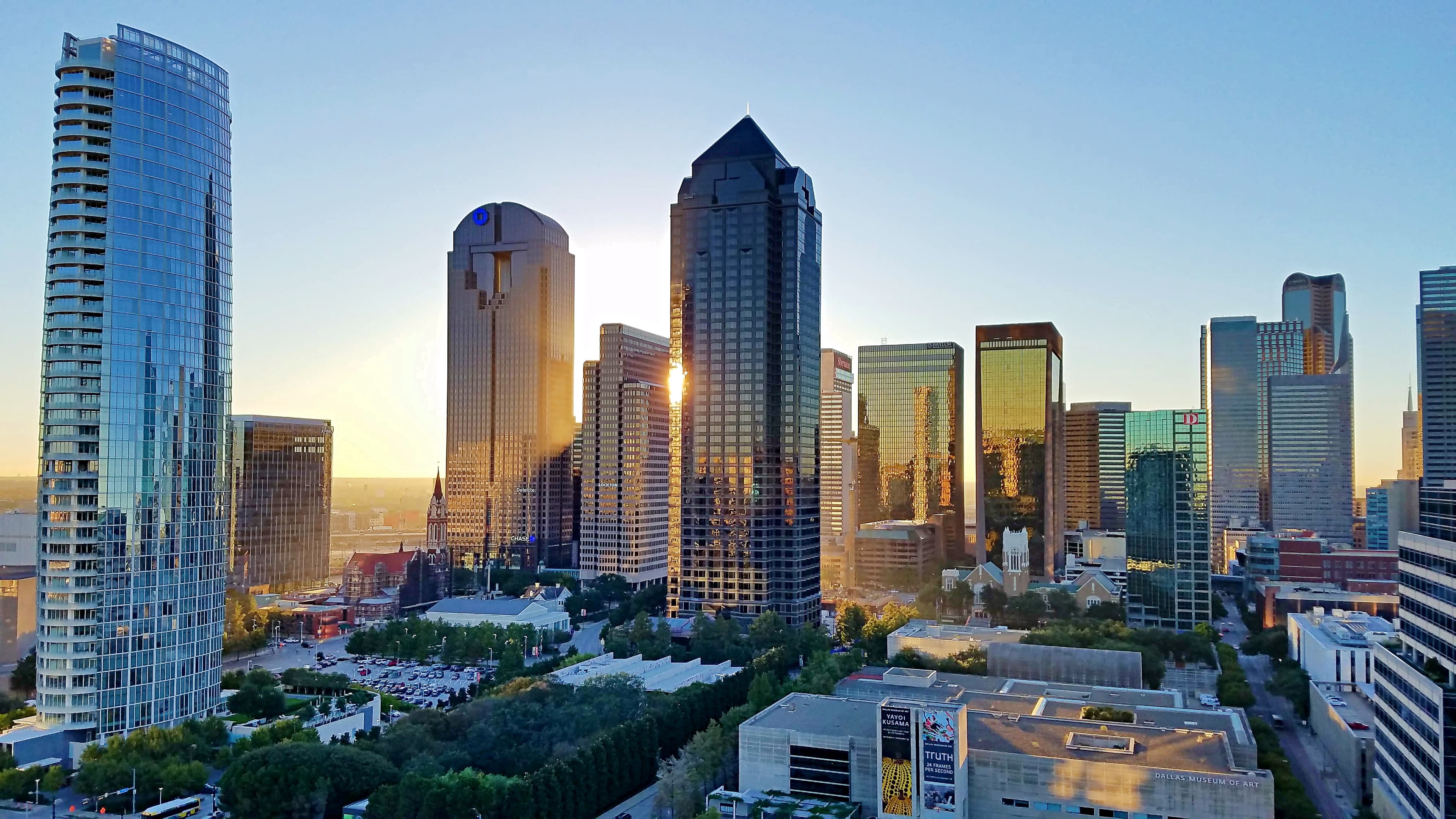
It is virtually impossible to neatly categorize Dallas. It is a wonderful place with an immense and diverse set of attractions, food and people. From the posh, ultra-modern Uptown and Victory developments, to the old-world elegance and upper-crust attitude of Turtle Creek, to the "real life" feel of largely-suburban North Dallas.
The home of Erykah Badu, Stevie Ray Vaughan, The Chicks, Norah Jones, and St. Vincent, Dallas is an eclectic place with cultural influences from all over the South and West.
Tourism information
VisitDallas (Dallas Convention and Tourist Bureau), 325 North St. Paul Street, Suite 700, ☏ +1 214-571-1000. There is much information on their site, and you can also contact them individually or via an email form on this page. (updated Aug 2021)
Climate
Being in the American South, Dallas has a subtropical climate with mild winters, hot summers, and a very wet spring and fall in between. In winter and summer it can also be a very dry place, as it receives warmer, drier weather from the Mojave Desert in the west and the Great Plains in the north.
Winters are generally mild, with average highs in the 50s and 60s F (10-20 °C) and average lows around the freezing mark. It often snows in Dallas a couple of times a year, and there is the rare day when temperatures will not get out of the 30s F (0-5 °C), but for the most part winter is just drier and cooler. There is, however, the danger of freezing rain and ice storms.
Spring and fall bring very pleasant temperatures, but spring is also known for its storms. Because Dallas lies within Tornado Alley, springtime weather can be quite volatile and severe storms often occur. Summers are hot with mostly low humidity, with temperatures often surpassing 100 °F (38 °C). Heat indices typically average around 100 °F (38 °C) during the day and 79 °F (26 °C) at night; but heat indices can climb up to 110 °F (43 °C) during the day and remain above 85 °F (29 °C) at night on some particularly hot and sweltering days.
Average rainfall in Dallas is 37.1 inches (942.3 mm) per year, and average snowfall is about 2.5 inches (63.5 mm) per year.
See
Dealey Plaza in Downtown Dallas was the site of the assassination of President John F. Kennedy. The Sixth-Floor Museum maintains a collection of artifacts related to JFK and his assassination. The JFK Memorial Plaza is a stark but elegant space for quiet reflection on the President's life.
Dallas City Hall in Downtown Dallas is an imposing Brutalist edifice by famous architect I.M. Pei. Recognizable to film buffs as OCP headquarters from the movie Robocop, which was mostly filmed in Dallas.
Klyde Warren Park is a trendy park Downtown Dallas decking Woodall Rogers Freeway for three blocks in the Arts District, and has food trucks, a high-end café, and occasional outdoor performances and readings.
Museums
Most of Dallas's museums are found Downtown. Clustered together are the Dallas Museum of Art, which has exhibits from all
historical periods from antiquity to the present day, the Nasher Sculpture Garden, and the Trammell Crow Collection of Asian Art. The Perot Museum of Nature and Science is a large science museum featuring permanent educational exhibits that are mainly geared toward kids.
At the airport is the Frontiers of Flight Museum, which has dozens of aircraft and hundreds of artifacts from many time periods on display.
Outside of Dallas
Most of Dallas's professional sports teams play in Arlington, just to the west of Dallas, including the Dallas Cowboys (the famous NFL football team), the Texas Rangers professional baseball team, the Dallas Wings WNBA (women's basketball) team, and the Arlington Renegades who play during the spring in the second-level United Football League.
FC Dallas Major League Soccer team plays in the northern suburb of Frisco.
Do
State Fair of Texas - A large part of Dallas' culture and probably its biggest attraction, the State Fair is hosted annually for three weeks around September and October.
More than anything, the Fair is known for its fair food, most of it deep-fried. Heated competitions held for the best-tasting and most creative of these have seen deep-fried incarnations of practically every food (and drink) imaginable. Concoctions can range from delectable (Fried Peaches and Cream and Fried Jerk Chicken) to bizarre (Fried Jello, Fried Dr. Pepper) to downright disgusting (Fried Butter).
The Fair's iconic mascot, Big Tex, is a 55-foot-tall (17-meter-tall) cowboy who smiles, talks, and waves at fair-goers, and the Texas Star Ferris Wheel, the tallest in North America until 1985, is a fairground institution.
There is also a huge array of commercial shows and marketplaces, including a large car show.
More traditional attractions include a wide assortment of carnival games and rides, rodeos, pig racing (yes, pig racing), and livestock shows.
Fair Park itself is the architectural jewel of the city - its Depression-era buildings were constructed in a stately Texan spin on Art Deco not found anywhere else in the world.
Try to avoid the second weekend, when UT and OU play their annual football game. Students from both colleges flood the Fair that weekend and lines and parking are horrible.
Speaking of parking, it's best to park for free at a DART station and ride the train to Fair Park Station to avoid the hassle and expense of on-site parking.
White Rock Lake. Escape the city bustle for a stroll at this large park in East Dallas. This is really a beautiful getaway, but locals would tell you to avoid driving around here at night — ghosts haunt the waters.
Golf - There are a lot of wonderful courses in the Dallas area. The city boasts five municipal courses with reasonable greens fees. Of these, Tenison Highlands in East Dallas and Cedar Crest in South Dallas offer the best test of golf, and can be the most crowded, especially on weekends. There are any number of terrific daily-fee public courses in the D/FW area as well.
Eat
Areas with high concentrations of restaurants include the following:
Beltline Road through Addison and North Dallas, just north of I-635, has perhaps the most restaurants per-capita in the U.S. If there is a type of food you like then you can probably find it there.
Greenville Avenue running north to south in East Dallas, has many restaurants along its length, particularly in Lower Greenville.
Knox and Henderson streets (the "Knox/Henderson" neighborhood), off US-75 Uptown have many laid-back, stylish restaurants.
McKinney Avenue is the heart of Uptown, with a wide variety of quality establishments.
The West End in the northwest part of Downtown has a good mix of original local restaurants and successful chain establishments.
The Bishop Arts District of South Dallas, one of the city's more bohemian spots, is full of unusual and innovative restaurants.
Dallas has a good number of its own chain restaurants which have become quite successful in the area, offering unique local flavors.
Spring Creek Barbeque. Spring Creek Barbeque has 15 Texas style restaurants across the North Texas area. The menu is very simple. Beef, ham sausage, turkey, chicken, and ribs are available for entrees (you can have combinations also). Side items available are corn, beans, potato salad, cole slaw, and baked potatoes. In addition, fresh homemade bread rolls are served with each dish and more are delivered to your table during each meal.
Cristina's. Several DFW locations. Lunch specials are very reasonably priced. Service across all of the family owned and operated locations is blindingly fast no matter the location. The chips and salsa are arguably some of the freshest and best in the Metroplex. A unique signature menu item is the "Queso Flameado" where the server melts cheese by fire tableside and then wraps the gooey cheesey goodness in several freshly made tortillas.
Main Street in Downtown has seen major improvements over the last few months, with plenty of places to eat and to play. Highly Recommended. Don't forget to stop by the City Tavern for a longneck or two.
Drink
Uptown, the area bound by Haskell on the north, Woodall Rogers Freeway on the south, Turtle Creek on the west and Central Expressway on the east, is where Dallas' beautiful people go to see and be seen. Trendy to the nth degree, this neighborhood contains very upscale fashionable clubs. Some of the hottest clubs, such as Candleroom, are private. If you want to check out one of these places be sure to go with someone that is a member or have a concierge call ahead for you. Republic is also cool nightspots, with no membership required. No shorts, jeans, team jerseys, tennis shoes, or flip-flops.
Beer, wine and liquor stores
If you're looking to fill a mini-fridge or cooler with your own beverages a bit of planning might be required. Alcohol is only sold in certain parts of the city and in certain suburbs so getting to a liquor store can involve some travel. Also, Texas' liquor laws specify that any store that sells liquor cannot open on Sunday nor stay open after 9PM any other day. Stores that sell beer and wine cannot sell either from midnight to noon on Sunday. A smartphone app that locates liquor stores (and shows their hours) is very useful as many of those stores in the Dallas area tend to be well inside neighborhoods as opposed to along highways, and hotel desk staff can tell you if you're in a 'wet' or 'dry' area of Dallas. Liquor stores can become quite crowded after 8PM (especially on Saturday) and remember to be extra-alert after dark. In 'wet' areas beer and wine is easily and safely available at grocery stores.
Get around
By car
The car is by far the simplest and most reliable way to get around Dallas. Local rental companies offer better prices, but national chains offer more convenient locations and return policies. As in most cities, the worst traffic is in the direction of the city center during the morning and away from it in the afternoon. The roads where rush hour is the worst, especially in the mornings, are I-35, US-75 (where what would be a 20-minute trip without traffic can become a 1-2-hour trip with traffic), and the stretch of I-635 between them.
The grid
Dallas' street system is built on three nested grids. The smallest grid, running west-by-southwest to east-by-northeast, covers only the central business district and neighborhood of Deep Ellum in downtown. The next-largest grid runs southeast from Love Field through downtown and South Dallas to end at the 7,000-acre (30-km2) Great Trinity River Forest, the largest urban hardwood forest in the nation. The rest of the city and most of the suburbs roughly adhere to a simple north/south by east/west grid of one-mile (1.6-km) square blocks.
Highway nicknames
US-75 is also called or "Central Expressway," or "Central," and changes into I-45 south of Downtown.
The road east of downtown that connects US-75 and I-45 is officially called I-345, though it is usually simply referred to by one of those names.
The Mixmaster is a hectic and confusing 5-mile (8-km) stretch southwest of Downtown where I-35E and I-30 briefly merge into a single highway.
Woodall Rogers Freeway (TX-366) is the 2.6-mile (4.2-km) highway that forms the traditional northern boundary of downtown, connecting I-35E in the west to U.S. 75 in the east.
I-635, the highway that runs the north and east perimeter of the city, is also called LBJ, or Lyndon B. Johnson Freeway.
There are two branches of I-35: I-35E, which runs north-south through Dallas; and I-35W, which runs north-south through Fort Worth. They merge at Denton in the north and Hillsboro in the south.
I-35E is called I-35, Stemmons Freeway, and just "Stemmons," but rarely by its official name.
TX-114, the highway that runs from I-35E to DFW Airport, is also called John W. Carpenter Freeway, or Airport Freeway.
Stay safe
Tourists should avoid anywhere south of the Trinity River at night (and maybe even during the daytime), with the exceptions of North Oak Cliff, the Bishop Arts District, and Fair Park. There is little to see outside those areas anyway. South and West Dallas are mostly low-income, high-crime residential and industrial areas: as in any such area, know where you are going, stay there, and don't dawdle or wander, especially at night. Avoid Downtown's Government District at night (the few blocks around City Hall). It's not inherently dangerous, but it has a lot of homeless people running about. Stick to West End and the Arts District. Uptown and North Dallas are generally safe after dark.
Police officers in Texas are kind and helpful for the most part, and they will generally find ways to make you feel safe. Sadly, this does not (always) apply to police officers in Dallas. Texas law can be strict, but the Dallas Police Department is notorious for its ferocious zero-tolerance attitude to even the slightest of misdemeanors. When approached by a local police officer, listen, cooperate, and speak carefully at all times.
Also, avoid driving on the highways after 2AM on weekends, when all the bars have just closed and many tipsy drivers are in a hurry to get home.
In the event that you fall victim to identity theft while visiting Dallas, the Federal Bureau of Investigation (FBI) operates a major field office in Dallas.
Practical facts for United States
Taken from open data. Rules and numbers change, so check locally before you rely on them.
- Currency
- US Dollar (USD)
- Languages
- American English, Spanish (United States), Hawaiian, and French
- Plugs and power
- Types A and B, 120 V at 60 Hz
- Traffic drives
- On the right
- Emergency numbers
- Any emergency911
- Country calling code
- +1
- Time zones
- America/Adak, America/Anchorage, America/Boise, America/Chicago, and 25 more
Official travel advice
Quoted from each government as published, with the date they last changed it. We do not add a verdict of our own.
UK Foreign, Commonwealth & Development Office
- No areas listed that it advises against travelling to
Read the full adviceThis travel advice also covers American Samoa, Guam, Northern Mariana Islands, Puerto Rico, and United States Virgin Islands.
Entry and visas
Entry rules depend on your passport and change without notice. Check the official pages before you book.
Sources