
Australia
A plan for Canberra
Not a list of things to see in Canberra — a day-by-day plan somebody could actually follow, built from places we can point to a source for. Make your own in about a minute.
- 2 nights
- Couple
- Balanced pace
- Mid-range budget
Every place here was checked on 2026-10-27 or later, and each one says where it came from.
The plan, day by day
Day 1
09:30
You arrive
13:00
The Alby
Suggested because you chose food
- 1h
- Meal
14:30
National Portrait Gallery
Picked because you chose culture & museums and local experiences + balanced energy
- 2h 30m
- Culture & museums
2h open
Nothing planned here. That was on purpose.
19:00
Assembly
Suggested because you chose food
- 1h 30m
- Meal
20:30
Casey Jones
Picked because you chose food and local experiences + balanced energy
- 1h 30m
- Food
Day 2
08:00
Tilley Devine's Cafe
Suggested because it fits a mid-range budget
- 45m
- Meal
45m open
Nothing planned here. That was on purpose.
09:30
Australian War Memorial
Picked because you chose culture & museums and local experiences + balanced energy
- 2h 30m
- Culture & museums
1h open
Nothing planned here. That was on purpose.
13:00
The Dock
Suggested because you chose food
- 1h
- Meal
14:30
Canberra Glassworks
Picked because you chose culture & museums and local experiences + balanced energy
- 2h 30m
- Culture & museums
2h open
Nothing planned here. That was on purpose.
19:00
Street of Asia
Suggested because you chose food
- 1h 30m
- Meal
20:30
Canberra Theatre
Picked because you chose culture & museums + balanced energy
- 2h 30m
- Culture & museums
Day 3
08:00
Space Kitchen
Suggested because you chose food
- 45m
- Meal
45m open
Nothing planned here. That was on purpose.
09:30
Lanyon Homestead
Picked because you chose culture & museums and local experiences + balanced energy
- 2h 30m
- Culture & museums
1h open
Nothing planned here. That was on purpose.
13:00
OTIS Dining Hall
Suggested because you chose food
- 1h
- Meal
14:30
You leave
Weather through the year
Monthly averages from NASA's 25-year climate record, day and night together.
Best months: January, March, November, and December
| January | Mild, some rain: 21°C, 58 mm |
|---|---|
| February | Mild, some rain: 19°C, 92 mm |
| March | Mild, some rain: 17°C, 68 mm |
| April | Mild, some rain: 13°C, 41 mm |
| May | Cold: 9°C, 31 mm |
| June | Cold: 6°C, 65 mm |
| July | Cold: 5°C, 46 mm |
| August | Cold: 6°C, 53 mm |
| September | Cold: 9°C, 47 mm |
| October | Mild, some rain: 13°C, 59 mm |
| November | Mild, some rain: 16°C, 75 mm |
| December | Mild, some rain: 18°C, 71 mm |
From the Wikivoyage guide
Quoted from the travel guide anyone can edit, as it read on the day we took it.
Understand
History
After a long tussle for supremacy between Melbourne and Sydney, the Australian constitution at federation in 1901 specified that a new Australian capital city would be built between the two, and seven years later the site for what would become Canberra was established. A design competition was held for the city in 1911 which was won by Chicago-based architect Walter Burley Griffin in 1912. The name "Canberra" was made official in 1913, beating out some endearingly wacky contenders including "Sydmelperadbrisho", "Wheatwoolgold" and "Kangaremu". However, much of Griffin's plan was not implemented during his lifetime in part due to the Great War, the Great Depression and conflict between Griffin and the commission tasked with implementing his ideas. To give just two examples, Lake Burley Griffin was part of his original design but only implemented in the 1960s, almost three decades after his death and the light rail system Griffin originally envisioned took over a century to see even the first line enter service.
The Australian Capital Territory was created from land inside New South Wales, and originally governed directly by the federal government. In 1988 the federal government granted the area "responsible government" (aka "home rule") and the first local elections were held in 1989 with parties opposed to the very idea of a local government for the Capital Territory garnering significant support. Politically the local Legislative Assembly has often been a "hung parliament" with neither right wing Liberals nor left wing Labor able to govern on their own, but the office of Chief Minister has mostly been held by the Labor Party.
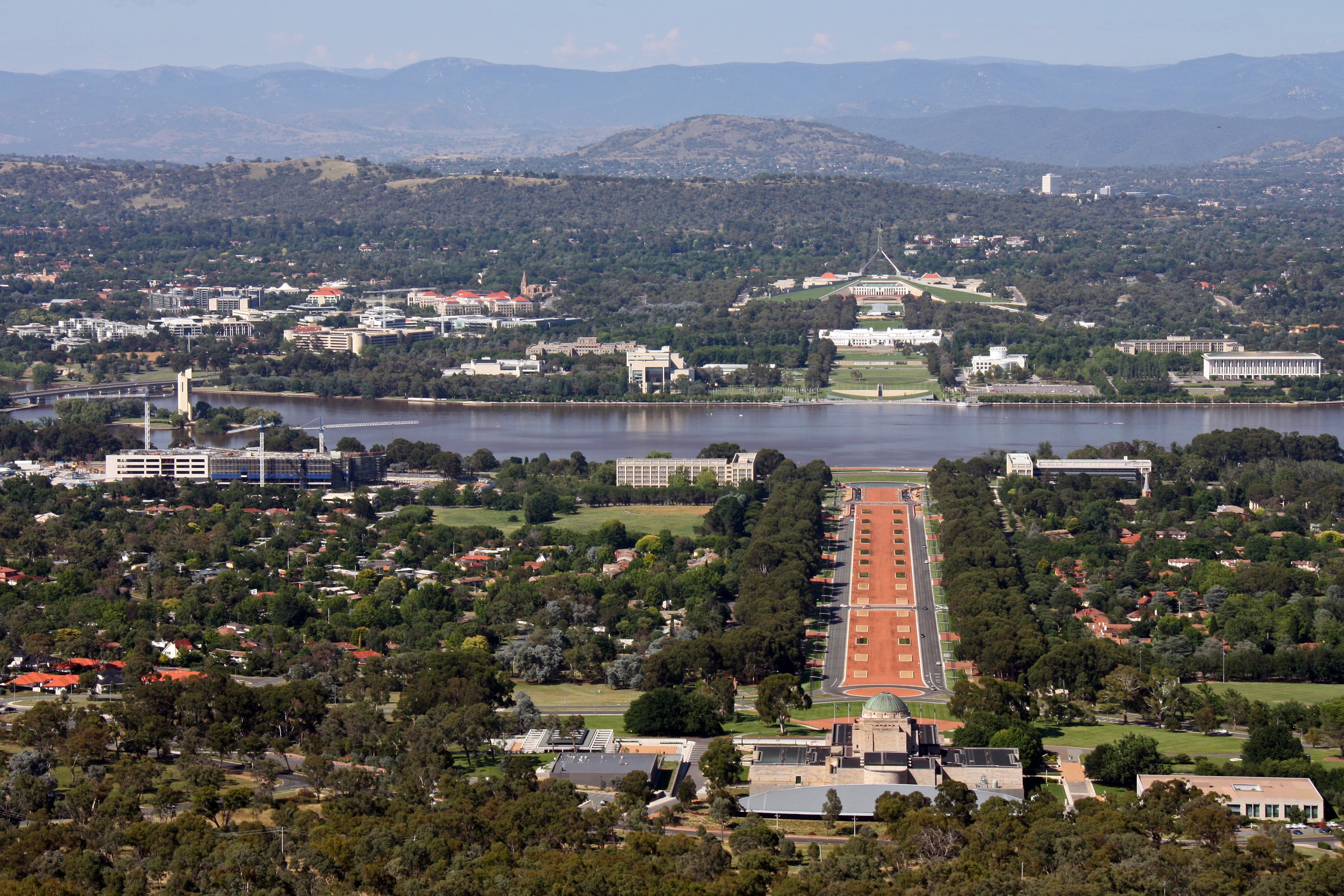
Canberra is a highly planned city, its primary design conceived by the American architect Walter Burley Griffin, built on the shores of a man-made lake (Lake Burley Griffin). Populated at first largely by politicians and public servants, it has taken time to develop its own identity and culture. Extensive building of national facilities and museums has made it a unique destination.
See
Individual listings can be found in Canberra's district articles
Canberra, as the national capital of Australia, contains a lot of government buildings, and many of them are often open for tours. By far the most significant one is Parliament House in Capital Hill, but other important buildings include the High Court of Australia, Old Parliament House, the Government House, the Royal Australian Mint and The Lodge, though not all of them are always open to the public. There are other buildings that are of national importance too, such as the National Library of Australia and the Australian War Memorial.
Most of the time, much of what to see in Canberra is located in South Canberra, or to be more specific, particularly more centred within Parliamentary Triangle which contains the High Court, National Archives, National Gallery, National Library, National Portrait Gallery, both the current Parliament House and the Old Parliament House and the science museum of Questacon.
The other parts of South Canberra don't have as many points of interest, but they are nevertheless still great sights worth visiting. The most notable sight in South Canberra outside Parliamentary Triangle is the Royal Australian Mint.
North Canberra too has several important sights, the most important of them all being the Australian War Memorial though there are many military sites in the east of North Canberra, particularly on Anzac Avenue.
Museums
Being the capital of Australia, the city has no shortage of museums for a city of its size. Many of its museums are in two particular districts, South Canberra, and Acton. Many of South Canberra's museums are mostly spread out evenly, while most of Acton's museums are part of the Australian National University campus, and as such, many relate to educational content that's found at unis.
Not withstanding, there are plenty of museums in other districts too, just not as many – such as the National Dinosaur Museum in Gungahlin, which showcases a good range of dinosaur exhibitions in Australia, or the Canberra Space Centre, which is one of the premiere astrotourism sites in Australia.
Do
See the districts articles for more listings.
Ride Canberra's Mountain Bike Trails: There are several locations around Canberra to ride mountain bicycles, many of which are considered some of the best in Australia. See Canberra Off Road Cyclists (CORC) for locations. Canberra is also home to the largest 24-hour Mountain Bike Race in the world, held in early October each year.
Helpfully between Civic and the War Memorial, walk through the Heritage-listed suburb of Reid. Observe the houses with leafy surrounds, the wide roads, little walking paths and recreation areas, in one of the oldest untouched Canberran suburbs. As (some) locals would say: “as Burley Griffin intended”.
Geocaching. Canberra has an incredibly active Geocaching community.
Explore Tidbinbilla Nature Reserve, which is about a 40-minute drive south of Canberra via Tuggeranong Parkway and Tharwa Drive. There are a large number of walks which offer stunning views of the Brindabella Mountains. You can also take Ranger-guided walks or have fun with the hands on displays such as the interactive computer program on Tidbinbilla's bird species and look at the live animal displays. The gift shop sells an interesting range of clothes, toys, books, cards and souvenirs. Coffee and light refreshments are also available.
Go tobogganing in Corin Forest, Tourist Drive 5, ☏ +61 2 6235-7333. Weekends, ACT school & public holidays, 10AM-4PM. This alpine recreation facility features a bobsled ride in summer, and snowplay and tobogganing in winter. It is high enough to receive natural snowfalls. Check the website or call before heading up that the road is open, and that there is snow. Free entry, rides from $7, all day pass $35.
Eat
Individual listings can be found in Canberra's district articles
Canberra has many fine eateries, but beware – many will be closed on Sundays. There are large clusters of restaurants in Civic, Braddon, Dickson, Kingston and Manuka. An unusual feature of the Canberra dining scene is that some of the city's best restaurants are hidden away in small suburban shopping centres – locals often nominate these as their favourites.
All public buildings territory-wide are smoke-free.
Cafes
Just like the rest of Australia, coffee culture in Canberra is strong and Canberrans make good use of their cafes, and as such there are cafes nearly everywhere. In most cafes, all the important Australian coffees (such as espresso, flat white or a mocca) plus a couple of additions like hot chocolate are a standard in nearly all cafes. On top of that, many cafes will also typically have what you can expect to find at most bakeries, modified to suit a cafe. However, do be aware that most of what you get in cafes in Canberra can get very sweet.
Dress codes
Australians are generally casual and laid back though it's a bit more formal in Canberra, but still feel free to wear whatever you think suits well. Although most people make an effort to dress up for fancier restaurants, there is no requirement and both restaurants and diners alike are relaxed about dress standards, and so it is quite uncommon to see people wearing jeans at restaurants, especially among the younger generations.
Drink
Individual listings can be found in Canberra's district articles
Canberra's many bars and clubs will be closed on Sunday nights and early into the week. Civic can appear to be a ghost town but there are areas such as Bunda Street where you will always find some happening funky bars
Get around
Canberra is designed for cars and very spread out, so renting a car is the most practical option, particularly if you intend to venture beyond the city center. Public transport is usable but does not cover all points of interest, while renting a bicycle is a great alternative if the weather cooperates. Walking is not a practical option for most visitors.
By public transport
Public transport in Canberra is affordable and generally punctual, with most parts of the city accessible by tram or bus. Journey planning can be undertaken using the Transport Canberra website or MyWay+ app (which also conveniently tells you how many kilojoules you'll burn!). Google Maps or Apple Maps are also usable. Civic is the main hub for public transport. The other town centres have smaller bus interchanges.
Fares
The MyWay+ ticketing system covers all tram and bus services operated by Transport Canberra.
There are three ways to pay for your journey:
Credit or debit card. A MasterCard or Visa credit or debit card is accepted, including those in a digital wallet like Apple Pay or Google Pay. Your fare is deducted from your card as you touch on and touch off each mode of transport. Trams have validators to touch before you board and after you alight. Buses have validators to touch as you board and alight. A failure to touch off each mode of transport will result in a fixed fare of $1.88.
Travel card. A MyWay+ travel card can be purchased at select retail outlets or online. The card can be topped up at select retail outlets, ticket vending machines or online. The card costs $5 so visitors are usually better off just using a credit or debit card.
QR code. A MyWay+ QR code can be purchased at ticket vending machines or online.
Stay safe
Canberra is a very safe city and enjoys one of the lowest crime rates in Australia. Take the usual precautions against opportunistic crime, however. Valuables should not be left in sight within unattended cars, especially overnight.
Despite its apparent affluence, Canberra has people who live the rough life. Particularly around Civic, it is not unusual to be asked for money. If you simply say that you don't have any money, the beggar will usually move on.
Once you leave Civic, Canberra is fairly spread out. For much of the year, evenings can become cold and windy fairly quickly. Don’t count on adequate lighting even in otherwise popular or marked footways/cycleways. Similarly, when traveling on such routes in between city centres, or when in the bush, it is possible not to see anyone else for an entire journey. Have a map and appropriate clothing. On hot days, carry water. For bicycle riders, having the means to fix a puncture, and having proper lights is necessary in Canberra.
If you go bushwalking, don't count on mobile phone reception. This is especially the case for tracks in the parks located outside the Canberra urban area. If you're walking in those areas, carry an alternate form of communication such as a personal locator beacon in case you or a member of your party needs assistance.
Do not swim in the lakes (including Lake Burley Griffin) until you check online, as poor water quality can make doing so unsafe. Few Canberrans ever swim in the lakes due to algal blooms in summer, but water quality is now better than it used to be.
Death cap mushrooms (Amanita phalloides) are common in many Canberra suburbs, and ingestion of even one can cause death
Being the "bush capital", you might encounter wildlife, even in the city areas. An eastern grey kangaroo can grow over 2 metres tall, taller than a very tall man, and can seriously injure you. Do not get too close, especially to a mother with a joey, and appreciate them from a distance. Keep an eye out for kangaroos and other wildlife when driving, especially at night.
Practical facts for Australia
Taken from open data. Rules and numbers change, so check locally before you rely on them.
- Currency
- Australian Dollar (AUD)
- Language
- Australian English
- Plugs and power
- Type I, 230 V at 50 Hz
- Traffic drives
- On the left
- Emergency numbers
- Any emergency000
- Country calling code
- +61
- Time zones
- Antarctica/Macquarie, Australia/Adelaide, Australia/Brisbane, Australia/Broken Hill, and 8 more
Official travel advice
Quoted from each government as published, with the date they last changed it. We do not add a verdict of our own.
UK Foreign, Commonwealth & Development Office
- No areas listed that it advises against travelling to
Read the full adviceGlobal travel impacts due to escalation in the Middle East
Escalation in the Middle East has caused widespread travel disruption, including airspace closures, delayed and cancelled flights.
Your travel plans may be affected, even if your destination is not in the Middle East. Before you travel:
• check travel advice for any countries or territories you are transiting through
• check for the latest updates from your airline or tour operator
• review your travel insurance policy for coverage
• monitor local and international media for the latest information and sign up for travel advice email alerts
Bushfires in Australia
There is a higher risk of bushfires in Australia during the spring and summer seasons, from October to February. For advice, visit the bushfires section on the safety and security page.
US Department of State
Level 1 of 4: Exercise normal precautions
Read the full adviceExercise normal precaution in Australia.
Australia is generally a safe destination for travelers.
Review our Travel Guidance for Australia to learn how to prepare for a safe trip.
Entry and visas
Entry rules depend on your passport and change without notice. Check the official pages before you book.
Sources