
United States
A plan for Buffalo
Not a list of things to see in Buffalo — a day-by-day plan somebody could actually follow, built from places we can point to a source for. Make your own in about a minute.
- 2 nights
- Couple
- Balanced pace
- Mid-range budget
Every place here was checked on 2026-10-21 or later, and each one says where it came from.
The plan, day by day
Day 1
09:30
You arrive
13:00
Big Ditch Brewing Company
Suggested because you chose food
- 1h
- Meal
14:30
Theodore Roosevelt Inaugural National Historic Site
Picked because you chose culture & museums and local experiences + balanced energy
- 2h 30m
- Culture & museums
2h open
Nothing planned here. That was on purpose.
19:00
JJ's Casa-Di-Pizza
Suggested because you chose food
- 1h 30m
- Meal
20:30
Shea's 710 Theatre
Picked because you chose culture & museums + balanced energy
- 2h 30m
- Culture & museums
Day 2
08:00
ECafé
Suggested because it fits a mid-range budget
- 45m
- Meal
45m open
Nothing planned here. That was on purpose.
09:30
Explore & More Children's Museum
Picked because you chose culture & museums and local experiences + balanced energy
- 2h 30m
- Culture & museums
1h open
Nothing planned here. That was on purpose.
13:00
Shango New Orleans
Suggested because you chose food
- 1h
- Meal
14:30
USS Croaker
Picked because you chose culture & museums and local experiences + balanced energy
- 2h 30m
- Culture & museums
17:00
USS The Sullivans
Picked because you chose local experiences + balanced energy
- 2h 30m
- History
19:30
@ Eleven Wings & Cuisines
Suggested because you chose food
- 1h 30m
- Meal
21:00
Kleinhans Music Hall
Picked because you chose culture & museums and local experiences + balanced energy
- 2h 30m
- Culture & museums
Day 3
08:00
Overwinter Coffee
Suggested because you chose food
- 45m
- Meal
45m open
Nothing planned here. That was on purpose.
09:30
USS Little Rock
Picked because you chose culture & museums and local experiences + balanced energy
- 2h 30m
- Culture & museums
1h open
Nothing planned here. That was on purpose.
13:00
Ristorante Lombardo
Suggested because you chose food
- 1h
- Meal
14:30
You leave
Weather through the year
Monthly averages from NASA's 25-year climate record, day and night together.
Best months: June, July, August, and September
| January | Cold: -4°C, 64 mm |
|---|---|
| February | Cold: -4°C, 57 mm |
| March | Cold: 1°C, 63 mm |
| April | Cold: 7°C, 81 mm |
| May | Mild, some rain: 13°C, 85 mm |
| June | Mild, some rain: 19°C, 87 mm |
| July | Mild, some rain: 22°C, 91 mm |
| August | Mild, some rain: 22°C, 79 mm |
| September | Mild, some rain: 18°C, 87 mm |
| October | Mild, some rain: 11°C, 98 mm |
| November | Cold: 5°C, 75 mm |
| December | Cold: -1°C, 80 mm |
From the Wikivoyage guide
Quoted from the travel guide anyone can edit, as it read on the day we took it.
Understand
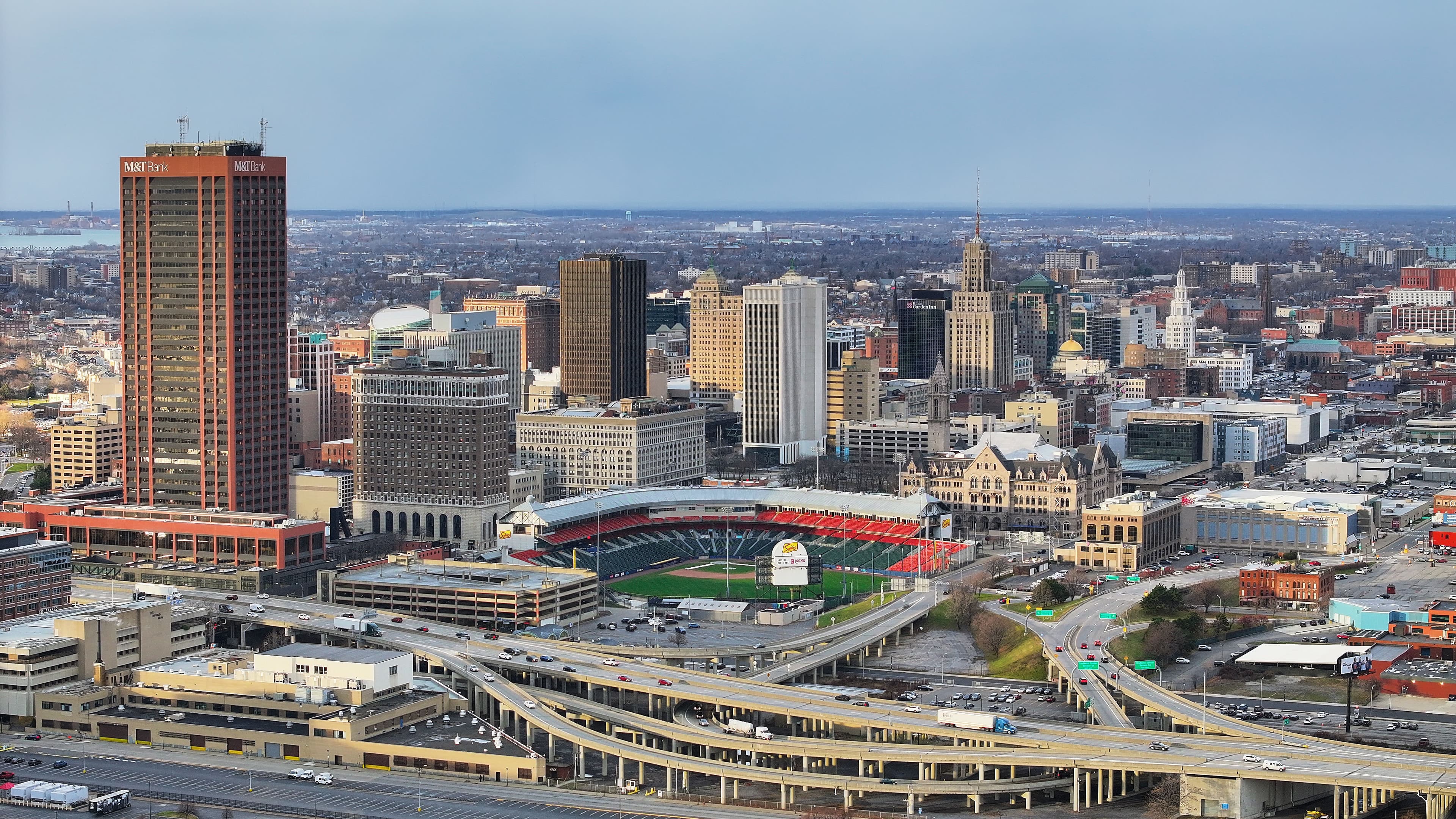
Buffalo is New York State's second-largest city, with (as of 2020) a population of 278,000 in the city proper and 1.1 million in the metropolitan area. Buffalo is the cultural and economic center of the Western New York region. Once an industrial powerhouse, the city suffered the effects of deindustrialization in the 20th century and developed a reputation as a stagnant working-class city. Buffalo's economy turned around in the early 21st century with the arrival of cleaner, high-tech industries and services, yet the city retains a palpable sense of its history as an important industrial center, with majestic historic buildings and sites telling the story of its rise, fall, and resurgence.
History
Beginnings
Though the area had been settled by the Iroquois since well before Columbus and was visited periodically by French fur trappers beginning in the 17th century, Buffalo's history begins about 1789, when Cornelius Winney set up a trading post at the mouth of the Buffalo River. At the time, this site was still far beyond the frontier of white settlement. It was not until 1793 that the Holland Land Company, a syndicate of investors from the Netherlands, purchased the tract of Western New York wilderness that included Buffalo. Land agent Joseph Ellicott, who arrived at Winney's trading post in 1798, felt that it had the potential to be the site of a thriving city. He gave the name New Amsterdam to the village he laid out there, though it was soon renamed Buffalo after the adjacent river. Ellicott laid out a grand radial pattern of streets and public squares inspired by the one designed by his brother Andrew for Washington, D.C.
See
For detailed listings of attractions, please see the respective district articles.
Museums
Buffalo's wealth of cultural attractions is surprising given the city's somewhat small size. The museums here are many and varied, and are a point of pride for Buffalo's citizens. Arguably the most interesting among them are a great number of institutions that focus on the area's past.
1 Buffalo History Museum (Formerly the Buffalo & Erie County Historical Society Museum), 25 Nottingham Ct (Metro Bus 20 or 32), ☏ +1 716-873-9644. Tue-Sat 10AM-5PM, Wed until 8PM, Sun noon-5PM, Resource Center by appointment during business hours, Research Library Wed-Sat 1PM-5PM. Has by far the most extensive collection of artifacts relevant to the history of Buffalo and Western New York from pre-Columbian times to the present day. It was built for the Pan-American Exposition in 1901, so it is perhaps not surprising that the Exhibition is a particular focus of the exhibits. $7, seniors and students 13-21 $5, children 7-12 $2, members and children under 7 free. Research Library $7, free to members.
2 Lower Lakes Marine Historical Society Museum, 66 Erie St. (Metro Rail: Seneca), ☏ +1 716-849-0914. Thu & Sat 10AM-3PM and by appointment. The shipping industry was greatly important to Buffalo's economy in earlier times, and the Lower Lakes Marine Historical Society's mission is to pay tribute to and increase awareness and appreciation of, that facet of local history. To that end, a wide variety of historic artifacts, old photographs, models, and interpretive materials relevant to the Great Lakes shipping trade are displayed in a warm and airy museum in what was once the offices of Howard H. Baker and Company, a ship chandlery that served Buffalo Harbor in the 19th century. Free.
Do
Festivals and events
The festivals and events listed in this section take place at multiple venues city- or regionwide. For events specific to a particular venue or neighborhood, see the respective district articles.
The lion's share of festivals and events in Buffalo take place during the warm months, naturally, but efforts have been made to expand the slate of offerings in winter as well.
Buffalo Greek Fest. Serves as the traditional start of the summer festival season and held each year at the beginning of June at the Hellenic Orthodox Church of the Annunciation on historic Delaware Avenue. Showcases the cuisine, traditional music and folk dances of Greece, along with cultural exhibits and architectural tours of the beautiful church.
Galbani Buffalo Italian Heritage Festival. Live music, carnival rides, games, and attractions of all kinds on the first weekend in July. The star of the show is the food, with offerings from well-known Italian markets as well as demonstrations by chefs from local Italian restaurants.
Dyngus Day. A traditional Polish holiday that falls on the Monday after Easter, Buffalo hosts the largest Dyngus Day celebration in the world at its New York Central Terminal. After a parade, traditional Polish food and (even more popularly) drink are served in the old dining room, with polka bands attracting revelers to the dance floor. Celebrations are also held at St. Stanislaus, Bishop & Martyr Church, the Adam Mickiewicz Library, as well as Polish bars and taverns.
Buffalo Pride Festival. Kicks off with a flag-raising ceremony in Niagara Square, continues with a "Gay 5K" footrace through the streets of downtown, picks up intensity in Allentown with the Dyke March and a raucous street festival (21+ admitted), culminates in Canalside with the Pride Festival itself (a family-friendly event), and closes out with a beach party at Woodlawn Beach State Park in Hamburg.
Eat
Local specialties
No visit is complete without trying some Buffalo wings. Oh, sure, everyone thinks they've tried them, but nothing compares to the ones you can get in Buffalo. (But please don't call them "Buffalo wings"; around here, they're just "wings".) The classic recipe, as originated in 1964 at the Anchor Bar on Main Street, is a chicken wing fried up crisp, then tossed in a mixture of butter and hot sauce (Frank's Red Hot for best results) in varying proportions according to your spice tolerance, then optionally finished on the grill for a bit of extra char. The debate over who serves the best wings in town is endless, but as a general rule, head to one of Buffalo's many off-the-beaten-path corner bars.
If you're not a fan of Buffalo sauce, virtually anywhere with wings on the menu will offer barbecue sauce as an alternative. Other varieties you'll come across frequently include garlic parmesan, lemon pepper (especially popular among Buffalo's African-American community), honey mustard, and "Italian style" (i.e. breaded and smothered in marinara sauce). Or for something truly unique, head to South Buffalo, which has its own homegrown style of wings.
In much the same vein: if you enjoy chicken fingers, there's scarcely a better place for you to visit than Buffalo. Like any other city, you can find them served as a meal in themselves, but here they also come chopped up and used as pizza toppings, in tacos, on salads, and — above all — in the form of chicken finger subs: whole chicken fingers slathered in Buffalo wing sauce and used as the filling in a submarine sandwich. A variant is the stinger sub, basically a steak hoagie plus chicken fingers. Any sub shop or pizzeria in town should be able to make you a chicken finger sub, but for the stinger, the odds-on favorite is local chain Jim's Steakout, where it was invented.
Outside the realm of deep-fried chicken, another local specialty is beef on weck, a sandwich that consists of slices of slow-roasted beef layered on a kümmelweck roll (a Kaiser roll topped with caraway seeds and Kosher salt) and traditionally garnished with horseradish. Any place that serves hot sandwiches is likely to have beef on weck on the menu, but the two restaurants whose beef on weck has the best reputation are Schwabl's (on Center Road in West Seneca) and Charlie the Butcher.
Drink
For bar listings, please see the respective district articles.
As an enduringly blue-collar town, Buffalo has a fairly dense concentration of bars and taverns. In fact, according to the U.S. Census Bureau, Buffalo is among the top ten cities in the United States in number of bars per capita. Drinkers in Buffalo aren't limited to rough-and-tumble working-class watering holes, though — although there are plenty of those. Buffalo has a number of more upscale nightlife districts, each with a distinct character, from the dance clubs of Chippewa Street, to the hipster dives of Allentown, to the cocktail bars in the Theater District, to the yuppie hangouts of the Elmwood Village, to the historic taverns of the Cobblestone District and the Old First Ward.
Last call in Buffalo is 4AM. For this reason, many bars in Buffalo don't get going until sometime after midnight on weekends.
Weekend nights usually see the police out in force in Buffalo's nightlife districts, searching for drunk drivers. You can often find taxis lingering around the bars, but competition for a cab can be fierce and rates are often high. Uber and Lyft are often a better option in these cases.
Coffee shops
Coffee culture is alive and well in Buffalo. Though Starbucks outlets are a dime a dozen here as elsewhere in the country, locally owned mom-and-pop cafés have always been where it's at for Buffalo's trendy set, and there are three principal neighborhoods where you'll find them. Downtown — particularly the Theater District and the 500 block of Main Street — sports a handful of grab-and-go places for office workers in need of a quick caffeine fix, Allentown's coffee shops are great places to lounge in an ambience that's trendy yet not stiflingly pretentious, and at the far end of the spectrum, the off-the-beaten-path coffeeshop scene on the West Side cranks the hipster factor up to 11, with an atmosphere and clientele such that you might wonder whether you're in Buffalo or Brooklyn.
Get around
For most visitors to Buffalo, access to an automobile will prove extremely useful, although Buffalo's public transportation system provides access to the majority of the metropolitan area. Travelling around the city proper by public transit can be relatively hassle-free, especially on weekdays; however, transit riders travelling to the suburbs should be prepared for service that is infrequent (and, on the weekends, often non-existent).
By car
In addition to the Interstate highways mentioned in the "Get In" section, Buffalo has several intraurban expressways useful to visitors:
The Kensington Expressway (NY 33) begins at the airport on Genesee Street, proceeding westward through the suburb of Cheektowaga and the East Side before turning southward and concluding downtown at Oak Street.
The Scajaquada Expressway (NY 198) is a short highway that connects the Kensington Expressway with Interstate 190. The Scajaquada is a convenient route to the neighborhoods of Parkside and the Elmwood Village, the popular commercial strips of Hertel Avenue and Grant Street, as well as attractions like Delaware Park, the Albright-Knox Art Gallery, the Buffalo History Museum, the Darwin D. Martin House, and the Burchfield Penney Art Center.
The Buffalo Skyway (NY 5) begins downtown at I-190, extending southward parallel to the shore of Lake Erie with access to Gallagher Beach, Tifft Nature Preserve, and other Outer Harbor attractions. After passing over the Union Ship Canal via the Father Baker Bridge, the divided highway ends, but Route 5 continues as a wide, busy six-lane surface road (variously known as the Hamburg Turnpike, Lake Shore Road, or simply Route 5) that passes through the suburban areas of Lackawanna and Hamburg and continuing southward along the lake shore.
Stay safe
The reputation of Buffalo's East Side as a rough part of town can be exaggerated by locals, but it's not entirely undeserved. Generally speaking, the East Side is the city's poorest residential district, with widespread urban blight and high crime rates plaguing many parts of the district (especially the Bailey Avenue corridor). To a lesser extent, some parts of the West Side also have these problems. That being said, crime rates in Buffalo have fallen to levels not seen in half a century. What violent crime does occur is usually drug- and gang-related and does not target tourists. Follow general precautions that would apply in any urban area — lock car doors, keep valuables out of sight, be aware of your surroundings, etc. — and you should be fine pretty much anywhere.
Panhandlers can be found occasionally on Chippewa Street downtown and in Allentown and the Elmwood Village, though not nearly to the degree of most other cities. Aggressive panhandling is virtually unknown.
Practical facts for United States
Taken from open data. Rules and numbers change, so check locally before you rely on them.
- Currency
- US Dollar (USD)
- Languages
- American English, Spanish (United States), Hawaiian, and French
- Plugs and power
- Types A and B, 120 V at 60 Hz
- Traffic drives
- On the right
- Emergency numbers
- Any emergency911
- Country calling code
- +1
- Time zones
- America/Adak, America/Anchorage, America/Boise, America/Chicago, and 25 more
Official travel advice
Quoted from each government as published, with the date they last changed it. We do not add a verdict of our own.
UK Foreign, Commonwealth & Development Office
- No areas listed that it advises against travelling to
Read the full adviceThis travel advice also covers American Samoa, Guam, Northern Mariana Islands, Puerto Rico, and United States Virgin Islands.
Entry and visas
Entry rules depend on your passport and change without notice. Check the official pages before you book.
Sources