
Slovakia
A plan for Bratislava
Not a list of things to see in Bratislava — a day-by-day plan somebody could actually follow, built from places we can point to a source for. Make your own in about a minute.
- 2 nights
- Couple
- Balanced pace
- Mid-range budget
Every place here was checked on 2026-10-27 or later, and each one says where it came from.
The plan, day by day
Day 1
09:30
You arrive
13:00
Stará tržnica
Suggested because you chose food
- 1h
- Meal
14:30
Bratislava City Gallery
Picked because you chose culture & museums + balanced energy
- 2h 30m
- Culture & museums
2h open
Nothing planned here. That was on purpose.
19:00
Jedáleň Tržnica
Suggested because you chose food
- 1h 30m
- Meal
20:30
Old building of the Slovak National Theatre
Picked because you chose culture & museums + balanced energy
- 2h 30m
- Culture & museums
Day 2
08:00
Kaffee Mayer
Suggested because it fits a mid-range budget
- 45m
- Meal
45m open
Nothing planned here. That was on purpose.
09:30
Slovak National Gallery
Picked because you chose culture & museums + balanced energy
- 2h 30m
- Culture & museums
1h open
Nothing planned here. That was on purpose.
13:00
Fresh Market
Suggested because you chose food
- 1h
- Meal
14:30
Red Crayfish Pharmacy
Picked because you chose culture & museums + balanced energy
- 2h 30m
- Culture & museums
2h open
Nothing planned here. That was on purpose.
19:00
Len tak
Suggested because you chose food
- 1h 30m
- Meal
20:30
Divadlo Pavla Országha Hviezdoslava
Picked because you chose culture & museums + balanced energy
- 2h 30m
- Culture & museums
Day 3
08:00
Delight
Suggested because you chose food
- 45m
- Meal
45m open
Nothing planned here. That was on purpose.
09:30
Castra Gerulata
Picked because you chose culture & museums + balanced energy
- 2h 30m
- Culture & museums
1h open
Nothing planned here. That was on purpose.
13:00
Hostinec U Deda
Suggested because you chose food
- 1h
- Meal
14:30
You leave
Weather through the year
Monthly averages from NASA's 25-year climate record, day and night together.
Best months: June, July, August, and September
| January | Cold: -1°C, 40 mm |
|---|---|
| February | Cold: 1°C, 36 mm |
| March | Cold: 5°C, 41 mm |
| April | Cold: 11°C, 35 mm |
| May | Mild, some rain: 16°C, 71 mm |
| June | Mild, some rain: 21°C, 73 mm |
| July | Mild, some rain: 23°C, 69 mm |
| August | Mild, some rain: 22°C, 69 mm |
| September | Mild, some rain: 17°C, 69 mm |
| October | Cold: 11°C, 49 mm |
| November | Cold: 5°C, 43 mm |
| December | Cold: 0°C, 41 mm |
From the Wikivoyage guide
Quoted from the travel guide anyone can edit, as it read on the day we took it.
Understand
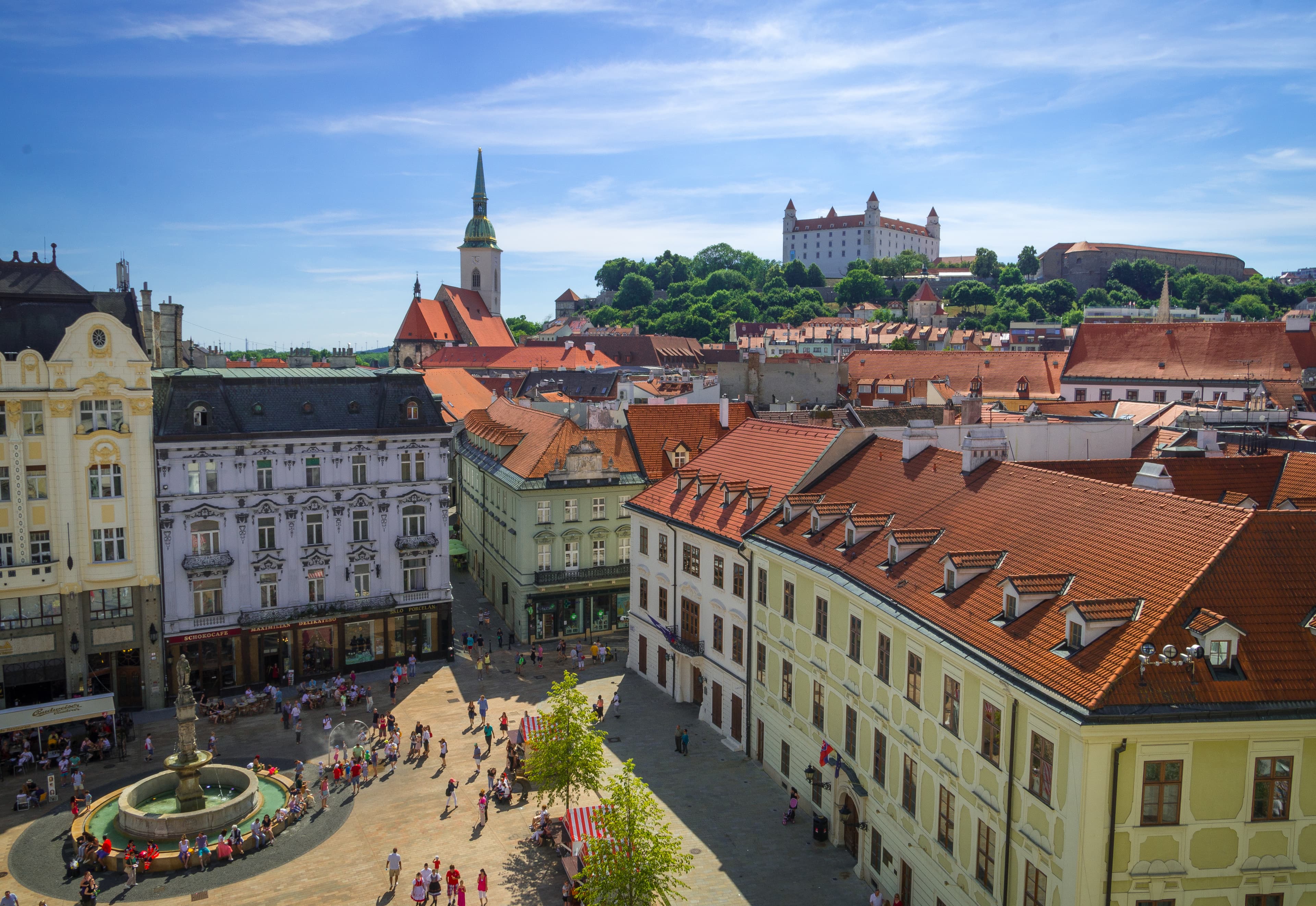
Bratislava has a very pleasant medieval inner city with narrow, winding streets, a hill-top castle next to the river Danube, and many historic churches and buildings to visit. The old town is centered on two squares, Hlavné námestie (main square) and Hviezdoslavovo námestie (Hviezdoslav square, named after a famous Slovak poet). Of a rather different architectural character are some of the communist-era buildings found in the modern parts of the city; a prime example is Petržalka housing estate, the biggest communist-era concrete block housing complex in Central Europe, which stretches on endlessly just across the river. Move further east and there are plenty of rural places to explore. There are farms, vineyards, agricultural land, and tiny villages less than 50 km to the north and east of Bratislava.
Bratislava and its surroundings form the second-most prosperous region in Central and Eastern Europe, with a per capita GDP of around 167% of the EU-27 average. Bratislava is the sixth richest region of the European Union, and GDP per capita is about three times higher than in other Slovak regions.
History
After the fall of the Great Moravian Empire, Slovakia became part of the Kingdom of Hungary from the 10th century (later included with the Austro-Hungarian Empire) until the end of the First World War. The city was the capital (1536-1784), the coronation city (1563-1830), and the seat of the Diet (1536-1848) of the Kingdom of Hungary for three centuries. In this period, eleven Hungarian kings and queens were crowned at St. Martin's Cathedral. At that time, the city was called Preßburg in German and Pozsony in Hungarian, and had a clear German (42%) and Hungarian (40%) ethnic majority (1910 census). In 1919, the Treaty of Trianon created Czechoslovakia, and Bratislava was attached to the newly founded state. In the same year, the name Bratislava was officially adopted for the first time.
See
Bratislava Castle
If your time in Bratislava is limited, try to make a concerted effort to visit the castle. It's the main highlight of Bratislava, though it does require a short climb up several flights of stairs.
To access the general castle precinct, use tram line 9 to Kapucínska. From Kapucínska, cross the dual carriageway on the overpass and then head south (left in direction from tram stop) onto Židovská. There will be a divide, but keep right and follow the cobblestone road. After a climb, you should see some stairs on your right – follow those stairs up until you reach the castle precinct.
1 Bratislava Castle (Bratislavský hrad), ☏ +421 2 54411444. Tue-Sun 10:00-18:00. The castle contains a Museum of Bratislava History, and a baroque garden. There is also a restaurant open till after the actual castle tours into the night. The general precinct area immediately outside the castle, including the vantage points of the city are usually always open during the daytime, and is free to access. Adult €14. (updated Mar 2026)
Museums and galleries
For museum-goers, Bratislava is the place to go, with some bigger and loads of small museums around town. Every year in the weekend around 24 April Bratislava celebrates a festival called "Bratislava for All", giving locals and visitors the possibility to visit most of the facilities governed by the city for free or a reduced fee, this including most of the museums and galleries. In May, the city's museums and galleries keep their gates open to visitors until late at night, this being called the "Night of Museums and Galleries".
2 Red Crayfish Pharmacy Pharmacological Museum (Farmaceutické múzeum), Michalská 28. 10:00–18:00, closed Tuesdays.
3 Slovak National Gallery (SNG). For a taste of visual arts, pay a visit to the National Gallery at the embankment between Starý most and Nový most with permanent collections of Slovak and European medieval art pieces, although the temporary exhibitions tend to be far more interesting.
4 Bratislava City Gallery (GMB). Bratislava City Gallery is also a good pick to see displays of historical fine arts, paintings and sculptures along with interesting temporary exhibitions.
Do
Take a stroll through the centre of the town. Bratislava has one of the smallest historical centers of any European capital but the charm is more concentrated. The streets have been completely renovated over the last ten years, bringing life back here. Since then a multitude of cafes, bars and restaurants of all kinds have opened here, accompanied by a few souvenir shops and fashion stores. On warm days almost every cafe has an outdoor seating section in the street, bustling with life and giving the city a unique cozy feeling.
When it comes to sightseeing, Bratislava Castle generally is a must and is already opened after the reconstruction. You can visit also Slavin memorial for some really astounding views of the city. It's a calm and romantic spot but beware, it can get really windy up there. The City Museum located in the Old Town Hall offers visitors climbing up the steep stairwells of the clock tower or seeing the town's historical dungeons, an exhibition that was quite outdated but still scary in 2008.
In summer, you can also visit Bratislava Zoo, providing a nice walk between the animal enclosures, the latest addition being some rare white tigers. The facilities of the zoo are slowly being renovated to attract more visitors and the zoo is a favourite for families on sunny days. You can also go to the Botanical Gardens of Comenius University (Botanická 3, take tram X6 to stop Botanická záhrada) for quiet and peaceful strolls in this green space. There are also several lakes opened for bathing. The biggest and probably the most famous lake is called Zlaté piesky (Golden Lakes) or Vajnorské jazerá, known as Bager lake (the later is used for bating only unofficially).
Eat
Bryndzové halušky (small, spaetzle-like dumplings with sheep's cheese and topped with pieces of meat) is the national dish of Slovakia and recommended to try. Potent garlic soup (but perhaps not on a date) and Slovak white wine (due to its cooler climate, Slovakia's reds pale in comparison with some of Europe's other offerings), schnitzels, goulashes and other typically Central European foods. Fresh vegetables are more common here thanks to the large amount of land given over to agriculture.
In December, don't miss the Christmas market in front of the Old Town Hall. The traditional foods of the Christmas market are roasted pork or chicken sandwich burgers ("ciganska pecienka") with mustard and onions, potato pancakes ("loksa") with various fillings ranging traditionally from plain ones with goose fat, with garlic or goose liver to poppy seed, nut or chocolate. Bread with pork fat and onions is also popular. Also there are a few stands which offer specialities from other European countries. You can wash down the food with a cup of red or white mulled wine or a small cup of honey wine, also tea with or without rum is available, as well as grog or other "hot mixed drinks" like the Červený medveď (red bear).
There are a large number of restaurants in the center of Bratislava in all price ranges so there are plenty to choose from.
Drink
Try Kofola, a Slovak and Czech soft drink with a similar colour to Coca-Cola, but lower in sugar and caffeine (and carbonation). Some places serve "draft Kofola" which indeed is draft from a barrel in a way similar to beer (it used to be co-produced by a Bratislava brewery). Some Slovaks say draft Kofola is even better than the bottled version and that it is best enjoyed outside in the sun, for example after a hike or a bike or rollerblade ride. Kofola is a popular alternative to beer if you want to hang out but don't want to drink alcohol. Vinea is another genuine Slovak soft drink made from grapes, offered both in "white" (green grapes) and "red" varieties (red grapes) and even in a rather sweet and maybe not-so-tasty "soft" version without carbon dioxide.
There are quite a few Slovak beer brands, e.g. Zlatý Bažant, Šariš, Smädný Mních and Topvar. Stein beer is a local Bratislava variety which used to be brewed practically in the city centre. There are three micro-breweries offering beer in Bratislava, Mestiansky Pivovar, Richtar Jakub and Patronka.
If spirits are more your thing, perhaps you will enjoy Slivovica, a fruit-plum brandy of high quality that is associated with Slovakia.
Coffee
Čiary, Laurinská 138/11, 811 01. Fri–Mon 10:05–18:55; closed Tue–Thu.
grão, Jesenského 194/12, 811 02, ☏ +421 944 294 763. Mon–Fri 08:00–19:00; Sat–Sun 09:00–19:00.
Kaviareň Vták, Špitálska 2214/20, 811 08. Mon–Fri 08:00–17:00; Sat–Sun 09:00–17:00.
KOFI, Karadžičova 4105/33, 811 08, ☏ +421 905 372 561. Mon–Fri 07:30–17:30; Sat 09:30–15:00; closed Sun.
MONO, 1062, Budovateľská 1062/25, 821 08. Mon–Thu 08:30–15:00; closed Fri–Sat; Sun 10:00–15:00.
Brew Bar Café, Rožňavská 1/A, 831 04 Nové Mesto, ☏ +421 918 411 737. Mon–Fri 07:30–19:00; Sat 08:00–16:00; closed Sun.
SVÄG TO GO, Kozia 22, 811 03, ☏ +421 911 246 553. Mon–Fri 07:00–17:00; Sat 09:00–14:00; closed Sun.
Bars
The best pubs offering Slovak beers can be found in the Old Town: Kristian in Michalska street or Bar Parada in Hviezdoslavovo square. All of them are quite cheap (about €1 per half-liter glass of beer). Obchodna street is also full of cheap bars targeting students and younger crowds, for example Baron and Starter (you can also smoke inside).
Get around
Generally, Bratislava is a walking city, though as of the early 2020s with increasing number of cycling lines. The centre is very small and cosy and you can easily walk from one side to another in a few minutes. The city centre is a pedestrian zone, but be aware of cyclists and occasional cars that can sometimes drive rather quickly in between the pedestrian area and outdoor cafes.
Public transport
If you want to travel outside of the centre, use the trams or trolley buses if you need to get from one point to another quickly. Bratislava has a rather good public transport system mainly operated by the city transport company DPB (website in Slovak only). Buses tend to be the slowest means of transport. Stops typically have to be requested, except for trams. To enter bus/trolleybus one has to be standing visibly on the bus stop. To exit, one needs to press a button nearby doors and the driver will stop at the next stops. Bus doors have to be opened by passengers (except for few oldest buses), just push a button on the door or near the door.
A single-journey ticket costs €1.09, valid for 30 minutes only. There is a longer validity ticket available for €1.60 (valid for 60 minutes). All tickets can be used for any number of travels within the specified time period. If you are staying for a holiday, consider buying one from a choice of longer term tickets valid for 1, 3 and 7 days (24, 72, and 168 hours from validation) for €4.80, €10.8 and €14.40 respectively. For more information about tickets, check the IDS BK (Integrated Transport System) website. Note that you also need to buy a separate ticket for your suitcase or other large luggage; buy a luggage ticket for €0.55 which covers 180 mins.
Stay safe
Bratislava is generally very safe by Western standards. It is quite small and the crime rate is low. There is a significant police presence in the city, especially the historical parts, and it is generally not a problem to walk around the city at night. The centre especially is under camera surveillance.
There is very little violent crime in Bratislava. Walking alone after midnight outside of the historical centre is not recommended on Fridays, since you could have an unpleasant encounter with rowdy drunks who could congregate around cheaper establishments. If a problem occurs, you can reach the police on phone number 158. General emergency number (police, fire dept., ambulance) can be reached by dialing 112.
Always ask for printed receipts in establishments to avoid being overcharged. Especially taxi drivers might try to do that. For reference, the usual fare is around €4 around the town, and you shouldn't be charged more than around €10 getting anywhere in Bratislava. Your best bet is to call a taxi dispatch or use one of the mobile apps (see above). Ask around for a recommendation in your hotel/hostel.
On pedestrian crossings without traffic lights, watch out for aggressive drivers. Some of them might not give you the right of way.
Practical facts for Slovakia
Taken from open data. Rules and numbers change, so check locally before you rely on them.
- Currency
- Euro (EUR)
- Languages
- Slovak and Hungarian
- Plugs and power
- Types C and E, 230 V at 50 Hz
- Traffic drives
- On the right
- Country calling code
- +421
- Time zone
- Europe/Bratislava
Official travel advice
Quoted from each government as published, with the date they last changed it. We do not add a verdict of our own.
UK Foreign, Commonwealth & Development Office
- No areas listed that it advises against travelling to
US Department of State
Level 1 of 4: Exercise normal precautions
Read the full adviceExercise normal precaution in Slovakia.
Slovakia is generally a safe destination for travelers.
Review our travel guidance for Slovakia to learn how to prepare for a safe trip.
Entry and visas
Entry rules depend on your passport and change without notice. Check the official pages before you book.
Sources