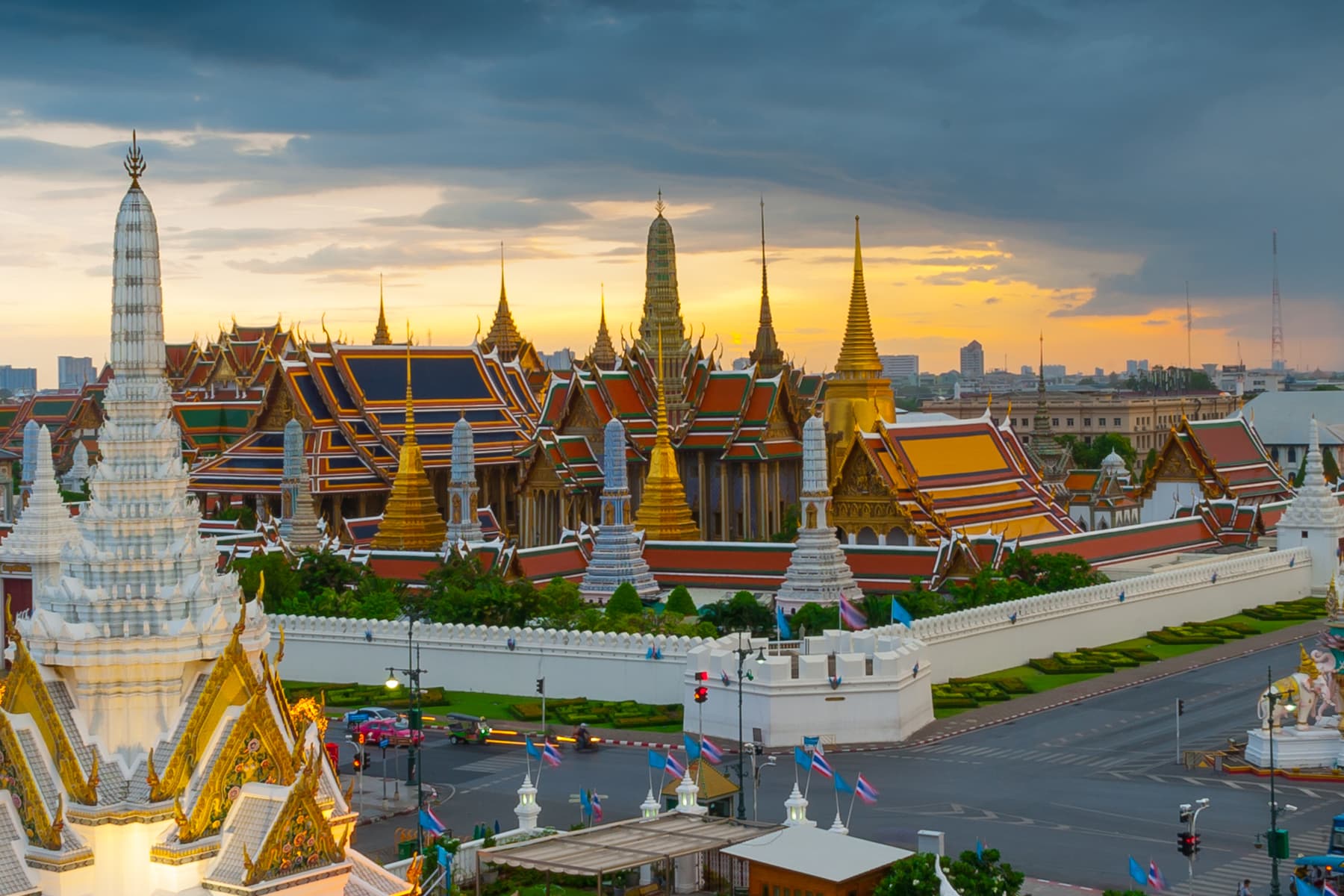

Thailand
A plan for Bangkok
Not a list of things to see in Bangkok — a day-by-day plan somebody could actually follow, built from places we can point to a source for. Make your own in about a minute.
- 2 nights
- Couple
- Balanced pace
- Mid-range budget
Every place here was checked on 2026-10-27 or later, and each one says where it came from.
The plan, day by day
Day 1
09:30
You arrive
13:00
Prachak Restaurant
Suggested because you chose food
- 1h
- Meal
14:30
Nai Lert Park Heritage Home
Picked because you chose culture & museums and local experiences + balanced energy
- 2h 30m
- Culture & museums
2h open
Nothing planned here. That was on purpose.
19:00
Gaggan
Suggested because you chose food
- 1h 30m
- Meal
20:30
Golden Dome
Picked because you chose culture & museums + balanced energy
- 2h 30m
- Culture & museums
Day 2
08:00
Like Italy Cafe-Bakery
Suggested because it fits a mid-range budget
- 45m
- Meal
45m open
Nothing planned here. That was on purpose.
09:30
Bangkok Art and Culture Centre
Picked because you chose culture & museums + balanced energy
- 2h 30m
- Culture & museums
1h open
Nothing planned here. That was on purpose.
13:00
T & K seafood
Suggested because you chose food
- 1h
- Meal
14:30
Children's Discovery Museum
Picked because you chose culture & museums + balanced energy
- 2h 30m
- Culture & museums
17:00
M.R. Kukrit's House
Picked because you chose culture & museums and local experiences + balanced energy
- 2h 30m
- Culture & museums
19:30
Bourbon Street
Suggested because you chose food
- 1h 30m
- Meal
21:00
Sala Chalermkrung Royal Theatre
Picked because you chose culture & museums + balanced energy
- 2h 30m
- Culture & museums
Day 3
08:00
Jedi Cafe
Suggested because you chose food
- 45m
- Meal
45m open
Nothing planned here. That was on purpose.
09:30
Jim Thompson House
Picked because you chose culture & museums and local experiences + balanced energy
- 2h 30m
- Culture & museums
1h open
Nothing planned here. That was on purpose.
13:00
The Canton House
Suggested because you chose food
- 1h
- Meal
14:30
You leave
Weather through the year
Monthly averages from NASA's 25-year climate record, day and night together.
Best months: January, November, and December
| January | Warm and dry: 26°C, 16 mm |
|---|---|
| February | Warm and dry: 29°C, 14 mm |
| March | Hot: 30°C, 47 mm |
| April | Hot: 31°C, 75 mm |
| May | Hot: 30°C, 164 mm |
| June | Rainy: 28°C, 165 mm |
| July | Rainy: 28°C, 169 mm |
| August | Rainy: 28°C, 181 mm |
| September | Wet season: 27°C, 278 mm |
| October | Wet season: 27°C, 203 mm |
| November | Warm and dry: 26°C, 39 mm |
| December | Warm and dry: 25°C, 10 mm |
From the Wikivoyage guide
Quoted from the travel guide anyone can edit, as it read on the day we took it.
Understand
Just under 14 degrees north of the equator, Bangkok is a tropical metropolis that is also one of the most traveller-friendly cities in Asia. A furious assault on the senses, visitors from northern climates are immediately confronted by the heat, the pollution, unpleasant smells, and the irrepressible smile worn by many Thais. The city is surprisingly safe (except for petty crimes) and more organised than it initially appears, and is full of hidden gems waiting to be discovered. The high relative humidity and warm temperature favour the growth of tropical plants — you'll find exotic orchids and delicious fruit everywhere. Bougainvillea and frangipani bloom practically all over the city. Thai cuisine is justifiably famous, varied, and affordable. Bangkok for many represents the quintessential Asian capital. Saffron-robed monks, garish neon signs, graceful Thai architecture, spicy dishes, colourful markets, traffic jams, and the tropical climate come together in a happy coincidence. It is difficult to leave with only lukewarm impressions of the city.
History
"Bangkok" was originally a small village on the west bank of the Chao Phraya River. After the fall of Ayutthaya in the late 18th century, King Taksin the Great turned that village into Siam's new capital and renamed it Thonburi. In 1782, King Rama I moved the capital to the eastern bank of the river at Rattanakosin; originally the site of a Chinese community, which was moved outside the new city walls to Yaowarat. King Rama I named the city Krung Thep, as it is now known to Thais, and which in English translates as the "City of Angels".
See
Individual listings can be found in Bangkok's district articles
Most of Bangkok's sights are concentrated on the island of Rattanakosin, often referred to as the "Old City". Out of Bangkok's hundreds of temples, the Grand Palace, Wat Pho and Wat Arun usually make up the top 3. The Grand Palace has an immense size, so expect to spend at least a full morning or afternoon there. Within the palace grounds is Wat Phra Kaew, the most sacred Buddhist temple of Thailand. Unlike other temples, it is not one building, nor are there living spaces for monks. Instead, it is a collection of highly decorated holy buildings and monuments. One of its buildings houses the Emerald Buddha, and while you might not expect it from its size, it is the most sacred Buddha image in Thailand.
Nearby is Wat Pho, home to the world's largest reclining Buddha image and a famed massage school. Take the ferry across the Chao Phraya River to Thonburi for the outstanding Wat Arun. The main structure is about 60 to 88 m high and it is surrounded by four smaller prangs. It is one of Thailand's most picturesque temples, and is engraved on the inner part of all ten baht coins. It is so recognisable that it even became the logo of the Tourism Authority of Thailand (TAT). If you climb it, and look closely, you will see that it is beautifully decorated with colourful broken Chinese porcelain pieces. Heading back to Rattanakosin, there are many other major temples you could visit, including the Golden Mount, Wat Suthat and Wat Ratchanaddaram.
Do
Individual listings can be found in Bangkok's district articles
Festivals
All of Thailand's major festivals are celebrated in Bangkok. New Year is celebrated three times. There's the new year following the Gregorian calendar at January 1, celebrated with a huge fireworks display at Ratchaprasong intersection. Then there's Chinese New Year in January or February, with grandiose and colourful Chinese lion and dragon processions in Yaowarat. Finally, the water festivities of Songkran celebrate the traditional Thai New Year in the middle of April. Khao San Road degenerates into a war zone as farangs and locals duke it out with super soakers. More respectable celebrations are held at Sanam Luang, where the revered Phra Phuttha Sihing image is displayed and bathed by devotees, and at the Wisut Kasat intersection, where a Miss Songkran beauty contest is held and accompanied by merit-making and entertainment.
During the Royal Ploughing Ceremony in May, farmers believe that an ancient Brahman ritual, conducted at Sanam Luang, is able to forecast whether the coming growing season will be bountiful or not. The event dates back to the Sukhothai Kingdom and was re-introduced in 1960 by King Bhumibol Adulyadej. It is considered the official commencement of the rice-growing season (and the rainy season). Nowadays, the ceremony is conducted by King Maha Vajiralongkorn. Loi Krathong (ลอยกระทง), the Festival of Lights, usually takes place in November. Krathongs are floating rafts made from lotus flowers and banana leaves with a lighted candle and incense on top. On the night of the full moon, Thais send their krathong down a river, canal or pond, and the owner's bad luck carries away along with it insuring a fresh start. Celebrations take place all over town with parades, concerts and beauty pageants. Loi Krathong coincides with the Lanna festival Yi Peng (ยี่เป็ง). At this festival, a multitude of Lanna-style paper lanterns are launched into the air. Lumphini Park is the best place to launch a krathong down the pond or to launch a paper lantern into the sky.
Eat
Individual listings can be found in Bangkok's district articles
Bangkok boasts a stunning 50,000 places to eat; not only thousands of Thai restaurants, but a wide selection of world-class international cuisine too. With the rise of the expat community and high expenditure for local Thais, Bangkok has fast become a gastronomical paradise. Prices are generally high by Thai standards, but cheap by international standards. A good meal is unlikely to cost more than 300 baht, although there are a few restaurants (primarily in hotels) where you can easily spend 10 times this.
Sukhumvit is known for many of popular restaurants but the business district of Silom is now littered with many of Bangkok's top dining destinations. Practically every cuisine in the world is represented here, be it French, Lebanese, Mexican, Vietnamese, or fusion combining many of these together in a quirky, but delicious mix. Bangkok's Italian town is Soi Ton Son near Siam Square. Of course, for those on a budget, street stalls abound with simple Thai dishes at around 30 baht. There are especially plenty of budget restaurants in Khao San Road.
There are plenty of vegetarian restaurants in the more tourist-friendly parts of town (especially in hippie district Khao San Road). Vegetarian dishes are also readily available on the menus of regular restaurants. On request, even typical street restaurants will easily cook a vegetarian equivalent of a popular Thai dish for you. Ask for "jay" food to leave the meat out of the dish. For example, "khao pad" is fried rice and "khao pad jay" is vegetarian fried rice. The most common animal product used would be oyster sauce. To avoid it, say "mai ao naam man hoi". Be aware that all street noodle vendors use meat broth for noodle soup.
For Muslims, the alleys around Haroon Mosque in the Bang Rak area are home to many Muslim families, and hence full of stalls selling halal food. Another good place to find halal food is the Ramkhamhaeng Night Market, located next to the campus of Ramkhamhaeng University.
Drink
Individual listings can be found in Bangkok's district articles
Bangkok's nightlife is infamously wild, but it's not quite what it used to be. Due to social order campaigns, there have been quite a few crack-downs on opening hours, nudity, and drug use. Most restaurants, bars and clubs are now forced to close at 01:00, although quite a few are allowed to stay open till 02:00 or later. Informal roadside bars do stay open all night, particularly in Sukhumvit and Khao San Road. You must carry your passport for ID checks and police occasionally raid bars and discos, subjecting all customers to drug tests and searches, though these mostly occur at places that cater for high-society Thais.
One of Bangkok's main party districts is Silom, home to a wide range of bars and nightclubs catering to all tastes, as well as the famous Patpong night market area. For a drink with a view, the open-air rooftop bars of Vertigo and Sirocco are particularly impressive. A large number of stylish and upscale bars and nightclubs can be found in the higher sois of Sukhumvit, particularly the hip area of Thong Lo (Soi 55).
Hippie hangout Khao San Road is also slowly gentrifying and a score of young artsy Thai teenagers have also made their mark there. Going out in Khao San Road is mostly casual, sitting at a roadside bar watching people pass by, but the Gazebo Club is a nightclub that stays open till the sun gets up. Most of the younger Thais prefer to congregate around Ratchadaphisek, home to the Royal City Avenue strip of nightclubs where you can find popular nightclubs like 808, Route 66, Cosmic Cafe, and more.
RCA, the Royal City Avenue strip, is home to much more than nightclubs. You will be able to find fun karaoke clubs, go-carting, arcades and bars like the Overtone Music Cave which is a place where music students to perform. The Overtone Music Cave is frequently visited by recording artists as well as music students and is becoming a real Bangkok music hot spot.
Smoking is forbidden in all restaurants, bars and nightclubs, whether air-conditioned or non-air-conditioned. It is enforced at some venues, but the ordinance is flouted in areas such as Nana Plaza.
Get around
Bangkok has a decent public transportation network by Southeast Asian standards, but much room for improvement lies in its integration. Bangkok is notorious for its traffic jams, so visitors are advised to rely on the rail and river networks whenever possible. Transit Bangkok is a journey planner that can help you choose the best route.
By train
Three separate operators form the Bangkok rail network: the Skytrain (BTS), the Metro (MRT), and the State Railway of Thailand (SRT). Each operator has a different fare system, meaning you will have to buy a separate ticket or stored value card for each network you wish to use. Fare payments can be made by tapping a contactless Mastercard or Visa on the fare gates of all MRT and SRT lines, but not the BTS lines. Whilst transferring between operators is relatively straightforward, different names are used for some interchange stations. For instance, the interchange station known as Asok in the BTS system is known as Sukhumvit in the MRT system. Trains operate between 06:00 and 00:00. Trains are generally clean, modern and reliable, with signs and announcements in Thai and English.
Skytrain
The Skytrain (BTS) operates three lines. The Sukhumvit line travels from Khu Khot (N24) in the north to Kheha (E23) in the south. The Silom line travels from Bang Wa (S12) in the west to National Stadium (W1) in the city centre. The Gold line travels from Krung Thon Buri (G1) to Khlong San (G3).
Tickets are zone-based. You can buy and reload a "Rabbit" card at all stations. A new card costs 200 baht, including 100 baht stored value, and a 100 baht non-refundable issuing fee. Your passport is required to buy the card. You can make payments at some convenience stores, restaurants and supermarkets with the card. Alternatively, you can buy a One-Day Pass for 150 baht per day. Single journey cards can be purchased at ticket counters and vending machines. All vending machines accept coins (Thai baht only). Some vending machines accept 20, 50 and 100 baht notes but there is often a queue to use them. Single journey cards are tapped on the scanner to enter and deposited in the slot to exit. Fare payments cannot yet be made by tapping a contactless Mastercard or Visa on the fare gates.
Stay safe
Given its size, Bangkok is surprisingly safe, with violent crimes like mugging and robbery unusual. Most violent crime in Bangkok is connected to disputes between organized crime syndicates; if you do not bother them, they generally will not bother you. Generally speaking, the tourists who get into trouble are the ones who get into drunken fights. One of the biggest dangers are motorbikes who ride on pavements at speed, go through red lights, undertake buses as they stop to let passengers off and generally drive far too fast especially through stationary traffic. If you are going to hire a bike, make sure you have insurance in case you are injured. You may be the world's best driver but you'll meet many of the world's worst drivers in Thailand.
Bangkok does have more than its fair share of scams, and many individuals in the tourist business do not hesitate to overcharge unwary visitors. As a rule of thumb, it is wise to decline all offers made by someone who appears to be a friendly local giving a hapless tourist some local advice. Short-changing tourists is reasonably common as well, don't hesitate to complain if you are not given the correct change.
Never get in a tuk-tuk if someone else is trying to get you into one. Most Bangkok locals do not approach foreigners without an ulterior motive.
Possession and use of e-cigarettes (vapes) are illegal here. Violators can face heavy fines or even imprisonment.
Scams
There are dozens of scams in Bangkok, but by far the most widely practiced is the gem scam. Always beware of tuk-tuk drivers offering all-day tours for prices as low as 10 baht. You may indeed be taken on a full-day tour, but you will end up only visiting one gem and souvenir shop after another. Don't buy any products offered by pushy salespeople — the "gems" you can supposedly sell overseas for huge profits are pretty much always worthless pieces of cut glass and the suits are of deplorable quality. The tuk-tuk driver gets a commission if you buy something — and fuel coupons even if you don't. Unless the idea of travelling by tuk-tuk appeals to you, it's almost always cheaper, more comfortable and less hassle to take a metered taxi.
Practical facts for Thailand
Taken from open data. Rules and numbers change, so check locally before you rely on them.
- Currency
- Thai Baht (THB)
- Languages
- Thai and English
- Plugs and power
- Types A, B, C, and F, 220 V at 50 Hz
- Traffic drives
- On the left
- Country calling code
- +66
- Time zone
- Asia/Bangkok
Official travel advice
Quoted from each government as published, with the date they last changed it. We do not add a verdict of our own.
UK Foreign, Commonwealth & Development Office
- Advises against all but essential travel to parts of the country
Read the full adviceAreas where FCDO advises against travel
Thailand-Malaysia border
FCDO advises against all but essential travel to parts of the south, near the Thailand-Malaysia border:
• Pattani Province
• Yala Province
• Narathiwat Province
• The districts of Chana, Thepa, Na Thawi and Saba Yoi in southern Songkhla Province
FCDO also advises against all but essential travel on the Hat Yai to Padang Besar train line that runs through these provinces.
This is due to regular attacks in the provinces by the border with Malaysia. See Safety and security.
Thailand-Cambodia border
FCDO advises against all but essential travel to areas within 20km of the land border with Cambodia.
Fighting occurred along parts of the border in July 2025, and further clashes took place in early December, involving rocket and artillery fire. Land borders and crossings between Thailand and Cambodia remain suspended. Tourist sites close to the border, including the Khao Phra Wihan Preah Vihear temple, the Ta Kwai Ta Krabey temple and the Ta Muen Thom Tamone Thom temple, are closed. There are unexploded landmines in the area. Travel to affected border regions should be avoided.
Find out more about why FCDO advises against travel.
US Department of State
Level 1 of 4: Exercise normal precautions
Read the full adviceExercise normal precaution in Thailand. Some areas have increased risk. Read the entire Travel Advisory.
Thailand is generally a safe destination for travelers. Review our Travel Guidance for Thailand to learn how to prepare for a safe trip.
• Exercise Increased Caution near the Thai-Cambodian border due to the risk of armed conflict.
• Exercise Increased Caution in the Yala, Pattani, and Narathiwat provinces due to the risk of unrest.
Entry and visas
Entry rules depend on your passport and change without notice. Check the official pages before you book.
Sources