
Denmark
A plan for Århus
Not a list of things to see in Århus — a day-by-day plan somebody could actually follow, built from places we can point to a source for. Make your own in about a minute.
- 2 nights
- Couple
- Balanced pace
- Mid-range budget
Every place here was checked on 2026-10-27 or later, and each one says where it came from.
The plan, day by day
Day 1
09:30
You arrive
13:00
Ris Ras Filliongongong
Suggested because you chose food
- 1h
- Meal
14:30
The Old Town
Picked because you chose culture & museums + balanced energy
- 2h 30m
- Culture & museums
2h open
Nothing planned here. That was on purpose.
19:00
Kohalen
Suggested because you chose food
- 1h 30m
- Meal
20:30
Musikhuset Aarhus
Picked because you chose culture & museums + balanced energy
- 2h 30m
- Culture & museums
Day 2
08:00
Café Gaya
Suggested because you chose food
- 45m
- Meal
45m open
Nothing planned here. That was on purpose.
09:30
Museum Ovartaci
Picked because you chose culture & museums + balanced energy
- 2h 30m
- Culture & museums
1h open
Nothing planned here. That was on purpose.
13:00
Frederikshøj
Suggested because you chose food
- 1h
- Meal
14:30
KØN - Gender Museum Denmark
Picked because you chose culture & museums + balanced energy
- 2h 30m
- Culture & museums
17:00
ARoS Aarhus Kunstmuseum
Picked because you chose culture & museums + balanced energy
- 2h 30m
- Culture & museums
19:30
Le Bleu
Suggested because you chose food
- 1h 30m
- Meal
21:00
Den Fede Drue
Picked because you chose food + balanced energy
- 1h 30m
- Food
Day 3
08:00
Coffee Collective
Suggested because it fits a mid-range budget
- 45m
- Meal
45m open
Nothing planned here. That was on purpose.
09:30
Moesgaard Museum
Picked because you chose culture & museums + balanced energy
- 2h 30m
- Culture & museums
1h open
Nothing planned here. That was on purpose.
13:00
Gastromé
Suggested because you chose food
- 1h
- Meal
14:30
You leave
Weather through the year
Monthly averages from NASA's 25-year climate record, day and night together.
Best months: June, July, and August
| January | Cold: 1°C, 65 mm |
|---|---|
| February | Cold: 1°C, 52 mm |
| March | Cold: 3°C, 47 mm |
| April | Cold: 7°C, 44 mm |
| May | Mild, some rain: 11°C, 55 mm |
| June | Mild, some rain: 15°C, 73 mm |
| July | Mild, some rain: 17°C, 82 mm |
| August | Mild, some rain: 17°C, 86 mm |
| September | Mild, some rain: 14°C, 69 mm |
| October | Cold: 10°C, 85 mm |
| November | Cold: 6°C, 73 mm |
| December | Cold: 3°C, 67 mm |
From the Wikivoyage guide
Quoted from the travel guide anyone can edit, as it read on the day we took it.
Understand
Aarhus is known as "The City of Smiles" (Danish: Smilets By). This slogan probably started as publicity to improve the city's image, but it has nevertheless caught on.
Being a university city and centre of education, Aarhus has a large student population and one of the lowest median ages of any city in Europe. The cultural scene here is always thriving. For years, Aarhus has been an incubator for Danish artists and performers. It is also home to Aarhus Festuge, Scandinavia's largest cultural festival, held annually for 10 days at the end of August. In addition, Aarhus, along with the East Jutland Metropolitan area for which it serves as the central hub, is the fastest-growing area in Denmark in terms of population. There is a huge building boom taking place with new high-rises sprouting like mushrooms on the skyline. Little wonder, then, that Aarhus was selected as 2017's European Capital of Culture, with a full slate of events on tap all year throughout the entire city and region.
Most locals speak excellent English. You will have no trouble getting around or ordering food using only English.
Orientation
Aarhus C
Aarhus City is the central district and the most active area of the city with several interesting and special neighbourhoods, including these:
Indre by (Inner City) is the old medieval core of the city which used to be walled and gated up until 1857. A large part of the inner city is pedestrianized. The Latin Quarter is a small special quarter with cobblestone streets, low-rise buildings and old townhouses that has been preserved.
Vesterbro, situated north and west of Indre by, is mostly a residential area. However, you'll find several major attractions including the Botanical Gardens, the Old Town museum and the main university campus.
Øgade-kvarteret is a residential quarter immediately northwest of the Latin Quarter and also presents a unique town environment with low-rise buildings and colourful townhouses, mostly from around the 1850s to 1920s. Most of the streets of the quarter are named after Danish islands.
Aarhus Ø is a new residential neighbourhood on the harbourfront.
See
Many attractions and events in Aarhus are free, and there is an interesting street life, so even on a budget you can have an enjoyable experience.
History
With a history dating back to at least the 700s in the Viking Age, Aarhus holds many historic buildings, some of which are of national importance.
1 Aarhus Viking Museum, Skt. Clemens Torv 6, ☏ +45 89 42 11 00. Mon-Wed Fri 10:00-16:00, Thu 10:00-17:00. Small Viking museum located across from the cathedral in the basement of the Nordea Bank. The museum focuses on local history during the Viking Age and most of the displayed items were excavated on site. If you are interested in Viking Age history in general, visit the large Moesgaard Museum (MoMu) south of the city. 30 kr for adults.
2 Museum Aarhus. A permanent exhibition within the Old Town Museum opened in spring 2017. The museum displays Aarhus' history with a focus on the last 150 years, the period when it expanded from a small provincial port town to its current status of second-largest city.
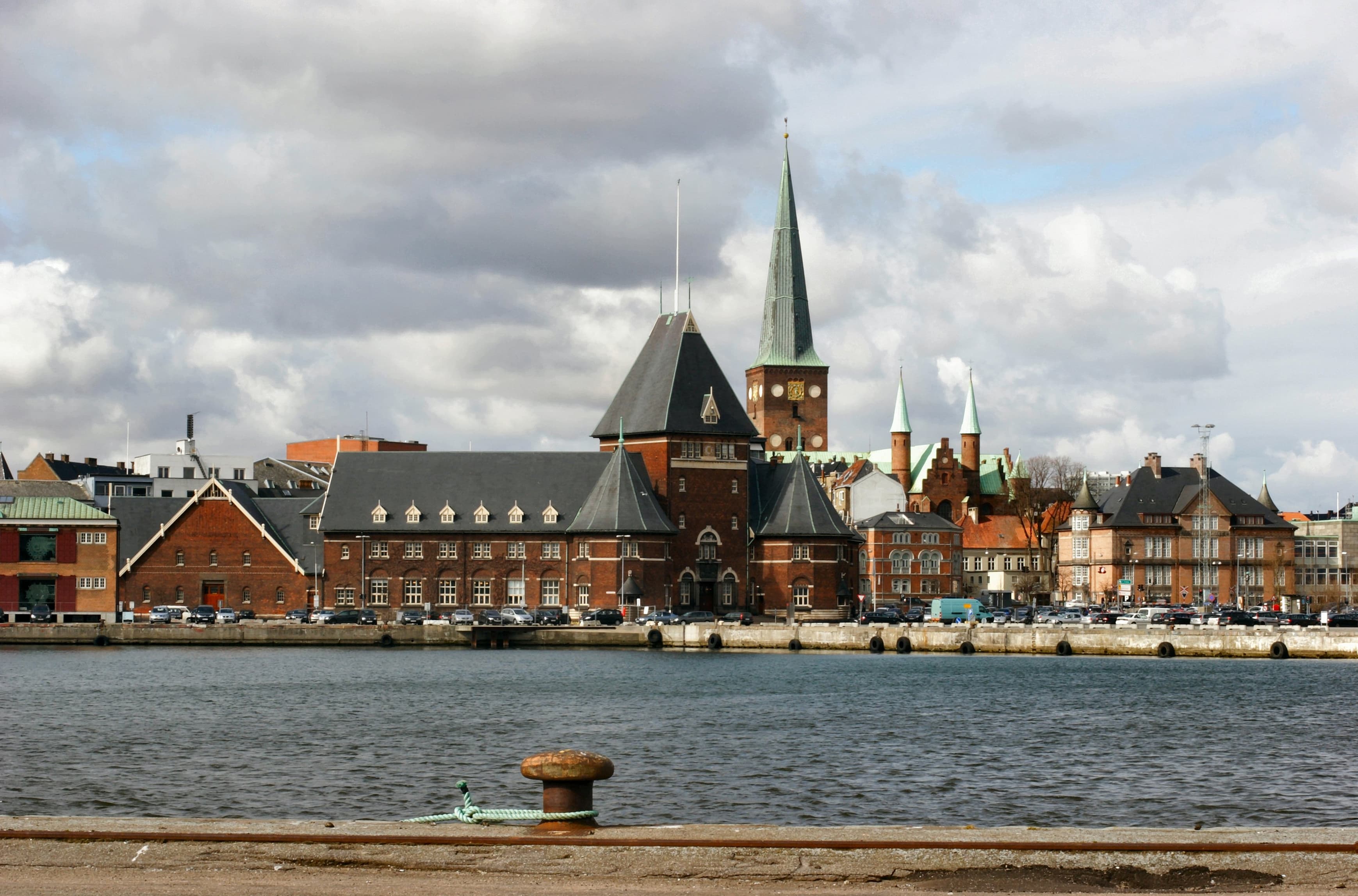
3 Aarhus Domkirke (Aarhus Cathedral), Domkirkepladsen 2, ☏ +45 86 20 54 00. Daily May-Sep 09:30-16:00; Oct-Apr 10:00-15:00. The beautiful cathedral is more than 800 years old, and the longest and the tallest in Denmark. It took 100 years to build and it is the oldest building in the city, still standing. Concerts are sometimes arranged and the tower offers a good view. Behind the church is Aarhus Cathedral School, also with an 800-year history. Free (a fee for the tower).
4 Vor Frue Kirke (Church of Our Lady), Vestergade 21, ☏ +45 86 12 12 43. Medieval church with an interesting crypt church in the basement. The crypt church, built around 1060, is one of the oldest stone churches in Scandinavia. Through a door on the left inside the main church you can enter a former priory with an atrium garden. Free.
Apart from the old churches, the Latin Quarter in the city center has many historic houses in a preserved environment, just walk around the cobblestoned streets and have a look. There are many niche boutiques, cafés and restaurants.
Several professional guides arrange historic walks around town.
Do
For a city its size, Aarhus offers a multitude of things for visitors to do. Public events are generally oriented for folks of all ages and budgets, so whether you're a solo visitor, a family, young, old, handicapped, on a tight budget, or in the mood to splurge, there's much to choose from.
Guided tours and sightseeing
A selection of top-rated guided tours in Aarhus includes:
AarhusGuides (Go to the city hall or the cathedral, depending on your tour). Organisation of professional guides offering group tours in and around Aarhus in multiple languages. Regular tours comprise a City Hall tour available year round and a city walk, starting out from the Cathedral, available in July and August. Book and pay for your tour online. Personalized tours for your own group is also possible; this organization is very experienced. kr 136 - 146 (free for children). (updated May 2026)
2 Aarhus Culture Walks, Banegårdspladsen 1 (Go to the Central Station's main entrance), ☏ +45 27 12 21 79, info@aarhusculturewalk.dk. Sat 11:00 and 14:00. Every Saturday at 11:00 and 14:00, two-hour culture walks starts off from the square outside the Central Station. Just show up or book on-line and save 15 percent. The tours covers both present and older times city life, architecture, art and local stories. Tours on other days of the week and with more personalized themes can be arranged for groups of ten or more people. Adults kr 170; Seniors and Minors kr 140, free for Children under 12 years. (updated May 2026)
Eat
Aarhus is generally known as one of the best places to eat in Denmark. However, the best places are not necessarily located at the most prominent addresses, so a bit of browsing is recommended if you have a particular interest in fine dining. Prices tend toward the low end (by Danish standards) — perfect for perennially cash-strapped university students — but that's not necessarily an indicator of low quality; you can find surprisingly good food at some of these budget-priced places. Several spots have lunch offers.
Most larger hotels have their own restaurant, usually with decent-quality international fare at mid-range prices, and some with outstanding dining. Check the "Sleep" section or individual hotel websites for further details about these spots; you don't have to have a room there to dine. As the fine dining wave has swept across Denmark, it evolved, and in the 2020s a whole new range of restaurants popped up, offering fine dining experiences for affordable prices. Of course they do not offer the same expensive luxury foods and wines as gourmet restaurants, but you can certainly have a fine dining experience at these spots. In the countryside around Aarhus, traditional inns (kroer) also offer culinary experiences comprising both native Danish fare as well as international cuisine, again mostly at mid-range prices.
With an immigrant population of around 15%, Aarhus has many opportunities for ethnic food; Italian, Greek, Middle Eastern, Chinese, Vietnamese, Thai and Japanese food are the most common cuisines, and again, prices are usually quite affordable.
Drink
Aarhus has a lively nightlife, with everything from big mainstream clubs to small alternative hangouts playing niche music. Aarhus' young population fuels a major part of the partying, and the large numbers of students tend to keep prices reasonable. The legal age for buying alcohol in Denmark is 16 and 18 relative to the amount of alcohol present in a given drink, but some bars limit entry to those over 20 or even 25. In any case, it pays to have picture ID on you if you want to indulge in the bar scene. Prices are generally higher than in other parts of Europe, but cheaper than Copenhagen and with several budget options. Entry fees are almost non-existing. The action tends to concentrate around Jægergårdsgade, Frederiksgade, Åboulevarden, Vestergade, the Latin Quarter, Mejlgade, Nørregade, and the riverside (Åen), the latter of which is the most expensive area.
The nightlife in Denmark and Aarhus is quite safe, though occasionally plagued with young immigrants (primarily of Middle Eastern descent) who harass people, sell drugs, and engage in vandalism. These incidents might be rarer these days, but if you are a group of young males with a Middle Eastern look, be aware that you could risk being denied access to some of the more popular spots. Drinking does not limit itself to the night (or the weekends) in Danish culture, so you will not have a problem finding a good place for a cold beer, a nice drink or a glass of wine in the afternoon or even in the morning.
The most widely available Danish beers are Tuborg, Carlsberg and Ceres. With a 150-year history in Aarhus, Ceres was by many considered the "beer of Aarhus", with Ceres TOP as the flagship pilsner, but the beer is not brewed locally anymore. Most places also serve other well-known international brands, mostly on draft, and non-alcoholic beer is prevalent. Quite a few spots specialize in quality beers and craft brews, and offer a large variety for the beer connoisseur. This trend seems to have spilled over and affected many of the regular places as well.
Get around
On foot
The entire city is clean and well organized, which makes walking an excellent and enjoyable way to get around. The inner city has an extensive pedestrian zone, and almost every town road in Denmark has sidewalks. If you want to venture further out, several routes have been established for exercise and for leisurely strolls. Known as "sunbeams", they avoid heavily trafficked roads and includes nature experiences.
By bicycle
Bicycles are easily available for rent in the central parts of town. In addition to the listings below some hotels have rental bikes available for their guests.
Even though Denmark is very flat generally, Aarhus has some of the steepest roads in the country and they can be quite a challenge if you aren't used to ride a bicycle. However, most roads are a breeze and on longer rides, you can usually plan your route to avoid the hardest ascends if you fear the "Aarhusian Alps".
The inner city of Aarhus has a network of bicycle streets (Danish: Cykelgader) where priority is given to cyclists. Here bicycles can use the entire lane and cars are not supposed to drive faster than normal cycling speed. However not all drivers respect these rules (perhaps because they are unaware of them), so you should still watch out for car traffic.
Donkey Republic. Offers bicycles to be picked up around the clock at many central street spots, including a pick-up spot outside the central station. The bicycles are readily identified by their bright orange colour and they are paid for through a smartphone app. Remember to return your bike to a pick-up spot! kr 1 per minute (max kr 250 per day). (updated Jul 2026)
9 Friis Cykler, Jens Baggesens Vej 86, DK-8200 Aarhus N (At the inner Ringroad, not far from the Botanical Gardens and the University Park), ☏ +45 86 16 65 05, brianfriis@godmail.dk. Mon-Fri 09:00-17:30; Sat 10:00-13:00. Professional bike shop with a selection of rental bikes. If you want to rent a quality bike for an extended time, and in various sizes, including child-size, visit this shop. kr 60 per day; 1 week kr 300. (updated Jul 2026)
Practical facts for Denmark
Taken from open data. Rules and numbers change, so check locally before you rely on them.
- Currency
- Danish Krone (DKK)
- Languages
- Danish (Denmark), English, Faroese, and German (Denmark)
- Plugs and power
- Types C, E, F, and K, 230 V at 50 Hz
- Traffic drives
- On the right
- Emergency numbers
- Any emergency112
- Country calling code
- +45
- Time zone
- Europe/Copenhagen
Official travel advice
Quoted from each government as published, with the date they last changed it. We do not add a verdict of our own.
UK Foreign, Commonwealth & Development Office
- No areas listed that it advises against travelling to
Read the full adviceThis travel advice also covers the Faroe Islands and Greenland.
US Department of State
Level 2 of 4: Exercise increased caution
Read the full adviceExercise increased caution in the Kingdom of Denmark due to terrorism.
Terrorist groups continue plotting possible attacks in the Kingdom of Denmark. Terrorists can attack with little or no warning. They could target tourist spots, transport hubs, markets/shopping malls, local government facilities, hotels, clubs, restaurants, places of religious importance, parks, major sporting and cultural events, schools, airports, and other public areas.
The Kingdom of Denmark consists of Denmark, the Faroe Islands, and Greenland. For additional information, please review the travel guidances for Denmark and the Faroe Islands and for Greenland.
Entry and visas
Entry rules depend on your passport and change without notice. Check the official pages before you book.
Sources